# AI-powered GTM context graph for automated B2B outbound (2025)
AI-powered GTM context graphs capture the decision traces behind every customer interaction, enabling autonomous agents to personalize and automate B2B outbound at scale. Unlike CRMs that record outcomes, context graphs store [why interactions happened and what should happen next](https://www.warmly.ai/p/resources/resources), providing the situational awareness needed for intelligent automation. Foundation Capital identifies this as [AI's trillion-dollar opportunity](https://foundationcapital.com/context-graphs-ais-trillion-dollar-opportunity/).
## TLDR
- Context graphs store decision traces and causal chains behind account interactions, not just outcomes like traditional CRMs
- [40% of organizations are scaling AI](https://www.outreach.io/resources/reports-guides/2025-agentic-ai-revenue-intelligence-idc-report) across revenue teams, with generative AI potentially unlocking [$0.8-1.2 trillion in sales productivity](https://everworker.ai/blog/ai-agents-outbound-prospecting-b2b-2026-playbook)
- Five-layer agent architecture powers context graphs: signal ingestion, entity resolution, decision engine, execution agents, and context storage
- Key use cases include signal-driven prospecting (60-80% time reduction), intent-based prioritization (78% higher conversion), and warm demand generation
- Companies using GTM Intelligence see [5x higher revenue growth and 89% higher profits](https://assets.ctfassets.net/kyld7105l6mt/2vt7UJfuxR3BzIfqkBC4Qk/1c27f0dfc35e43569c1df35c11120362/GTM_Intelligence_Report_2025.pdf) than peers
- Success requires entity resolution, semantic normalization, and proper governance with explainable AI recommendations
B2B go-to-market teams have spent years wiring together CRMs, marketing automation platforms, and intent-data feeds, yet the same bottleneck keeps appearing. The tools record what happened, but none of them capture why it happened or what should happen next. That gap is precisely where AI-powered GTM context graphs come in.
A context graph stores the decision traces behind every interaction with an account, giving autonomous or human-in-the-loop agents the situational awareness they need to personalize, time, and automate outbound at scale. In the sections that follow, you will learn what a context graph actually is, why 2025 marks an inflection point for adoption, how the underlying agent architecture works, and which concrete use cases are already delivering measurable ROI.
## What is an AI-powered GTM context graph?
A context graph is the connected understanding of everything happening with an account, [structured for agent reasoning](https://www.warmly.ai/p/resources/resources). Unlike CRM fields that track stage, amount, and close date, a context graph captures the causal chain behind those outcomes.
Foundation Capital recently articulated why context graphs represent [AI's trillion-dollar opportunity](https://foundationcapital.com/context-graphs-ais-trillion-dollar-opportunity/). Traditional systems of record store objects. Context graphs store decisions:
- Which signals triggered outreach
- What the agent recommended and why
- How the prospect responded
- Which action moved the deal forward
"A context graph is an account's lived history, represented as a sequence of decisions over time," explains [Actively AI](https://www.actively.ai/blog/building-context-graphs-for-gtm-and-why-salesforce-cant-do-it).
This structure matters because GTM has three layers of context complexity: people fragmentation, systems fragmentation, and decision traces. Salesforce and other legacy platforms are optimized to store outcomes. They capture the state change but have no record of what determined the outcome. Context graphs fill that gap by turning scattered touchpoints into a reasoning substrate that agents can query and act upon.
## Why is 2025 the inflection point for context-driven outbound?
The timing is not accidental. Several market forces have converged to make context graphs urgent.
First, AI adoption is accelerating across revenue functions. An IDC white paper reports that [40% of organizations are now scaling AI](https://www.outreach.io/resources/reports-guides/2025-agentic-ai-revenue-intelligence-idc-report) across their revenue teams, while [92% of businesses plan generative AI investments](https://www.landbase.com/blog/ai-powered-gtm-trends) within three years.
Second, the economics of GTM are shifting. McKinsey finds generative AI could unlock [$0.8 to $1.2 trillion in sales and marketing productivity](https://everworker.ai/blog/ai-agents-outbound-prospecting-b2b-2026-playbook), with outsized gains from personalization and automation in B2B.
Third, legacy stacks are producing diminishing returns. Recent industry research shows [AI product usage has soared 893%](https://assets.ctfassets.net/kyld7105l6mt/2vt7UJfuxR3BzIfqkBC4Qk/1c27f0dfc35e43569c1df35c11120362/GTM_Intelligence_Report_2025.pdf) since 2022, yet companies are seeing savings of under 10% and revenue lift of under 5%. The bottleneck is not compute or model capability. It is context.
"This disparity between non-investors and early adopters indicates that revenue technology organizations are at an inflection point, where those without agentic AI strategies risk falling behind competitors," observes Michelle Morgan of IDC ([Outreach](https://www.outreach.io/resources/reports-guides/2025-agentic-ai-revenue-intelligence-idc-report)).
**Key takeaway:** Organizations that capture decision traces today will compound their advantage as agentic AI matures.
## How does the five-layer agent architecture power context graphs?
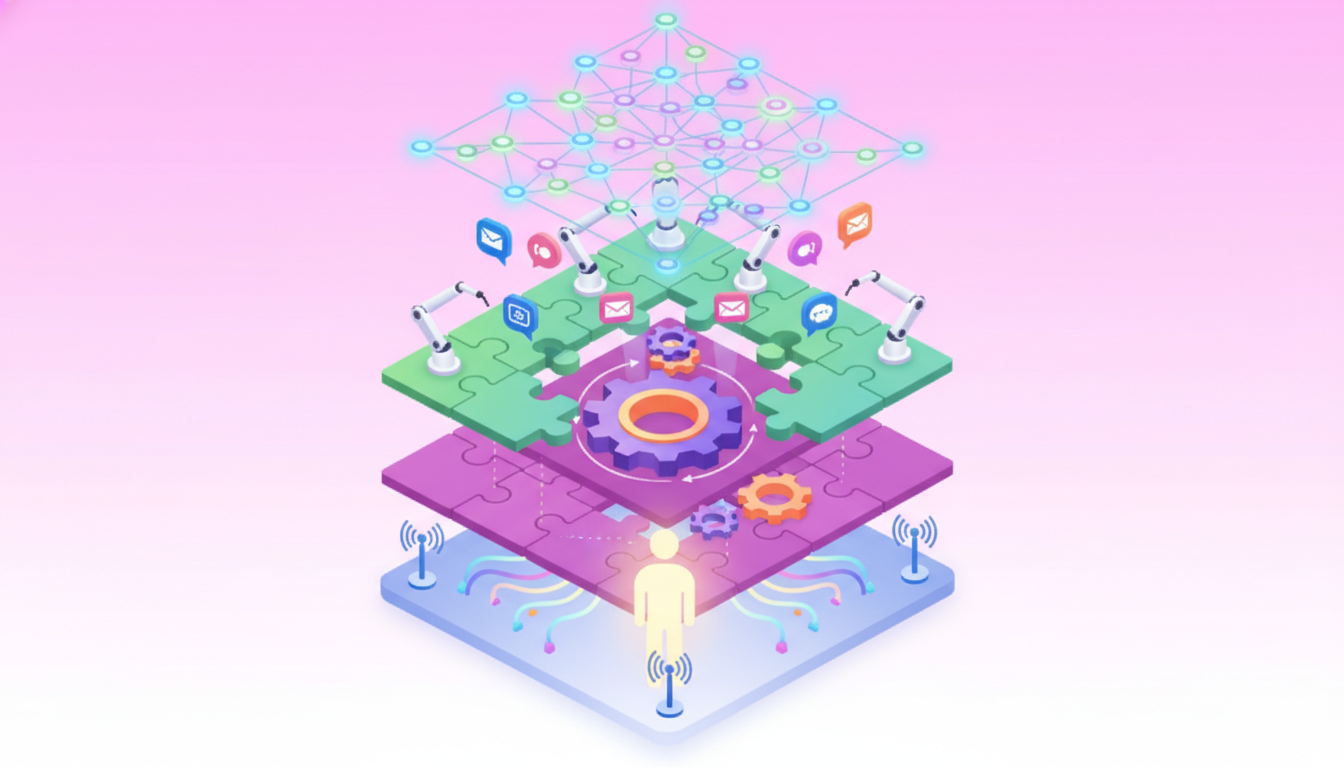
Building agents for GTM is fundamentally harder than building agents for coding. GTM environments are dynamic, involve multiple personas, and span long time horizons. To handle that complexity, leading platforms organize their systems into [a five-layer agent architecture](https://www.warmly.ai/p/resources/resources):
| Layer | Function |
|-------|----------|
| Signal ingestion | Collects intent, firmographic, and behavioral data |
| Entity resolution | Unifies records across tools into a single identity graph |
| Decision engine | Applies rules and models to determine next-best actions |
| Execution agents | Orchestrate outreach across email, LinkedIn, chat, and ads |
| Context graph | Stores decision traces so agents can reason over history |
The critical insight is that "the other half is the missing layer that actually runs enterprises: the decision traces" ([Foundation Capital](https://foundationcapital.com/context-graphs-ais-trillion-dollar-opportunity/)). Humans no longer operate the agents directly. They configure behavioral specifications, observe outputs, and tune responsibilities.
Aviso's unified data layer illustrates how this works in practice. The platform [proactively ingests and synchronizes data](https://www.aviso.com/blog/the-unified-data-layer-behind-aviso-s-single-pane-of-glass-for-revenue-teams) across the revenue stack into a relationship-rich knowledge graph, then exposes a structured SQL interface that AI agents can query and act upon.
Databricks offers similar capabilities for capturing production traces. Its Mosaic AI Agent Framework [automatically logs traces to MLflow experiments](https://docs.databricks.com/gcp/en/mlflow3/genai/tracing/prod-tracing) for real-time viewing and long-term retention, enabling teams to audit every decision an agent makes.
## Which B2B outbound use cases benefit most from context graphs?
Context graphs shine wherever personalization, timing, and continuity matter. Below are the use cases already generating measurable outcomes.
**1. Signal-driven prospecting**
AI agents source and enrich ICP accounts, craft one-to-one personalized outreach, orchestrate multichannel cadences, qualify replies, and book meetings. Deployed well, they [cut manual prospecting time 60 to 80%](https://everworker.ai/blog/ai-agents-outbound-prospecting-b2b-2026-playbook) and increase qualified pipeline within 30 to 60 days.
**2. Intent-based prioritization**
Intent data users achieve up to [78% higher conversion rates](https://www.landbase.com/blog/ai-powered-gtm-trends). Organizations using AI-powered predictive intent platforms report [60% higher accuracy in identifying accounts](https://www.marketsandmarkets.com/AI-sales/intent-data-for-b2b-sales) that will convert within 90 days. Additional benefits include:
- 3x higher conversion rates
- 40% shorter sales cycles
- [25% improvement in lead quality](https://www.marketsandmarkets.com/AI-sales/intent-data-for-b2b-sales)
**3. Warm demand generation**
"Warm demand beats cold outreach. Use AI agents to initialize relationship and intent before your team ever emails or calls," advises Max Greenwald, CEO of Warmly ([Ignite Startups](https://insights.teamignite.ventures/p/ignite-startups-max-greenwald-on)).
By blending website behavior, firmographics, tech stack signals, and channel touchpoints, context graphs score buying readiness rather than raw MQLs.
## How do you build the data foundation for a context graph?
Context graphs require three foundational capabilities.
**Entity resolution at scale**
The average enterprise runs [42+ GTM tools](https://pipeline.zoominfo.com/sales/why-gtm-ai-keeps-failing). When data lives in siloed systems, the system of record loses context. Entity resolution unifies duplicate records, matching company aliases, domain variations, and contact role changes into a single identity graph.
**Semantic normalization**
Raw fields mean different things across systems. Semantic normalization maps disparate taxonomies to a common ontology so agents can query intent signals, deal stages, and engagement metrics consistently.
**Intent signal integration**
Gartner Digital Markets enables teams to [uncover buying signals from more than 100 million B2B buyers](https://www.gartner.com/en/digital-markets/b2b-intent-data) researching software across Capterra, GetApp, and Software Advice. Prospects spend [50% of their time seeking information from third-party sources](https://www.gartner.com/en/digital-markets/insights/how-to-use-buyer-intent-data-to-your-sales-advantage), making external intent data essential for prioritizing outreach.
| Data Type | Source Examples | Role in Context Graph |
|-----------|-----------------|----------------------|
| First-party intent | Website visits, content downloads | Highest fidelity buying signals |
| Second-party intent | Partner platforms, review sites | Extends visibility beyond owned channels |
| Third-party intent | Publisher networks, content syndication | Captures early-stage research behavior |
## What KPIs prove the ROI of context-graph automation?
Measuring AI agent ROI separates hype from reality. The metrics below have emerged as industry benchmarks.
**Forecast accuracy**
Gong leverages [300+ unique signals to predict deal outcomes](https://www.gong.io/ai-powered-sales-forecasting) with 20% more precision than algorithms based solely on CRM data. Customers report forecast accuracy reaching 95%.
**Deal health and early intervention**
Outreach analyzed [33 million weekly interactions across 6,000+ customers](https://www.outreach.io/resources/blog/ai-sales-agent) and found that Deal Health Scores achieve 81% accuracy, enabling teams to intervene while deals are still salvageable.
**Opportunity-centric execution**
More than half of companies now prioritize [opportunity-centric execution with dynamic buying groups](https://www.leandata.com/resources/state-of-gtm-efficiency-report/), improving precision and deal velocity.
**Revenue growth correlation**
Companies using GTM Intelligence to fuel their go-to-market efforts see [5x higher revenue growth, 89% higher profits, and 2.5x higher valuations](https://assets.ctfassets.net/kyld7105l6mt/2vt7UJfuxR3BzIfqkBC4Qk/1c27f0dfc35e43569c1df35c11120362/GTM_Intelligence_Report_2025.pdf) than peers.
"The future of sales technology brings with it opportunities to blend human intuition with technological innovation," notes Michelle Morgan of IDC. "Organizations that effectively harness these intelligence systems will turn real-time insights into immediate action and competitive advantage."

## What pitfalls, governance and transparency issues should you avoid?
Agentic AI adoption fails predictably when organizations overlook transparency, governance, and change management.
**Lack of explainability**
Reps ignore AI recommendations when systems cannot explain their reasoning. Outreach's research confirms that [workflow-integrated and explainable recommendations](https://www.outreach.io/resources/blog/ai-sales-agent) drive adoption, while black-box outputs stall after pilots.
**Autonomy without guardrails**
An Icertis survey reveals that [56% of business leaders are very concerned](https://techcrunch.com/sponsor/incertis/from-contracts-to-commerce-why-ai-agents-are-the-next-frontier-in-enterprise-trade/) about granting autonomy to AI agents without proper guardrails. Teams trust AI agents more when humans have the final say on high-stakes decisions.
**Common pitfalls to avoid:**
- Deploying generic agents instead of process-specific ones
- Skipping rigorous ROI measurement frameworks
- Underinvesting in data quality and entity resolution
- Ignoring privacy regulations like GDPR and CCPA
AWS addressed these concerns by introducing [Policy in Amazon Bedrock AgentCore](https://techcrunch.com/2025/12/02/aws-announces-new-capabilities-for-its-ai-agent-builder/), which allows users to set interaction boundaries using natural language, and AgentCore Evaluations, a suite of 13 pre-built systems that monitor correctness, safety, and tool selection accuracy.
## Where are context graphs headed next?
The trajectory points toward full agentic orchestration.
Forrester predicts that AI will not incrementally improve enterprise applications. Instead, it will "dismantle and reinvent them into an [agentic business fabric](https://www.forrester.com/report/the-agentic-business-fabric-ais-architectural-transformation-of-business-applications/)." This new paradigm automates and orchestrates data, workflows, and human expertise through a composable, intelligent mesh, rendering traditional application silos obsolete.
Foundation Capital anticipates that [AI will rewrite the rules of software economics](https://foundationcapital.com/ten-predictions-for-tech-and-ai-in-2025/), shifting pricing from seats to outcomes. AI-native startups will challenge incumbents by delivering value faster and at lower cost.
The core question is not whether existing systems of record survive. It is "whether entirely new ones emerge, [systems of record for decisions](https://foundationcapital.com/context-graphs-ais-trillion-dollar-opportunity/), not just objects." Startups positioned in the orchestration path have a structural advantage because they capture decision traces as a byproduct of execution.
## Putting context graphs to work in your 2025 GTM
Context graphs are no longer a theoretical concept. They are production-ready infrastructure for teams that want to automate B2B outbound without sacrificing personalization or timing.
To get started:
1. Audit your current GTM stack for data silos and entity duplication
2. Prioritize intent signals that correlate with closed-won deals
3. Pilot an agent workflow on a single use case before scaling
4. Instrument decision traces so you can audit and improve over time
Warmly helps B2B SaaS companies uncover anonymous website traffic, identify high-intent accounts, and automate outbound personalization to drive more pipeline. The platform [pushes identified leads to all your GTM tools and AI agents](https://www.warmly.ai/p/resources/playbooks), ensuring context flows seamlessly across your stack.
For teams ready to move from fragmented workflows to context-driven orchestration, Warmly offers playbooks covering AI chat, job-change monitoring, high-intent follow-ups, and competitor targeting. Explore the full library at [Warmly Playbooks](https://www.warmly.ai/p/resources/playbooks).
## Frequently Asked Questions
### What is an AI-powered GTM context graph?
An AI-powered GTM context graph is a connected understanding of all interactions with an account, capturing decision traces rather than just outcomes. It enables agents to personalize, time, and automate outbound processes effectively.
### Why is 2025 considered an inflection point for context-driven outbound?
2025 marks an inflection point due to the convergence of AI adoption, shifting GTM economics, and diminishing returns from legacy systems. Organizations capturing decision traces now will gain a competitive advantage as agentic AI matures.
### How does the five-layer agent architecture support context graphs?
The five-layer agent architecture includes signal ingestion, entity resolution, decision engines, execution agents, and context graphs. This structure allows agents to reason over historical data and automate decision-making processes.
### What are the key benefits of using context graphs in B2B outbound?
Context graphs enhance B2B outbound by improving personalization, timing, and continuity. They enable signal-driven prospecting, intent-based prioritization, and warm demand generation, leading to higher conversion rates and shorter sales cycles.
### How does Warmly utilize context graphs to enhance B2B sales?
Warmly uses context graphs to identify high-intent accounts and automate outbound personalization, driving more pipeline. The platform integrates identified leads into GTM tools and AI agents, ensuring seamless context flow across the stack.
## Sources
1. [https://www.warmly.ai/p/resources/resources](https://www.warmly.ai/p/resources/resources)
2. [https://foundationcapital.com/context-graphs-ais-trillion-dollar-opportunity/](https://foundationcapital.com/context-graphs-ais-trillion-dollar-opportunity/)
3. [https://www.outreach.io/resources/reports-guides/2025-agentic-ai-revenue-intelligence-idc-report](https://www.outreach.io/resources/reports-guides/2025-agentic-ai-revenue-intelligence-idc-report)
4. [https://everworker.ai/blog/ai-agents-outbound-prospecting-b2b-2026-playbook](https://everworker.ai/blog/ai-agents-outbound-prospecting-b2b-2026-playbook)
5. [https://assets.ctfassets.net/kyld7105l6mt/2vt7UJfuxR3BzIfqkBC4Qk/1c27f0dfc35e43569c1df35c11120362/GTM_Intelligence_Report_2025.pdf](https://assets.ctfassets.net/kyld7105l6mt/2vt7UJfuxR3BzIfqkBC4Qk/1c27f0dfc35e43569c1df35c11120362/GTM_Intelligence_Report_2025.pdf)
6. [https://www.actively.ai/blog/building-context-graphs-for-gtm-and-why-salesforce-cant-do-it](https://www.actively.ai/blog/building-context-graphs-for-gtm-and-why-salesforce-cant-do-it)
7. [https://www.landbase.com/blog/ai-powered-gtm-trends](https://www.landbase.com/blog/ai-powered-gtm-trends)
8. [https://www.aviso.com/blog/the-unified-data-layer-behind-aviso-s-single-pane-of-glass-for-revenue-teams](https://www.aviso.com/blog/the-unified-data-layer-behind-aviso-s-single-pane-of-glass-for-revenue-teams)
9. [https://docs.databricks.com/gcp/en/mlflow3/genai/tracing/prod-tracing](https://docs.databricks.com/gcp/en/mlflow3/genai/tracing/prod-tracing)
10. [https://www.marketsandmarkets.com/AI-sales/intent-data-for-b2b-sales](https://www.marketsandmarkets.com/AI-sales/intent-data-for-b2b-sales)
11. [https://insights.teamignite.ventures/p/ignite-startups-max-greenwald-on](https://insights.teamignite.ventures/p/ignite-startups-max-greenwald-on)
12. [https://pipeline.zoominfo.com/sales/why-gtm-ai-keeps-failing](https://pipeline.zoominfo.com/sales/why-gtm-ai-keeps-failing)
13. [https://www.gartner.com/en/digital-markets/b2b-intent-data](https://www.gartner.com/en/digital-markets/b2b-intent-data)
14. [https://www.gartner.com/en/digital-markets/insights/how-to-use-buyer-intent-data-to-your-sales-advantage](https://www.gartner.com/en/digital-markets/insights/how-to-use-buyer-intent-data-to-your-sales-advantage)
15. [https://www.gong.io/ai-powered-sales-forecasting](https://www.gong.io/ai-powered-sales-forecasting)
16. [https://www.outreach.io/resources/blog/ai-sales-agent](https://www.outreach.io/resources/blog/ai-sales-agent)
17. [https://www.leandata.com/resources/state-of-gtm-efficiency-report/](https://www.leandata.com/resources/state-of-gtm-efficiency-report/)
18. [https://techcrunch.com/sponsor/incertis/from-contracts-to-commerce-why-ai-agents-are-the-next-frontier-in-enterprise-trade/](https://techcrunch.com/sponsor/incertis/from-contracts-to-commerce-why-ai-agents-are-the-next-frontier-in-enterprise-trade/)
19. [https://techcrunch.com/2025/12/02/aws-announces-new-capabilities-for-its-ai-agent-builder/](https://techcrunch.com/2025/12/02/aws-announces-new-capabilities-for-its-ai-agent-builder/)
20. [https://www.forrester.com/report/the-agentic-business-fabric-ais-architectural-transformation-of-business-applications/](https://www.forrester.com/report/the-agentic-business-fabric-ais-architectural-transformation-of-business-applications/)
21. [https://foundationcapital.com/ten-predictions-for-tech-and-ai-in-2025/](https://foundationcapital.com/ten-predictions-for-tech-and-ai-in-2025/)
22. [https://www.warmly.ai/p/resources/playbooks](https://www.warmly.ai/p/resources/playbooks)