# AI-Powered GTM Context Graph for B2B Sales Teams (2025)
AI-powered GTM context graphs transform scattered buyer signals into unified intelligence structures that AI agents can query and act upon. While CRMs capture what happened, context graphs reveal why by linking accounts, touchpoints, and outcomes into [machine-readable decision layers](https://pipeline.zoominfo.com/sales/why-gtm-ai-keeps-failing). Leading revenue teams report 60-80% reduction in prospecting time and faster pipeline growth through [intent routing and personalization](https://everworker.ai/blog/ai-agents-outbound-prospecting-b2b-2026-playbook) powered by these architectures.
## At a Glance
• Context graphs combine knowledge graphs with LLMs to ground AI in [precise enterprise knowledge](https://www.aviso.com/blog/knowledge-graph-ai-revenue-trust), reducing hallucinations and enabling domain-specific reasoning
• Clean data foundations are critical—the average enterprise runs 42+ GTM tools with overlapping, inconsistent records that must be unified first
• Core architecture includes ontology layers for sales logic, RAG for real-time knowledge retrieval, and persistent memory for [cross-session recall](https://www.aviso.com/blog/knowledge-graph-ai-revenue-trust)
• Practical applications include intent detection, account prioritization, and 1:1 personalization at scale, with [70% of B2B marketers](https://www.gartner.com/en/digital-markets/insights/how-to-use-buyer-intent-data-to-your-sales-advantage) now using intent data
• Graph neural networks achieve 3.62% better forecast accuracy while agentic AI drives [3-15% higher revenues](https://www.mckinsey.com/industries/financial-services/our-insights/agentic-ai-is-here-is-your-banks-frontline-team-ready) per relationship manager
• Compliance requirements include GDPR fines up to €20 million and new FTC rules prohibiting B2B misrepresentations
Every 2025 sales stack needs an AI-powered GTM context graph to connect intent, engagement, and revenue outcomes. Traditional CRMs capture state changes but rarely explain the *why* behind them. Context graphs fill that gap by stitching buyer signals, account relationships, and touchpoints into a living knowledge structure that AI agents can query, reason over, and act upon.
This guide breaks down what a context graph is, why your data foundation makes or breaks it, and how leading revenue teams unlock real pipeline gains with these architectures.
## What is an AI-Powered GTM Context Graph?
A context graph is the causal chain behind revenue outcomes. While a CRM tells you *what* happened, the graph captures *why* it happened by linking buyers, accounts, touchpoints, and results into a [machine-readable decision layer](https://pipeline.zoominfo.com/sales/why-gtm-ai-keeps-failing).
Glean describes its Enterprise Graph as a system that "understands how your company really works—capturing relationships across people, projects, teams, and processes—to deliver AI that understands your business [better than any employee](https://www.glean.com/product/enterprise-graph)." The same principle applies to GTM: an AI-native knowledge graph grounds large language models in precise, persistent, and [explainable enterprise knowledge](https://www.aviso.com/blog/knowledge-graph-ai-revenue-trust).
Unlike static firmographics, context graphs evolve with every new signal. They visualize complex relationships and provide real-time insights into customer behavior and preferences, enabling segmentation, prioritization, and personalization that [outpaces traditional methods](https://www.leadgenius.com/resources/ai-knowledge-graphs-outperforming-traditional-firmographics-for-superior-customer-engagement).
**Key takeaway:** A context graph transforms scattered GTM data into a unified structure that AI agents can reason over—turning CRM snapshots into actionable intelligence.
## Why Does Your Data Foundation Make—or Break—GTM AI?
Most GTM AI is still "expensive autocomplete," according to industry observers. The culprit is fragmented data. The average enterprise runs [42+ GTM tools](https://pipeline.zoominfo.com/sales/why-gtm-ai-keeps-failing), each storing overlapping but inconsistent records. Your CRM might have 18 different Cisco records, none of which resolve to a single entity.
Before you can build a graph, you need:
- **Entity resolution at scale** – Merging duplicate accounts and contacts into canonical records.
- **Semantic normalization** – Standardizing job titles, industries, and product names across systems.
- **Hierarchy and relationship management** – Mapping subsidiaries, parent companies, and buying committees.
- **First-party and third-party unification** – Blending your own engagement data with external intent signals.
Firmographics have long been the default segmentation method, but they are being outpaced by the more nuanced approach offered by [knowledge graphs](https://www.leadgenius.com/resources/ai-knowledge-graphs-outperforming-traditional-firmographics-for-superior-customer-engagement). Until your data foundation is solid, AI will hallucinate or surface irrelevant recommendations.
**Key takeaway:** Clean, unified data is the prerequisite for any context graph—without it, AI investments deliver limited ROI.
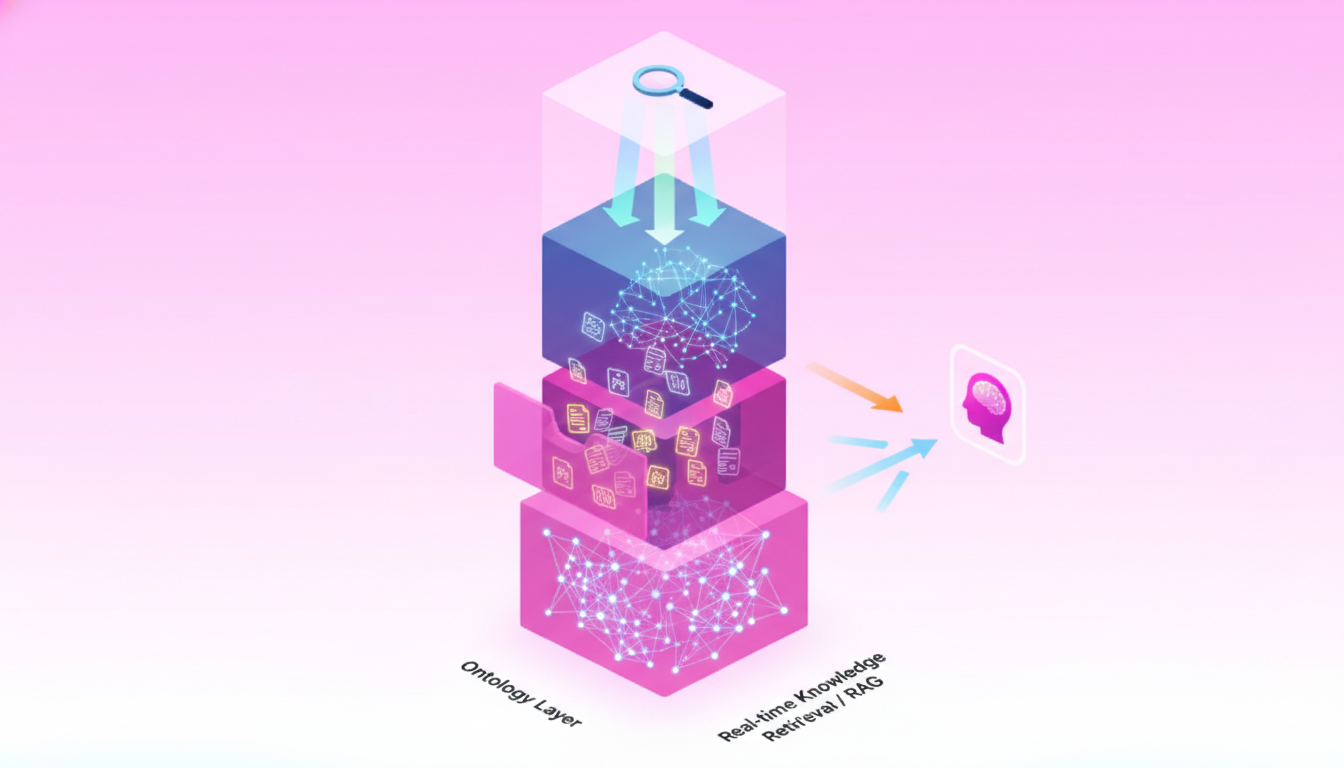
## Inside the Graph: Ontologies, RAG, Memory & Explainability
A context graph is more than a database; it is a layered architecture that enables AI agents to reason like experienced sellers.
| Layer | Purpose |
|-------|-------|
| **Ontology** | Encodes sales logic and taxonomy into a machine-readable format so AI can understand deal stages, qualification criteria, and product hierarchies. |
| **Retrieval-Augmented Generation (RAG)** | Supplies LLMs with external knowledge [retrieved in real time](https://www.aviso.com/blog/knowledge-graph-ai-revenue-trust) from structured and unstructured sources, reducing hallucinations. |
| **Memory** | Gives agents persistent recall of facts, decisions, and behavioral patterns [across sessions](https://www.aviso.com/blog/knowledge-graph-ai-revenue-trust). |
| **Explainability & Traceability** | Links AI outputs—forecast changes, risk scores, recommendations—back to the exact data points and [reasoning paths](https://www.aviso.com/blog/knowledge-graph-ai-revenue-trust) that informed them. |
### LLMs + Knowledge Graphs
Large language models excel at understanding and generating natural language, but they struggle with grounding responses in company-specific data, understanding domain-specific logic, and maintaining continuity across interactions. Knowledge graphs are a way of storing data that represents real-world entities and the [relationships between them](https://www.quantexa.com/blog/knowledge-graphs-for-b2b-sales/).
Combining LLMs with knowledge graphs provides "the best of both worlds—a simple, natural language interface powered by a broad set of contextual, domain, and [organization-specific data](https://www.quantexa.com/blog/knowledge-graphs-for-b2b-sales/)." McKinsey estimates this combination can unlock nearly [$1 trillion of annual impact](https://www.quantexa.com/blog/knowledge-graphs-for-b2b-sales/) across sales and marketing functions.
## Which Revenue Plays Do Context Graphs Unlock?
Over half (56%) of CSOs report significant misalignment between their sales tech stacks and the [actual workflows of sellers](https://www.salesloft.com/resources/guides/turn-buyer-signals-into-action). Context graphs close that gap by powering five practical use cases:
1. **Intent detection** – Surface accounts actively researching your category before competitors see them.
2. **Account prioritization** – Rank prospects by composite fit-plus-timing scores instead of static lists.
3. **1:1 personalization** – Generate context-rich outreach tailored to each buyer's role and recent activity.
4. **Forecast accuracy** – Feed deal-stage signals and engagement velocity into predictive models.
5. **Rep coaching** – Analyze call transcripts and recommend next-best actions grounded in graph context.
Signal-based selling prioritizes outreach based on timing, not just fit. It uses buyer behavior, engagement, and change signals to surface when prospects may be more open to a conversation, with AI [helping teams act at scale](https://www.amplemarket.com/blog/signal-based-selling). Well-deployed AI agents cut manual prospecting time [60–80%](https://everworker.ai/blog/ai-agents-outbound-prospecting-b2b-2026-playbook) and increase qualified pipeline within 30–60 days.
### Real-Time Intent Routing
Buyer intent data reveals which companies are actively researching a solution before they ever fill out a form. By the end of 2022, more than [70% of B2B marketers](https://www.gartner.com/en/digital-markets/insights/how-to-use-buyer-intent-data-to-your-sales-advantage) were utilizing third-party intent data to target prospects or engage groups of buyers in selected accounts—and that number has only grown.
Routing works best when signals flow directly into a context graph. Reps receive prioritized daily workflows, and automations launch tasks the moment a [signal fires](https://www.salesloft.com/resources/guides/turn-buyer-signals-into-action). The result: faster response times and higher connect rates. Warmly's visitor-ID engine supplies those signals directly to your context graph, ensuring reps act on fresh intent.
### 1:1 Personalization at Scale
Outbound sales are no longer about sending the most emails—it's about "delivering the right message to the right prospect at the right time," as Aviso notes. AI Personalizer workflows generate tailored scripts for email, LinkedIn, SMS, and phone calls, ensuring each message is role-specific and [adapted to buyer insights](https://www.aviso.com/blog/aviso-ai-personalizer-for-one-to-one-prospecting).
Context graphs power this by surfacing comprehensive account insights—industry trends, competition landscape, company challenges—alongside DISC personality profiles derived from conversation intelligence. The outcome is messaging that builds trust instead of triggering unsubscribes.
## Illuminating the Dark Funnel with Context Signals
Across nearly every B2B SaaS category, [80–95% of website visitors](https://medium.com/@daccord7/the-rise-of-anonymous-website-engagement-and-what-it-means-for-b2b-saas-growth-9b2d71fbdbd0) are now anonymous. Cookie tracking has declined 40–60%, and third-party intent providers report 25–45% signal degradation. Meanwhile, buyers increasingly turn to AI tools like ChatGPT and Claude as private advisors, leaving no [attribution trail](https://insights.strategicabm.com/feel-the-force-of-the-dark-funnel).
This hidden activity—known as the dark funnel—explains why traditional attribution breaks down. Context graphs address the gap by:
- **De-anonymizing traffic** – Reverse IP lookup tools identify companies visiting your site even [without a form fill](https://ow.ly/6U8h50Y0vvt).
- **Identity graphs** – Match device IDs to professional profiles to reveal who is engaging.
- **AI pattern recognition** – Correlate social spikes with tangible results that human analysts would miss.
Dark funnel attribution reveals the early-stage content that actually initiates buying cycles, enabling sales teams to tailor messaging based on the specific articles or competitor comparisons a prospect recently consumed. Warmly helps B2B SaaS teams uncover anonymous website traffic and identify high-intent accounts in real time, turning dark funnel visitors into qualified pipeline.
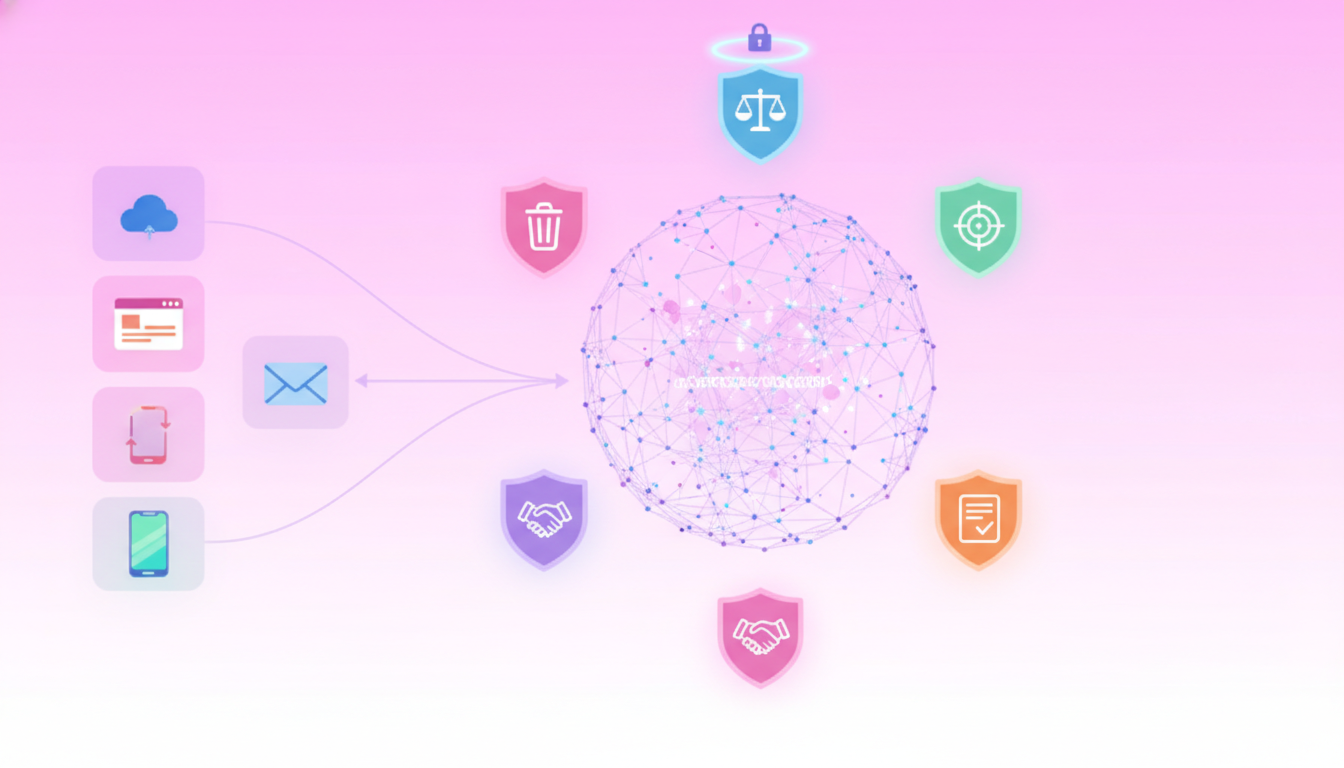
## How Do You Build a Compliant Context Graph?
GDPR fines for non-compliant B2B data practices can reach [€20 million or 4% of global revenue](https://persana.ai/blogs/compliant-b2b-data), whichever is higher. In the U.S., the FTC's updated Telemarketing Sales Rule now [prohibits misrepresentations](https://www.federalregister.gov/documents/2024/04/16/2024-07180/telemarketing-sales-rule) in B2B calls, and California's Delete Act requires data brokers to register and honor [consumer deletion requests](https://cppa.ca.gov/regulations/pdf/data_broker_reg_delete_act_statute_eff_20260101.pdf) by 2026.
Compliance guardrails for context graphs include:
| Requirement | Action |
|-------------|-------|
| Lawful collection | Document a legal basis (legitimate interest or consent) for every data source. |
| Purpose limitation | State clearly why you collect data and use it only for that reason. |
| Audit trails | Maintain records of data provenance and processing activities. |
| Vendor vetting | Ensure third-party enrichment providers comply with GDPR, CCPA, and emerging state laws. |
| Deletion workflows | Enable automated purges when contacts exercise opt-out rights. |
The B2B exemption myth is dead: business contact data is now fully protected under privacy laws. Teams that invest in compliant infrastructure gain a trust advantage over competitors who cut corners.
## Future Frontiers: GNN Forecasting & Agentic Workflows
Graph neural networks (GNNs) are moving from research labs into production revenue systems. A recent study published in *Nature Scientific Reports* demonstrated that a knowledge-graph-enhanced GCN-LSTM model achieved a [3.62% reduction in forecast error](https://www.nature.com/articles/s41598-026-35113-4) compared to traditional benchmarks, highlighting the accuracy gains possible when relational data feeds deep learning.
Meanwhile, agentic AI is reshaping how revenue platforms operate. Banks that rewire a single frontline domain with agentic systems report [3–15% higher revenues per RM](https://www.mckinsey.com/industries/financial-services/our-insights/agentic-ai-is-here-is-your-banks-frontline-team-ready) and 20–40% lower cost to serve. Forty percent of organizations are now [scaling AI across revenue functions](https://www.clari.com/blog/agentic-ai-revenue-platforms), and those without agentic strategies risk falling behind.
Venture activity reflects the momentum: early movers in the AI x GTM stack are capturing structural advantages while the window remains open.
## Bringing It All Together
Context graphs are the connective tissue that make intelligence-driven GTM possible—linking buyers, signals, and outcomes in a structure AI can reason over.
For sales leaders ready to act:
1. **Audit your data foundation** – Identify duplicate records, missing hierarchies, and unintegrated signal sources.
2. **Define your ontology** – Map deal stages, qualification criteria, and product taxonomies into a machine-readable format.
3. **Start with high-value plays** – Deploy intent routing and personalized outreach before tackling complex forecasting.
4. **Build compliance in from day one** – Document legal bases, honor deletion requests, and vet vendors rigorously.
Warmly helps B2B SaaS teams uncover anonymous website traffic, identify high-intent accounts, and automate outbound personalization—all grounded in real-time buyer signals. If you're ready to move from scattered data to unified intelligence, a context graph is the foundation that ties it all together.
## Frequently Asked Questions
### What is an AI-powered GTM context graph?
An AI-powered GTM context graph is a system that connects buyer signals, account relationships, and touchpoints into a living knowledge structure. It helps AI agents query, reason, and act upon data, transforming CRM snapshots into actionable intelligence.
### Why is a solid data foundation crucial for GTM AI?
A solid data foundation is crucial because fragmented data can lead to AI hallucinations and irrelevant recommendations. Clean, unified data allows for effective entity resolution, semantic normalization, and relationship management, which are essential for building a reliable context graph.
### How do context graphs enhance sales team performance?
Context graphs enhance sales team performance by enabling intent detection, account prioritization, 1:1 personalization, forecast accuracy, and rep coaching. They provide real-time insights into customer behavior, allowing for more targeted and effective sales strategies.
### What role does Warmly play in utilizing context graphs?
Warmly helps B2B SaaS teams uncover anonymous website traffic and identify high-intent accounts in real time. By integrating visitor-ID engines with context graphs, Warmly ensures sales reps act on fresh intent signals, improving response times and connect rates.
### How do context graphs address the dark funnel in B2B sales?
Context graphs address the dark funnel by de-anonymizing traffic, using identity graphs, and employing AI pattern recognition. This approach reveals early-stage content that initiates buying cycles, allowing sales teams to tailor messaging based on specific prospect activities.
## Sources
1. [https://pipeline.zoominfo.com/sales/why-gtm-ai-keeps-failing](https://pipeline.zoominfo.com/sales/why-gtm-ai-keeps-failing)
2. [https://everworker.ai/blog/ai-agents-outbound-prospecting-b2b-2026-playbook](https://everworker.ai/blog/ai-agents-outbound-prospecting-b2b-2026-playbook)
3. [https://www.aviso.com/blog/knowledge-graph-ai-revenue-trust](https://www.aviso.com/blog/knowledge-graph-ai-revenue-trust)
4. [https://www.gartner.com/en/digital-markets/insights/how-to-use-buyer-intent-data-to-your-sales-advantage](https://www.gartner.com/en/digital-markets/insights/how-to-use-buyer-intent-data-to-your-sales-advantage)
5. [https://www.mckinsey.com/industries/financial-services/our-insights/agentic-ai-is-here-is-your-banks-frontline-team-ready](https://www.mckinsey.com/industries/financial-services/our-insights/agentic-ai-is-here-is-your-banks-frontline-team-ready)
6. [https://www.glean.com/product/enterprise-graph](https://www.glean.com/product/enterprise-graph)
7. [https://www.leadgenius.com/resources/ai-knowledge-graphs-outperforming-traditional-firmographics-for-superior-customer-engagement](https://www.leadgenius.com/resources/ai-knowledge-graphs-outperforming-traditional-firmographics-for-superior-customer-engagement)
8. [https://www.quantexa.com/blog/knowledge-graphs-for-b2b-sales/](https://www.quantexa.com/blog/knowledge-graphs-for-b2b-sales/)
9. [https://www.salesloft.com/resources/guides/turn-buyer-signals-into-action](https://www.salesloft.com/resources/guides/turn-buyer-signals-into-action)
10. [https://www.amplemarket.com/blog/signal-based-selling](https://www.amplemarket.com/blog/signal-based-selling)
11. [https://www.aviso.com/blog/aviso-ai-personalizer-for-one-to-one-prospecting](https://www.aviso.com/blog/aviso-ai-personalizer-for-one-to-one-prospecting)
12. [https://medium.com/@daccord7/the-rise-of-anonymous-website-engagement-and-what-it-means-for-b2b-saas-growth-9b2d71fbdbd0](https://medium.com/@daccord7/the-rise-of-anonymous-website-engagement-and-what-it-means-for-b2b-saas-growth-9b2d71fbdbd0)
13. [https://insights.strategicabm.com/feel-the-force-of-the-dark-funnel](https://insights.strategicabm.com/feel-the-force-of-the-dark-funnel)
14. [https://ow.ly/6U8h50Y0vvt](https://ow.ly/6U8h50Y0vvt)
15. [https://persana.ai/blogs/compliant-b2b-data](https://persana.ai/blogs/compliant-b2b-data)
16. [https://www.federalregister.gov/documents/2024/04/16/2024-07180/telemarketing-sales-rule](https://www.federalregister.gov/documents/2024/04/16/2024-07180/telemarketing-sales-rule)
17. [https://cppa.ca.gov/regulations/pdf/data_broker_reg_delete_act_statute_eff_20260101.pdf](https://cppa.ca.gov/regulations/pdf/data_broker_reg_delete_act_statute_eff_20260101.pdf)
18. [https://www.nature.com/articles/s41598-026-35113-4](https://www.nature.com/articles/s41598-026-35113-4)
19. [https://www.clari.com/blog/agentic-ai-revenue-platforms](https://www.clari.com/blog/agentic-ai-revenue-platforms)