Build a GTM Context Graph from Visitor ID and Intent Signals
A GTM context graph connects visitor identification data with real-time intent signals to create a unified view of B2B buying journeys. It combines server-side tracking for enhanced data accuracy with knowledge graph principles, enabling teams to identify accounts showing purchase intent and trigger automated, personalized outreach that typically improves conversion rates 2-3x.
At a Glance
- GTM context graphs link visitor IDs, intent signals, and behavioral data into a queryable knowledge layer for revenue teams
- Server-side GTM implementation provides better data accuracy, privacy compliance, and enrichment capabilities compared to client-side tracking
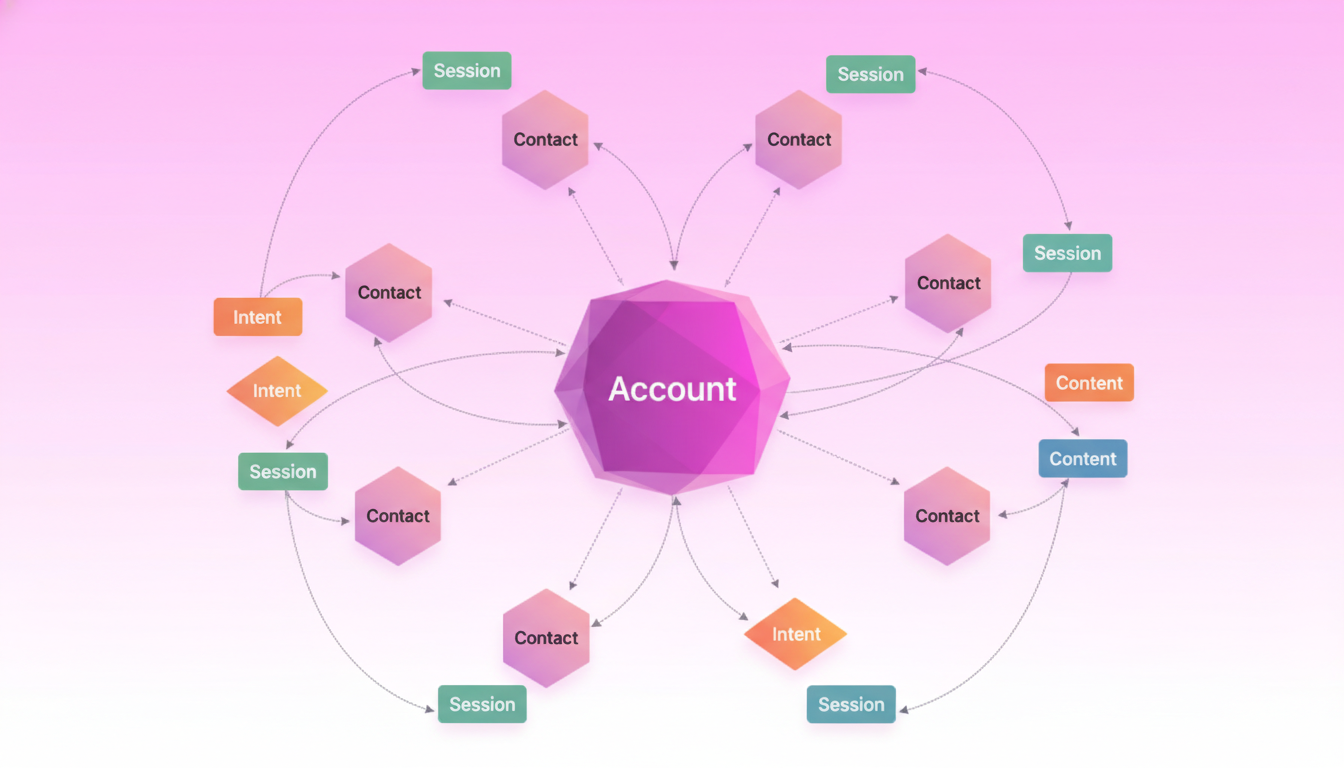
- Key graph components include account nodes, contact nodes, session nodes, and intent nodes connected through temporal relationships
- Intent knowledge graphs can scale to 351 million edges, effectively predicting new session intentions and enhancing recommendations
- Activation use cases include real-time lead prioritization, automated tier promotion, and personalized multi-channel sequences
- Leading platforms like Common Room can reveal up to 50% of website traffic at the person level for US-based visitors
A GTM context graph is the connected understanding of everything happening with an account, structured in a way that agents can reason over. For B2B go-to-market teams, building this unified layer means fusing visitor identification data with real-time intent signals to create a queryable view of buying journeys. This guide walks through the architecture, implementation, and activation of a GTM context graph using server-side tagging, knowledge graph principles, and modern enrichment tools.
What is a GTM context graph?
A GTM context graph is a knowledge-graph layer that connects disparate data points to provide a unified view of the business ecosystem. At its foundation, the graph links visitor identification data (who is on your site) with intent signals (what they are researching) through nodes representing accounts, contacts, sessions, and behaviors.
The concept builds on established knowledge graph frameworks that progress through distinct phases: establishing a base knowledge graph, developing a connected context graph with temporal data, and integrating AI for automated insights. For GTM use cases, this translates to capturing visitor identity, layering behavioral and intent signals, and enabling real-time personalization and routing.
Researchers have demonstrated the power of this approach at scale. One framework for intention knowledge graphs constructed a graph with 351 million edges using e-commerce data, modeling temporal, causal, and conceptual relationships between user intentions. The model effectively predicted new session intentions and enhanced product recommendations, outperforming previous methods.
For B2B teams, the GTM context graph serves a similar function: capturing the deliberate mental processes of buyers as they research, evaluate, and move toward purchase decisions. The Salesforce Interactions SDK exemplifies this approach, providing an extensible data capture framework for tracking user interactions, managing identity through cookies, and supporting consent-based activation.
Why connect visitor IDs with intent data?
The revenue impact of fusing identity and intent is substantial. According to Forrester, intent data has become a differentiator for B2B marketing and sales organizations. Organizations that fail to invest in intent data risk falling behind competitors who can identify and act on buying signals in real time.
Website visitor identification uses IP-to-company matching to reveal which organizations are researching your offerings before they fill out forms, transforming anonymous traffic into qualified prospect lists based on actual buying intent rather than cold outreach.
The highest-value signals that predict near-term conversion include:
- Multiple visits within a week
- Pricing page engagement
- Demo request abandonment
- Case study downloads
- Contact page visits
These behaviors indicate strong purchase intent and warrant immediate sales outreach. When combined with firmographic and technographic data, visitor intelligence creates highly qualified prospect lists aligned with ideal customer profiles.
Key takeaway: Linking de-anonymized visitor IDs with buying-stage intent allows teams to act while interest peaks, typically improving conversion rates 2-3x compared to firmographic targeting alone.
How do you collect visitor ID & intent signals with server-side GTM?
Server-side tagging transforms how teams collect and enrich visitor data. Google Tag Manager Server-Side offers a framework for implementing advanced data enrichment, enabling organizations to enhance data collection with precision, security, and flexibility.
Traditional client-side tracking suffers from data loss, privacy constraints, and performance issues due to restrictions on third-party cookies, ad blockers, and browser limitations.
Server-side tagging addresses these challenges by providing:
- Enhanced data accuracy through clean, structured, and enriched data
- Privacy compliance with GDPR and CCPA through controlled data processing
- Improved page performance by reducing client-side JavaScript execution
- Better personalization by combining first-party data with external sources
- Reduced dependency on client-side cookies for resilient tracking
One of the most powerful use cases is enriching event data with first-party CRM and CDP information. A global e-commerce brand achieved 25% higher ad attribution accuracy and a 15% increase in conversion rates through this strategy.
Server-side transformations allow you to control which event parameters are exposed to tags, enhancing data privacy and processing. These transformations can be applied broadly or to specific tags with conditions determining their activation.
Transformations offer three core functions for managing event parameters:
| Transformation Type |
Purpose |
Use Case |
| Allow parameters |
Selectively share specific event parameters with tags |
Expose only necessary data points to analytics |
| Augment event |
Modify values or add new parameters |
Append enrichment data from CRM lookups |
| Exclude parameters |
Remove sensitive data from tags |
Strip PII before sending to third parties |
Transformations can be ordered by priority to fine-tune execution sequence, allowing granular control over parameter manipulation before tag activation. GTM preview mode enables verification of transformation rules by inspecting event data and tag details.
Designing the context graph schema
The graph schema defines how nodes, edges, and temporal relationships connect to support GTM use cases. Effective schemas model the complexity of B2B buying journeys where multiple stakeholders interact across extended timeframes.
"Using the Amazon m2 dataset, we construct an intention graph with 351 million edges, demonstrating high plausibility and acceptance." - arXiv, 2024
A well-designed GTM context graph includes these node types:
- Account nodes: Company-level entities with firmographic attributes
- Contact nodes: Individual stakeholders with role and engagement data
- Session nodes: Website visits with behavioral sequences
- Intent nodes: Research topics and buying signals
- Content nodes: Pages, assets, and touchpoints
Edges represent relationships: contacts belong to accounts, sessions are initiated by contacts, sessions exhibit intent, and content influences intent. The Relational Graph Perceiver architecture demonstrates how to efficiently integrate structural and temporal context using cross-attention mechanisms that allow models to reason across distant parts of the graph.
This architecture supports multi-task learning across diverse predictive tasks without separate models, achieving state-of-the-art performance on benchmarks while maintaining computational efficiency that scales linearly with input nodes.
Handling time & repeat intent
Temporal dynamics are critical for accurate intent prediction. The HyperHawkes model addresses this by using Hawkes Processes to model temporal dynamics of intents, capturing repeated consumption patterns and long-term user interests.
In sequential recommendation scenarios, user intent drives consumption behavior. Repeat consumption occurs due to habits: buyers frequently revisit pricing pages, return to case studies, and re-engage with comparison content with specific intent patterns.
A temporal subgraph sampler enhances global context by retrieving nodes beyond immediate neighborhoods to capture temporally relevant relationships. This approach allows the model to incorporate nonlocal temporal context, recognizing that a pricing page visit yesterday may matter more than a perfect firmographic match from last quarter.
How can teams activate the graph for outbound & ABM?
Signal-based selling prioritizes outreach based on timing, not just fit. It uses buyer behavior, engagement, and change signals to surface when prospects may be more open to a conversation, with AI helping teams act on those moments at scale.
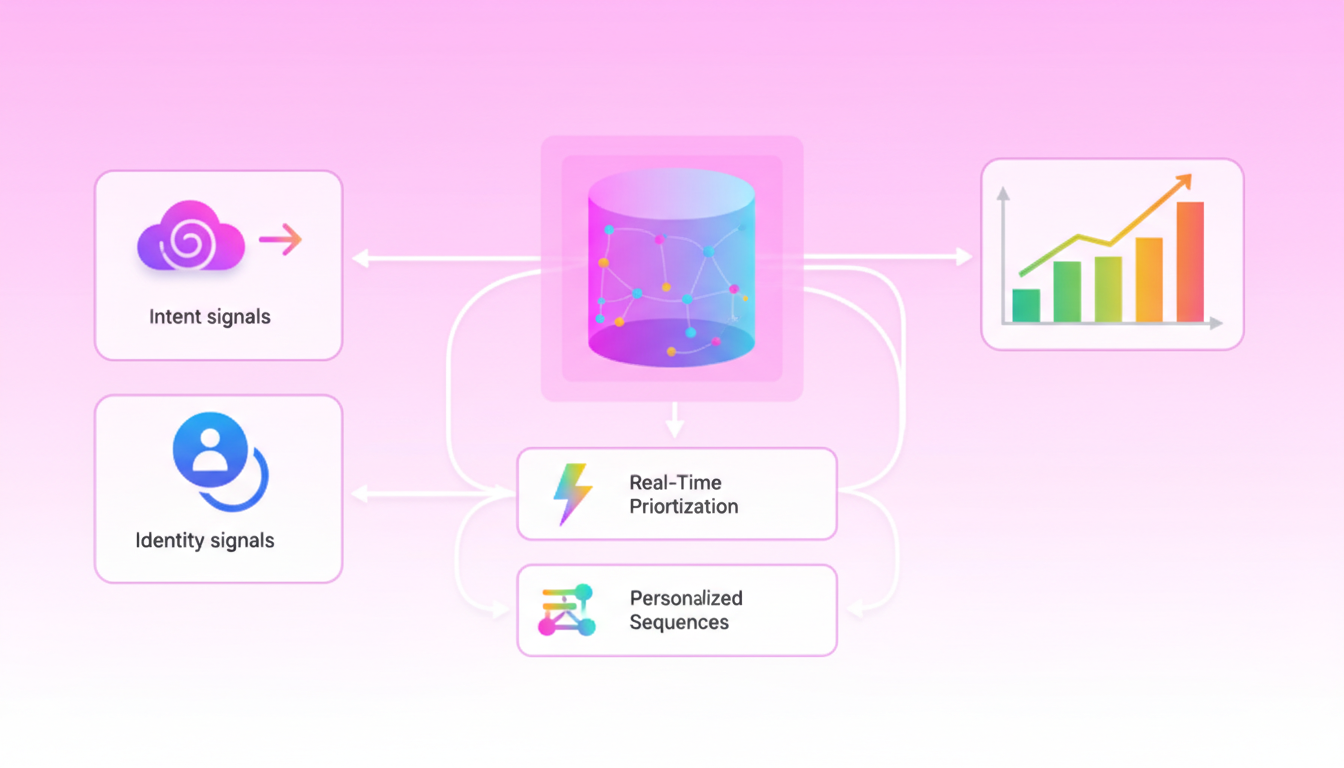
Activation use cases for the GTM context graph include:
Real-time prioritization: Accounts showing active buying signals (executive changes, funding events, compliance initiatives) move to the top of outreach queues, improving conversion rates 2-3x compared to static firmographic targeting
Automated tier promotion: When a target account announces funding on Tuesday, automated scoring rules promote them to Tier 1 by Wednesday
Personalized multi-channel sequences: Graph insights trigger coordinated outreach across email, LinkedIn, and ads based on specific behaviors
Account-level visibility: Platforms like Common Room reveal up to 50% of website traffic, combining web visits with hundreds of other signals to identify in-market accounts
"Once our reps got their hands on Common Room, the response was unanimous: 'Buy it, please.' We sourced pipeline right away running plays from product usage, web visits, GitHub activity - you name it." - Common Room Customer
The graph enables AI-orchestrated research that eliminates preparation overhead, cutting SDR prep time from 15 minutes to 2-3 minutes per account by generating strategic hypotheses automatically.
How do privacy, consent & measurement shape your graph?
Privacy-compliant implementation requires proper consent mechanisms and adherence to GDPR/CCPA regulations. A privacy-first approach includes:
- Consent-based activation for non-essential tracking
- Data pseudonymization including IP masking
- First-party and server-side collection preference
- Vendor DPAs and retention policies
- Legal basis validation per jurisdiction
Google Tag Manager emphasizes that PII should not be included in conversion data sent to Google without explicit user consent. Implementation requires persisting tokens via cookies with proper consent flows and secure HTTPS endpoints.
GTM preview mode enables verification of transformation rules, ensuring intended modifications are applied before deployment. This allows teams to confirm that sensitive parameters are excluded and enrichment data is properly appended.
Key ROI metrics for graph-powered visitor intelligence include:
- Conversion rate improvement
- Lead quality scores
- Sales cycle length
- Deal size impact
- Marketing efficiency
Expect faster campaign launches and improved lead quality, but validate uplifts with baselines and A/B tests before relying on them.
Several platforms support building and activating GTM context graphs:
| Platform |
Primary Capability |
Key Differentiator |
| Clay |
Data enrichment and workflow automation |
Waterfall enrichment queries multiple providers until finding a match; de-anonymizes company-level traffic |
| Common Room |
Signal unification and person-level identification |
Up to 50% person-level visibility of US-based web traffic; unifies web visits with buying signals |
| Intentsify |
Multi-signal intent intelligence |
Processes 1.1 trillion monthly intent signals across 4.2 million in-market accounts; first to offer buying-group level intent |
Clay's Web Intent feature helps sales teams prioritize high-intent accounts engaging with websites. The platform uses waterfall enrichment to query multiple data providers, ensuring comprehensive coverage that exceeds any single provider.
Common Room combines web visitor identification with hundreds of other signals, enabling AI agents to automate personalized outbound. The platform accelerates speed to lead with real-time web visit alerts.
Intentsify's Orbit platform covers over 90,000 topics with unlimited keywords, using proprietary NLP to automate intent model setup. The platform supports global coverage across NA, EMEA, APAC, and LATAM regions.
Bringing it all together
Building a GTM context graph requires connecting visitor identification, intent signals, and temporal relationships into a unified layer that powers real-time personalization and routing. The implementation path follows these steps:
- Deploy server-side GTM with proper transformations for data enrichment
- Design a graph schema capturing accounts, contacts, sessions, and intent
- Integrate temporal samplers to model repeat intent patterns
- Activate through signal-based outreach and automated tier promotion
- Measure with closed-loop attribution connecting marketing to revenue
Warmly demonstrates the impact of this approach in practice. The platform attributes approximately 43% of its closed/won deals to insights and playbooks generated from its own tool. On average, Warmly identifies and adds approximately 1,050 net new ICP accounts to the CRM each month, with the marketing team creating intent-based lead scoring to ensure proper prioritization of contacts and accounts.
For B2B SaaS companies focused on website visitor identification and intent-based outbound, the GTM context graph represents the foundation for next-generation revenue orchestration. Warmly provides the visitor identification, intent intelligence, and automated outreach capabilities needed to build and activate this architecture at scale.
Frequently Asked Questions
What is a GTM context graph?
A GTM context graph is a knowledge-graph layer that connects disparate data points to provide a unified view of the business ecosystem, linking visitor identification data with intent signals to enhance B2B sales and marketing strategies.
Why is connecting visitor IDs with intent data important?
Connecting visitor IDs with intent data allows B2B organizations to identify and act on buying signals in real time, improving conversion rates by 2-3x compared to traditional firmographic targeting.
How does server-side GTM enhance data collection?
Server-side GTM enhances data collection by providing clean, structured, and enriched data, ensuring privacy compliance, improving page performance, and reducing dependency on client-side cookies for resilient tracking.
What are the key components of a GTM context graph schema?
A GTM context graph schema includes nodes for accounts, contacts, sessions, intent, and content, with edges representing relationships such as contacts belonging to accounts and sessions exhibiting intent.
How does Warmly utilize GTM context graphs?
Warmly uses GTM context graphs to attribute approximately 43% of its closed/won deals to insights and playbooks generated from its tool, adding around 1,050 net new ICP accounts to the CRM monthly.
Sources
- https://www.linkedin.com/pulse/advanced-data-enrichment-gtm-server-side-elevate-your-margub-alam-1oloc
- https://www.mightyandtrue.com/post/how-to-scale-b2b-pipeline-without-scaling-headcount-a-signal-based-outbound-playbook
- https://arxiv.org/html/2412.11500v2
- https://www.commonroom.io/product/web-visitor-identification/
- https://www.tigeranalytics.com/perspectives/blog/implementing-context-graphs-a-5-point-framework-for-transformative-business-insights/
- https://developer.salesforce.com/docs/data/salesforce-interactions-sdk/guide/c360a-api-salesforce-interactions-web-sdk.html
- https://www.forrester.com/report/if-your-b2b-organization-is-not-investing-in-intent-data-you-are-falling/RES179896
- https://www.landbase.com/blog/how-to-use-company-visited-website-signal-for-list-building
- https://developers.google.com/tag-platform/tag-manager/server-side/transformations
- https://openreview.net/pdf?id=fcVIJ2WSIX
- https://openreview.net/pdf?id=t0q7KbmB7o
- https://www.amplemarket.com/blog/signal-based-selling
- https://www.landbase.com/blog/how-to-use-visitor-intelligence-to-identify-hidden-opportunities
- https://developers.google.com/actions-center/legacy/tutorials/tutorial-using-google-tag-manager
- https://www.clay.com/blog/web-intent
- https://www.intentsify.io/solutions/intentsify-orbit
- https://warmly.ai