GTM Agent Harness with AI SDR: Automate 80% of Prospecting
AI SDRs now automate 60-80% of prospecting tasks while maintaining 14.2% conversion rates versus 3% for generic human outreach, with hybrid teams achieving 4-7x higher conversions by combining AI's scale with human relationship-building for complex deals.
At a Glance
- AI SDRs handle 1,000+ daily contacts at 60-75% lower cost than human SDRs while maintaining quality personalization
- AI-enabled teams see 83% revenue growth compared to 66% for non-AI teams
- Hybrid approaches deliver best results: AI handles volume prospecting, humans own complex relationship building and closing
- 96% of buyers prefer personalized outreach, making AI's ability to scale contextual messaging a competitive advantage
- Implementation typically shows ROI within 3.2 months versus 8.7 months for human SDR hires
- GTM agent harnesses connect intent signals, AI orchestration, and CRM systems to automate the full journey from visitor to qualified meeting
An AI SDR can now handle the bulk of your outbound workflow, automating research, personalized outreach, and first-round qualification while your human reps focus on the conversations that close deals. With 70% of sales teams already using AI tools, the question is no longer whether to adopt, but how quickly you can integrate AI into your GTM motion.
This guide breaks down exactly how AI SDRs compare to human-only approaches, explains the GTM agent harness that powers modern prospecting automation, and provides a roadmap for building hybrid sales teams that maximize both efficiency and conversion.
Why AI SDRs Are Re-Shaping Outbound
An AI SDR is software that automates the research, outreach, and initial qualification process. Modern AI SDRs use large language models to personalize messages at scale, analyze prospect data, respond to replies, and hand off qualified leads to humans. Unlike traditional automation tools that simply blast templates, these systems craft contextually relevant messages for each prospect.
The adoption curve has been steep. According to Gong Labs, 96% of revenue leaders expect their teams to be using AI by next year. The AI-powered sales tools market is growing at 42% annually, and teams that delay adoption are giving competitors an edge.
What makes AI SDRs particularly compelling is their speed to value. Many teams start seeing results within weeks, faster than it takes to onboard and ramp up a human SDR. While a new hire typically requires 3-9 months to reach full productivity, an AI SDR can begin generating qualified pipeline almost immediately after configuration. Warmly customers typically cut prospecting time 70%, proving the platform's impact early in any rollout.
Key takeaway: AI SDRs represent a structural shift in outbound prospecting, combining research, personalization, and orchestration into a continuous loop that scales with quality rather than just volume.

AI SDR vs. Human SDR: How Do Cost, Scale & Conversion Compare?
The performance data reveals a clear pattern: AI and humans each dominate different parts of the prospecting funnel.
Scale and Cost Efficiency
| Metric |
AI SDR |
Human SDR |
| Daily contacts |
1,000+ without quality degradation |
50-100 before fatigue sets in |
| Annual cost |
$15-35K |
$75-110K fully loaded |
| Response rate |
24% |
8% |
| Technical questions answered immediately |
87% |
15% |
AI SDRs now handle 3-5x more conversations at 60-75% lower cost. The math is compelling: an AI system can engage over 1,000 contacts daily without the quality degradation that human reps experience after their 50th or 100th outreach.
Analysis of over 10 million interactions shows AI SDRs deliver 3x higher response rates and 4x more qualified leads generated per month, with a 60% lower cost per qualified lead.
Where Humans Still Win
The conversion picture tells a different story. AI SDRs convert meetings to opportunities at 15% versus human SDRs' 25%. Human reps demonstrate:
- 2.5x higher conversion from qualified lead to meeting
- Superior relationship building capabilities
- Better objection handling in complex scenarios
- Adaptability to unique situations
"The reality is that AI will not eliminate SDR roles by 2026. Instead, it will fundamentally reshape how sales development teams operate," according to Monday.com's analysis.
The ROI Equation
Payback periods favor AI dramatically. AI SDR payback period averages 3.2 months compared to 8.7 months for human SDRs. Looking ahead, 73% of companies plan AI SDR implementation, with only 8% expected to remain human-only by 2026.
What Is a GTM Agent Harness & How Does It Turn Signals Into Meetings?
A GTM agent harness is the orchestration layer that connects buyer intent signals, AI prospecting agents, and your existing sales infrastructure into a unified system. Think of it as the nervous system that coordinates data flows, triggers actions, and ensures every high-intent prospect receives timely, relevant outreach.
The architecture typically includes three layers:
- Signal capture and enrichment - collecting first and third-party intent data
- AI agent orchestration - coordinating research, personalization, and outreach
- CRM integration and measurement - syncing activities and tracking outcomes
AI agents for outbound prospecting autonomously source and enrich ICP accounts, craft 1:1 personalized outreach, orchestrate cadences across email and LinkedIn, handle replies, qualify interest, and book meetings in your CRM. Deployed well, they cut manual prospecting time 60-80% and increase qualified pipeline within 30-60 days.
Warmly's platform brings this harness to life by combining visitor identification, intent intelligence, and AI-powered outreach orchestration—enabling teams to automate the full journey from anonymous website visitor to qualified meeting.
McKinsey estimates that agentic AI will power more than 60% of the increased value that AI is expected to generate from deployments in marketing and sales.
Real-Time Signals & Visitor Identification
The foundation of effective AI prospecting is signal capture. The Signals AI Predictive Model combines first-party website engagement, third-party research intent data, and Salesforce data to identify where each account is in their buyer journey.
Modern platforms collect and unify dozens of signal types including firmographic, technographic, persona, behavioral, intent, and buying-group activity. This creates a comprehensive picture of which accounts are actively researching solutions like yours.
First-party intent comes from your own properties like website visits and product usage, offering highly accurate insights. Third-party intent comes from external sources like G2 reviews or industry discussions, and helps identify early-stage prospects. Platforms like Amplemarket track 20+ signals, including website activity, company news, product usage, job changes, CRM updates, and third-party insights.
Multi-Agent Orchestration & CRM Sync
A revenue orchestration platform (ROP) is a unified software solution that connects sales engagement, revenue intelligence, forecasting, deal management, and AI-powered analytics across the entire customer lifecycle to guide predictable revenue growth and operational efficiency.
In 2024, Forrester coined the term revenue orchestration platform to describe this new category. According to Forrester Principal Analysts, these platforms "are the closest revenue technology has come thus far to providing a 'single pane of glass' for frontline resources."
Modern GTM platforms connect with existing tools so data, context, and actions move seamlessly across your stack. This includes real-time sync with CRMs like HubSpot and Salesforce, integration with intent and ABM tools, and communication alerts through Slack and Microsoft Teams.
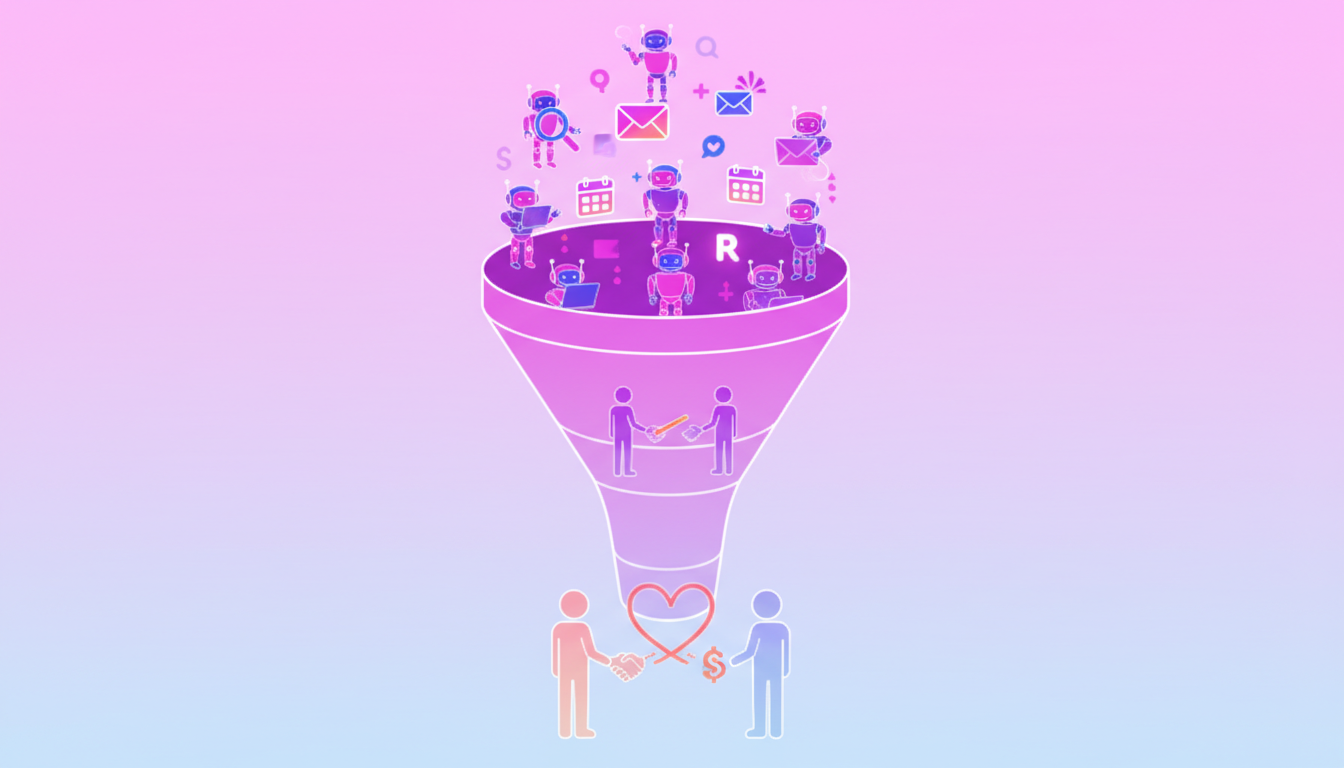
How Do You Design Hybrid Sales Teams So Humans Own the Final 20 %?
The data is clear: hybrid teams combining AI and human SDRs deliver the best results, with AI handling volume-based prospecting and humans focusing on relationship building and complex sales scenarios.
Companies leveraging this hybrid approach report 4-7x higher conversion rates and 70-80% cost savings compared to traditional all-human SDR teams.
The Optimal Division of Labor
Hybrid teams will dominate. The key is combining AI for repetitive tasks with human SDRs for relationship building to maximize both efficiency and deal closure rates.
AI should own:
- Initial research and data enrichment
- First-touch personalized outreach at scale
- Response to routine inquiries
- Lead scoring and qualification
- Meeting scheduling logistics
Humans should own:
- Complex relationship building
- Enterprise stakeholder navigation
- Nuanced objection handling
- Strategic account mapping
- Deal negotiation and closing
AI excels at scale but humans drive conversions. Use AI for research, initial outreach, and qualification at volume, then hand qualified prospects to humans who excel at turning meetings into opportunities.
Reimagining the Sales Process
The secret to significant gains lies in reimagining sales processes rather than just automating existing ones. AI can handle tasks that free up sellers to spend more time with customers, and early successes show 30% or better improvement in win rates.
Sellers may spend only about 25% of their time actually selling to customers. AI could double that by taking on much of the work that surrounds selling but doesn't add much value, leaving more time for customer service and relationship building.
ROI & Pipeline Impact: What Results Do Leading Teams Report?
The pipeline impact from AI SDR adoption is substantial and measurable across multiple dimensions.
Revenue Growth
AI-enabled teams see 83% revenue growth compared to 66% for non-AI teams. Sellers that frequently use AI generate 77% more revenue than those not using AI at all, according to Gong Labs research.
Companies that use AI for lead generation experience a 30% increase in lead quality and a 25% increase in conversion rates. Predictive lead scoring has been linked to a 75% increase in conversion rates.
Efficiency Gains
Customers typically see 60-80% reductions in manual prospecting time and faster lift in qualified meetings within 30-60 days. Companies that automate their prospecting process see a 40% reduction in sales cycle time and a 20% increase in sales productivity.
100% of AI-powered SDR users reported time savings, with nearly 40% saving 4-7 hours per week. Sales professionals save an average of 5 hours weekly on scheduling, follow-ups, and data entry with AI implementation.
Conversion Improvements
AI-led outreach converts at 14.2% versus 3% for generic human outreach when fully personalized. The personalization advantage is significant: 96% of buyers are more likely to purchase from brands that personalize, making AI's ability to craft contextual messages at scale a genuine competitive advantage.
Common Pitfalls & How to Mitigate Risk
Despite the promise, implementation challenges can derail AI SDR initiatives. Understanding these pitfalls helps you avoid them.
Data Quality Issues
More than four out of five sellers cite inaccuracy and poor integration as obstacles. Without clean, connected data, sellers don't know why an account is hot, who to engage, what to pitch, or how to tailor the message.
Contact data decays by about 2.1% each month, so schedule regular hygiene. Ensure your CRM is the personalization database with properly structured fields that you'll actually reference in outreach.
Personalization Gone Wrong
Cold email response rates in 2026 highlight a growing divide between average campaigns and top performers. While most campaigns see reply rates between 1% and 8.5%, highly targeted and personalized efforts achieve rates as high as 40-50%.
The difference comes down to relevance. Personalization boosts results: emails tailored to recipients see a 32% higher response rate, while customized subject lines improve open rates by 50%.
Avoid the trap of surface-level personalization. Move beyond first-name merges to reference a lead's tech stack, a public trigger event, or a role-specific pain point.
Change Management Challenges
LLM-generated emails consistently produced higher click-through rates, and in some cases, significantly higher average order value, even when conversion rates remained unchanged. But realizing these gains requires organizational adaptation.
LLMs are best viewed not as replacements for human creativity, but as scalable partners in the personalization process, particularly when aiming to balance productivity with contextual relevance. Teams need training on prompt engineering, quality oversight, and knowing when to escalate to human judgment.
Key takeaway: The most successful implementations focus AI pilots on one or two domains at the front end of the sales life cycle, where sellers need the most help identifying, informing, and acting on leads.
Key Takeaways for 2026 GTM Leaders
The strongest sales teams don't choose between humans or AI. They combine them into integrated workflows where each handles what they do best.
Here's your action plan:
Start with signal capture - Implement visitor identification and intent tracking to feed your AI agents with high-quality data
Deploy AI for volume work - Let AI handle research, initial outreach, and routine qualification at scale
Reserve humans for complexity - Focus your human SDRs on enterprise deals, relationship building, and complex objection handling
Integrate your stack - Ensure bidirectional CRM sync so activities and insights flow seamlessly between systems
Measure what matters - Track cost per qualified meeting, not just activity volume
Warmly's AI SDR platform enables exactly this hybrid approach, combining visitor identification and intent intelligence with AI-powered outreach orchestration. The platform identifies high-intent accounts visiting your website, enriches contact data, and triggers personalized multi-channel sequences, all while syncing activities back to your CRM for full visibility.
For B2B teams ready to automate 80% of prospecting while keeping humans in control of the conversations that close deals, the technology is mature and the ROI is proven. The question is whether you'll capture that advantage before your competitors do.
Frequently Asked Questions
What is an AI SDR and how does it work?
An AI SDR is software that automates the research, outreach, and initial qualification process in sales. It uses large language models to personalize messages, analyze prospect data, respond to replies, and hand off qualified leads to human sales reps.
How do AI SDRs compare to human SDRs in terms of cost and efficiency?
AI SDRs can handle 3-5 times more conversations at 60-75% lower cost compared to human SDRs. They engage over 1,000 contacts daily without quality degradation, whereas human reps typically manage 50-100 contacts before experiencing fatigue.
What is a GTM agent harness and its role in sales?
A GTM agent harness is an orchestration layer that connects buyer intent signals, AI prospecting agents, and sales infrastructure into a unified system. It coordinates data flows and actions to ensure timely, relevant outreach to high-intent prospects.
Warmly's platform combines visitor identification, intent intelligence, and AI-powered outreach orchestration to automate the journey from anonymous website visitor to qualified meeting, significantly reducing manual prospecting time and increasing pipeline efficiency.
What are the benefits of a hybrid sales team combining AI and human SDRs?
Hybrid sales teams leverage AI for volume-based prospecting tasks while human SDRs focus on relationship building and complex sales scenarios. This approach results in higher conversion rates and significant cost savings compared to traditional all-human teams.
Sources
- https://aisdr.com/ai-sdr-industry-report/
- https://intelibot.ai/pages/blog/ai-sdr-vs-human-sdr-comparison.html
- https://www.woodpecker.co/blog/cold-email-statistics/
- https://www.gong.io/files/gong-labs-state-of-revenue-ai-2026.pdf
- https://salestools.io/blog/data-revolution-ai-sdrs-vs-humans
- https://monday.com/blog/crm-and-sales/will-ai-replace-sdrs/
- https://everworker.ai/blog/ai-agents-outbound-prospecting-b2b-2026-playbook
- https://www.mckinsey.com/capabilities/growth-marketing-and-sales/our-insights/agents-for-growth-turning-ai-promise-into-impact
- https://www.qualified.com/signals
- https://www.leadspace.com/platform/real-time-signals
- https://www.amplemarket.com/signals
- https://outreach.io/resources/blog/what-is-revenue-orchestration-platform
- https://wyzard.ai/integrations/
- https://www.bain.com/insights/ai-transforming-productivity-sales-remains-new-frontier-technology-report-2025/
- https://intelligentresourcing.co/blogs/the-2026-intelligent-prospecting-ai-resourcing-playbook
- https://www.bcg.com/publications/2025/how-ai-agents-will-transform-b2b-sales
- https://arxiv.org/abs/2504.02475