GTM Agent Harness with Person-Level ID: Warmly vs Alternatives
Warmly's person-level visitor identification resolves 15% of website traffic to named individuals, compared to company-only tools that match IP addresses to accounts without revealing the actual buyer. This 15% slice represents actively researching buyers, delivering higher-intent signals that drive 500% conversion rate increases when combined with AI-powered outreach at peak moment of interest.
TLDR
- Person-level identification connects website behavior to specific individuals, not just company domains, enabling precise 1:1 outreach and accurate attribution
- Warmly identifies 15% of visitors as named contacts versus 65%+ company-only coverage, but that smaller cohort converts at dramatically higher rates
- AI agents multiply person-level data value by automating outreach within minutes of site visits, achieving 12.5% connection rates for warm calling
- GDPR compliance requires proper legitimate interest assessments, audit trails, and consent management for processing personal visitor data
- Implementation takes 30 days from audit to activation, with teams seeing $20,000 in closed deals within the first week
Person-level visitor identification turns anonymous clicks into named, revenue-ready buyers—a seismic leap your 2026 GTM can't ignore.
Most B2B marketing teams obsess over attribution models, campaign performance, and lead scoring. Yet all of these efforts rest on a fragile foundation: identity data that is fragmented across systems and sessions. When you can resolve a website visitor to an actual person—not just an IP-mapped company—you unlock the precision needed for true 1:1 outreach, accurate attribution, and smarter scoring.
This post examines why person-level identification matters now, how a 15% individual match rate can outperform company-only tools, and how AI agents multiply the value of that data. We will also cover compliance guardrails, vendor evaluation criteria, and a 30-day rollout blueprint.
What Is Person-Level Visitor Identification—and Why Does It Matter for 2026 GTM Teams?
Person-level visitor identification goes beyond matching an IP address to a company logo. It connects every touchpoint, behavior, and engagement signal to the right person or account, creating a unified customer profile.
In practical terms, identity resolution unifies records across Salesforce, Marketo, HubSpot, and other systems using a combination of deterministic and probabilistic matching. Deterministic matching relies on verified, first-party signals such as email addresses or authenticated logins. Probabilistic matching uses statistical models to infer identity from IP addresses, device fingerprints, and behavioral patterns.
The stakes are high. Researchers at Princeton University conducted the largest measurement of online tracking to date, crawling the top 1 million websites. They found over 81,000 third-party trackers present on at least two first parties, confirming that the digital footprint landscape is vast—yet most of that data never gets stitched to a real buyer.
"Today's B2B landscape demands more than data aggregation, it requires a transformative approach to engaging every individual within an account or opportunity and understand their preferences and journeys," said Tapan Patel, Research Director for Customer Data Platform, Intelligence and Analytics at IDC.
When you resolve visitors to people rather than companies alone, you can:
Attribute marketing programs to won opportunities with higher confidence
Score leads based on full journey context, not partial signals
Personalize outreach the moment intent appears
Key takeaway: Identity resolution is the missing link for accurate attribution, better lead scoring, and trustworthy reporting.

Skeptics often ask whether a 10–20% individual match rate moves the needle. The short answer: yes—dramatically.
Company-level identification (IP-to-company matching) catches roughly 65%+ of B2B traffic. Individual-level identification has a narrower hit rate, typically 10–25%, but produces higher-intent signals. Warmly resolves 10–20% of visitors to named contacts, averaging around 15%.
Why does a smaller slice matter more? Because that slice represents the humans actively researching your solution—not the intern downloading a whitepaper for a college project. Accuracy rates for company identification remain low across services, and even high-coverage tools often misattribute visits.
Warmly customers have reported a 500% conversion rate increase in the first week, a 3x enterprise pipeline lift, and $20,000 closed in the first seven days of use. Those results stem from acting on person-level signals while intent is still warm.
"Company matches are solid. We get about 70% of our B2B traffic identified to an account. Individual matches are around 15%." — Warmly review
The math is straightforward: a smaller, high-intent cohort converts at multiples of a larger, low-precision list.
How Do AI Agents Multiply the Value of Person-Level Data?
Identifying a visitor is step one. Acting on that signal before it decays is step two—and this is where AI agents shine.
AI agents for pipeline acceleration are autonomous systems that research accounts, personalize outreach, qualify leads, orchestrate plays, and progress deals without manual effort. According to an IDC report sponsored by Outreach, 40% of organizations are scaling AI across revenue functions.
Teams commonly cut manual prospect research by 70–90% and automate 60–80% of follow-up tasks. The payoff is shorter cycles, higher conversion, and more revenue per rep.
SaaStr deployed 20+ AI agents in six months and saw 15,000 messages sent in 100 days with 5–7% response rates. Sales reps now wake up to pre-booked qualified meetings instead of cold form fills.
Speed-to-Lead & Warm-Calling Playbooks
Person-level data unlocks specific plays that company-only tools cannot support:
Instant warm calling. Warmly saw a 12.5% connection rate with high-intent prospects on its own website, converting live visitors into sales calls within minutes.
Hyper-personalized outreach. After implementing Autobound, Warmly generated personalized outreach using real-time buying signals, automating the most time-consuming part of prospecting.
Opportunity-specific nurture. Enterprise sales teams lose 60% of identified opportunities to silence, not competition. SalesPlay's Auto-Nurture Agent lets sellers configure campaigns for all viable opportunities—the system drafts messaging, sellers review and approve.
These playbooks collapse the time between signal and action, which is critical because every extra hour before first touch lowers connect and meeting rates.
How Do You Stay GDPR-Compliant While Tracking People, Not Just IPs?
Person-level identification raises legitimate privacy questions. The good news: a well-designed program can operate lawfully under GDPR and CCPA.
Article 6(1)(f) GDPR is one of the six legal bases for lawful processing of personal data. For processing to rely on legitimate interest, three cumulative conditions must be fulfilled:
The pursuit of a legitimate interest by the controller or a third party
The necessity to process personal data for that interest
The interests or fundamental rights of data subjects do not take precedence
Legitimate interest assessments require that "only the interests that are lawful, clearly and precisely articulated, real and present may be considered legitimate." Organizations must also explore less intrusive alternatives and apply data minimization.
Practical safeguards include:
Maintaining complete audit trails for data subjects and deletion requests
Using verified B2B data sources aligned with GDPR and CCPA frameworks
Obtaining explicit consent where required and honoring opt-out requests promptly
The AP fined the Royal Dutch Tennis Association €525,000 for sharing member information under commercial interests without proper balancing—a cautionary tale for GTM teams that skip the compliance homework.
Key takeaway: A proper legitimate-interest assessment is not a checkbox exercise; it requires full consideration of the nature of the interest, the impact on the data subject, and the existence of additional safeguards.
Which Questions Should You Ask a Vendor Claiming "Identity Resolution"?
Not all identity resolution is created equal. Use the matrix below to separate substance from marketing.
| Evaluation Dimension |
Questions to Ask |
| Match Methodology |
Does the vendor use deterministic, probabilistic, or hybrid matching? What is the stated accuracy rate, and how is it validated? |
| Data Sources |
Are signals first-party, second-party, or third-party? How frequently is the data refreshed? |
| Compliance Posture |
Does the vendor provide audit trails, consent management, and deletion workflows? |
| Integration Depth |
Can the platform sync visitor insights to your CRM, marketing automation, and Slack in real time? |
| Confidence Scoring |
Does the vendor surface confidence levels (High/Medium/Low) so you can filter out low-quality matches? |
| Multi-Provider Strategy |
Can you layer multiple data providers to increase both coverage and accuracy? |
"Like most of sales technology, the sales intelligence market is changing rapidly, driven by organizations' need for actionable insights and personalized engagement in a highly competitive landscape," says Michelle Morgan, Research Manager for AI-Enabled Sales at IDC.
The Forrester Wave for Intent Data Providers offers a side-by-side comparison of top vendors. Gartner defines revenue intelligence as applications that provide deeper visibility into customer interactions and seller activity—look for platforms that meet that bar.
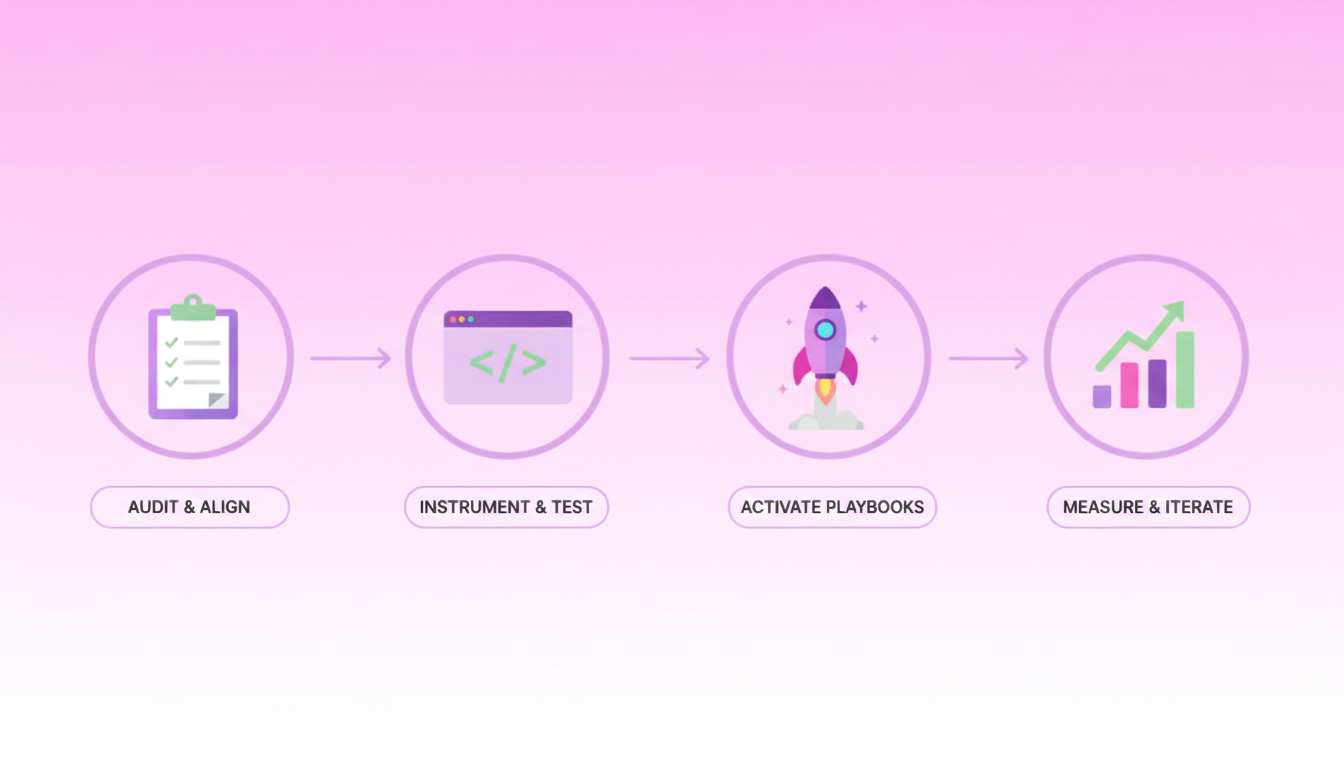
Rolling Out Person-Level ID in Your Stack: A 30-Day Blueprint
Deploying identity resolution does not require a multi-quarter initiative. Follow this phased approach:
Week 1 – Audit & Align
Map current systems (CRM, MAP, chat, analytics) and identify integration gaps
Define ICP criteria and confirm legal basis for processing
Week 2 – Instrument & Test
Week 3 – Activate Playbooks
Week 4 – Measure & Iterate
Track meeting-booked rate, speed-to-lead, and attribution coverage
Salesforce's Engagement Agent now supports over 1 million monthly outreach actions after a multi-agent re-architecture—proof that scale is achievable
Change-Management Tips for SDR & RevOps
Technology alone does not guarantee adoption. Keep these principles in mind:
Explain the reasoning. Reps ignore AI recommendations when systems can't explain their reasoning. Choose platforms that surface why a visitor was flagged and what action is recommended.
Preserve human oversight. Teams trust AI agents more when humans have the final say on high-stakes decisions. Build approval workflows for automated outreach.
Deliver guidance in real time. Salesforce empowered sellers with a proactive system that delivers personalized guidance in real time—contributing $28M in generated pipeline and $9M in closed ACV over four months.
Person-Level ID: Small Data, Big Moat
Company-only identification will always be easier—and always be less valuable. A 15% individual match rate sounds modest until you realize it represents the most motivated slice of your traffic, captured at the moment of peak intent.
Warmly combines website visitor identification with AI-powered outbound automation. The visitor identification matches real people to real accounts, and the AI outbound triggers while the intent is still warm. For B2B SaaS companies using website visitor identification and intent-based outbound, that combination creates a compounding advantage competitors cannot easily replicate.
If you are ready to turn anonymous clicks into booked meetings, explore how Warmly's person-level identification and AI orchestration can accelerate your pipeline.
Frequently Asked Questions
What is person-level visitor identification?
Person-level visitor identification connects every touchpoint and engagement signal to the right person, creating a unified customer profile. This approach goes beyond IP-to-company matching, allowing for more precise marketing and sales strategies.
Warmly's 15% person-level ID focuses on high-intent individuals, leading to higher conversion rates compared to broader company-only identification. This targeted approach results in more effective outreach and better lead scoring.
What are the benefits of using AI agents with person-level data?
AI agents enhance the value of person-level data by automating tasks such as account research, personalized outreach, and lead qualification. This automation reduces manual effort, shortens sales cycles, and increases conversion rates.
How can companies ensure GDPR compliance with person-level identification?
To ensure GDPR compliance, companies should conduct legitimate interest assessments, maintain audit trails, use verified data sources, and obtain explicit consent where necessary. These steps help balance data processing with privacy rights.
What should you consider when evaluating identity resolution vendors?
When evaluating vendors, consider their match methodology, data sources, compliance posture, integration capabilities, and confidence scoring. These factors determine the accuracy and effectiveness of their identity resolution solutions.
Sources
- https://www.yourfriend.tech/blog/warmly-review
- https://www.warmly.ai/p/media/customer-love-case-studies
- https://www.warmly.ai/p/case-studies/warmly-marketing
- https://www.revsure.ai/blog/building-a-unified-identity-graph-the-technical-backbone-of-accurate-b2b-attribution
- https://senglehardt.com/papers/ccs16onlinetracking.pdf
- https://my.idc.com/getdoc.jsp?containerId=US50514223
- https://www.yourfriend.tech/blog/visitor-id-tools-showdown
- https://blog.syftdata.com/p/how-accurate-are-site
- https://www.outreach.io/resources/reports-guides/2025-agentic-ai-revenue-intelligence-idc-report
- https://everworker.ai/blog/ai-agents-for-pipeline-acceleration-b2b-saas
- https://www.saastr.com/saastrs-ai-agent-playbook-how-we-deployed-20-agents-to-scale-8-figure-revenue-with-single-digit-headcount/
- https://www.autobound.ai/case-study/warmly
- https://www.marketsandmarkets.com/AI-sales/how-salesplay-automates-opportunity-specific-nurture
- https://www.edpb.europa.eu/system/files/2024-10/edpbguidelines202404legitimateinterest_en.pdf
- https://iapp.org/news/a/dutch-dpa-fine-for-commercial-interests-under-legitimate-interest-balancing-test/
- https://my.idc.com/getdoc.jsp?containerId=US53016125
- https://www.forrester.com/report/the-forrester-wave-tm-intent-data-providers-for-b2b-q1-2025/RES182002
- https://www.gartner.com/reviews/market/revenue-intelligence
- https://engineering.salesforce.com/scaling-sales-agents-engineering-next-gen-ai-for-the-enterprise-era/
- https://www.salesforce.com/blog/ai-sales-enablement/