Real-time sales automation AI: Identifying anonymous B2B visitors
Real-time sales automation AI identifies anonymous B2B visitors at the contact level, not just the company level, enabling immediate personalized outreach while prospects are actively researching. Modern platforms achieve 85% accuracy in intent scoring and can increase qualified leads by 168% in one month, fundamentally changing pipeline economics for B2B sales teams.
TLDR
• Real-time AI platforms identify individual contacts visiting your site, providing names, titles, emails, and LinkedIn profiles rather than just company-level data
• Only 2-5% of website visitors convert through traditional forms, leaving 95-98% of buyer intent invisible to sales teams
• Modern solutions use behavioral analysis to score intent with 85%+ accuracy, far exceeding the 20% accuracy of traditional methods
• Speed matters: Up to 50% of deals go to the first vendor to respond, making real-time identification and automated outreach critical
• Leading implementations report dramatic results, with companies like RealVNC discovering 190 hidden visitors who created 2.34x more revenue than 9,000+ form fills
Most of your website traffic never fills out a form. With only 2-5% of visitors converting through traditional channels, the vast majority of buying intent vanishes into thin air. Real-time sales automation AI changes that equation by identifying anonymous B2B visitors at the contact level, scoring their intent, and triggering personalized outreach before they leave your site.
From dark traffic to warm conversations—why now?
The stakes have never been higher for B2B sales teams. Consider this: by 2027, 95% of seller research workflows will begin with AI, up from less than 20% in 2024. Yet most organizations still operate blind to who actually visits their websites.
The math is brutal. When 98% of buying intent remains invisible, you're not just losing leads. You're losing the entire context of what accounts care about, which pages signal urgency, and who the actual decision-makers are. Traditional analytics tell you someone from "Company X" visited your pricing page. What they don't tell you is whether that visitor was an intern or the VP of Operations.
This matters because B2B buyers spend roughly 17% of buying time with all suppliers combined. That leaves precious little live interaction per vendor. If you can't identify and engage high-intent visitors while they're actively researching, you've already lost ground to competitors who can.
By 2025, 75% of B2B sales organizations will augment traditional sales playbooks with AI-guided selling solutions. The shift isn't optional. It's existential.
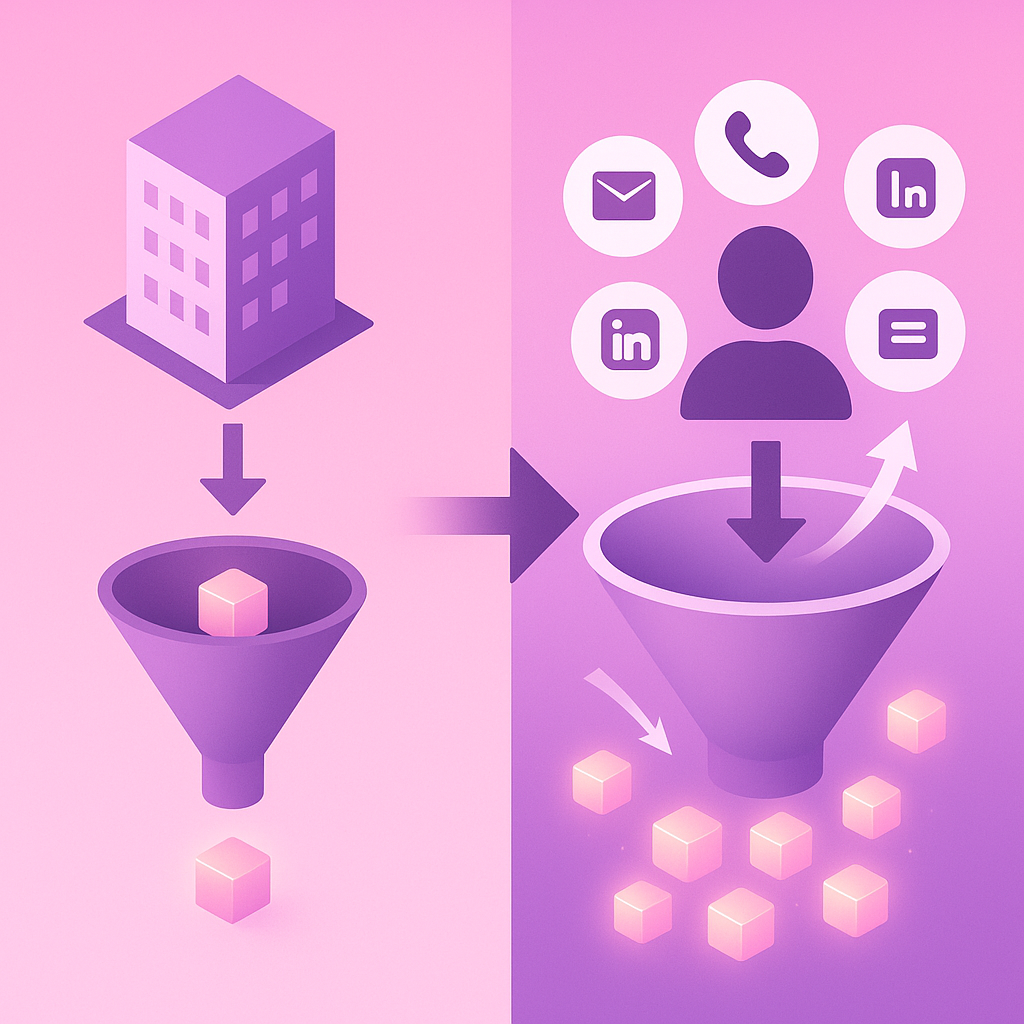
Why identifying individuals—not just companies—changes the revenue game
Company-level identification was revolutionary a decade ago. Today, it's table stakes that leave too much on the table.
Here's the gap: on average, 70% of your website visitors are new, unknown, and anonymous. Traditional ABM tools identify up to 30% of visitors but can't reveal their real-time buyer intent. They completely miss the anonymous majority.
The revenue impact of closing this gap is dramatic. When Lift AI customers moved from company-level to contact-level identification with behavioral scoring, one user reported: "Lift AI increased our qualified leads by 168% in one month!"
Speed compounds the advantage. Research indicates that up to 50% of closed deals go to the first vendor to respond to customers. When you know which individual is browsing your integration documentation at 2 PM on a Tuesday, and that person matches your ICP, you can engage within minutes rather than days.
The context matters too. 67% of consumers think it's important for brands to automatically adjust content based on the current context. Generic "someone from Acme Corp visited" alerts don't enable that personalization. Knowing that Sarah Chen, VP of Revenue Operations at Acme Corp, just spent 12 minutes on your Salesforce integration page does.
Key takeaway: Contact-level identification with real-time intent scoring creates a fundamentally different pipeline velocity than company-level awareness alone.
How real-time sales automation AI actually works
The technology stack has matured significantly. Modern platforms combine four core capabilities: data capture, identity resolution, intent scoring, and automated orchestration.
The process begins when a visitor lands on your site. A lightweight script records consented visits, pages viewed, and context. This first-party data forms the foundation.
Next comes the intelligence layer. The system attempts to resolve visit-to-company and find verified contacts across a 450M+ B2B dataset using waterfall enrichment. Waterfall enrichment means the platform queries multiple data providers in sequence until it finds a match, dramatically improving resolution rates.
Platforms like Knock2 take this further by revealing the real decision makers behind each visit, including name, title, LinkedIn, email, phone, firmographics, and engagement history. This transforms anonymous traffic into actionable sales intelligence.
Data enrichment adds crucial context. Modern tools can add over 40+ attributes like company industry, revenue, employees, address, social pages, or contact role and employer links. This enrichment happens in real-time, typically within seconds.
Pixel, server, and first-party data foundations
The technical implementation starts with consented tracking. Pixel capture through a lightweight script records consented visits, pages viewed, and context.
Privacy compliance isn't optional. Leading platforms build on GDPR and CCPA-compliant foundations, using first-party data and explicit consent mechanisms. This matters because browser fingerprinting is a growing technique for identifying users online without traditional methods like cookies, and regulations increasingly scrutinize these practices.
The shift toward first-party data has accelerated as data deprecation is eroding the availability of digital signals and undermining traditional identity resolution tactics. Organizations that built their identification strategies on third-party cookies face a reckoning.
Real-time intent scoring engines
Not all visitors are equal. Intent scoring separates the curious from the committed.
The problem with static firmographic rules is accuracy. The average intent signal is less than 20% accurate, which means AI agents, sales teams, and marketing campaigns chase wrong leads while real opportunities slip away.
Behavioral models change this equation. Platforms like Lift AI use Microbehavioral Analysis to score buyer intent with proven 85%+ accuracy. The model analyzes aggregate website behavior patterns trained on billions of data points, identifying buying signals that firmographic data alone would miss.
This scoring happens in real-time as visitors navigate. The system continuously updates intent scores based on pages viewed, time spent, scroll depth, return visits, and dozens of other behavioral signals.
Toolscape 2026: from IP look-ups to contact-level intelligence
The market has evolved from simple IP identification to sophisticated buyer intelligence platforms. Understanding where different tools sit on this spectrum helps teams make informed decisions.
Traditional IP & firmographic tools
The first generation of visitor identification relied on reverse IP lookup. Leadfeeder identifies the names of the companies visiting your website, enabling sales teams to see which accounts show interest.
These tools deliver value. Users report meaningful results: "By using Leadfeeder for online lead generation we've increased qualified sales leads by 34%".
But they hit a ceiling. IP-based identification reveals organization-level data, not individual visitors. You know Acme Corp visited. You don't know which of their 500 employees, what their role is, or whether they have buying authority.
Additionally, job changes, hiring momentum, funding news, and tech adoption update in real time, so your team starts conversations when prospects are most open to them. Static company data misses these timing signals.
Next-gen AI platforms (Warmly, Lift AI, Knock2)
The current generation addresses the individual identification gap directly.
Lift AI works for every single visitor, even if they're completely anonymous with zero other data. The platform uses machine learning trained on billions of behavioral data points to assign intent scores regardless of whether the visitor can be identified.
Warmly approaches the problem through multi-channel orchestration. The platform personalizes and orchestrates outreach to visitors via multiple channels like email, LinkedIn, chat based on attributes and intent. When a high-intent visitor lands on your site, Warmly can simultaneously alert your sales team, trigger a personalized chat experience, and queue an email sequence.
Knock2 focuses specifically on contact-level data for sales-led teams. One customer described it as "Contact-level buying intent we can actually operationalize".
Platforms like NanoTarget claim to identify up to 70% of anonymous visitors. More importantly, they provide context beyond basic identification: "Other tools give you a name and email. NanoTarget shows you intent, engagement, and exactly when to reach out."

Implementing with confidence: data, compliance, and identity resolution
Rolling out AI-powered visitor identification requires attention to data quality, privacy compliance, and technical integration.
Start with your data foundation. The future of identity resolution looks promising, with advancements in AI and ML expected to enhance data matching accuracy and efficiency. But these capabilities require clean, well-structured first-party data to work effectively.
As Roger Beharry Lall, research director at IDC, notes: "In a post-cookie world, mastering identity resolution is not just an option"; it's the cornerstone of personalized, privacy-first customer relationships.
Prioritize compliance from day one. Leading platforms maintain certifications that matter:
Map your integration requirements. HubSpot's data enrichment, for example, partners with industry leaders for fresh, accurate data, with more than 200 million profiles in their dataset. Ensure your chosen platform connects seamlessly with your existing CRM and sales engagement tools.
Build a measurement framework. Define success metrics before implementation. Common benchmarks include identification rate improvement, time-to-first-touch reduction, and pipeline contribution from identified visitors.
Benchmarks & outcomes you can defend in the boardroom
The business case for real-time visitor identification rests on measurable outcomes. Here's what leading implementations deliver:
Pipeline multiplication: RealVNC discovered 190 hidden visitors who created 2.34x more revenue than over 9,000 form fills during the same month. That's not incremental improvement. It's a fundamental shift in pipeline economics.
ROI within months: Laura Miller, Director of Sales Development at NameCoach, booked 26 qualified meetings using Warmly, translating to a 282% return on their initial investment in just half a year.
Revenue acceleration: "We increased our revenue by six figures within 4 months of starting with Instantly." - Alexander on Trustpilot
Efficiency gains: Sales teams report dramatic productivity improvements when they can focus on identified, high-intent visitors rather than working blind lists. Okta increased their sales team efficiency by 5x by focusing SDRs on high-intent website visitors.
These aren't cherry-picked examples. They reflect a consistent pattern: organizations that move from company-level to contact-level identification with real-time intent scoring see step-function improvements in pipeline generation.
What's next: agentic AI, transparency pressure, and privacy-first signals
The technology continues evolving rapidly. Three trends will shape the next phase.
Agentic AI moves from concept to deployment. Agentic AI is a transformative leap in AI for sales. It enables autonomous or semiautonomous software entities to perceive, decide and act within digital or physical environments. For visitor identification, this means AI that doesn't just score intent but takes action: routing conversations, triggering sequences, and engaging prospects without human intervention.
Transparency demands increase. The Foundation Model Transparency Index reveals concerning trends. The average score out of 100 fell from 58 in 2024 to 40 in 2025. As AI becomes more central to sales processes, buyers and regulators will demand clearer explanations of how identification and scoring decisions are made.
Privacy-first architectures become mandatory. Researchers are exploring concepts like personhood credentials, digital credentials that empower users to demonstrate they are real people, not AIs, to online services, without disclosing any personal information. The tension between identification capability and privacy protection will intensify.
Forrester predicts that missteps in large-scale AI deployments will force a pragmatic reset. Organizations that move thoughtfully, building on compliant foundations with clear governance, will outlast those that optimize purely for identification rates.
Key takeaways
Real-time sales automation AI has fundamentally changed what's possible in B2B visitor identification. The technology exists today to:
1. Identify individuals, not just companies - Moving beyond IP-based company identification to contact-level intelligence with verified emails, phone numbers, and LinkedIn profiles
2.
Score intent in real-time - Using behavioral analysis to determine who's ready to buy with
proven 85%+ accuracy, far exceeding the industry average
The organizations winning today aren't the ones with the most website traffic.
They're the ones converting anonymous visitors into pipeline before competitors even know those visitors exist.
Warmly helps B2B sales teams do exactly that. The platform reveals individuals and companies visiting your site through reverse IP lookup, scores intent, and alerts sales reps when high intent accounts visit so they can engage immediately. For teams ready to transform anonymous traffic into qualified pipeline, exploring Warmly's visitor identification and automated outreach capabilities is a logical next step.
Frequently Asked Questions
What is real-time sales automation AI?
Real-time sales automation AI is a technology that identifies anonymous B2B visitors at the contact level, scores their intent, and triggers personalized outreach before they leave your site, enhancing lead conversion and engagement.
Why is identifying individuals instead of companies important in B2B sales?
Identifying individuals rather than just companies allows sales teams to engage directly with decision-makers, providing personalized interactions and improving conversion rates. This approach closes the gap left by traditional company-level identification, which often misses the majority of anonymous visitors.
How does real-time intent scoring work?
Real-time intent scoring uses behavioral analysis to determine a visitor's readiness to buy. Platforms like Lift AI analyze website behavior patterns to score intent with high accuracy, allowing sales teams to focus on high-potential leads.
What are the compliance considerations for using AI in visitor identification?
Compliance is crucial when using AI for visitor identification. Leading platforms ensure GDPR and CCPA compliance, using first-party data and explicit consent mechanisms to protect user privacy and adhere to regulations.
How does Warmly help B2B sales teams with visitor identification?
Warmly helps B2B sales teams by revealing individuals and companies visiting their site, scoring intent, and alerting sales reps when high-intent accounts visit. This enables immediate engagement and conversion of anonymous traffic into qualified pipeline.
Sources