What is a GTM agent harness? Complete B2B guide (2025)
A GTM agent harness is the orchestration framework that unifies multiple autonomous AI agents working across your B2B revenue tech stack, providing shared data access, coordination rules, and security guardrails. This connective layer transforms isolated automation into a coordinated system, with companies seeing up to 62% reduction in CRM administrative work and 7x pipeline growth at 80% lower costs.
At a Glance
• A GTM agent harness coordinates AI agents across sales, marketing, and revenue operations tasks through unified data layers and orchestration frameworks
• Early adopters report 7× higher conversion rates and 80% lower pipeline generation costs compared to traditional SDR teams
• Three core layers power the harness: Agent Layer (specialized task execution), Orchestration Layer (workflow coordination), and Integration Layer (system connectivity)
• Reduces CRM administrative work by up to 62%, giving sales reps 30-40% more time for selling activities
• Implementation requires unified data ingestion, clear governance policies, and focus on high-frequency, high-effort tasks for maximum ROI
A GTM agent harness is the connective tissue that lets autonomous AI agents collaborate across your B2B go-to-market stack. As agentic AI reshapes how revenue teams operate, understanding this foundational layer has become essential for sales, marketing, and RevOps leaders who want to move beyond siloed automation toward coordinated, intelligent execution.
This guide defines the term, breaks down its core components, and shows you how to build and measure a harness that drives real pipeline acceleration.
What Is a GTM Agent Harness?
A GTM agent harness is the orchestration framework that unifies multiple autonomous AI agents working on go-to-market tasks. It provides shared data access, sets coordination rules, enforces security guardrails, and logs every step, turning isolated agents into a coordinated digital workforce for revenue teams.
Think of it as the operating system for agentic GTM.
Agents are systems that independently accomplish tasks on your behalf, leveraging large language models to manage workflow execution and make decisions. But without a harness, these agents operate in silos, duplicating effort, missing context, and creating governance blind spots.
The shift toward agentic AI is structural, not incremental. As Bain & Company notes, "Agentic AI is a structural shift in enterprise tech, reshaping companies with agents that can reason, coordinate, and execute complex workflows." Yet most companies are unprepared: capturing full value requires rethinking systems, data, and governance to support scalable, safe agent deployment.
Gartner research reinforces the urgency. Among organizations with high AI maturity, 91% already have a centralized approach to agent coordination. By 2028, 33% of enterprise software applications will include agentic AI, up from less than 1% in 2024.
The harness is what separates scattered automation experiments from a unified revenue engine.
Which Building Blocks Power a GTM Agent Harness?
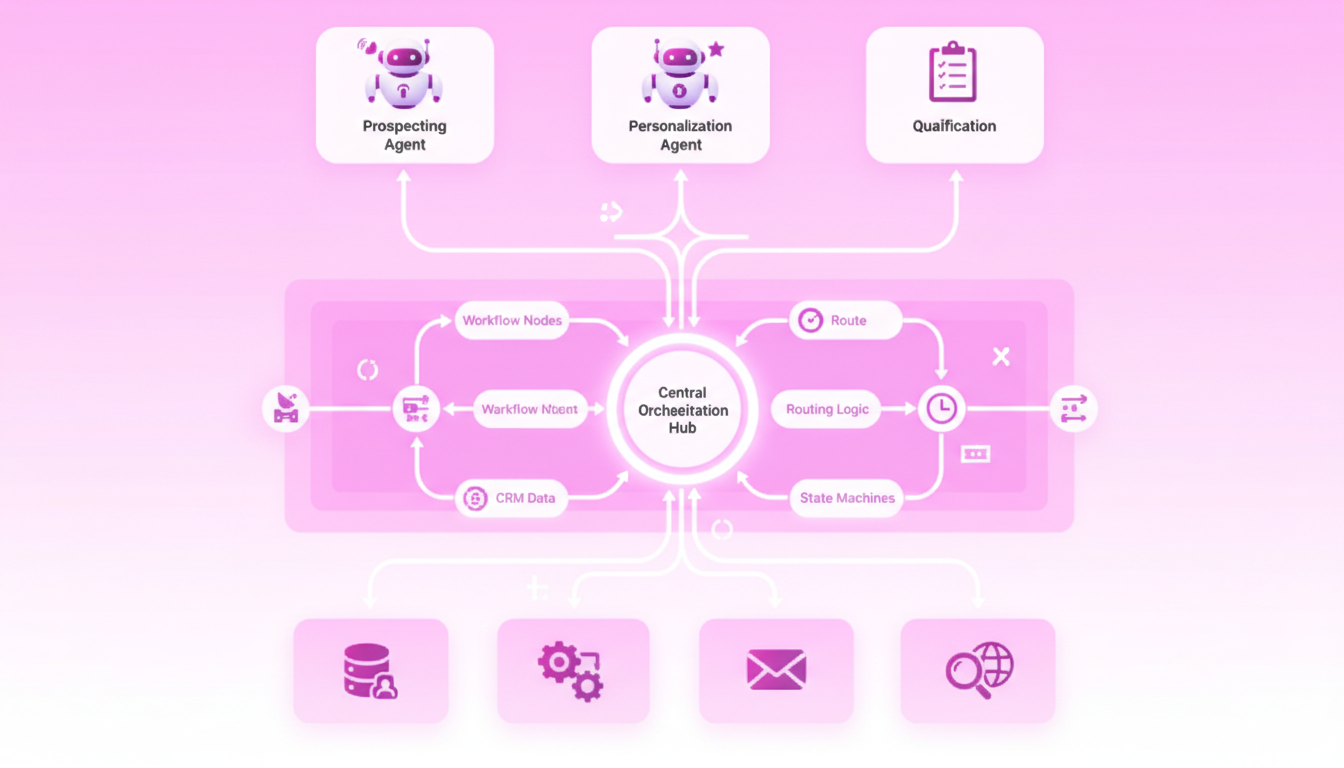
A GTM agent harness comprises three fundamental layers that enable specialized agents to work together seamlessly. Understanding these layers helps you evaluate platforms and architect your own implementation.
Research from the World Journal of Advanced Engineering Technology and Sciences describes a three-layer architectural framework consisting of the Agent Layer, Orchestration Layer, and Integration Layer. These layers facilitate the seamless operation of specialized agents responsible for prospecting, personalization, and deal acceleration.
| Layer |
Purpose |
Key Functions |
| Agent Layer |
Houses specialized task agents |
Prospecting, personalization, qualification, deal acceleration |
| Orchestration Layer |
Coordinates workflows |
Task decomposition, routing, state management |
| Integration Layer |
Connects to existing systems |
CRM sync, data enrichment, tool APIs |
By 2028, 33% of enterprise software will include agentic AI. The companies that build robust harnesses now will capture disproportionate value.
Data & Memory Layer
The data layer serves as the foundation. Without unified, real-time data, agents make decisions in isolation and duplicate work across the funnel.
HockeyStack's Atlas platform illustrates this principle: it ingests GTM data from every system across your revenue stack, standardizes it, and applies an intelligent categorization layer. This creates a single source of truth that all agents can query.
GTM Engine takes a similar approach, automatically capturing every customer interaction from Gmail, Outlook, Zoom, Slack, and Gong. AI then transforms raw interactions into structured CRM data instantly, eliminating the garbage-in, garbage-out problem that plagues most agent deployments.
Key takeaway: Your harness is only as good as your data layer. Prioritize unified ingestion before adding more agents.
Orchestration & Interface Layer
The orchestration layer is where intent becomes intelligence. It sits between user requests and backend systems, handling the complex dance of understanding, routing, processing, and responding.
As Graph Digital explains, this layer handles intent classification, resource routing, state management, and response orchestration. The interface layer is deterministic code, not AI. The AI provides personality and natural language understanding; the interface provides reliability, performance, and scalability.
Bain & Company describes the hierarchy clearly: "Higher-level orchestrator agents are like project managers that oversee a whole process, breaking it down into subtasks and tracking progress." Task agents execute individual assignments and return results to the orchestrator.
Effective orchestration includes:
- Intent classification that goes beyond keyword matching
- Resource routing that decides whether to query existing data or trigger fresh computation
- State management across sessions, users, and organizations
- Response orchestration that makes technical operations feel conversational
Why B2B Revenue Teams Need an Agent Harness Now
The business case for a GTM agent harness centers on three outcomes: efficiency gains, cost reduction, and pipeline acceleration.
Agents handling CRM administrative tasks can reduce that work by up to 62%, giving sales reps 30-40% more time to focus on actual selling. This isn't theoretical. GTM Engineer AI Agents have demonstrated the ability to boost B2B pipeline by up to 7x while cutting costs 80%.
Google Cloud reports that 74% of executives achieve ROI within the first year of deploying AI agents. Among those reporting productivity gains, 39% have seen productivity at least double.
The math is compelling:
| Metric |
Impact |
| CRM admin reduction |
Up to 62% |
| Pipeline generation costs |
80% lower |
| Conversion rate improvement |
Up to 7x |
| Time to first-year ROI |
74% of organizations |
Without a harness, you get isolated automation wins. With one, you get compounding returns as agents learn from each other and share context across the funnel.
How Do You Build and Orchestrate a Harness Securely?
Building a GTM agent harness requires attention to architecture, integration, and governance. The good news: you don't need to start from scratch.
OpenAI's practical guide to building agents emphasizes that guardrails are a critical component of any LLM-based deployment. These should be coupled with robust authentication and authorization protocols, strict access controls, and standard software security measures.
For CRM integration specifically, AI agents can reduce manual data entry by 80% while enabling 5x faster lead response and 35% higher conversion rates. The integration pattern matters: use bidirectional sync via APIs (Salesforce and HubSpot both offer robust options), implement error handling, and maintain audit logs.
Implementation steps:
- Audit current workflows to identify high-effort, high-frequency tasks
- Select a data foundation that unifies signals across your stack
- Deploy task agents for specific functions (prospecting, qualification, CRM hygiene)
- Build orchestration logic that routes tasks and manages state
- Establish governance policies before scaling
Security, Compliance & Human Oversight
As agent autonomy increases, governance becomes non-negotiable. Bain advises that "Tech leaders should continue to modernize core platforms while prioritizing interoperability, security, and accountability."
The risks are real. TechCrunch notes that 56% of business leaders are concerned about granting autonomy to AI agents without proper guardrails.
Governance essentials:
- Define what data agents can access and how long they retain it
- Maintain human-in-the-loop oversight for high-stakes decisions
- Log all agent actions for auditability
- Use approved frameworks and protocols only
- Conduct regular security audits of agent integrations
High-Impact Use Cases Across the Revenue Funnel
A GTM agent harness enables coordinated plays across the entire buyer journey. Here are the highest-impact applications.
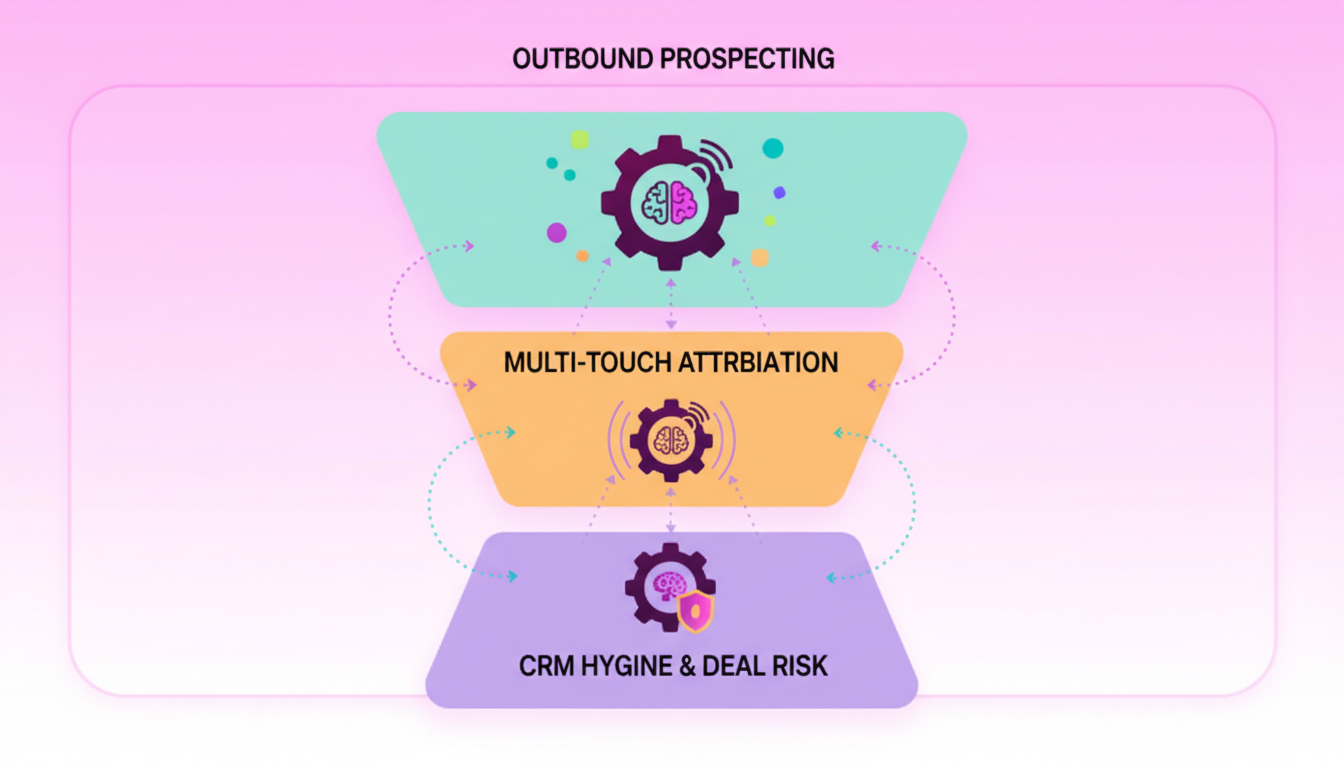
McKinsey research finds that generative AI could unlock $0.8 to $1.2 trillion in sales and marketing productivity, with outsized gains from personalization and automation in B2B. The Pedowitz Group reports that AI-powered multi-touch attribution can achieve 92% attribution accuracy and 100% touchpoint coverage.
Outbound Prospecting & SDR Automation
AI agents for outbound prospecting autonomously source and enrich ICP accounts, craft personalized outreach, orchestrate cadences across email and LinkedIn, handle replies, qualify interest, and book meetings directly into your CRM.
Deployed well, they cut manual prospecting time 60-80% and increase qualified pipeline within 30-60 days. Frontiers in Artificial Intelligence reports that AI-driven lead generation systems like Scrapus achieve 3x higher relevant lead yield through reinforcement learning.
Multi-Touch Attribution & Budget Optimization
Attribution agents continuously ingest new interactions, refresh weights as patterns shift, and provide segment-level insights across channels, campaigns, and accounts.
AI-powered multi-touch attribution can replace 25-40 hours of manual assembly with a 3-6 hour streamlined flow. Treasure Data notes that outdated attribution models may be misallocating as much as $50 million per year for each enterprise.
CRM Hygiene & Deal Risk Detection
Agents can automatically update CRM records with accurate information from calls, emails, and meetings. More importantly, they identify potential deal issues like disengaged stakeholders or missing champions before those issues derail opportunities.
GTM Engine provides real-time health scoring based on engagement patterns and deal progression signals. Forecasting built on customer behavior, not rep inputs, creates risk-adjusted close dates that roll up instantly for leadership.
What Pitfalls Can Derail Your Agent Harness?
Three failure modes consistently undermine agent harness implementations: agent washing, data debt, and over-automation.
Agent washing occurs when companies rebrand existing automation tools or AI assistants as "AI agents" without actually building autonomous capabilities. True AI agents run end-to-end processes, execute autonomous multi-step workflows, make contextual decisions, and adapt to outcomes in real-time. If your "agent" requires human intervention at every step, it's not an agent.
Data debt is the most common implementation challenge. According to Chiefmartec and MartechTribe's survey, 56% of respondents cited poor data quality as a significant barrier to agent deployment. Agents amplify data problems: garbage in, garbage out at scale.
Over-automation happens when teams deploy agents for tasks that don't warrant them. Salesforce research shows that highly complex tasks still require judgment. Workflows involving nuance, cross-functional alignment, and strategic decisions are better suited for agent augmentation, not full automation.
The antidote: start with high-effort, high-frequency tasks where agents can deliver measurable time savings. Build governance before scaling. Validate data quality before trusting agent outputs.
KPIs & ROI Framework to Measure Success
Measuring agent harness performance requires a framework that captures efficiency gains, quality improvements, and revenue impact.
Salesforce's research team surveyed over 2,700 internal sellers to identify where agents save the most time. Their finding: "Effortful, frequent tasks deliver the greatest ROI. When agents support actions that are both demanding and repetitive (for example, writing sales outreach emails), the time savings are tangible and add up."
Google Cloud reports that organizations see a median 40% cost-per-unit savings for their most mature workflows. G2's 2025 AI Agents report confirms this, noting that respondents report a median 40% cost-per-unit savings and strong correlation between agent efficiency and speed to market.
Recommended KPIs:
| Category |
Metrics |
| Efficiency |
Time saved per task, manual work reduction %, tasks completed per agent |
| Quality |
Data accuracy, attribution confidence, error rates |
| Revenue |
Pipeline generated, conversion rate lift, deal velocity |
| Adoption |
Agent utilization, user satisfaction, feature coverage |
How Can Warmly Jump-Start Your Agent Harness?
Warmly is a leading visitor identification and intent intelligence platform used by B2B sales teams to uncover anonymous website traffic, identify high-intent accounts, and automate outbound personalization to drive more pipeline.
Warmly's playbooks offer proven strategies for revenue teams to create and close pipeline, including the ability to push Warmly-identified leads to all your GTM tools and AI agents. This positions Warmly as the signal layer that feeds your broader agent harness with high-quality intent data.
When considering AI sales agents, factors like alignment with your sales funnel, access to real-time buying signals, integration with existing tools, and personalization capabilities matter most. Warmly addresses these requirements by surfacing the intent signals that agents need to prioritize and personalize outreach.
For teams building their first harness, Warmly's platform connects natively with CRMs like Salesforce and HubSpot, ensuring that AI agents can sync data bidirectionally and trigger workflows based on real-time visitor behavior.
Harness Agents, Unleash Revenue
A GTM agent harness transforms scattered automation into a coordinated revenue engine. The building blocks exist today: unified data layers, orchestration frameworks, specialized task agents, and governance protocols.
The companies pulling ahead are already putting these pieces together. Early movers are focusing investments on the most valuable areas, building foundational capabilities, and using agents in the transformation itself.
Start by auditing your current GTM workflows for high-effort, high-frequency tasks. Build your data foundation before adding more agents. Establish governance early. And measure what matters: efficiency, quality, and revenue impact.
Warmly's playbooks and resources provide a practical starting point for teams ready to harness agents and unleash revenue.
Frequently Asked Questions
What is a GTM agent harness?
A GTM agent harness is an orchestration framework that unifies autonomous AI agents working on go-to-market tasks, enabling them to collaborate effectively across a B2B revenue stack.
Why is a GTM agent harness important for B2B revenue teams?
A GTM agent harness is crucial for B2B revenue teams as it enhances efficiency, reduces costs, and accelerates pipeline by coordinating AI agents to work together seamlessly, rather than in isolation.
What are the core components of a GTM agent harness?
The core components of a GTM agent harness include the Agent Layer, Orchestration Layer, and Integration Layer, which together facilitate the seamless operation of specialized agents for tasks like prospecting and deal acceleration.
How does Warmly support the implementation of a GTM agent harness?
Warmly supports the implementation of a GTM agent harness by providing high-quality intent data and integration capabilities with CRMs, enabling AI agents to prioritize and personalize outreach effectively.
What are the potential pitfalls in implementing a GTM agent harness?
Potential pitfalls include agent washing, data debt, and over-automation. These can be mitigated by ensuring true autonomous capabilities, maintaining high data quality, and deploying agents for appropriate tasks.
Sources
- https://www.gtmengine.ai/documentation/agents-overview
- https://www.landbase.com/blog/what-is-an-agentic-ai-gtm-engineer-in-2025
- https://cdn.openai.com/business-guides-and-resources/a-practical-guide-to-building-agents.pdf
- https://www.bain.com/insights/building-the-foundation-for-agentic-ai-technology-report-2025/
- https://www.gartner.com/en/articles/agentic-ai
- https://journalwjaets.com/sites/default/files/fulltext_pdf/WJAETS-2025-0927.pdf
- https://www.hockeystack.com/ai
- https://www.gtmengine.ai/content/platform/collect
- https://graph.digital/articles/agent-intent
- https://cloud.google.com/transform/roi-of-ai-how-agents-help-business
- https://zengato.com/blog/ai-crm-integration-guide
- https://techcrunch.com/sponsor/incertis/from-contracts-to-commerce-why-ai-agents-are-the-next-frontier-in-enterprise-trade/
- https://everworker.ai/blog/ai-agents-outbound-prospecting-b2b-2026-playbook
- https://www.pedowitzgroup.com/multi-touch-attribution-analysis-with-ai
- https://www.frontiersin.org/journals/artificial-intelligence/articles/10.3389/frai.2025.1606431/abstract
- https://www.treasuredata.com/blog/multi-touch-attribution-agent/
- https://www.hockeystack.com/blog-posts/ai-agents-for-gtm-teams
- https://ctidigital.com/insights/2026-trends-the-agentic-boom-is-underway/
- https://www.salesforce.com/blog/how-to-measure-agent-roi/
- https://learn.g2.com/hubfs/G2-InsightReport-AIAgents2025.pdf
- https://www.warmly.ai/p/resources/playbooks
- https://www.warmly.ai/p/blog/factors-to-consider-when-buying-an-ai-sales-agent