What is customer support chatbot AI? B2B SaaS buyer's guide
Customer support chatbot AI uses natural language processing and machine learning to automate service conversations, with Gartner predicting 70% adoption by 2028. Modern AI chatbots go beyond simple rules to understand context, route tickets, and enable human agents to focus on complex issues while reducing operational costs by 30%.
At a Glance
• Customer support chatbots combine NLP, large language models, and CRM integration to deliver automated, intelligent conversations
• 85% of service leaders plan to explore or pilot conversational AI solutions in 2025
• By 2029, agentic AI will autonomously resolve 80% of common service issues without human intervention
• Key deployment areas include customer support automation, lead qualification, meeting scheduling, and onboarding assistance
• Success requires strong knowledge management, with 61% of leaders reporting documentation backlogs that could impact chatbot performance
• Future systems will take autonomous actions like canceling subscriptions and negotiating rates, not just answering questions
Customer support chatbot AI is transforming how B2B SaaS teams handle service interactions. As buyer expectations rise and support volumes grow, more organizations are turning to conversational AI to deliver faster, more personalized experiences.
Gartner predicts that by 2028, at least 70% of customers will use a conversational AI interface to start their customer service journey. For B2B companies, the question is no longer whether to adopt chatbot AI but how to evaluate, implement, and measure it effectively.
This guide answers the essential questions B2B SaaS buyers face when exploring customer support chatbot AI, from understanding core components to measuring ROI and preparing for the agentic future.
Defining customer support chatbot AI and why it matters now
Customer support chatbot AI uses natural language processing and machine learning models to automate frontline service conversations. These systems enhance interactions, automate tasks, and boost agent productivity, leading to more efficient and personalized customer experiences.
Unlike simple rule-based bots, modern AI chatbots leverage large language models to understand context, surface answers, route tickets, and even summarize cases so human agents can focus on complex issues. They learn continuously, improving response quality over time.
The urgency is clear. Gartner research shows agentic AI is poised to revolutionize service interactions, with predictions that by 2029, AI will autonomously resolve 80% of common customer service issues without human intervention, reducing operational costs by 30%.
For B2B SaaS teams, this shift means:
• Faster response times across time zones
• Consistent service quality at scale
• Freed-up human resources for strategic, high-value work
Key takeaway: Customer support chatbot AI is no longer optional for B2B SaaS companies seeking competitive advantage in customer experience.
How do customer support chatbots actually work?
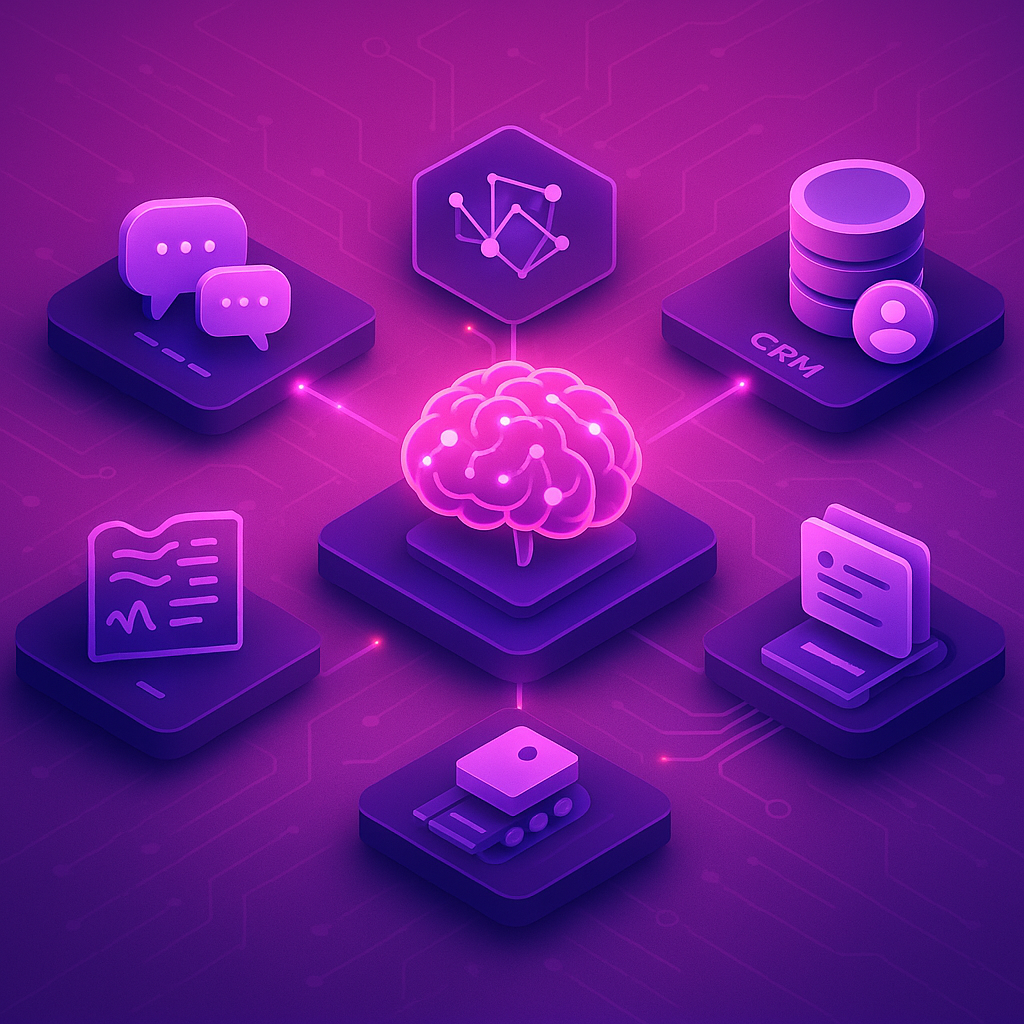
Customer support chatbots combine several core technologies to deliver intelligent, automated conversations.
Core components
| Component |
Function |
| Natural Language Processing (NLP) |
Interprets customer messages and extracts intent |
| Large Language Models (LLMs) |
Generates contextual, human-like responses |
| Knowledge Management |
Connects the bot to product documentation, FAQs, and help articles |
| CRM Integration |
Personalizes responses using existing customer data |
| Ticketing & Routing |
Categorizes and prioritizes issues, escalates when needed |
AI is used across the entire customer service lifecycle. Virtual assistants provide real-time answers, sentiment analysis tools gauge satisfaction, ticketing platforms automatically categorize issues, and personalization engines deliver tailored experiences.
Architecture choices
B2B SaaS teams typically choose between:
1. No-code platforms with pre-built templates and visual builders
2. Developer-friendly frameworks offering advanced NLP and customization
3. CRM-native solutions that integrate seamlessly with existing data
For example, chatbot builders integrated with CRM systems can deliver friendlier, more personalized messages based on information already known about a contact. Any data collected by chatbots automatically syncs to a contact's timeline, giving teams complete context.
Many leaders deploying conversational GenAI rely on well-maintained knowledge libraries. However, 61% of leaders report a backlog of articles to edit, and more than one-third have no formal process for revising outdated content. This knowledge management gap is a critical consideration when evaluating chatbot platforms.
Key takeaway: Effective chatbot architecture requires tight integration between NLP, knowledge management, and your existing CRM and ticketing systems.
Where do B2B SaaS teams see the biggest ROI from chatbots?
B2B SaaS companies deploy customer support chatbots across multiple use cases, each delivering measurable returns.
High-impact use cases
| Use Case |
Benefit |
| Customer support automation |
Reduces ticket volume, shortens resolution time |
| Lead qualification |
Engages visitors 24/7, captures and scores prospects |
| Meeting scheduling |
Eliminates back-and-forth, improves show rates |
| Onboarding assistance |
Guides new users through setup and configuration |
| Knowledge base search |
Surfaces answers instantly from documentation |
Gartner identifies high-impact AI use cases including customer personalization, agent assistance, sentiment analysis, virtual assistants, case summarization, and fraud detection.
Quantified results
Real-world deployments show significant ROI:
Beyond cost savings, chatbots drive revenue by qualifying leads around the clock and accelerating pipeline velocity. Lead generation chatbots operate 24/7 to ensure no opportunities are missed, driving meaningful interactions that move prospects closer to conversion.
For companies like Warmly that combine visitor identification with AI engagement, chatbots can leverage rich context about who is on your site to personalize conversations and route high-intent prospects directly to sales, maximizing both efficiency and conversion rates.
Key takeaway: The biggest ROI comes from high-volume, repetitive workflows where chatbots can resolve issues end-to-end or hand off qualified leads to sales.
What should you look for when buying a customer support chatbot platform?
Selecting the right chatbot platform requires evaluating features, pricing models, integration capabilities, and vendor support.
Feature checklist
• CRM integration: Basic integration for smaller teams, advanced for enterprise needs
• AI-powered insights: Prospect intent identification and conversation analytics
• Multi-channel support: Web, chat, email, and voice capabilities
• Knowledge management: Ability to train on your documentation and FAQs
• Human handoff: Seamless escalation to live agents with full context
• Security and compliance: Enterprise-grade data protection
Pricing models comparison
Chatbot pricing varies significantly across vendors:
| Vendor Type |
Starting Price |
Model |
| Entry-level |
$39-$50/month |
Per seat or conversation-based |
| Mid-market |
$600-$2,500/month |
Volume tiers with overage fees |
| Enterprise |
Custom pricing |
Unlimited conversations, dedicated support |
For example, some platforms offer starter plans at $50/month for 1,000 chats, while others price at $600/month for 150 conversations with additional conversations at $4 each. Enterprise plans typically require direct consultation.
ROI considerations
When building the business case, consider:
• Cost per contained conversation: Organizations can achieve meaningful savings with mature chatbot deployments
• Agent efficiency gains: Chatbots that collect context before handoff reduce average handle time
• Revenue impact: Improved lead qualification and faster response times drive conversion
Evaluating human handoff & escalation flows
Handoff capability is where chatbot implementations often succeed or fail. Contact centers must balance AI and human agents, training bots to recognize when chatbot-to-human handoff should occur.
Key handoff triggers to evaluate:
• User preference (customer requests a human)
• Issue urgency or complexity
• High-value account identification
• Negative sentiment detection
• Regulatory or compliance sensitivity
Effective escalation systems detect when automation is no longer optimal, route conversations to skilled humans with full context, and pass structured information including intent, history, and sentiment. The best systems provide transcript, events, and prior actions in a single, scannable panel rather than a wall of text.
Closed-loop learning is equally important. Every escalation should be tagged with outcomes so CX and RevOps teams can see where automation should expand or pull back to avoid broken experiences.
Key takeaway: Evaluate platforms on integration depth, escalation intelligence, and transparent pricing that scales with your growth.
How do you roll out a chatbot and measure success?
Successful chatbot implementation requires a structured rollout and clear success metrics.
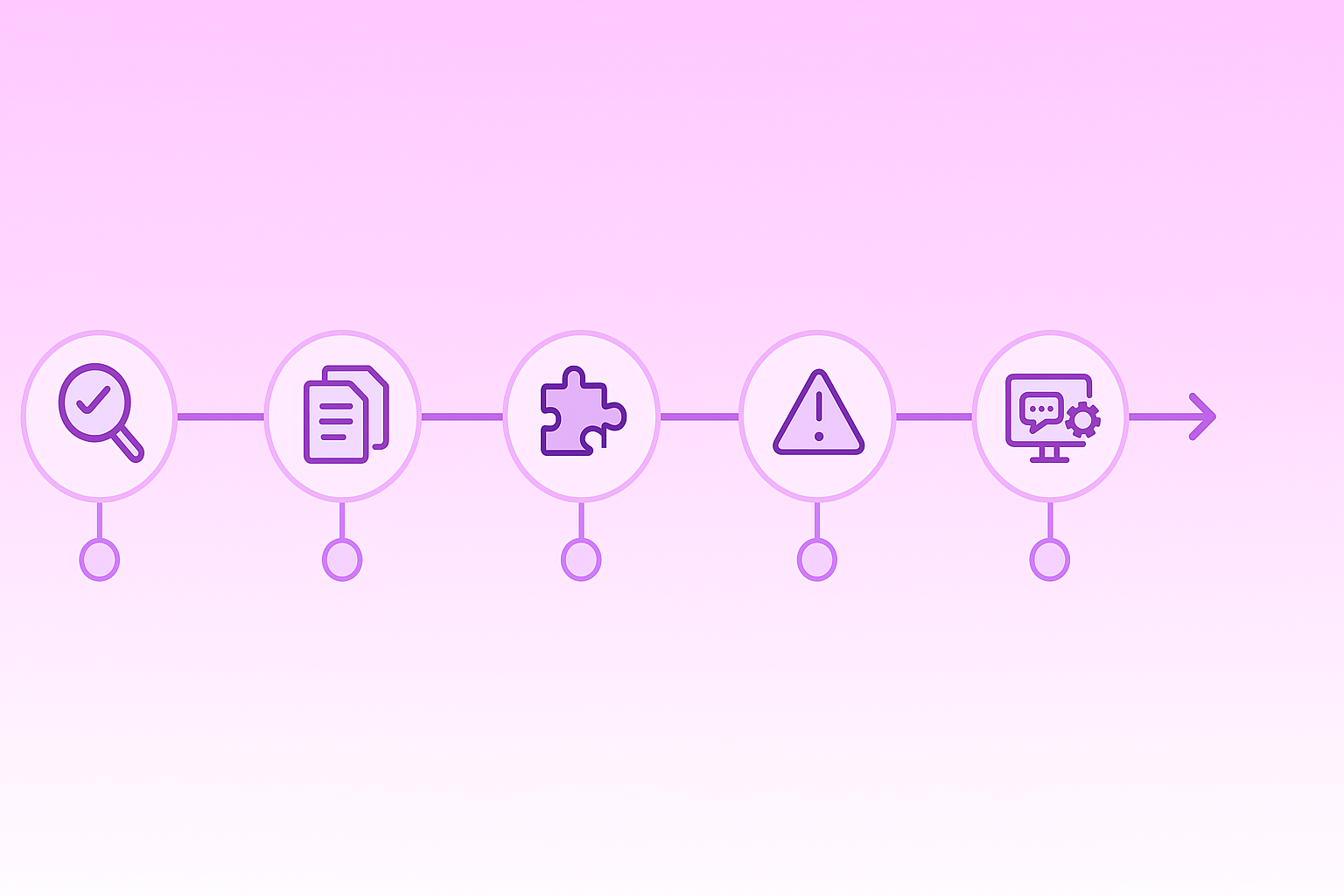
Implementation roadmap
1. Define scope: Start with high-volume, well-documented use cases
2. Prepare knowledge base: Audit and update documentation; address article backlogs
3. Configure integrations: Connect CRM, ticketing, and communication channels
4. Set escalation rules: Define triggers for human handoff based on complexity and value
5. Train and test: Run pilot with internal teams before customer-facing launch
6. Monitor and iterate: Use conversation analytics to identify improvement areas
Organizations see a 26% improvement in ARR when product management and customer success are closely aligned. This alignment is critical during chatbot rollout.
Platforms like Warmly can enhance implementation by providing visitor identification data that gives chatbots richer context about who they're engaging with, enabling more personalized conversations from day one and improving qualification accuracy before handoff to sales teams.
Key performance indicators
Track these metrics to measure chatbot success:
| Metric | Definition | Benchmark |
|--------|------------|-----------||
| Containment rate | Percentage of issues resolved without human intervention | 80% for mature deployments |
| Customer satisfaction (CSAT) | Happiness with specific interactions | Top brands score 80-90% |
| Customer effort score (CES) | Ease of getting support | Under 70% indicates high effort |
| First contact resolution | Issues resolved in single interaction | Higher is better |
| Average handle time | Time to resolve including any escalation | Should decrease over time |
| Churn rate | Customers who stop using your service | Top SaaS performers maintain under 5% |
AI can enhance measurement itself. Organizations deploy chatbots for onboarding, use AI for automated surveys and feedback analysis, and leverage intelligent segmentation to optimize communications.
Governance considerations
Establish clear ownership for:
• Knowledge base maintenance and updates
• Escalation rule refinement
• Performance review cadence
• Customer feedback integration
Key takeaway: Start with a focused pilot, measure against clear KPIs, and build governance processes that ensure continuous improvement.
Where is customer support chatbot AI heading next?
The future of customer support chatbot AI lies in agentic systems that go beyond answering questions to taking autonomous action.
The rise of agentic AI
Gartner predicts that by 2029, agentic AI will autonomously resolve 80% of common customer service issues, leading to a 30% reduction in operational costs. Unlike traditional chatbots, agentic AI can:
• Navigate systems to complete tasks (cancel subscriptions, process returns)
• Negotiate on behalf of customers (shipping rates, contract terms)
• Execute multi-step workflows without human intervention
"Agentic AI has emerged as a game-changer for customer service, paving the way for autonomous and low-effort customer experiences," noted Daniel O'Sullivan, Senior Director Analyst at Gartner.
Market momentum
Adoption is accelerating rapidly:
• Nearly 60% of companies have AI agents in production
McKinsey projects agentic AI will power more than 60% of increased value from AI deployments in marketing and sales.
Preparing your organization
By 2028, automated systems will be able to contain two-thirds of customer interactions within self-service due to advancements in conversational AI. To prepare:
• Invest in knowledge management infrastructure now
• Build escalation frameworks that can evolve with AI capabilities
• Train teams to work alongside AI agents rather than compete with them
• Establish governance for graduated autonomy as trust develops
Key takeaway: The shift to agentic AI is coming faster than many expect. Start building the infrastructure and organizational readiness now.
Key takeaways
Customer support chatbot AI has evolved from a novelty to a strategic imperative for B2B SaaS companies. Here's what to remember:
1.
Define success metrics early. Customer churn rate measures customers who stop using your product. Top SaaS performers maintain churn under 5%, and chatbots can directly impact this through faster, more consistent support.
2. Start with high-volume use cases. Focus initial deployment on repetitive, well-documented workflows where chatbots can resolve issues end-to-end.
3. Prioritize knowledge management. Your chatbot is only as good as the information it can access. Address documentation backlogs before launch.
4. Build robust escalation flows. The handoff experience often determines customer perception. Ensure seamless context transfer to human agents.
5. Plan for agentic capabilities. The platforms you choose today should support the autonomous, action-taking AI agents of tomorrow.
For B2B SaaS companies looking to combine visitor identification with AI-powered engagement, Warmly offers an integrated approach. Warmly's platform identifies anonymous website traffic, surfaces high-intent accounts, and enables personalized outreach, creating a foundation for intelligent customer engagement that complements chatbot AI investments.
The companies that move now to implement thoughtful, well-integrated chatbot AI will be best positioned to capitalize on the agentic future while delivering superior customer experiences today.
Frequently Asked Questions
What is customer support chatbot AI?
Customer support chatbot AI uses natural language processing and machine learning to automate service conversations, enhancing interactions and boosting agent productivity.
How do customer support chatbots work?
They combine technologies like NLP, large language models, and CRM integration to deliver intelligent, automated conversations, improving response quality over time.
What are the benefits of using chatbots in B2B SaaS?
Chatbots offer faster response times, consistent service quality, and free up human resources for strategic tasks, leading to improved customer experiences and operational efficiency.
How can B2B SaaS companies measure the ROI of chatbots?
ROI can be measured through metrics like containment rate, customer satisfaction, and cost-per-conversation savings, with chatbots reducing ticket volumes and improving lead qualification.
What should B2B SaaS companies consider when choosing a chatbot platform?
Key considerations include CRM integration, AI-powered insights, multi-channel support, knowledge management, and seamless human handoff capabilities.
How does Warmly enhance chatbot implementation?
Warmly provides visitor identification data, enabling chatbots to personalize conversations and improve lead qualification accuracy, complementing AI engagement strategies.
Sources