Best Signal Based Marketing Tools: Warmly vs Others (2025)
Signal-based marketing tools capture behavioral and firmographic data in real-time, enabling sales teams to engage prospects while interest peaks. Warmly's streaming architecture processes 20+ buying signals instantly via Slack alerts, while batch-processing competitors like Leadfeeder require manual work and periodic refreshes. Teams using real-time signals report 10× conversion rates compared to delayed responses.
Key Facts
• 100× higher contact odds when responding within 5 minutes versus 30 minutes to inbound inquiries
• 15-20% reply rate lift achieved by Warmly users within 30 days of implementing real-time alerts
• 42-hour average response time still common across B2B organizations, missing critical engagement windows
• $700/month starting price for Warmly versus $42k/year for enterprise competitors like Qualified
• 3× meetings booked by Series A cybersecurity startup using Warmly's job change and visitor alerts in first six weeks
B2B teams are racing to turn anonymous clicks into pipeline, and the fastest path runs through signal based marketing tools. In this post we compare Warmly's real-time engine with 2025's top alternatives, show the revenue impact of instant signals, and offer a checklist for choosing the right stack.
What Are Signal-Based Marketing Tools?
Signal-based marketing tools ingest continuous streams of behavioral and firmographic data and surface them in seconds so sales teams can act while interest is hottest. These platforms monitor buying signals such as website visits, job changes, and third-party intent to notify teams when prospects are ready to engage.
As Chris Miller of Warmly explains, the company helps customers identify and engage with warm leads in real time by bridging human outreach and automation. The approach centers on what Miller calls signal-based selling:
"Your highest intent leads are always going to be on your website. With signal-based selling, you're using Warmly to monitor the buying signals of your best prospects and it notifies you when those prospects are ready to buy."
The technical foundation enabling this category has matured rapidly. Real-time analytics and AI inference over continuous event streams are now fundamental to applications such as fraud detection, industrial IoT, and personalized online services. Streaming engines like Apache Flink, Spark Structured Streaming, and Kafka Streams have become the backbone for feature computation and low-latency inference.
AI SDR tools represent the next evolution of this category. These are agentic systems that automate prospecting, enrichment, personalization, qualification, routing, meeting booking, and follow-ups across channels such as email, LinkedIn, Slack, WhatsApp, and website chat.
The core distinction in this market comes down to timing: does a platform deliver signals in real time, or does it batch-process data overnight?
Real-Time Intent vs Batch: Does Speed Drive Revenue in 2025?
The shift from batch to streaming processing marks a fundamental change in how organizations generate value from buyer data. A detailed survey in the Journal of Information Systems Engineering and Management discusses this paradigm shift, covering the technical foundations of streaming rather than classical batch processing, along with the strengths and challenges of each approach.
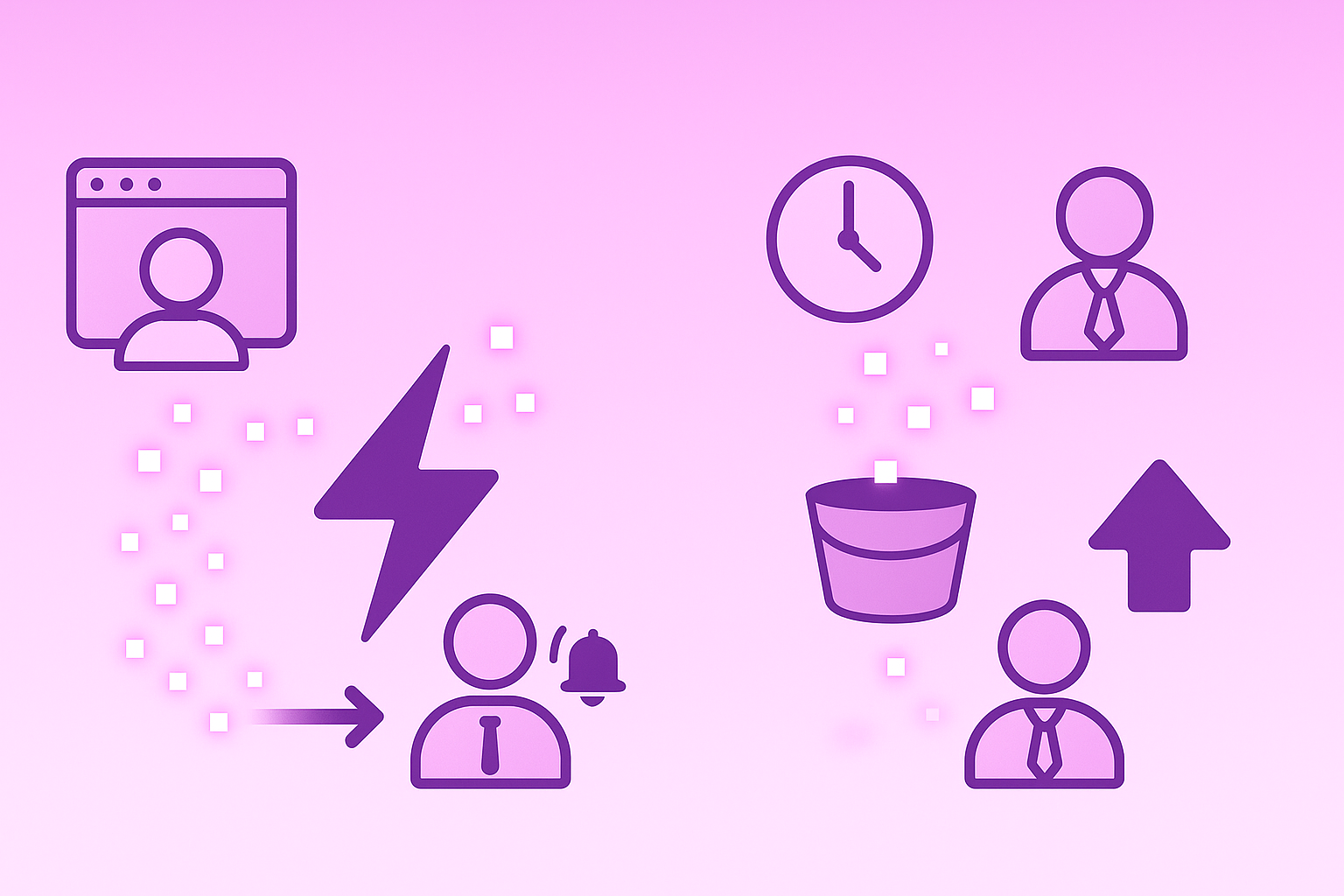
Batch-processing competitors like Leadfeeder refresh data periodically, often requiring manual work to action leads. In contrast, Warmly pushes more than 20 buying signals to reps in real time, enabling immediate engagement while prospects are still on-site.
The revenue impact is measurable. Jay Leano from Behavioral Signals shared his experience:
"Within the first month of using Warmly we were able to double our enterprise pipeline with outbound campaigns that converted quickly on our site. Mind blown."
– Warmly vs Leadfeeder
Speed matters because production systems continue to face challenges in meeting three critical objectives simultaneously: adapting to concept drift in data, achieving strict latency and throughput service-level objectives, and managing compute and memory resources efficiently. Streaming architectures solve these challenges but require purpose-built infrastructure.
To illustrate the constraints of batch systems, Leadfeeder's API allows a maximum of 100 requests per minute for an API token. This rate limiting makes real-time use cases impractical at scale.
Latency, Conversion & Revenue Uplift
The data on response time is unambiguous. Here are the key metrics that demonstrate why real-time signals outperform batch processing:
•
100× higher contact odds: Responding within 5 minutes vs. 30 minutes can change the odds of contact by up to
100ו
10× conversion rates: Teams using Warmly's real-time alerts report
10× conversion rates by responding immediately
•
42-hour average response time: Many organizations still average approximately
42 hours to first response, missing the critical engagement window entirely
Teams using Warmly saw a 15-20% lift in reply rates within 30 days of implementation. The compound effect of faster response times shows up across the entire funnel.
Key takeaway: Sub-minute alerts dramatically outperform daily exports, with the difference often measuring in orders of magnitude for contact rates and conversion.
Which Signal-Based Marketing Platforms Stand Out in 2025?
The AI SDR platform landscape includes several distinct approaches to signal-based selling. Below is a comparison of leading platforms and their core capabilities:
| Platform |
Primary Approach |
Key Strength |
Pricing |
Best For |
| Warmly |
Real-time website signals |
20+ intent signals via Slack |
From $700/month |
Lean GTM teams |
| Knock AI |
Messaging-first inbound |
Slack/LinkedIn/WhatsApp engagement |
From $700/month |
B2B SaaS inbound |
| Martal Group |
Managed AI + human SDR |
80% SDR task offload |
Custom |
Mid-size to enterprise |
| Scrapus |
AI web crawling |
~90% lead qualification precision |
Custom |
Automated prospecting |
Martal Group offloads up to 80% of SDR tasks, combining AI outreach with human sales expertise to automate prospecting, sequencing, follow-ups, and meeting booking. Meanwhile, Scrapus significantly outperforms baseline approaches in lead discovery rate, extraction accuracy, and lead qualification, achieving approximately 90% precision and recall.
Knock AI
Knock AI takes a messaging-first approach to inbound qualification. The platform engages and captures leads on messaging apps like Slack, LinkedIn, and WhatsApp, enriching data, detecting intent categories, and routing to the correct calendar while improving responses over time.
Core capabilities include:
• Detects buyer intent and enriches information in real time
• Answers from continuously learned knowledge
• Qualifies prospects and routes conversations to the correct human representative
Knock AI orchestrates routing logic and calendar handoffs with high intent accuracy. Pricing starts from $700 per month.
The platform's strength lies in messaging channels, but it lacks the comprehensive website visitor identification that Warmly provides. For teams whose primary inbound flow comes through Slack communities or LinkedIn, Knock AI offers strong coverage. However, organizations that need to capture anonymous website traffic will find gaps in this approach.
Martal Group
Martal Group operates as a managed-service platform, combining AI outreach with human SDR execution. This hybrid model delivers measurable results: clients experience 4–7× higher campaign conversions compared to pure software solutions.
The platform replaces the typical SDR tech stack. On average, sales dev reps juggle 10–12 different tools including CRM, email sequencer, LinkedIn, data sites, and dialers, contributing to tool fatigue. Martal consolidates these into a single managed service.
For personalization, the platform uses AI to research each prospect and tailor outreach. It can pull tidbits like a prospect's recent blog post or a news headline about their company, and insert that into an email opener to catch attention.
The managed model works well for mid-size to enterprise teams without internal SDR capacity. However, the dependency on external teams means less control over messaging and slower iteration cycles compared to self-serve platforms like Warmly.
Scrapus
Scrapus takes an innovative approach to lead generation through AI-powered web crawling. The platform autonomously crawls the open web for company information, extracts and enriches relevant data using natural language processing and knowledge graphs, matches findings to user-defined ideal customer profiles, and generates concise natural-language lead summaries using large language models.
The results are impressive: approximately 3× higher relevant lead yield from web crawling due to reinforcement learning, and a substantial increase in extraction F1 score from approximately 0.77 to 0.92 through transformer-based NLP. The system achieves strong performance metrics, including over 90% precision in identifying relevant leads with recall in the high-80% range.
Scrapus represents a significant step toward automating labor-intensive business processes through AI. However, the platform's batch-oriented crawling approach means it excels at building prospect lists rather than capturing real-time website intent. For teams prioritizing live engagement over list building, this creates a timing gap.
Why Warmly Leads the Pack in Real-Time Signals
Warmly sends real-time notifications to the right sales reps when prospects are showing buying intent. This immediate alerting capability distinguishes the platform from competitors that rely on periodic data refreshes.
The platform offers several key advantages:
•
Comprehensive signal coverage: While competitors like Qualified tell you when web visitors are active, Warmly can notify reps in Slack about 20+ signals from job changes to
third-party research intent•
Data enrichment: Warmly combines CRM data with industry-leading enrichment partners to reveal exactly who is on your site, their activity,
job, and more•
Accessible pricing: Qualified's non-SMB-friendly pricing begins at $42k a year, while Warmly offers a free plan and budget-friendly packages from
$700/month•
Automation-first design: Qualified was purpose-built for 10+ sales reps to monitor chat continuously. Warmly was built for the AI and automation age, requiring
no human repsTeams using Warmly saw a 15-20% lift in reply rates within 30 days of implementation according to G2 Reviews. The platform's routing capabilities allow configuration by territory mapping, account owner, website activity, chat engagement, surge score, industry, company size, and more.
Customer Outcomes
Real-world results demonstrate the impact of instant alerts:
•
Fast time to value: One customer shared their experience: "Our time to first value was crazy quick, within the first week, someone landed on our site, Warmly identified them, I initiated the call and onboarded them right there. That was a
$20k deal."
•
Doubled enterprise pipeline: Jay Leano from Behavioral Signals reported: "Within the first month of using Warmly we were able to double our enterprise pipeline with outbound campaigns that converted quickly on our site.
Mind blown."
•
10× faster qualification: Ashley T. Atlee, VP Sales, noted: "Engaging prospects who are researching us, live on our website, is game changing. We're able to qualify 10× faster and convert far more sales qualified leads than
ever before."
•
3× meetings booked: A Series A cybersecurity startup needed fast outbound. Using Warmly's job change alerts and website visitor notifications, they achieved a
3× increase in meetings booked in the first six weeks.

How Do You Evaluate & Implement a Signal-Based Stack?
Selecting and deploying a signal-based marketing platform requires careful consideration of your team's capabilities, existing infrastructure, and growth objectives. Here is a checklist for evaluating options:
1. Assess AI readiness
By 2027, 95% of seller research workflows will begin with AI, up from less than 20% in 2024 according to Gartner. Organizations that effectively harness intelligence systems will turn real-time insights into immediate action and competitive advantage.
2. Evaluate integration requirements
AI-driven CRM automation eliminates the need for manual data entry, reducing human error by 46%, improving accuracy by 45%, and accelerating updates by 46%. Ensure your chosen platform integrates with your existing CRM and communication tools.
3. Plan for consolidated tooling
AI-native platforms can deliver an 80% reduction in research and manual tasks while achieving a 35% increase in sales velocity through better qualification. Look for solutions that consolidate multiple point tools.
4. Consider the long-term opportunity
McKinsey research sizes the long-term AI opportunity at $4.4 trillion in added productivity growth potential from corporate use cases. Over the next three years, 92% of companies plan to increase their AI investments.
5. Start with high-impact workflows
Begin by automating outreach for intent-driven accounts, allowing your team to focus on other high-priority activities. This approach lets you demonstrate value quickly while building organizational comfort with AI-assisted selling.
6. Measure response time baselines
Track your current first response time and set targets for improvement. Many organizations still average approximately 42 hours to first response, so even modest improvements to sub-five-minute windows can dramatically increase conversion.
Key takeaway: Success with signal-based tools requires both the right technology and organizational readiness to act on real-time insights.
Key Takeaways
The comparison between real-time and batch-processing signal tools comes down to a fundamental question: how quickly can your team act on buyer intent?
Warmly differentiates through the quality and real-time nature of signals and data. As Chris Miller notes:
"We differentiate ourselves now by the quality and real-time nature of signals and data. We have the industry's best de-anonymization data for both individual contacts and accounts."
– Paddle
Warmly is a higher-ROI alternative to enterprise chat tools, helping smaller teams engage high-intent leads at every step via chat, email, and LinkedIn. The platform's combination of comprehensive signal coverage, accessible pricing, and automation-first design makes it particularly well-suited for B2B SaaS companies looking to scale their go-to-market operations.
For teams evaluating signal-based marketing tools in 2025, the path forward is clear: prioritize platforms that deliver signals in real time, integrate with your existing workflows, and enable immediate action on buyer intent. The revenue impact of responding in minutes versus hours compounds across every stage of the funnel.
To see how real-time signals can transform your pipeline, explore Warmly's routing and alerts capabilities or compare features directly with Warmly vs Qualified.
Frequently Asked Questions
What are signal-based marketing tools?
Signal-based marketing tools process continuous streams of data to provide real-time insights, enabling sales teams to act on buyer intent immediately. They monitor signals like website visits and job changes to notify teams when prospects are ready to engage.
How does Warmly's real-time engine compare to batch processing?
Warmly's real-time engine delivers immediate alerts, allowing sales teams to engage prospects while they're still on-site, unlike batch processing which updates data periodically and may miss critical engagement windows.
What is the revenue impact of using real-time signals?
Using real-time signals can significantly increase conversion rates and pipeline growth. For example, teams using Warmly have reported 10× conversion rates and doubled enterprise pipelines within the first month of implementation.
How does Warmly integrate with existing sales workflows?
Warmly integrates seamlessly with existing CRM and communication tools, providing real-time alerts and data enrichment to enhance sales workflows and reduce manual data entry.
What are the key advantages of Warmly over competitors?
Warmly offers comprehensive signal coverage, real-time notifications, accessible pricing, and an automation-first design, making it ideal for B2B SaaS companies looking to scale their go-to-market operations.
Sources