What is Visitor Intelligence? How to Identify Website Visitors
Visitor intelligence identifies anonymous website traffic by combining IP address matching, behavioral tracking, and intent data to reveal which companies and contacts are visiting your site. Modern platforms can identify up to 65% of companies and 15% of individual visitors, transforming anonymous clicks into actionable pipeline opportunities for B2B revenue teams.
TLDR
• What it is: Technology that reveals anonymous website visitors by matching IP addresses to company databases and tracking behavioral signals across your site
• Core data layers: Combines firmographic data (company attributes), behavioral tracking (page views, time on site), and third-party intent signals
• Key methods: Uses reverse IP lookup, first-party cookies, and lightweight JavaScript tags for real-time visitor identification
• Privacy compliance: Modern platforms maintain GDPR and SOC2 compliance using first-party data collection methods
Visitor intelligence shows B2B teams who is on their site and what they care about, turning anonymous clicks into pipeline. It layers firmographic data, on-site behavior, and third-party intent signals to reveal which companies and contacts are researching your solutions. With 97% of buyers never filling out a form, mastering visitor intelligence has become essential for any revenue team serious about pipeline growth in 2026.
This guide breaks down the core data layers, practical identification methods, AI-driven scoring, and the metrics that prove ROI.
Why Does Visitor Intelligence Matter in 2026?
B2B buying behavior has shifted decisively toward digital. Today, 83% of B2B decision-makers prefer digital interactions over traditional face-to-face engagements. Yet most website visitors remain invisible. Statistics reveal that only 2% of website visitors fill out contact forms, leaving the remaining 98% anonymous.
This creates an "invisible funnel" that costs revenue teams countless opportunities. The companies visiting your pricing page, reading your case studies, and comparing your features are doing so without ever raising their hand. Without visitor intelligence, sales teams are left guessing while competitors with better visibility win the deal.
The market context reinforces the urgency. Intent data providers have become mission-critical, with Forrester evaluating and scoring the most significant providers to help B2B organizations select the right partner. Warmly monitors buying intent in real time, identifying ideal customers and engaging through the right channel at the right time.
Key takeaway: If you are not de-anonymizing your web traffic, you are leaving the vast majority of your pipeline in the dark.

What Data Layers Power Visitor Intelligence?
Visitor intelligence platforms fuse three core data layers to build actionable profiles:
| Data Layer |
What It Reveals |
Example Signals |
| Firmographic |
Company attributes |
Industry, employee count, revenue, headquarters |
| Behavioral |
On-site actions |
Pages visited, time on site, return frequency |
| Intent |
Research activity |
Topic searches, competitor comparisons, content consumption |
Firmographic Data
IP address intelligence involves translating a company's IP address into detailed firmographics, such as company name, employee count, revenue, industry, and geolocation. This layer answers the fundamental question: "What company is visiting?"
Behavioral Data
Behavioral signals capture what visitors actually do on your site. This includes page views, clicks, time spent, and specific actions like downloads or form submissions. These signals reveal purchase intent based on engagement depth.
Intent Data
Intent data extends beyond your website to capture research activity across the broader web. The Breeze Intelligence dataset is enhanced with LLMs and AI to give you access to 200 million+ profiles across buyers and companies. Forrester has identified and scored the most significant intent data providers for B2B organizations.
By combining these layers, platforms transform scattered touchpoints into unified buyer profiles that update continuously.
How Can You Identify Anonymous Website Visitors?
Marketers typically use two primary methods for tracking website visitors: cookies and IP address intelligence. Each approach offers distinct advantages.
Cookies and First-Party Tracking
A cookie is a small text file placed by a website on a visitor's computer. First-party cookies, set by your own domain, track individual session behavior and enable return visitor recognition. Modern platforms use lightweight JavaScript pixels that set first-party cookies to capture engagement data.
Reverse-IP and DNS Lookup
Factors identifies companies visiting your website by analyzing IP addresses. It matches anonymous traffic to company databases using reverse DNS lookup and enriches accounts with firmographic details like company name, size, industry, and location.
This method works because businesses often have static IP ranges registered to their corporate networks. When someone visits from that IP, the platform can match it to the corresponding organization.
De-Anonymization Script Tags
The most powerful identification happens through script tags embedded on your site. As one platform overview explains, "The magic is we add a script tag to your site. This way, we're advising companies and contacts, up to 60% of companies, and 15% of contacts."
Some platforms achieve even higher coverage by combining multiple data sources. Factors identifies up to 64% of anonymous visitors, leveraging a waterfall model that combines four data sources for better match rates.
How Do You Balance Identification With Privacy Regulations?
Privacy compliance is non-negotiable. Leading platforms follow a privacy-first approach, using only first-party cookies and IP-to-company matching while staying fully GDPR and SOC2 Type II compliant to protect user privacy.
Key compliance considerations include:
• Data minimization: Collect only what is necessary and ensure clear disclosure in privacy policies
The goal is identification that respects user privacy while delivering the intelligence revenue teams need.
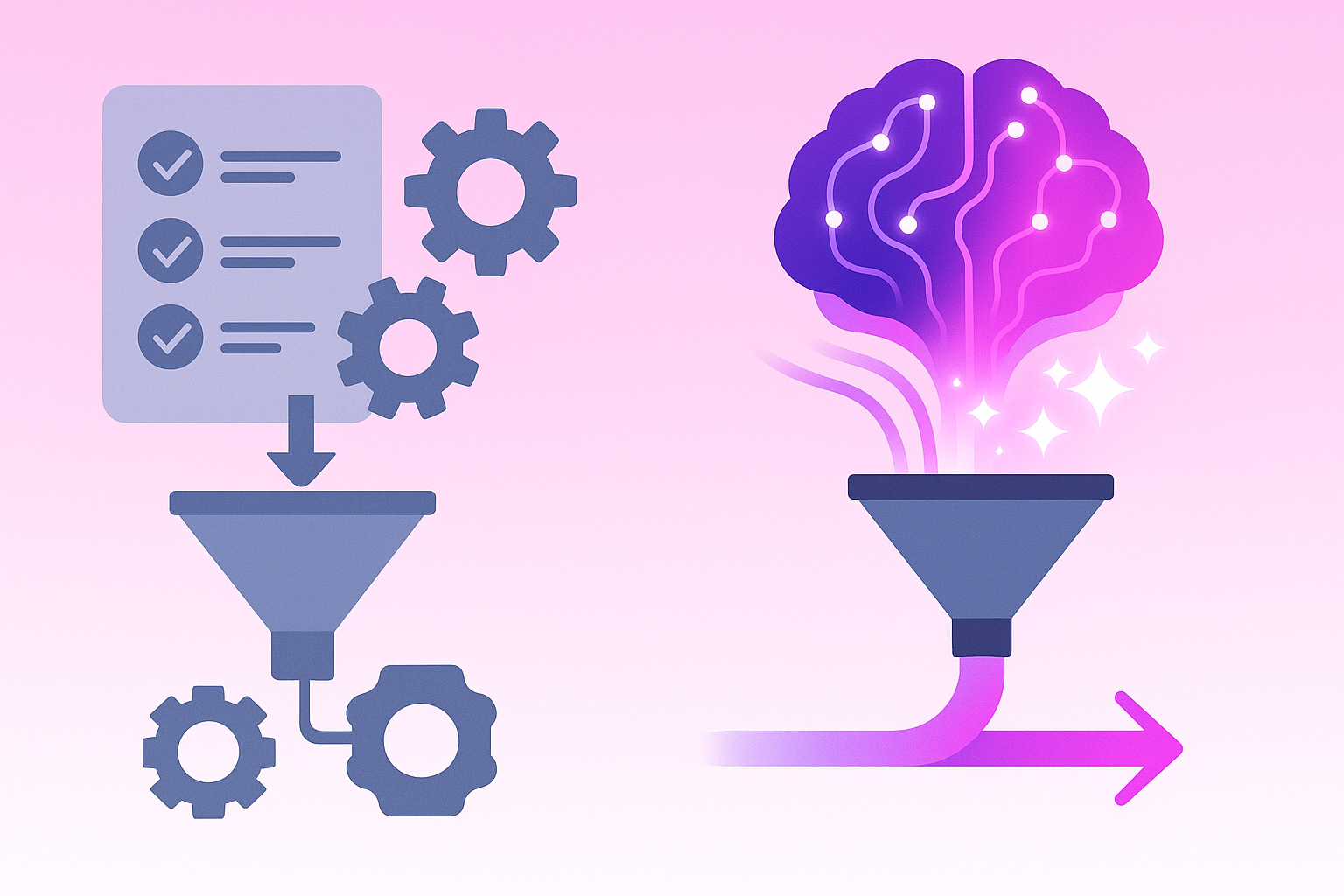
How Does AI-Based Lead Scoring Prioritize Website Visitors?
Lead prioritization is a critical task for B2B organizations because it allows them to allocate resources more effectively, focus their sales force on the most viable opportunities, and optimize time spent qualifying leads.
Traditional vs. Predictive Models
Lead scoring models fall into two segments: traditional models based on manual rules and predictive models that rely on historical data for pattern identification. Modern AI-powered scoring far outperforms rule-based approaches.
Recent research demonstrates the gap. One B2B software company analyzed lead data from January 2020 to April 2024 using fifteen classification algorithms. The Gradient Boosting Classifier showed superior performance, significantly improving the company's ability to identify high-quality leads compared to traditional methods.
AI-driven platforms like Scrapus demonstrate what is possible: approximately 90% precision and recall in lead qualification, with a roughly 3x higher relevant lead yield from web crawling due to reinforcement learning.
Behavioral Scoring Signals
Effective scoring systems identify critical behavioral signals that indicate buyer intent and readiness by setting up behavioral analytics that track interactions and define scoring thresholds signifying purchase intent. High-value signals include:
• Pricing page visits
• Demo or trial page engagement
• Multiple sessions within a short window
• Content downloads aligned with late-stage buying
What Does Real-Time Orchestration in the CRM Look Like?
Modern visitor intelligence goes beyond scoring to orchestrate real-time engagement. This is where identification data meets automated action.
Salesforce Data Cloud consolidates customer data from countless touchpoints into living, breathing profiles that update in real-time. Agentforce then interprets digital cues and identifies optimal moments for customer interaction, enabling predictive and proactive engagement.
In practice, this means:
1. Dynamic routing: Visitor identified, scored, and routed to the right rep within seconds
2. Intent-based triggers: High-scoring accounts automatically added to outreach sequences
This transforms visitor intelligence from passive reporting into an active pipeline engine.
Top B2B Use Cases: From ABM to Pipeline Generation
Visitor intelligence powers multiple revenue motions:
Account-Based Marketing
ABM has evolved into a dynamic, intent-driven strategy. By adopting intent-driven ABM, one company achieved a 215% increase in qualified opportunities and a 67% reduction in sales cycles.
Warmly customers report similar results. Sam Few, VP Sales & Marketing, shared: "Being able to have our account executives use Warmly to source warm leads on the website helped our pipeline grow over 60% in a quarter."
Sales-Marketing Alignment
Sales and marketing misalignment results in wasted efforts and resources, creating inefficiency in pipeline-generating functions. Visitor intelligence creates a shared view of high-intent accounts.
When both teams work from the same data, marketing can focus ad spend on accounts showing intent while sales prioritizes outreach to visitors engaging with key pages. Your pipeline-generation strategy must foster collaboration between sales and marketing to increase pipeline volume and quality.
Outbound Personalization
Visitor data transforms cold outreach into warm engagement. When a rep knows a prospect just viewed the pricing page, the conversation changes entirely. Teams can trigger automated playbooks that find key stakeholders at surging accounts and enroll them in custom persona-based sequences via email and LinkedIn.
What Metrics Prove Visitor Intelligence ROI?
Measuring visitor intelligence impact requires tracking multiple dimensions:
De-Anonymization Rates
The foundation metric is identification coverage. On average Warmly de-anonymizes 15% of individuals and 65% of companies visiting your site. Different platforms show varying rates:
| Metric |
Benchmark Range |
| Company identification |
40-65% |
| Contact identification |
10-15% |
| Accuracy rate |
Varies by provider |
As one analysis noted, accuracy rates remain low across services, making it important to evaluate providers carefully and use confidence scores to filter results.
Conversion and Pipeline Impact
The downstream metrics matter most. Companies using intent-driven strategies see dramatic improvements:
• Sales cycles are reduced by 3.2 times
• Customer acquisition costs drop by 65%
Visitor intelligence also impacts qualification speed. Ashley T. Atlee, VP Sales, captures this well: "Engaging prospects who are researching us, live on our website, is game changing. We're able to qualify 10x faster and convert far more sales qualified leads than ever before."
Leading Indicators
In a Gartner survey, nearly half of CSOs indicated that their mission-critical initiative is accelerating early pipeline and lead generation, while marketing leaders ranked marketing-qualified and sales-qualified leads among their most important metrics.
Track these leading indicators to gauge visitor intelligence effectiveness:
• Website-sourced MQLs and SQLs
• Speed to engagement for identified accounts
• Intent signal volume from target accounts
• Rep adoption of visitor intelligence data
Putting Visitor Intelligence to Work Today
Visitor intelligence transforms the 97% of anonymous website traffic into actionable pipeline. The technology has matured, the data layers are rich, and AI-powered scoring ensures reps focus on the accounts most likely to convert.
To get started:
1. Audit your current visibility: What percentage of visitors can you identify today?
2. Define your ICP criteria: Ensure firmographic and intent filters align with your target market
3. Map engagement workflows: Plan how identified visitors flow to sales for follow-up
4. Measure baseline metrics: Establish current conversion rates before implementation
Warmly is a leading visitor identification and intent intelligence platform used by B2B sales teams to uncover anonymous website traffic, identify high-intent accounts, and automate outbound personalization to drive more pipeline. For teams ready to turn website visitors into revenue, Warmly offers the identification coverage, intent signals, and orchestration capabilities needed to compete in 2026.
Frequently Asked Questions
What is visitor intelligence?
Visitor intelligence is a method that reveals who is visiting your website and what they are interested in by using firmographic data, on-site behavior, and third-party intent signals. It helps B2B sales teams identify high-intent accounts and automate personalized outreach.
Why is visitor intelligence important for B2B sales teams?
Visitor intelligence is crucial because it helps B2B sales teams uncover anonymous website traffic, identify high-intent accounts, and automate outbound personalization. This is essential as 97% of buyers never fill out a form, leaving most website visitors invisible without such intelligence.
How does visitor intelligence work?
Visitor intelligence works by combining firmographic, behavioral, and intent data to create actionable profiles of website visitors. This involves using methods like cookies, IP address intelligence, and de-anonymization script tags to identify and track visitor activity.
What are the benefits of using AI-based lead scoring in visitor intelligence?
AI-based lead scoring prioritizes website visitors by analyzing behavioral signals and predicting purchase intent. This allows sales teams to focus on the most viable opportunities, improving lead qualification speed and conversion rates significantly.
How does Warmly help B2B sales teams with visitor intelligence?
Warmly provides a platform that identifies anonymous website traffic, highlights high-intent accounts, and automates outbound personalization. It offers comprehensive identification coverage and intent signals, helping sales teams turn website visitors into revenue.
Sources