Val Yermakova is a co-founder at Warmly, where she focuses on product and design. With a background in UX and product design for B2B SaaS, Val helps shape the user experience across Warmly's platform. She writes about product design, data visualization, and building intuitive B2B tools.
Articles
Showing 0 of 0 items
Category
Resources
Resources
Resources
Resources
Startup Sales: A Founder’s Comprehensive Guide To Building A Repeatable Go-To-Market Motion (2026)
We recently raised an $11 million Series A led by Felicis, helping us continue the momentum into 2026.
Introduction to Warmly's Success Story
It wasn’t all up and to the right even if it might look that way from the outside (founders getting awarded Forbes 30 under 30, participating in both Y Combinator and Techstars).
Warmly was founded in 2019 (yes, you heard that right) and our initial product was a virtual name tag for Zoom. While the original product won accolades (like this PLG123 video) and was a Zoom Apps launch partner, ultimately we struggled to sell it. We had a second major product pivot as well before focusing on the current iteration during the second half of 2022.
Because we already had another product in-market, we built the sales orchestration platform in stealth for six months before sharing it publicly. This new product gets customers warm leads by de-anonymizing website traffic and then automatically following up with visitors via chat, video, email, or LinkedIn. This helps customers generate 10x more outbound leads than a traditional SDR while seeing 3x higher close rates because these are warm leads rather than cold ones.
Keep reading for our color commentary on how we built a repeatable go-to-market motion in 12 months and what we learned along the way.
Q1 2023: Founder-led sales
👨👩👧👦 Customers: 0 → 10
⚡️ GTM strategy: Design partners and founder friends
📈 Key experiment: Messaging
❓ Key questions:
(1) Can we sell Warmly at any price point?
(2) Can I stand up a basic funnel?
(3) Can I find the 10 most common objections and solve them?
Entering Q1, “everything but sales were already in place,” and so I could spend the majority of his time scaling go-to-market.
Our main initial experiment was on Warmly’s messaging. I needed the words for a sales person to be able to talk about what we were doing. Since we had previously built a solution that was different from the problems that customers were trying to solve, I was particularly keen to avoid making that mistake again.
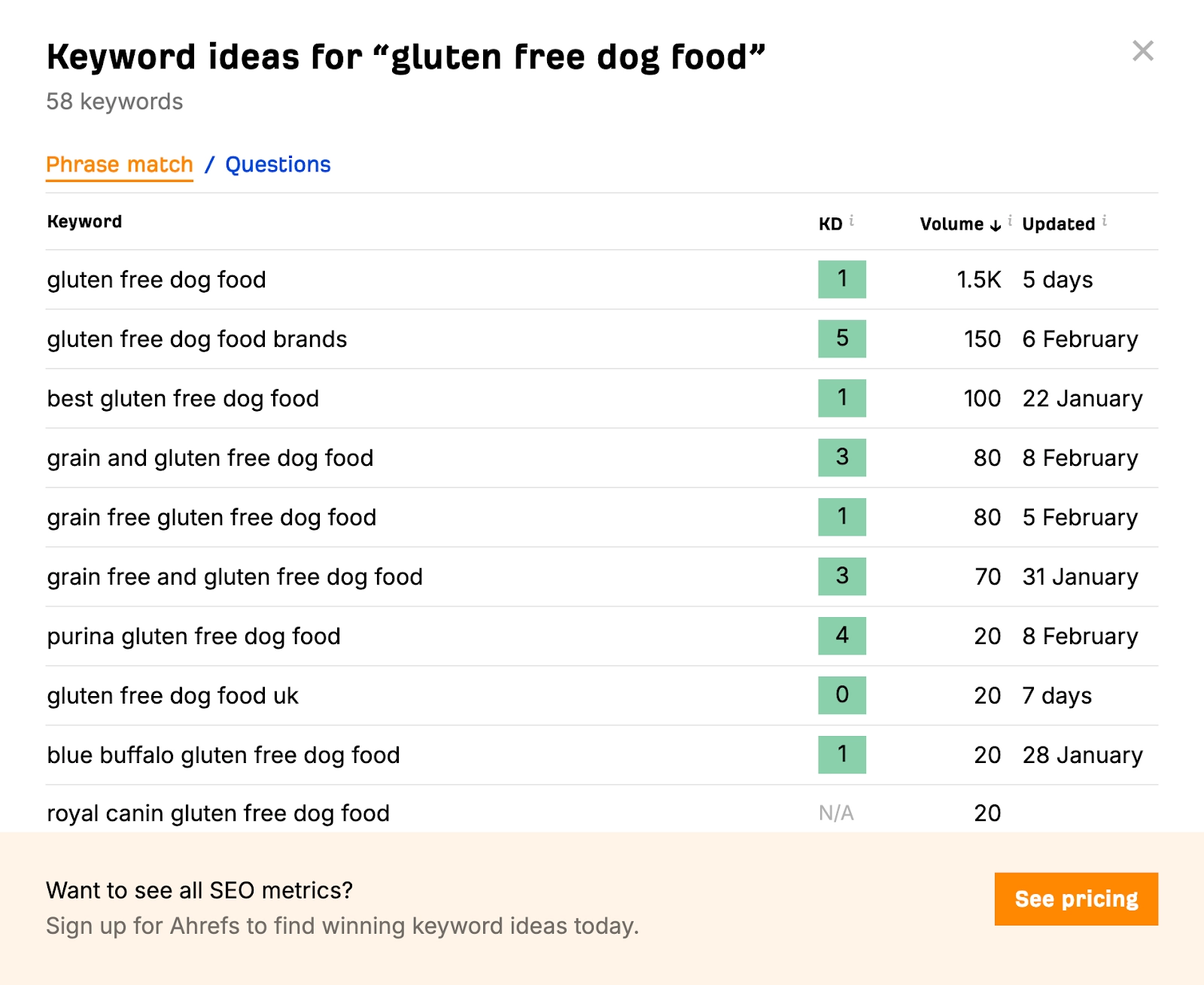
I began by looking at SEO rankings and researching what others in the space called themselves. One tactic is to go to every competitors’ website, write down all of the words on their homepages, and then build a word cloud around it. “Competitors spend five to six years figuring out how messaging works so why reinvent the wheel?”
One of my early email outreach messages
There were a bunch of category and message variations in Warmly’s market (ex: account-based marketing, contact databases, intent data). I tested some of these messages with potential design partners, allowing him to find out what competitors got wrong and what we got right. I then tested a message focused on a live video caller Slackbot that would capture people before we leave the website. That failed to land – people instead wanted outreach to be done for them in an automated way and done across multiple channels rather than just video chat.
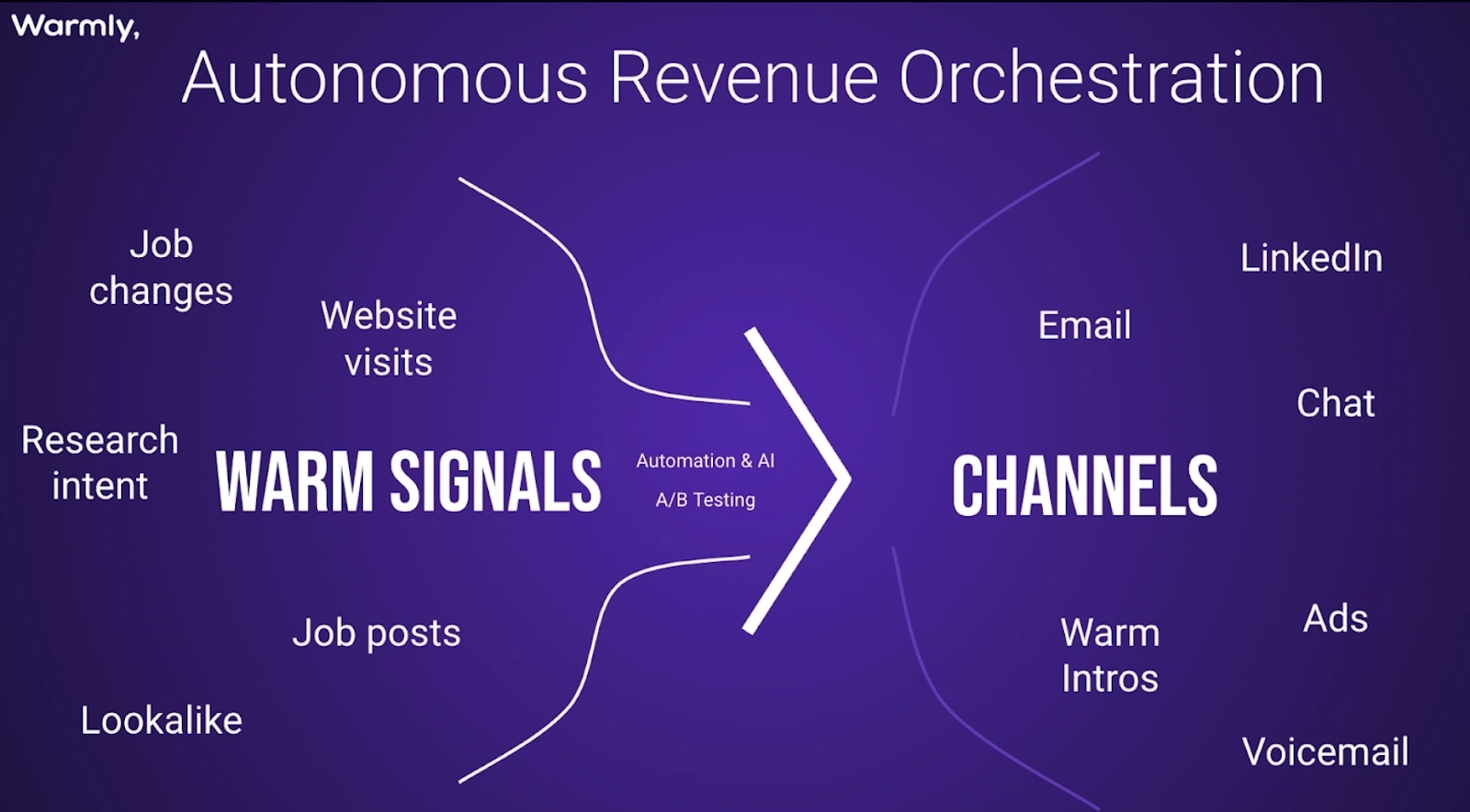
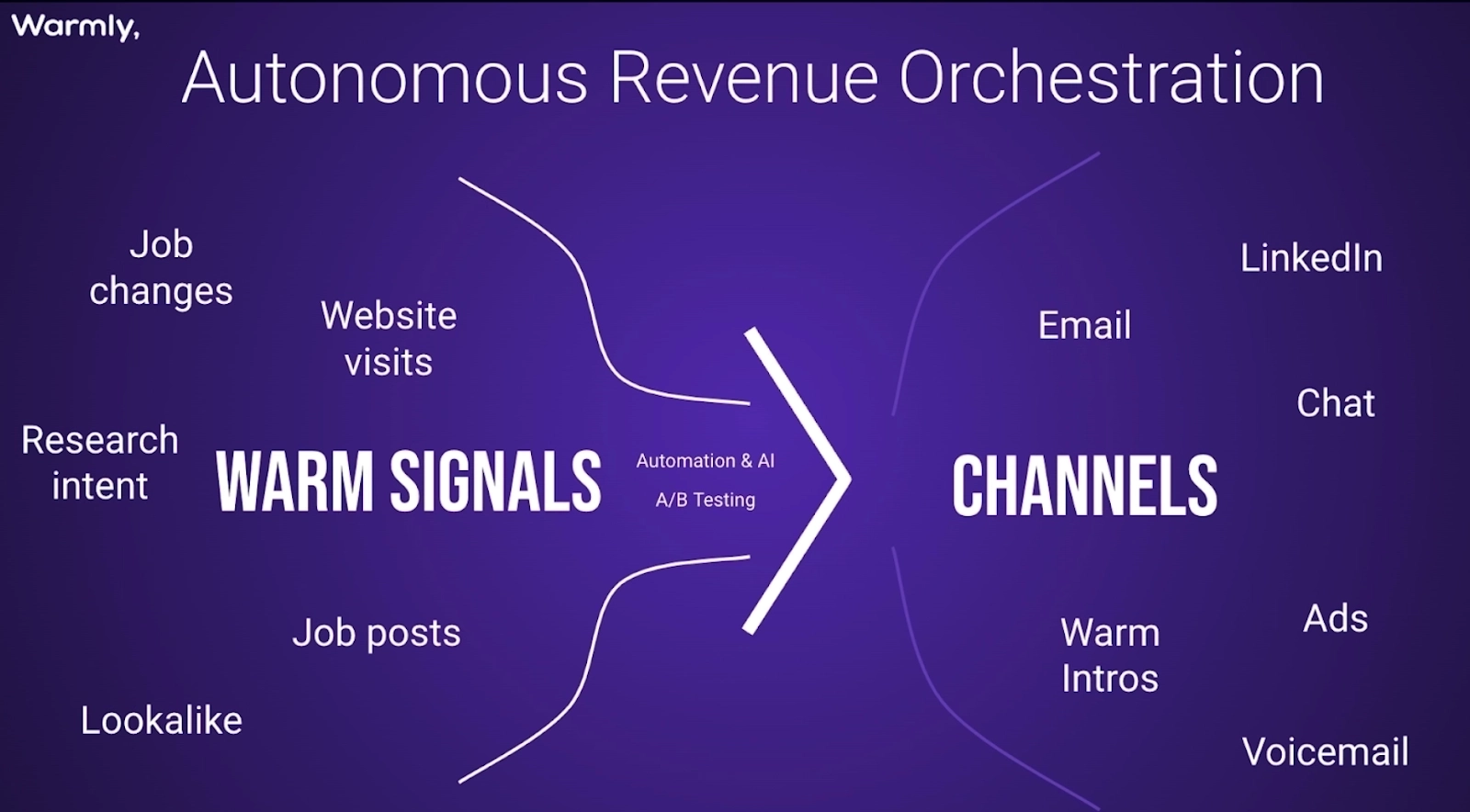
We landed on signal-based revenue orchestration, which captured what customers were trying to do and was meaningfully different from what competitors talked about. The simplified message was that Warmly helped you “get warm leads and talk to them live.” We could tell that it was working because prospects were nodding their head along and would say “here’s how I see that being used here”. (As an aside, I thought about AI sales orchestration, but found that people were sick of AI as a marketing message.)
I knew that Warmly's messaging wouldn't be completely solved in only a quarter. We were able to specifically tackle (a) what kinds of other tools did people have?, (b) what’s the category that we operate in?, (c) what phrases will get people to join a demo?, and (d) what phrases were other people using?
Another priority for Q1 was to set up a basic sales funnel.
Can I see that if I talk to roughly 10 people, one will close? If I talk to 20 people, will two close?
I had heard general benchmarks about having 5x coverage; that is, for every five qualified conversations, you close one deal. As a founder, I didn’t worry about hitting these exact benchmarks early on because he knew he was talking to “the most random people who weren’t in our ICP” and therefore would never buy. My bigger concern was the close rate among qualified prospects and finding out who was in Warmly’s ICP.
As a product with a $10-15k average annual contract value (ACV), I was looking to see that these deals could be closed in only a few meetings and with a 30-45 day sales cycle. Seeing positive signals, he was ready to scale the magic.
A snapshot of Warmly’s funnel stages for their outbound pipeline (we have separate pipelines for freemium, midmarket, and inbound)
After starting to prove out founder-led selling, I chose to recruit a sales leader and then hire sellers after that. This would've extended our go-to-market progress by a quarter if not for the fact that our early sales hires used to work at the same company as this new sales leader. If we had to recruit, ramp up, and train new sellers – particularly sellers who might not have been effective – it would’ve taken much longer.
I emphasized that I wasn’t looking for a sales leader from a really big, later stage company. It was important to me that the sales leader be scrappy, hungry, entrepreneurial, and experienced – but not someone who’s done it twenty times. If I couldn’t find someone like that, I believed that the safer path for Warmly would’ve been:
Founder-led sales first
Then hire a BDR/SDR to scale the founder
Bring on the first AE to report to me
Once that’s successful, hire a second AE
Then, hire a sales leader
My big experiment for the quarter was LinkedIn sequencing as a source of qualified pipeline. I had heard from other go-to-market leaders that email wasn’t working as well as it used to and that LinkedIn sequencing was still effective.
My co-founder Alan, Warmly’s SDR leader, and I adopted LinkedElf and Salesflow to max out our LinkedIn connections, adding 100 sales and marketing leader connections every week on auto-pilot. Then we wanted to do messaging on auto-pilot, too. We were able to send out 300 connection requests a week, seeing about half of them accept, and then one-eighth of them reply (half of which would be positive replies, the other half not so much…). Collectively, we were able to book about 10-15 meetings per week just from conversations on LinkedIn – and found a channel that we could continue to grow Warmly’s pool of leads.
A refined version of Warmly’s messaging now that we have more customer validation
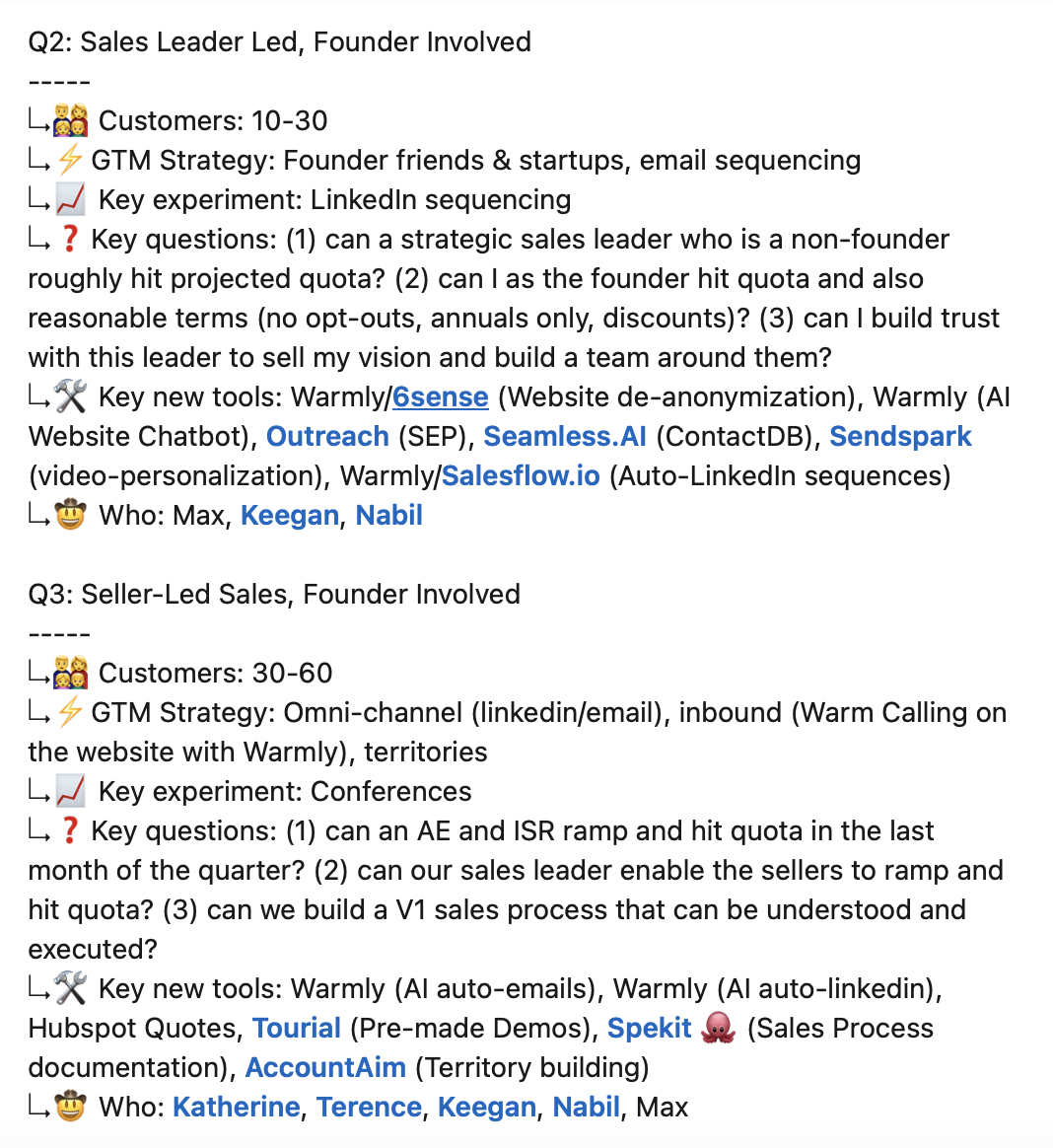
Q3 2023: Seller-led sales, founder involved
👨👩👧👦 Customers: 30 → 60
⚡️ GTM strategy: Omni-channel (Linkedin/email), inbound (warm calling on the website with Warmly), territories
📈 Key experiment: Conferences
❓ Key questions:
(1) Can an AE and ISR ramp and hit quota in the last month of the quarter?
(2) Can our sales leader enable the sellers to ramp and hit quota?
(3) Can we build a V1 sales process that can be understood and executed?
At this point, our new sales leader and I needed to quickly build out the go-to-market team. First, we made a financial model to check whether the math would work out. If you’re not reconciling your quota against your financial model, you’re screwed. The financial model allowed our team to see things like:
When is the next milestone we need to fit for fundraising?
How do we get there without being cash-out?
If Warmly had these milestones, how many reps do we need and when do we need to hire them?
What would quota have to be in order for all of this to work out?
While in the past mature SaaS companies might’ve aimed for a 5x quota to on-target earnings (OTE) ratio, I didn’t believe that was realistic given the current buying environment and given that our sellers would need to source some of their own leads. We instead aimed for a 3x quota:OTE ratio and a 50/50 split between base and OTE commission, which would fit Warmly’s financial model and allow us to attract the right caliber seller. (As an aside, I encourage others to pay a higher salary-to-commission ratio in the early days so you don’t lose talent while you’re figuring out what’s working and what’s not working.)
Here’s what the team structure ultimately looked like:
Sales leader (KPI = overall revenue that was sales-sourced / sales-closed)
Account executives, i.e. AEs (KPI = closed-won revenue)
Inbound sales reps, i.e. ISRs (KPI = closed-won revenue for very small deals and qualified opportunities among inbound demo requests)
At Warmly, the ISR role creates a path for SDRs to get promoted; ISRs can advance to AEs if they consistently hit quota
In Q3, we bet on attending conferences to diversify pipeline generation beyond LinkedIn, greenlighting five conferences for the quarter. For each conference, our sales leader Keegan Otter would attend with one sales rep. We decided not to buy a booth for any of them; rather, we simply went, were friendly, and tried to meet as many attendees as we could.
Three of the five events turned out to be successes; two were not, including Dreamforce which was both extremely large and lacked buyers in our ICP. Overall, the conferences generated more money in closed won sales than it cost for us to attend. But there were drawbacks. For example, I found that there were tons of meetings booked from conferences, but also a spike in demo no-shows. And it was draining for the team to be on the road for five events over the course of only six weeks.
Reflecting on the quarter, I believe that most companies find three to four channels that work for them. It’s important to try all the channels early on, then get laser focused and double down on the ones that work. Conferences were a ‘tweener’ – we needed to keep iterating.
Q4 2023: Seller-led and sales leader run
👨👩👧👦 Customers: 60 → 100+
⚡️ GTM strategy: No change from Q3 (repeatability!), just optimization
📈 Key experiments: LinkedIn social to drive inbound, PLG
❓ Key questions:
(1) Can I as the founder step away from closing altogether?
(2) Can the sellers hit quota each month across the quarter?
(3) Can we find repeatability in our core metrics (meetings held, SQOs, closed/won) and rates?
By Q4, Warmly’s go-to-market started to look more and more repeatable. My focus turned to optimization.
We bet on product-led growth (PLG), which Warmly had gotten good at during a previous pivot and hadn’t yet applied to the current product. Unlike the Zoom name tag product, the sales orchestration platform involves extra friction for self-service adoption – users have to install a script on their website.
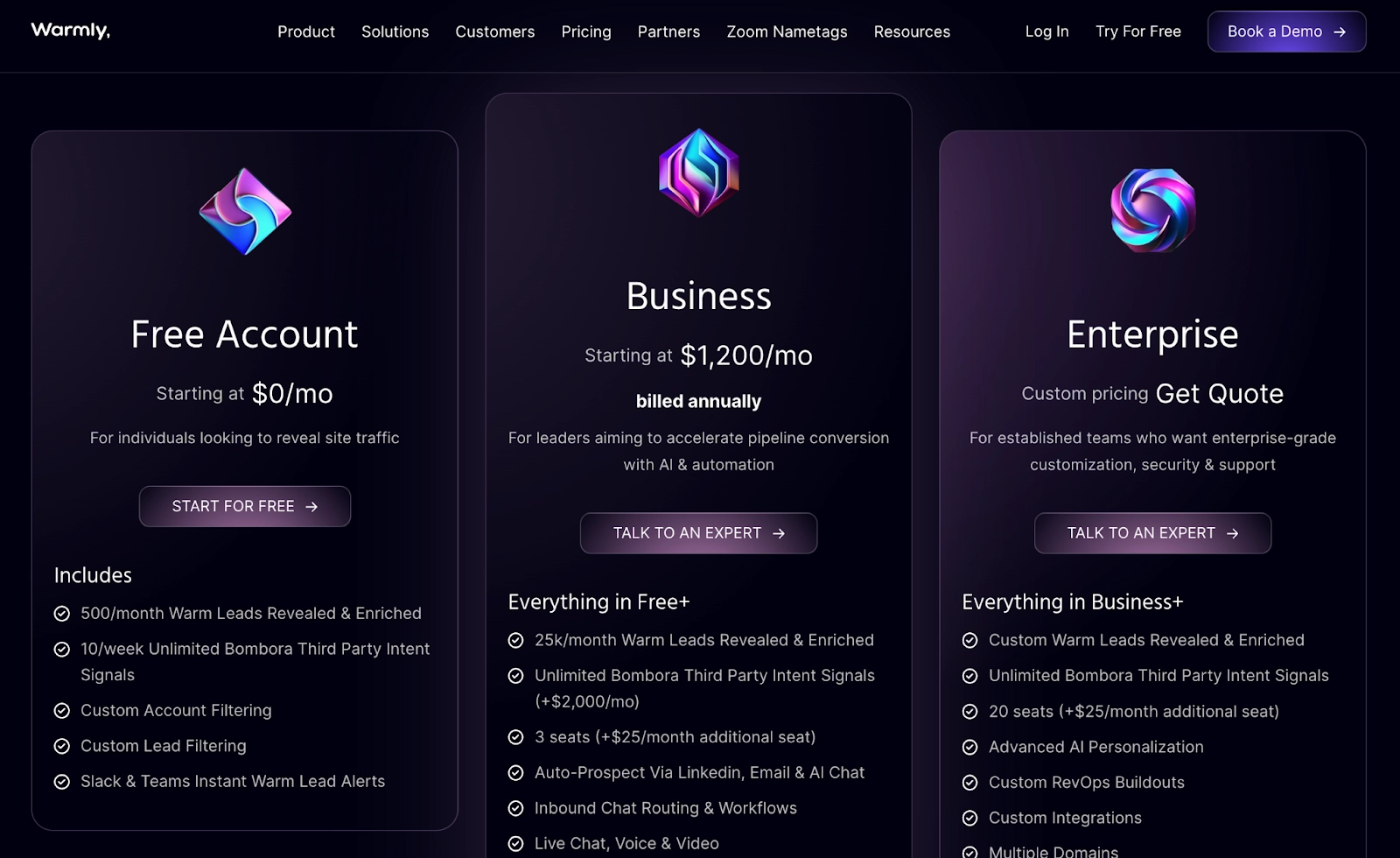
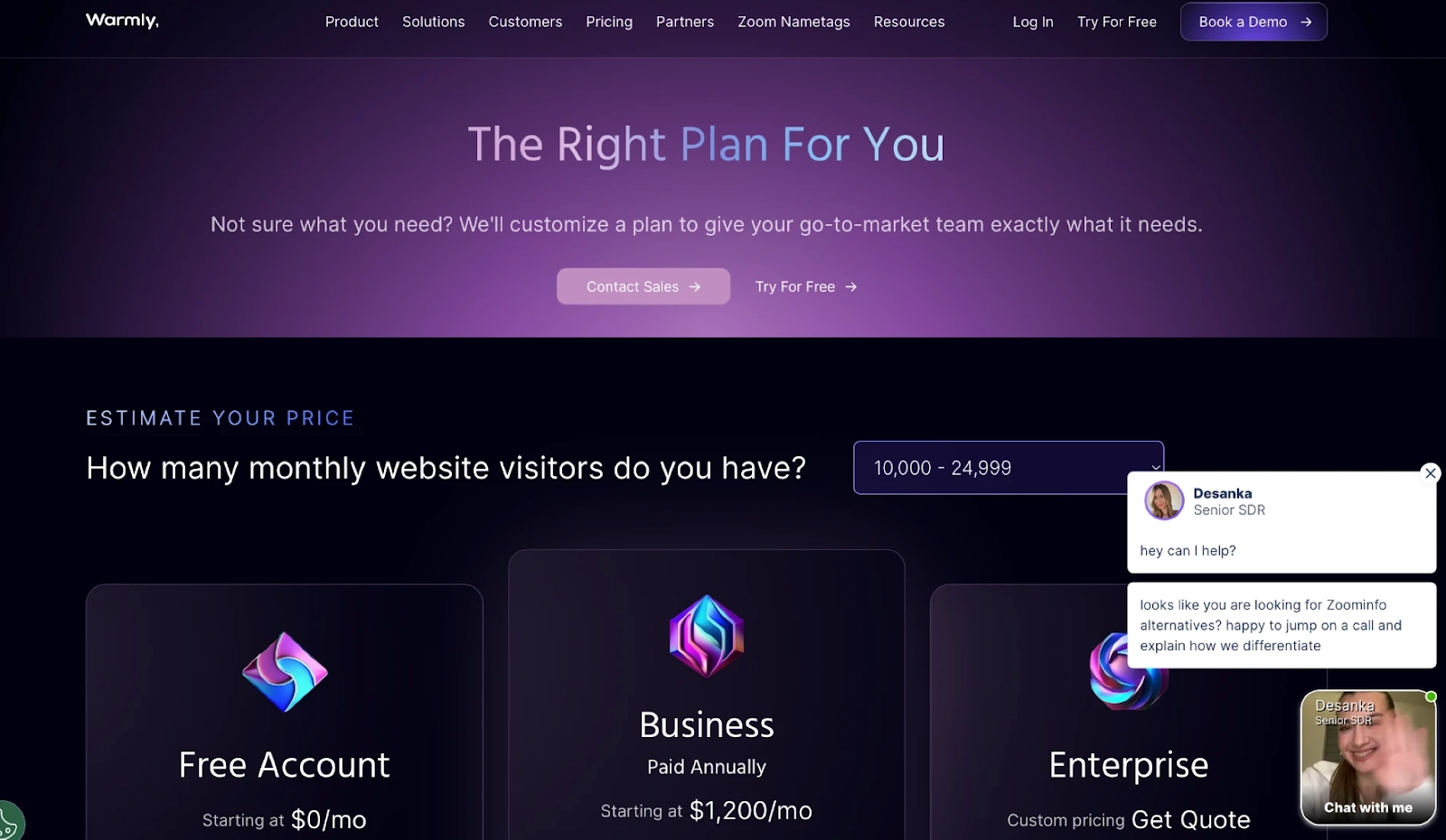
Warmly’s pricing page includes a free account for smaller customers
We got creative with the free offering, designing it to be an on-ramp to Warmly’s core product rather than a replacement. Free users would get access to up to 500 free warm leads each month along with intent signals and alerts about those leads. If users then want automation to act on those leads, that’s when they'd have to pay for it. There have now been over 1,000 installs of our PLG offering and we're still early in optimizing free-to-paid conversion.
Two key learnings that made PLG different this time around:
PLG became an acquisition strategy for a more valuable product. Before the pivot, we built a great product but people weren’t willing to pay for it. This time we validated that we could sell it before investing in PLG.
PLG helps segment Warmly’s prospects. We thought if we had both ‘book a demo’ and ‘try for free’ on the website, everyone would click ‘try for free’. It turns out that companies with less than 50 people naturally sign up for free while companies with more than 50 request a demo. That’s what we wanted.
Reflecting on the last 12 months – and what comes next
First tip: your CRM setup is critical (we chose HubSpot). At first I was very anti having a bunch of form-fills and I understand why reps hate updating a CRM, but the better you can do this in the early stage, the better. I would recommend five fields to always fill out:
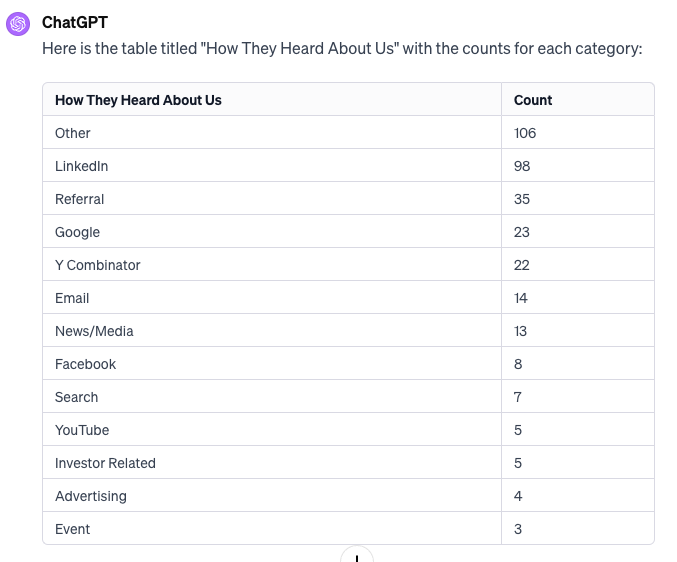
How did we hear about us?
How was the meeting booked? (Get really specific – Warmly has 20 sub-channels – because that will tell you what channel to double down on.)
If you closed-won or closed-lost to a competitor, which one?
Who was the associated AE?
Who was the associated SDR? (An associated SDR might be the same person as the AE if your AE’s are full-cycle.)
The beauty of CRM reporting when you have good data (the actual numbers have been anonymized)
Second: clean deals are better. The sooner you can get away from month-to-month, opt-out, weird deal terms, do it. It becomes a big headache for CSMs and for managing how you pay out reps.
Third: pay out your sales leader on a percentage of overall revenue that was sales-sourced and sales-closed (i.e. everything except for deals that are founder-sourced and closed). I don’t give commission out on deals that I find and close on my own as a founder. But any deal where an AE is involved or an SDR is involved, the sales leader gets a commission on overall revenue to align incentives.
Fourth, and finally: you and your sales leader should stay accountable for closing deals on your own. I still try to self-source and close three deals a month and my sales leader does, too. You have to be so close to the process and find issues with it before taking a step back.
Frequently Asked Questions
What is the best way to startup sales: a founder’s comprehensive to building a repeatable go-to-market motion (2026)?
The best approach depends on your specific situation. Follow the step-by-step guide above for proven methods. Key success factors include proper setup, consistent execution, and measuring results.
How long does it take to startup sales: a founder’s comprehensive to building a repeatable go-to-market motion (2026)?
Timeline varies based on complexity and resources. Simple implementations take days, while comprehensive strategies may take weeks to fully execute. Start with quick wins outlined above.
What tools do I need to startup sales: a founder’s comprehensive to building a repeatable go-to-market motion (2026)?
Essential tools are covered in the guide above. For B2B sales teams, Warmly can help by identifying website visitors and providing intent signals to prioritize your efforts.
What are common mistakes when trying to startup sales: a founder’s comprehensive to building a repeatable go-to-market motion (2026)?
Common pitfalls include moving too fast without proper setup, not measuring results, and using outdated tactics. Follow the best practices above to avoid these issues.
Can I automate this process?
Many aspects can be automated with the right tools. Warmly offers automation for website visitor identification and engagement. See the tools section above for automation options.
9 6sense Competitors You're Probably Looking At (2023)
Time to read
Alan Zhao
When it comes to account-based marketing software solutions, few come to mind as often as 6sense.
Their account intelligence data is best-in-class, and they’ve got an ecosystem of complementary features to support enterprise-level ABM plays.
They're the current leader in the space.
But good things don’t come cheap,.
For companies who don’t have the budget or need for the complexity that the 6sense platform offers, we wanted to list a few solid alternatives people typically consider.
We’re going to look at 9 nine of them in this guide to help you run an ABM playbook.
A Quick 101 Class On Account-Based Marketing (ABM)
All of the tools we will discuss here are aimed at teams running account-based marketing plays, but a few come at it from different angles.
So, before we dive into our nine 6sense competitors, it's a smart idea to take a quick step back and understand the ABM software landscape as a whole.
Account-Based Marketing In A Nutshell
Account-based marketing is a practice that’s been around for a few years now. Demandbase (the first competitor on our list) was an early proponent of the term and approach.
The idea is that before you run any sales or marketing playbooks, you first develop a list of highly qualified, high-value accounts you’d like to target.
You determine your ICP (ideal company profile), research companies that fit it, and build out your data around that so you can create highly personalized and super-targeted outreach based on the stage of the account's buyer journey.
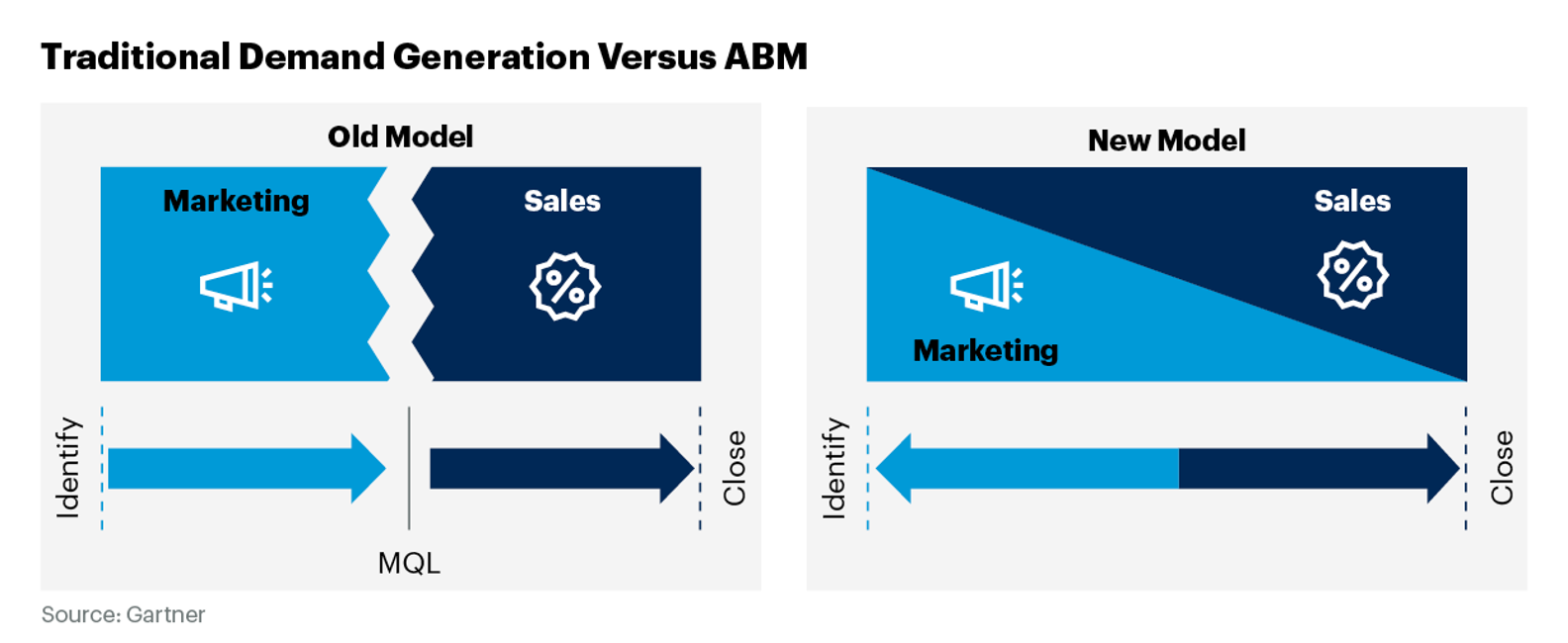
This is in contrast to the typical funnel, which sees marketers targeting “ideal customers” more broadly, capturing leads and nurturing them, then passing them on to the sales team to qualify, present, and close.
ABM is more costly from a CAC perspective and is usually reserved for targeting high-ticket enterprise organizations, where the deal size is large enough to justify a huge CAC.
The Role Of Software In Account-Based Marketing
As the account-based approach developed legs, two software needs emerged:
Marketing and advertising - A solution for orchestrating marketing activities like personalized advertising.
Sales intelligence data - Firmographic data on target companies, buying committee identification, and purchase intent signals.
The companies on this list of 6sense competitors basically came up on one of these two paths.
Brands like Demandbase and Terminus built their names on ad-based marketing workflows, whereas the likes of ZoomInfo and Clearbit built best-in-class data platforms to enable sales teams.
This division worked well in the 2010s when budgets for SaaS were huge, and software buyers favored best-in-class over all-in-one. The tide has changed from a SaaS buying perspective, however. Pursestrings are tightening, and buyers are looking to consolidate spending.
Couple this with the fact that ABM is now an established playbook (rather than a niche approach), and you’re seeing the two lanes merge into singular solutions.
Moreover, contact data has become commoditized, so the companies that took this route are looking for ways to continue growing net revenue retention (NRR) in a saturated market.
That’s why we’re seeing companies like ZoomInfo expand its feature set through strategic acquisitions, such as its purchase of Clickagy to add intent signaling to its offering.
The Issue With Account-Based Marketing Software Today
Account-based marketing software has become incredibly sophisticated.
Solutions like 6sense, Demandbase, and ZoomInfo all offer one-stop-shop solutions with best-in-class contact data as well as powerful sales and marketing orchestration.
Naturally, these companies have shifted upmarket in terms of sales targeting, taking advantage of increased demand:
Today’s ABM suites, then, are largely out of reach of small businesses and even some mid-market organizations.
They’re also incredibly complex, which is perfect for enterprise companies with large sales forces who are ready to run. But they’re often overkill for SMBs who just need to start walking first.
For that, some powerful AI-driven solutions have begun to emerge, offering a “crawl then walk” approach with a price tag to suit.
Warmly, for example, combines best-in-class data and de-anonymization and intent signals from sources like 6sense and Bombora with automated personalized action, helping you scale an AI SDR army without emptying the GTM warchest.
1. Demandbase - Best For Identifying Buying Groups
Demandbase is one of the longest-standing ABM platforms around.
While they didn’t quite coin the term, they were certainly one of the first go-to-market tools rallying around the idea of account-based selling and marketing.
Now that everyone else has jumped on the ABM train, they’ve shifted messaging to be around ABX (account-based experience), which places a greater emphasis on long-term relationships with customers and the broader revenue team (sales, marketing, customer success).
As their CMO, Jon Miller, puts it:
“It's more than a marketing tool; it's a business decision tool. You can use the data to make real-time decisions on your marketing and your sales processes.”
Why Consider Demandbase As An Alternative To 6sense?
At the high level, what Demandbase is trying to accomplish is fairly similar to 6sense’s mission:
Identify ideal accounts > enrich with firmographic data and buying intent signals > execute account-based playbooks via ads, sales outreach, etc.
They have a couple of standout features, though:
Buying Group AI: Demandbase finds the buying committee of contacts with AI so you can focus your attention on just them and allocate remaining resources elsewhere. Contact data is automatically synced to your CRM.
B2B ad capabilities: Demandbase has a demand-side platform (DSP) with some powerful people-based advertising tools to help GTM teams supplement sales outreach with personalized ads (social as well as display ads). When combined with the Buying Group AI feature, Demandbase can prioritize and target demand unit members using specific identifiers like names and emails.
Where Demandbase Falls Short
Demandbase, like 6sense (and most other ABM tools), serves the higher end of the market with real budget to deploy.
For example, an important feature is Demandbase’s B2B advertising, something that most smaller SMBs don’t even engage in.
It’s also quite expensive in and of itself, and while it does allow you to pick and choose modules from an “a la carte” menu, you’re looking at at least six figures to build out a full ABM motion.
Demandbase Pricing
Demandbase sets prices individually for each company, which is pretty much how things are done for software solutions in this category.
ZoomInfo offers a neatly organized suite of software platforms for GTM teams, spanning:
Marketing
Sales
Operations
HR
Why Consider ZoomInfo As An Alternative To 6sense?
ZoomInfo came up on the back of their best-in-class contact and company data.
That’s the core of their product offering, and they’ve developed into a GTM suite from there (mostly through acquisitions) as a way of expanding their offering and driving up ACV.
Standout features include:
A decent chatbot with solid “if/then” workflows
Conversation intelligence (think Gong)
A demand-side platform for running ABM ads
The biggest win with ZoomInfo here is that you can start out with just one module, and then when you decide to include another GTM-related product, you can just buy from the same supplier, avoiding the need to stitch together multiple tools.
For instance, you might start out with their SalesOS for things like contact data and sales automation. Then, as your ABM motion grows, you might integrate the MarketingOS to pick up advertising and chat features.
Where ZoomInfo Falls Short
Other than pricing (which is, again, prohibitive to most SMBs), there are a couple of small drawbacks to using ZoomInfo as a 6sense competitor.
Unlike Hubspot, which built all their offerings internally and had few integrations, a large chunk of their ZoomInfo's set beyond contact data came through acquisitions, as they’ve trained to keep increasing ACV.
As such, these acquisitions will need more time to bake in for the data to be fully integrated across all their systems, and since they don’t really have a “core focus,” they have begun to lose ground on being the expert at any one thing.
Their chat feature isn't quite as integrated into Salesforce as Qualified's or as AI-focused as Drift's or Warmly's. This stems from trying to cover too much surface area simultaneously via acquisition.
ZoomInfo Pricing
Like Demandbase, you have to speak with a sales rep to get any kind of pricing info.
You’re looking at ~$40k to get up to speed with workflows alone, however.
Terminus can, for the most part, be thrown into the same bucket as 6sense and Demandbase as far as what they’re trying to achieve.
They, too, are an account-based GTM platform, specifically targeting the higher end of the market with large budgets to deploy.
Why Consider Terminus As An Alternative To 6sense?
Where Terminus differs from other solutions is that they’re mostly focused on the marketing use case.
Features like targeted advertising, customized website experiences, and automated chatbots are all driven by a combination of first and third-party data.
Being so focused on marketing activities, their ad offering is pretty strong, with support for display advertising, retargeting, social media ads, and even audio advertising.
You can even include ads in your outbound emails with personalized dynamic signatures.
Where Terminus Falls Short
Whenever a platform focuses on one specific use case, the obvious drawback is that it becomes less suitable for others.
As such, most of where Terminus fails to stack up against competitors like 6sense and Demandbase is around the sales use case:
The sales workflows aren’t as robust as the likes of ZoomInfo or 6sense
The chatbot is more automated (like Drift) vs./ a human experience (like Warmly or Qualified)
Some sales engagement stuff exists, but the solution still feels like it doesn't close the loop between ABM and ABS (account-based selling) in the same way that competitors do
Terminus Pricing
While Terminus doesn’t outwardly advertise pricing, we’ve heard anecdotally that they cost a little less than 6sense (though, of course, they are less fully featured).
While Demandbase, ZoomInfo, and Terminus are the main 6sense competitors from the perspective of feature overlap, there are a number of other tools around that take a slightly different approach and are still suitable for use within an ABM motion.
Drift is the quintessential automated website chatbot (or conversational marketing tool).
Why Consider Drift As An Alternative To 6sense?
Drift is designed for high-volume traffic websites (so enterprise-facing) that can convert a percentage of visitors to leads using automated chat plays.
At this, it excels.
It has started leaning into AI-powered bots (though there are other more advanced Drift alternatives for that) and some sales-focused features like the automated booking of meetings and personalized videos that can be sent via email, chat, and LinkedIn.
These features are useful but not Drift’s main use case.
Where Drift Falls Short
Drift is clearly less fully featured than many of the other 6sense competitors mentioned here. A few drawbacks include:
Was a bit late to CRM integrations (initially took the stand-alone approach)
No human involvement (its a high-volume, low-touch play)
Reactive rather than proactive chat
Drift Pricing
Drift isn’t cheap, with plans starting at $30k a year and increasingly quickly from there for more advanced feature sets.
Clearbit is another slightly different alternative to 6sense.
While it does offer some sales and marketing-related playbooks, it's much more focused on high-quality sales intelligence.
Side note: Clearbit was recently acquired by HubSpot, which promises to be a powerful partnership (and aligns Clearbit’s data focus with HubSpot’s playbooks).
Why Consider Clearbit As An Alternative To 6sense?
Clearbit is a best-in-class data and intelligence platform.
Standout features here include:
Deanonymizing site traffic and then enriching it with excellent B2B data
Strong integrations with Salesforce and HubSpot
Buying committee identification (a tool they call Prospector)
A robust API for custom integrations
That last point is really the big idea with Clearbit. It's built with developer-focused GTM teams in mind.
You buy Clearbit not as a tool for sales engagement or running ABM playbooks. You buy it for best-in-class sales intelligence and hook it up to your other engagement and CRM tools to line up orchestration.
Where Clearbit Falls Short
The obvious drawback with Clearbit is that it doesn't come with any strong out-of-the-box playbooks to execute sales workflows.
If you don’t have a developer-focused GTM team, Clearbit isn’t for you.
That said, the HubSpot acquisition may change all of that, so stay tuned to see what happens in the coming months and years.
Clearbit Pricing
Clearbit has a free plan and a paid option (no pricing information available online).
You can also buy API credits, which aligns nicely with Clearbit’s idea of servicing teams who want to stitch together their tech stacks using best-in-class solutions.
Bombora, like 6sense and Demandbase, is a 3rd party intent data provider (though it lacks the ABM playbook features that these options offer)
However, whereas those competitors might use bidstream data (data passed from ad exchanges to targeting platforms), Bombora has a proprietary data set based on a collection of over 5,000 B2B websites.
The big upside of Bombora is that, as a result of their exclusive partnership agreements, their data is very unique.
Bombora’s intent data comes from the use of natural language processing to read and evaluate the content of pages that a potential buyer is on rather than only their engagement with ad placements.
This results in fewer false positives, which is a typical complaint with other third-party data providers.
With platforms like ZoomInfo, 6sense, and Demandbase, you’re likely to be getting bidstream data. By supplementing this with Bombora’s exclusive partnership data, you can improve intent signaling and build more time-relevant and personalized outreach campaigns.
Where Bombora Falls Short
You’ll note that we mentioned supplementing (not replacing) data from 6sense, Demandbase, or ZoomInfo with Bombora’s data.
That’s because Bombora is strictly a data licensor. They don’t have any workflow capabilities on top of that data, like most other 6sense competitors do.
To use Bombora, you’d need to layer them into your sales/marketing workflow and make sure the data is fully integrated so you can properly execute an ABM strategy.
For this reason, they don’t actually do a lot of direct business.
More commonly, Bombora sells its intent data to companies with platforms that can use this information to run an ABM playbook (Bombora is one of Warmly’s data sources, for instance).
This also means that they’re quite expensive if you try to work with them directly.
Bombora Pricing
Given that Bombora generally does larger partnership deals, it should be unsurprising that there is no publicly available pricing information.
7. Qualified - Best For Integrating With Salesforce
Qualified is all about turning website traffic into leads, primarily using live and automated chat tools.
Why Consider Qualified As An Alternative To 6sense?
Think of Qualified as a human-led version of Drift.
Like Drift, the idea is to use website chat to engage and convert visitors into leaders. But while Qualified does have some automation functionality, the focus is really on having a live human being engage with the customer.
It uses a feature called Signals to reveal your hottest accounts (using AI-predicted purchase intent), so reps can determine which leads to communicate with most urgently.
This communication can include live chat, audio, or even video, giving sales reps the flexibility to drive up engagement levels depending on the need, urgency, and intent demonstrated by the prospect.
The other thing that stands out with Qualified’s offering is its Salesforce integration.
The team at Qualified are all ex-Salesforce, meaning they’ve got some solid connections there, and have used this to build a best-in-class, native integration with Salesforce. If you’re deeply embedded in the Salesforce architecture, Qualified is a clear winner.
Where Qualified Falls Short
A couple of drawbacks we should mention include:
Only suitable for Salesforce users (no integration with other CRMs)
Pretty costly and requires a lot of setup and maintenance
The focus on live human interaction requires a significant amount of internal resources
For these reasons, Qualified is, like most of the 6sense alternatives discussed here, not generally suitable for SMB customers.
Qualified Pricing
The basic plan comes in at $42k a year, with the $72k plan adding more customization and stronger Salesforce connectivity.
8. RollWorks - Best For HubSpot Users And Advertisers
RollWorks is basically the ABM features of 6sense/Terminus, but for the SMB.
These guys have some impressive advertising functionality. Actually, that's where they came from.
RollWorks initially focused on creating an excellent experience for the advertising marketer before bolting on some of the sales-focused functionality we see in the platform today.
Why Consider RollWorks As An Alternative To 6sense?
It’s pretty tough to find a 6sense competitor where pricing is a pro, but RollWorks is actually super affordable, with plans starting at just $975 a month.
Like Terminus, RollWorks is more focused on the marketing use case than the sales use case.
They’re considered the ABM platform of choice for HubSpot CRM users and have tied their growth to HubSpot, claiming they have 150% more HubSpot integrations than its closest ABM competitor.
They also have a pretty good Salesforce integration, meaning if you're using one of these two major platforms, you can run sales playbooks there and use RollWorks to drive the advertising/marketing side of your account-based motion.
RollWorks’ standout feature (which it does super well) is Journey Stages. This allows you to see your total addressable market and identify what stage each account is at so you know where to focus your marketing and sales resources.
This isn’t a particularly unique feature in the ABM space, but it's generally reserved for enterprise-facing tools with enterprise price tags.
Where RollWorks Falls Short
One area where RollWorks is less capable is in the sales use case.
It's great at identifying hot accounts and serving them up ads, but it doesn’t have the B2B contact database that other platforms do, so you can’t use this to identify buying committees.
RollWorks isn’t trying to be an all-in-one solution like 6sense and other alternatives. This is reflected in the platform’s pricing and huge range of integrations.
What this does mean, of course, is that you’ll need to buy a bunch of other tools and stitch them all together to develop a full ABM suite.
Though some may see this as an upside, as it means you can crawl > walk > run.
RollWorks Pricing
Pricing for RollWorks starts at $975 per month for their Standard plan (they also have Professional and Ultimate tiers available with more advanced functionality.)
9. Warmly - Best For SMBs
Warmly is a 6sense partner. We work with 6sense's commercial team to help service the SMB, since they are primarily focused on the enterprise.
There aren’t a whole lot of 6sense competitors that are suitable for the SMB market from both a pricing perspective and a feature set standpoint.
Warmly'saccount-based orchestration and chat features combined with 6sense's de-anonymization data is trying to be one such solution, though.
Notice we said account-based orchestration, not marketing.
That’s because we believe that the future of account-based marketing requires a breakdown of traditional data siloes and the integration of artificial intelligence to deliver speed, coverage, and consistency.
6sense's account-based marketing capabilities drive high-intent target accounts to your website.
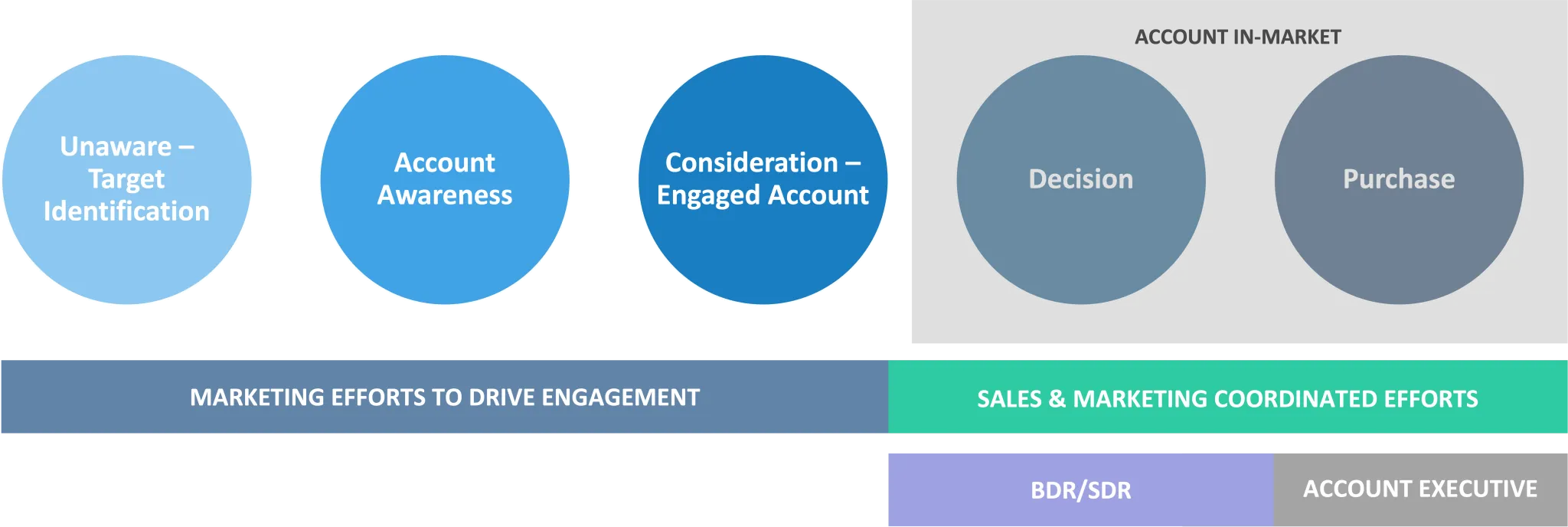
For example, you can purchase their ABM platform and Predictive Tier to sync with your CRM, evaluate closed won opportunities, and segment your TAM by consideration, awareness, decision, and purchase stages. Then you can send targeted ads to accounts in the consideration and awareness stage to move them further down the funnel.
Warmly comes in when the target accounts visit the site.
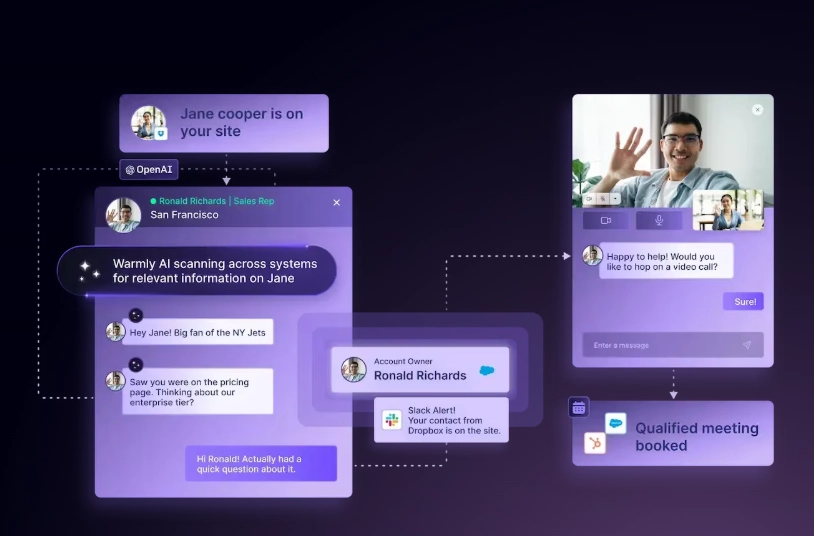
Warmly's AI chat starts a conversation with these high-intent accounts and alerts a sales rep via Slack or Microsoft Teams when they're ready for a human conversation. Warmly can then auto-discover and auto-sequence the buying committee of hot accounts who have engaged with the site but not filled out a form.
This drives more relevant traffic back to the site, which increases Warmly's ability to accelerate conversion across the funnel.
Source: Warmly.ai
Why Consider Warmly To Competitors of 6sense?
Warmly takes a different approach to the other 6sense competitors we’ve discussed so far.
Using generative AI to automate personalized sales outreach, we help you achieve the perfect balance between a human-led and AI-driven motion.
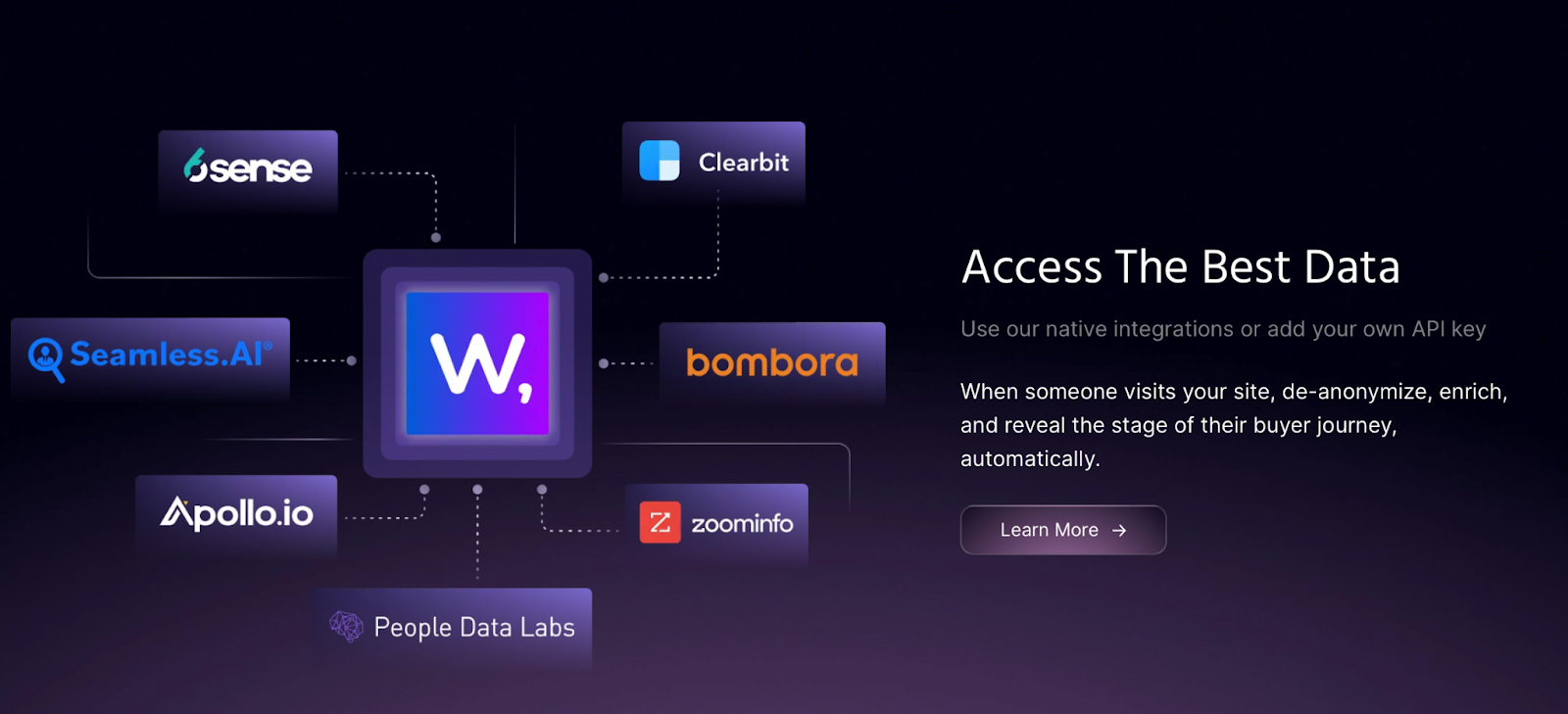
Best-in-class enrichment, de-anonymization, and intent data from 6sense, Bombora, Clearbit, and PeopleDataLabs is combined with intent signals from the tools in your tech stack (Apollo, Outreach, Hubspot, etc.) to trigger AI-driven outreach when the timing is right.
The goal here is to help SMBs achieve scale and speed to lead.
We know that 35-50% of sales go to the company that responds first, but most small businesses don’t have the internal resources to respond quickly enough, meaning many deals are lost to larger competitors.
Warmly helps you capture high-intent, high-urgency leads. Our AI platform runs your entire workflow—from intent being triggered to outreach being fired—until it's the right time for a rep to get involved.
Its tough to make the case that 6sense isn’t a fantastic tool for ABM-based teams.
They’ve got the best contact and intent data in the game (We use 6sense data internally to power our own GTM), and the platform is packed with great features to align sales and product marketing.
“6sense’s buyer intent data and predictive modeling are awesome. It helps sales teams prioritize accounts based on stages in the buyer journey.”
Product marketers can directly input messaging into the Sales Intelligence tool to empower AEs and BDRs with talk tracks that align with product marketing. Sales reps have visibility on what marketing has already done so they can move the conversation forward naturally.
Plus, there’s a really cool and unique feature called Conversational Email, which uses generative AI to handle low-risk customer communications.
In 2023, it was named a leader in the Gartner® Magic Quadrant™ for Account-Based Marketing Platforms for the third year running, joined only by Demandbase.
However, no tool is perfect, and you might not decide to invest in 6sense in a couple of situations.
You don’t have the budget
One of the great things about 6sense having such an extensive offering is that you can pick and choose different feature models to customize your plan.
However, certain modules need to be bought before others. To get to a point where you have full end-to-end orchestration (with features like the aforementioned conversational email function), you might be spending around $100k+ a year.
You need a chat ABM solution, not an enterprise-level feature set
You may have set up your own account-based marketing program and want to convert more quality accounts you're driving to your site.
You might want a chat solution that seamlessly integrates with your ABM program.
Qualified or Drift (for the enterprise) and Warmly (for SMBs) are good options here.
These solutions combine website engagement data with a 360 view of the account to enable intelligent conversations and lead routing for target accounts that visit the website.
Build An AI SDR Army With Warmly
6sense is one of the best solutions around. This is particularly true if you’ve got the budget, salesforce, and established playbooks to run a human-led account-based marketing motion.
Sometimes 6sense is not within reach from a budget standpoint. Even if it were, most small businesses don’t have the internal capability or resources to take advantage of 6sense’s enterprise-facing feature set.
You need to walk before you can run.
With Warmly's, you can start the "walk" phase of your ABM program and start seeing ROI in 20 minutes in just three easy steps:
Add a code snippet to the site
One-click authenticates your existing systems (Hubspot, Outreach, Apollo, Slack, LinkedIn, etc.)
Input your ICP company profiles and personas
You’ll immediately start improving conversion rates by revealing who is on your site, enriching that traffic with best-in-class data, syncing that data back to your CRM, and automating personalized outreach to the hottest accounts via email, LinkedIn, and chat.
What is 9 6sense Competitors You're Probably Looking At (2023)?
9 6sense Competitors You're Probably Looking At (2023) refers to the concepts and strategies covered in this article. Understanding these fundamentals helps B2B teams improve their sales and marketing effectiveness.
Why is 9 6sense Competitors You're Probably Looking At (2023) important?
This matters because it directly impacts pipeline generation and revenue. Teams that master these concepts see better results from their go-to-market efforts.
How can I implement this?
Start with the strategies outlined above. For B2B teams, combining these tactics with tools like Warmly—which identifies website visitors and automates engagement—can accelerate results.
What tools help with 9 6sense Competitors You're Probably Looking At (2023)?
Several tools can help, depending on your specific needs. Warmly is particularly useful for identifying high-intent website visitors and engaging them before they leave your site.
What are the best practices for 9 6sense Competitors You're Probably Looking At (2023)?
Key best practices are covered throughout this article. Focus on the fundamentals first, measure your results, and iterate based on data rather than assumptions.
Google and Yahoo's New Rules For Bulk Email Senders
Time to read
Alan Zhao
Google and Yahoo announced that they aim to reduce the amount of spam emails received by their users and improve email security.
Any bulk email sender will be subject to strict new requirements to avoid experiencing email deliverability issues.
Google will begin enforcing the new requirements on February 1st, 2024, while Yahoo will enforce theirs in Q1 of 2024.
These restrictions will change the way many organizations think about outbound prospecting.
How is "bulk sender" defined
A bulk sender is defined by Google and Yahoo as an organization sending 5,000 or more messages a day to any gmail or yahoo email address.
The daily threshold pertains to all emails originating from your entire organization, regardless of the platform or method used to send them.
This includes email marketing platforms like Hubspot or Mailchimp, sales sequencing tools like Outreach or SalesLoft, or emails from your application like password reset emails, newsletters, or product announcements.
What does this mean for bulk email senders?
You want to be careful to make sure your organization is not being flagged as spam. Once marked as spam it takes time for your email domain to normalize and your messages landing in the inbox again.
When do people mark your emails as spam?
When you aren't emailing the right person
You're sending irrelevant emails
You aren't kind in your communication
The email you sent was clearly AI-generated
You added the prospect to a multi-step automated email cadence (which auto-followed up five times with no response)
What are the risks of not following these requirements?
Starting February 1st, 2024, if a bulk-sending organization has an abuse complaint rate of 0.3% or higher, Google and Yahoo will automatically block all messages coming from that organization.
That's only 15 emails getting flagged before the hammer is dropped.
Globally, Gmail is the number one free-email service, usually making up between 40-60% of subscribers on a B2C sender's list worldwide, and a top three B2B mailbox provider. Yahoo is also among the top three for global representation on a B2C sender's list.
By not adhering to their new email guidelines you can expect your engagement metrics to begin dropping as your emails land in spam folders more and more.
Because Gmail and Yahoo's reputation-ranking system for senders is also based on subscriber engagement and your engagement has plummeted, it will create a snowball effect.
You'll begin to see open rates plummet, conversions plummet, and eventually, be unable to reliably deliver email from your domain.
Mailbox providers hold all the cards. It's how it's always been.
Why is Google and Yahoo doing this?
Google noted that their AI-powered defenses stop more than 99.9% of spam, phishing and malware from reaching inboxes and block nearly 15 billion unwanted emails daily.
"But now, nearly 20 years after Gmail launched, the threats we face are more complex and pressing than ever." -Google
The short answer is they want inboxes safer and more spam-free.
One thing is certain, email prospecting has already become saturated and buyers are getting numbed to anything that doesn't stand out. Now with ChatGPT, it's become even more difficult to distinguish a personalized email from one that AI generated.
Because of contact database tools like ZoomInfo and Apollo and email prospecting platforms like Outreach and Salesloft, any sales team can add thousands of prospects to email sequences with a few clicks.
Buyers are getting 20-30 "do you want to buy?" emails daily that they unsubscribe from or mark as spam.
It's a massive drain for everyone involved.
Successful sales teams are going to be those that can stand out from the crowd and create an incredible customer relationship.
How should sales teams be thinking about this?
I don't see these updates as anything but a good thing for sellers and customers. Totally agree that those who might be affected could be worried, but it's also an opportunity to improve processes and build better relationships with prospects.
If you're doing outbound the right way, you've got nothing to worry about. "Right" meaning adding value, thoughtful, contextual, human, relevant, and so on.
Sales leaders may need to reduce the autonomy they give to reps and have greater control over the outbound rules.
Reps will need to be more intentional with their outreach rather than carpet-bombing their ICP market with bulk email sequences.
Hopefully, in the future, when emails land in buyers' inboxes they'll be relevant and targeted towards actual need, which creates a better overall buyer experience.
Imagine seeing 1-2 emails daily from a seller helping you solve a problem you have today.
That would completely change the lens through which buyers view salespeople.
The Future of Outbound Outreach
Building effective outbound sales will come down to two things:
Is the company you're targeting in-market (ready to buy)?
Does the company have a favorable outlook on your brand?
As we've talked about in How the B2B SaaS Funnel Has Changed, nowadays, buyers do the majority of their research before even talking to a salesperson.
Building a strong brand in your buyers' mind around the problem you solve will play an important role when it comes time for the buyer to evaluate solutions.
Especially in B2B SaaS there are so many solutions out there it becomes difficult to parse through the noise.
Things like G2 reviews, awards, household brand case studies, and thought leader product endorsements matter.
If you know when prospects are in-market for your product AND they have developed a strong liking to your brand, then you don't need AI-generated copy and mass emails. You just need to find these people and say "what's up."
Easy right?
How Warmly Helps Sales Teams Thrive
Warmly is "warm leads" platform that helps you discover companies in-market for your product AND companies and people who have engaged with your brand. The platform synthesizes metadata across your sales and marketing techstack to arrive at an "Account Intent Signal Score."
When the score reaches a threshold, we help you autonomously outreach to the buyers at these companies who would find your product most relevant. And we take an omnichannel approach across email, LinkedIn, and website chat to reach them.
Source: warmly.ai
You can still use your favorite sequencing tools like Outreach, Apollo, SalesLoft or HubSpot. But now you're sending emails more responsibly and, with "fewer bullets in the chamber," more strategically to prospects that have the highest likelihood of converting.
Introducing a "warm outreach" process reduces the risk of over-sending mass emails AND being marked as spam for your entire email domain.
This announcement from Google and Yahoo, coming in the year's final quarter, offers an opportunity to put an outreach plan in place that sets your sales team up for success in the years to come.
Sales reps need a platform to help them outreach effectively without burning through your domain.
What is Google and Yahoo's New Rules For Bulk Email Senders?
Google and Yahoo's New Rules For Bulk Email Senders refers to the concepts and strategies covered in this article. Understanding these fundamentals helps B2B teams improve their sales and marketing effectiveness.
Why is Google and Yahoo's New Rules For Bulk Email Senders important?
This matters because it directly impacts pipeline generation and revenue. Teams that master these concepts see better results from their go-to-market efforts.
How can I implement this?
Start with the strategies outlined above. For B2B teams, combining these tactics with tools like Warmly—which identifies website visitors and automates engagement—can accelerate results.
What tools help with Google and Yahoo's New Rules For Bulk Email Senders?
Several tools can help, depending on your specific needs. Warmly is particularly useful for identifying high-intent website visitors and engaging them before they leave your site.
What are the best practices for Google and Yahoo's New Rules For Bulk Email Senders?
Key best practices are covered throughout this article. Focus on the fundamentals first, measure your results, and iterate based on data rather than assumptions.
Top 10 Qualified Alternatives & Competitors [2026]
Time to read
Alan Zhao
Qualified is somewhat of an industry standard when it comes to account-based marketing and chatbot-led lead gen.
They offer solid conversational chat, decent B2B buyer intent data, and fantastic customer service.
But here’s the thing:
Qualified is built for enterprise, not SMBs.
At a minimum, it will cost you $42k a year, plus the costs of running a sales team large enough to take the heavily human-led approach that Qualified promotes.
Plus, you pretty much have to be using Salesforce.
For large enterprises running a Salesforce + Marketo + 6sense tech stack, Qualified makes a lot of sense.
But for anyone not working in Salesforce (yes, other CRMs exist) or with a more modest budget, there are many other suitable options.
In this article, we’ll explore the 10 more realistic Qualified competitors & alternatives on the market.
TL;DR
Warmly offers the best alternative to Qualified with its AI-driven sales chat, website visitor identification, and intent enrichment capabilities that help GTM teams engage, qualify, and book meetings with high-intent leads, all at a fraction of Qualified’s price.
Enterprise-focused tools like Drift and 6sense are ideal for large organizations needing scalable ABM orchestration, predictive analytics, and CRM-deep integrations.
On the other hand, tools like Intercom, Social Intents, and Tars can help smaller teams deliver AI-powered customer support, proactive lead engagement, and interactive chatbot funnels without the enterprise price tag.
In fact, there are a few things it does exceptionally well:
Reporting - You can see exactly who’s coming to the site, what percentage of traffic fits your ICP, which campaigns are driving conversions, which accounts are hot, and so on.
Salesforce integration - Qualified is built by ex-Salesforce people, so they’ve got a pretty strong tie-in. The Qualified-Salesforce integration is about as deep as integrations get, so it's a great choice for larger teams who need everything fed into Salesforce as the source of truth.
Amazing customer support - The team at Qualified is hungry to get you leads, and you’ll have a dedicated CSM to guide you through setup, including setting up Salesforce.
It's billed as “pipeline generation software,” which largely rests on their conversational marketing tools (i.e., website chat).
While there is an AI component to the software (you can build automated chatbots), where Qualified differentiates itself from competitors like Drift is in taking a distinctly human-led approach.
The idea is that customers are chatting with real people, which is where the drawbacks begin.
Only Works If You Can Scale Your Sales Team
Qualified’s ethos is human-first. That means that, as a customer, when someone reaches out through website chat, it's a human being on the other end.
This is great from a personalization standpoint, providing better buying experiences (assuming the skill is there on the other end). But it also means you need a dedicated person to “man the chat.”
This is made clear by Qualified’s reporting, which is built around things like chat leaderboards and analysis of traffic hours, so you can set up your team around peak times.
It's a great tool if you can organize humans appropriately, but it is largely out of reach for SMBs and even mid-market businesses that don’t have inbound reps on hand nor the budget to hire them.
Not Built For SMB Budgets
Speaking of budget, Qualified is expensive.
It's one of the most expensive chat-based ABM tools around. You’re looking at $42k a year for their Growth plan and $72k for the Premier plan, and those are just the “starting at” points.
Then, you’ve got things like implementation and integrations with your tech stack (you typically see Qualified paired with Salesforce and 6sense) to build.
All of this means lengthy setup times, and requires an established revenue organization to set up all the reports and workflows, plus organize all the reps.
Non-Salesforce Users Are Out Of Luck
Lastly, Qualified only works on Salesforce.
As mentioned, the Salesforce integration is strong. But they don’t integrate with any other CRMs.
So, it's basically a Salesforce-only platform.
What are the 10 best Qualified alternatives on the market?
The best alternatives to Qualified are Warmly, Drift, and Intercom.
Here's a detailed breakdown:
ToolUse CasePricingWarmlyAI sales chat, website visitor ID, intent enrichment, live engagement, automationStarts from $10,000/year.DriftConversational marketing, AI chatbots, video engagement, CRM/light automationFrom ~$30,000/yr (Standard); advanced from $90,000/yrIntercomAI chat support, live chat, ticket handoff, customer commsStarter $888/yr; Pro/custom on requestHubSpot ChatBasic live chat, website messagingFree (limited); more with paid HubSpot plans6senseABM, buyer intent, AI lead scoring, predictive segmentsCustom; typical contracts $120K+/yr, multi-yearZoomInfoB2B data, chat, sales automation, full sales/ops suiteCustom; often $15,000–$40,000+/yrDemandbaseABM, intent data, segmentation, ad/pipeline automationCustom pricing; modules a la carteClearbitB2B data enrichment, website deanonymization, integrations, API accessFree plan; paid/API credits undisclosedSocial IntentsAI-powered web/live chat, visitor triggers, CRM/SaaS integrations$49–$299/mo; 14-day free trialTarsConversational landing pages, chatbot funnels, lead capture, routingFree 50 chats/mo; paid from $499/mo up to $7,999/mo; live chat handoff add-on
1. Warmly
Warmly offers the best Qualified alternative on the market as it lets you engage high-intent leads on your website by asking them qualifying questions, answering their queries, and booking meetings with them.
But it’s not just a sales chatbot that annoys everyone on your website for simply visiting your website with impersonal messages.
It actively monitors both on-site and off-site intent signals (e.g., which pages a visitor browses) and then uses these signals to qualify and score prospects before reaching out to them.
Disclosure: Even though Warmly is our sales tool, I’ll aim to provide an unbiased perspective on why Warmly offers the best Qualified alternative in 2026.
Let’s look at some capabilities that make Warmly popular among GTM teams looking to switch from Qualified:
How Does Warmly's AI Sales Chat Work?
Our AI Chat engages high-intent leads on your website by:
Asking them qualifying questions.
Answering their questions.
Booking meetings.
Offering relevant collaterals, etc.
➡️ Our AI Chat can be trained to your specific brand tone of voice and other requirements, such as info about your ICP, so it engages only with ICP-fit prospects.
The software actively monitors both on-site and off-site intent signals, such as:
Which pages does the visitor browse?
How often do they return?
Has the lead already engaged with our outbound campaigns?
Is the lead already in your CRM from a previous deal cycle?
Has the prospect already researched your competitors?
According to a recent study from HubSpot, about ~96% of prospects research companies or products before engaging sales teams, which shows that your buyers are doing heavy pre-contact research, which is why it's worth it to have visitor identification software coupled with your AI chatbot.
💡 The AI chat then uses these signals to qualify and score leads based on the actions they take.
Note: You can also automate lead routing using the round-robin method or set up any other criteria by which you want leads to be distributed to your sales team.
Use Cases of Warmly’s AI Sales Chat
Here’s how our customers have been using Warmly’s AI sales chat to drive pipeline: ⤵️
Reactivating Closed-Lost Accounts
You can connect your CRM to Warmly (HubSpot or Salesforce) to track Closed Lost deals and get notified when a lead from a previously lost deal re-engages on your site.
Teams can use our AI chatbot to create personalized messaging for closed-lost visitors and send Slack notifications to the relevant sales rep when they’re showing high-intent actions on your website (e.g., visiting your pricing page).
It’s also possible to configure the chatbot to trigger a personalized message based on previous deal history (e.g., referencing past conversations).
Instead of losing these deals all over again, you can use our AI chat to turn quiet re-visits into a reactivated pipeline with no form fill or manual tracking required.
Warming up leads through contextual conversations
Instead of pushing a cold form to your prospects, our AI sales chatbot starts a warm, on-brand conversation with them.
The AI chat then adjusts in real-time to each prospect’s journey, whether they’re exploring features for the first time or navigating your pricing page.
It’s capable of picking up on those signals and responding in a way that feels helpful, and not pushy.
You can train the AI Chat to speak your brand’s language, tone, voice, product positioning, and the whole branding package.
That means every interaction sounds like it’s coming from your team, not some third-party script that’s been installed on your website.
And because it feels more human, leads are far more likely to open up, share buying intent, and stick around.
This creates the ideal setup for warming up cold or curious lurkers, turning casual browsing into engaged dialogue.
➡️ And when you pair this with Warmly’s website visitor identification and intent enrichment, your sales team don’t just see a name and title. They see buying signals, past activity, and what the prospect cares about.
Instant routing to sales reps
Even though our AI chat is capable of booking meetings, I understand that there are leads who need a real person to get them to book a demo.
This is why, when a high-intent prospect is ready to talk, our AI chat can be configured to know when to step back and loop in a human sales rep right away.
Instead of letting that interest cool off with a “we’ll be in touch” kind of messaging, the instant routing brings one of your sales representatives into the conversation right then and there, when the lead is still hot.
The AI Copilot monitors live chat sessions, detects high-value signals, and pings the right rep via Slack or email.
That rep can jump in directly to continue the chat in real-time, or follow up minutes later with full context already in place.
AI Sales Chat Case Study: Warmly x Kandji
Kandji is an Apple device management platform that sought a way to engage high-intent website visitors without overwhelming its team.
The solution? Warmly’s AI chat that’s been built for speed, context, and instant handoffs.
After just about 8 minutes of rolling out Warmly’s AI chat, Kandji’s reps booked two qualified meetings.
Here’s how it worked:
Leads landed on their site, and Warmly’s AI chat greeted them with a personalized message based on their organization and intent signals.
When the prospects responded, the team’s reps were instantly alerted via Slack.
Two separate sales reps jumped in, continued the conversation in real-time, and were able to book meetings with qualified leads.
Since the AI chatbot was trained to reflect Kandji’s voice and messaging, and backed by real-time visitor data, it could start warm, relevant conversations that didn’t just gather info, but built trust.
This wasn’t just sales automation for the sake of it, but rather a fully integrated AI-human handoff that created real pipeline, quickly.
Pricing
Warmly’s pricing is modular and component-based and comes with a free plan that lets you identify up to 500 website visitors per month.
You can choose the components that best match the needs of your business, as components are priced by output and not just by a monthly fee.
There are 4 paid product plans that you can choose from:
AI Data Agent (Starts at $10,000/yr), which includes 10,000 credits, person-level web visitor de-anonymization (RB2B + Vector data), CRM integration, and access to our Coldly Contact Database.
AI Inbound Agent (Starts at $16,000/yr), which adds a native marketing outbound automation, domain warmup, and lead routing with custom CRM fields.
AI Outbound Agent (Starts at $22,000/yr), which adds automated signal-based outbound orchestration, AI chatbot & live video chat, email automation, automation, and email warmup.
Marketing Ops Agent (Starts at $25,000/yr), which adds AI-powered account scoring, AI enrichments and custom signals, buying committee identification, real-time buying intent signal tracking, and automatic updates across all enrichments, signals, account and lead lists.
➡️ Warmly’s pricing is ideal for larger SMB and MM companies with a growing or mature GTM motion with SDR, sales, and marketing functions.
Pros & Cons
✅ Identifies companies and individuals visiting your website and then engages them.
✅ AI chat that can be customized to engage with the customers you want.
✅ Advanced sales orchestration options.
✅ Live sales engagement functionality.
✅ Reveals who your hottest leads are right now.
❌ Pricing is modular.
2. Drift - Best For Enterprise
Drift is kind of the industry standard when it comes to automated chatbots.
It sits at the other end of the human-automation spectrum to Qualified, designed for high-volume lead funnelling.
Why Consider Drift As An Alternative To Qualified?
Drift is basically built for large enterprises with millions of visitors to their sites each month, something which would require a huge salesforce to cover with Qualified’s motion.
They’ve also started leaning into AI-powered chatbots, though there are other more advanced tools in this space.
One key feature that Drift has over Qualified is video. A sales rep can send an embedded video in an email (like a Vidyard). This kicks off a cool little playbook:
Prospect clicks the video
Directed to a landing page to watch the video
Drift notifies the rep that the prospect is watching the video right now
Sales rep can reach out to start a live conversation with the rep while they’re engaged
They’ve caught on now (they have native integrations with Salesforce, HubSpot, and a couple of others), but they decided earlier to be an independent platform that you do everything out of.
This means you didn’t have the tie-in to CRM deals and opportunities that Qualified offers.
So, it's not really a perfect alternative if you’re just looking for a non-Salesforce version of Qualified.
Drift Pricing
Drift is cheaper than Qualified, but still fairly expensive.
You’ll pay at least $30k annually for their standard plan and $90k upward for their more advanced packages.
So, Drift is still serving the same market as Qualified (and thus not ideal for SMBs).
2. Intercom - Best For Customer Support
Intercom is a household name in chat, though it comes at it from a support angle rather than a sales one.
Why Consider Intercom As An Alternative To Qualified?
Intercom is an industry standard for customer support.
It’s a people-driven chat tool, but they have started integrating more automated, AI-driven flows to respond to market demands.
This is great news for small businesses that might not have the budget for a dedicated support team but still want to provide at least some level of customer service, as Intercom’s AI chat tool is more cost-effective (and claims to resolve 50% of support requests instantly).
Where Intercom Falls Short
Intercom isn’t focused on the sales use case.
It is a passive rather than proactive chat tool (Qualified, Drift, and Warmly all take a proactive approach), and so it doesn’t respond to buying intent signals, like these solutions do.
Intercom Pricing
Intercom’s Starter plan begins at $888 per year. This includes their AI chatbot, but with limited functionality. You’ll have to upgrade to the Pro plan (custom pricing) to create custom answers.
3. HubSpot Chat - Best For Basic Chat
HubSpot Chat is a good out-of-the-box chat tool that requires minimal setup.
Why Consider HubSpot Chat As An Alternative To Qualified?
Okay, we gotta be real here.
HubSpot Chat isn’t super sophisticated. Out of all the Qualified alternatives, it's the weakest tool as an outbound chat for sales teams.
The big win, however, is that it's free. So, it can work as a starting point for small organizations with no budget.
Alternatives like Warmly and Drift provide these functions, but HubSpot Chat isn’t designed as an ABM tool so much as a human-led live chat solution.
HubSpot Chat Pricing
HubSpot Chat is one of many free tools from HubSpot.
Being a freemium tool, though, functionality is limited. You’ll need to subscribe to a paid plan to go deeper (in which case, you’re probably better off going with one of the other alternatives listed here.
4. 6sense - Best For Enterprise Account-Based Marketing
6sense is one of the most well-known platforms in the account-based marketing space and is also core Qualified partner.
Why Consider 6sense As An Alternative To Qualified?
6sense is a hugely comprehensive platform, as we reviewed in our 6sense review piece.
In 2023, it was named a leader in the Gartner® Magic Quadrant™ for Account-Based Marketing Platforms for the third year running, joined only by Demandbase.
Specifically, Gartner called out 6sense’s customer satisfaction, sales alerts and insights, and marketing strategy.
For those with an enterprise plan, 6sense also offers AI-driven recommended actions, helping sales reps focus on the highest-value activities.
Another cool feature is their conversational email.
It basically sends and responds to emails on your behalf using natural language. Obviously, this is a little scary, especially for enterprises, so it's generally reserved for low-stakes emails, but it's a cool way to clear a lot of tedious work off your plate.
Sure, it's great that you can pick and choose different modules and features to customize your plan (and pricing), but certain tiers need to be bought before others can activate.
For instance, to get the conversational email function we discussed above, you’ve got to buy the ABM platform, Predictive Analytics, and Orchestration tiers.
To get to a point where you have full end-to-end orchestration of a workflow, you’re spending ~120k.
Additionally, much of this is experimental and only works on Salesforce.
A few other drawbacks, as mentioned by Gartner, include:
Lack of attribution modeling
UX complaints
Some reports regarding ICP traffic (like ICP traffic converted to a meeting) are missing
6sense Pricing
6sense customizes pricing to your company’s specific needs. However, it's not cheap. You’re looking at about the same price range as Qualified or Drift.
5. ZoomInfo - Best For An All-In-One Platform
ZoomInfo is a suite of GTM software platforms. They have tools for marketing, operations, sales, and hiring, as well as a decent chatbot with solid “if/then” workflows.
Why Consider ZoomInfo As An Alternative To Qualified?
ZoomInfo is well-known as a best-in-class solution for contact and company data.
That’s really the core of their product offering. Everything else is built up around that.
For example, their SalesOS platform has prospect insights and buying intent signals, conversation intelligence (think Gong), data enrichment, and engagement tools like chat workflows and email automation.
They also have their own demand-side platform, so you can sync your audience so you can advertise to them.
The big benefit, then, is that when you want to add another GTM-related offering to your contract, you don’t need to stitch together another vendor. You just buy from the same supplier, reaping the benefit of native integrations.
Where ZoomInfo Falls Short
ZoomInfo does a lot of things well.
Where they fall short, though, is that in trying to do a lot of things well, they’ve started to lose ground on being the expert at any one thing.
ZoomInfo built its name on having the best contact data out there. But contact data has been commoditized and, in general, is an ongoing depreciating asset.
Realizing this, ZoomInfo has taken a “acquire and cross-sell” approach to expand revenue and keep growing ACV. They bought Insent.Ai for their chatbot tool, Comparably to expand their Talent asset, and Clickagy to improve intent signaling.
Diversifying into other offerings means less focus on their core competency, and so other vendors (like Apollo.io and Seamless.ai) have been gaining ground on contact data.
Their chat is also less powerful than alternatives like Qualified and lacks full CRM integrations. Again, this is a consequence of tackling too many surface areas at once, and acquiring tools rather than building them natively.
ZoomInfo Pricing
ZoomInfo is one of those “you gotta talk to us first” companies. We don’t have any pricing available, but we’ve heard that they’re also a pretty expensive solution, depending on the modules you opt to include.
6. Demandbase - Best For ABM Execution
Demandbase is another solid ABM tool and the only other platform named as a leader in Gartner’s 2023 Magic Quadrant.
Why Consider Demandbase As An Alternative To Qualified?
Demandbase is, for all intents and purposes, a #2 version of 6sense.
It's been around for a bit longer (so it kind of has a legacy interface) and was a proponent of ABM for years before other brands jumped on the idea.
It does most of the same stuff as 6sense, with slightly better segmentation and reporting, though Gartner scores it slightly lower on both its Completeness of Vision and Ability to Execute scales.
They also have a cool Buying Group AI feature in beta, which purports to “define, track, and engage members of a buying team within an account, outcome-driven ad campaigns to achieve marketing objectives, and prescriptive sales dashboards with recommendations for sellers.”
This is something many vendors have hand-waved at, but never quite nailed.
Where Demandbase Falls Short
Demandbase, like ZoomInfo and 6sense, has an “a la carte” model, and there’s plenty to choose from.
Unfortunately, “a la carte” generally translates to “expensive,” so this is another out-of-range tool for SMBs.
Demandbase Pricing
Demandbase creates pricing on a company-by-company basis, which is pretty much the standard for software solutions in this category.
7. Clearbit - Best For Developer-Focused GTM Teams
Clearbit is somewhat of a different beast from the rest, but still worthy of mentioning as a Qualified competitor thanks to its visitor identification and prospecting functionality.
More importantly, Clearbit was recently acquired by HubSpot, which has the potential to be a huge partnership in this space.
This acquisition combines CRM, data, and workflows, creating a solution that can break down data siloes and integrate seamlessly across systems. It will be one of the first to bring forth the new era of signal-based revenue orchestration.
As Whitney Sorson, CTO of Hubspot, puts it:
"Picture having complete data on over 20 million companies right inside HubSpot. All with over 100 rich data points about the companies and their decision-makers. Then, imagine being able to easily find high-fit prospects natively within your CRM. Finally, imagine that once those companies and contacts are in HubSpot, being alerted when those companies are showing buying intent."
Why Consider Clearbit As An Alternative To Qualified?
Clearbit is great at deanonymizing site traffic, enriching it with best-in-class B2B data, and then syncing that back to your CRM.
They’ve got strong integrations with both Salesforce and HubSpot, with the latter likely to strengthen, given the recent acquisition.
They also have a powerful tool called Prospector.
This uses AI and their B2B database to find the buying committee for a given account and then sync that back to your CRM to line up orchestration in engagement tools like Outreach and SalesLoft.
Lastly, they offer a robust API for custom connections. So, if you’re a developer-focused GTM team and have people who can stitch together systems to create automation off of data, Clearbit is a winner.
Where Clearbit Falls Short
That last point works both in favor of Clearbit and against it.
If you’re running classic sales-led motions, Clearbit doesn’t come with any out-of-the-box playbooks to execute sales workflows. It’s designed more with the developer in mind.
That might change as the HubSpot acquisition plays out, though it's clear that any workflows will need to take place in their own sales tools.
For now, though, Clearbit is like the building blocks but doesn’t necessarily solve the problems end to end. You need to integrate it into your other tools to make sure the data is being used to fuel the rest of your GTM.
Clearbit Pricing
Clearbit’s plan structure looks pretty simple. You’ve got a free option (obviously limited), a paid option (no pricing information given), and an option to just buy API credits.
9. Social Intents - Best For AI-Powered Customer Interactions
Social Intents delivers both AI‑powered web chat and live chat routed into familiar tools like Slack and Teams.
The tool is a viable alternative to Qualified for teams looking to train the chatbot on their website content, react to visitor behavior with triggers, and automatically escalate to human agents.
How does Social Intents AI sales chat work?
Social Intents’ AI-powered chatbot engages website visitors by combining customizable chat interfaces with conversational AI trained on your content, like website URLs, product docs, and knowledge base articles.
It proactively greets visitors based on behavioral triggers (like time-on-page or scroll depth), then starts smart conversations using GPT-4, Claude, or Gemini to answer questions and guide leads.
As users engage, the chatbot can qualify them with tailored questions, capture lead details, and initiate real-time workflows, such as booking demos, checking order statuses, or creating CRM entries.
You can set up "Custom Actions" that connect chat responses to tools like Salesforce, HubSpot, Zendesk, or your internal systems, no coding required.
If a human agent is online, the platform instantly alerts them via Microsoft Teams, Slack, or Zoom Chat so they can jump into the conversation.
If not, the AI continues qualifying, handles objections, and collects all necessary contact details.
Captured leads and transcripts are synced instantly to your CRM or collaboration platform.
Social Intents also supports omnichannel chat, including website, SMS (via Twilio), WhatsApp, and Messenger, and lets you fully customize chat widgets, proactive messages, and post-chat surveys.
Pricing
Social Intents offers five paid plans:
Starter: $49/month, includes 1 chat widget, 1 website, up to 3 agents, 200 chat conversations/month, free ChatGPT integration, and training on up to 200 URLs.
Basic: $79/month, includes everything in Starter and adds support for 2 widgets and websites, unlimited agents, 1000 monthly chats, shortcuts, support for ChatGPT, Gemini, and Claude, and 1000 AI-trained URLs.
Pro: $132/month, includes everything in Basic, plus 5 widgets and websites, 5000 monthly chats, automatic URL retraining, cross-team transfers, white-labeling, and 5000 trained URLs.
Business: $265/month, designed for larger teams, includes everything in Pro, plus 10 widgets and domains, 10,000 chats/month, real-time auto-translation, and advanced white-label features.
Agency/Reseller: $299/month, built for client work, includes 10 sub-accounts, branded portals, 10 chatbots, and the ability to bill clients directly (you can add more clients for $20/month each).
All plans are billed monthly, with discounts available for annual billing, and the first four come with a 14-day free trial.
Pros & Cons
✅ AI + human hybrid experience, where automated answers reduce workload, while live escalation ensures quality.
✅ Fast to deploy, you can set up in under 5 min with no dev support.
✅ A generous free trial and competitive pricing.
❌ Limited AI tuning ot training, advanced NLP customization is less accessible than specialized platforms.
❌ Some users have reported occasional problems with the software incorrectly displaying chats as offline.
10. Tars - Best For Replacing Static Landing Pages With Interactive Chatbot Funnels
Tars is a no-code conversational AI platform that lets marketers design chatbot-powered landing pages with drag-and-drop ease.
Its conversational agents is a good alternative to Qualified for teams looking to deliver smarter, interactive experiences by routing leads to the right content or workflows while integrating seamlessly with CRMs and analytics.
How does Tars AI sales chat work?
Tars’ AI-powered sales chat automates lead engagement by replacing static web forms with dynamic, conversational AI chatbots tailored for sales teams.
It’s designed to instantly greet website visitors, qualify them through smart question flows, and push them toward conversion.
As prospects engage, the chatbot captures key lead details; like name, company, and needs, using customizable workflows.
It can route high-intent leads to the right rep, offer calendar booking options, and even escalate to a human handoff in real time if needed.
If a rep is unavailable, the AI continues the conversation, nurtures the lead, and logs all data into your CRM or MAP (like HubSpot or Salesforce).
Tars also supports advanced targeting and trigger logic, so it can deliver different chat experiences based on traffic source, behavior, or firmographics.
Beyond chat, it includes integrations with paid ad platforms, helping sales and marketing teams maximize ROI by driving ad traffic directly into conversion-focused chatbot experiences rather than traditional landing pages.
Pricing
Tars has a freemium plan that includes 50 conversations per month, basic LLM models, a training limit of 5 knowledge bases and 1-month data retention.
If you need more features, there are two paid plans to choose from:
Premium: Starting at $499/mo for up to 500 conversations/mo and goes up to $7,999/mo for up to 10,000 conversations/mo, includes 12 months of data retention, advanced LLM models, training limit of 20 knowledge bases, etc.
Enterprise: Custom pricing, has custom volume, white-glove onboarding, unlimited knowledge bases, custom integrations, etc.
However, if you want live chat handoff, you’ll have to pay extra because this feature is available only as an add-on for Premium and Enterprise users, costing $600/yr/seat.
Pros & Cons
✅ Fast, code-free setup enables you to launch bots in under an hour with intuitive tools and proven templates.
✅ Flexible and powerful logic with detailed flows (gambits, conditional paths) that give more control than basic bots.
✅ Easy to use with an user-friendly interface.
❌ Limited AI-based understanding, as its chatbots rely more on pre-defined flows rather than dynamic natural language understanding.
❌ A steep learning curve.
An Army of AI SDRs at ¼ The Price of Qualified
It's tough to deny that Qualified is a solid platform.
If you’re deeply embedded in the Salesforce architecture and have the manpower to run a human-led motion, Qualified makes a lot of sense.
That’s a pretty niche situation, though.
For small and medium-sized businesses, lean sales teams, or any company working in any CRM that isn’t Salesforce, Qualified’s value prop becomes questionable, especially considering how expensive it is.
With Warmly, you can begin receiving hard ROI in 20 minutes with just two steps
Add a code snippet to the site
One-click authenticate your existing systems (Hubspot, Outreach, Apollo, Slack, etc.)
You’ll immediately start improving conversion rates by revealing who is on your site, enriching that with best-in-class data, syncing that data back to your CRM, and routing hot accounts to the right rep.
Plus, with plans starting from just $850 a month (billed annually), you’ll reduce your Qualified bill by ~75%.
The best 8 Qualified alternative depends on your specific needs. For inbound lead conversion, Warmly offers website visitor identification and AI chat engagement. Review the full comparison above to find the right fit for your team.
Why switch from 8 Qualified?
Common reasons to switch include pricing concerns, missing features, poor data quality, or needing capabilities like website visitor identification that 8 Qualified doesn't offer. Evaluate alternatives based on your specific pain points.
Is Warmly a good 8 Qualified alternative?
Warmly is an excellent alternative if you need website visitor identification, real-time buyer intent signals, and AI-powered chat engagement. It's particularly strong for inbound-focused teams wanting to convert website visitors.
How do I migrate from 8 Qualified?
Most alternatives offer migration support and CRM integrations that make switching straightforward. Export your data from 8 Qualified, then import into your new platform. Many tools have dedicated onboarding teams to help.
Which 8 Qualified alternative has the best data?
Data quality varies by provider and your target market. Test multiple platforms with your actual prospect list before committing. Look for tools that combine third-party data with first-party signals for better accuracy.
The Power of Category Design: Capturing 76% of Market Value
Time to read
Alan Zhao
What is category design?
Category design is the process of creating a new category of products in the market.
The reward for being a category king is extraordinary.
If you're not #1 in your customers' mind, try reframing and designing new category.
Benefits of being king:
Market Leadership: As the king of a category, you set the standards and define the norms within the market, often resulting in a loyal customer base that sees your brand as the go-to authority.
Pricing Power: Dominance in a category typically grants the flexibility to command premium pricing due to the perceived uniqueness and value of your offering, with less pressure from competitive pricing.
Enhanced Visibility and Growth Potential: Being at the forefront of a category often attracts more media attention, strategic partnerships, and investment opportunities, fueling further growth and solidifying market position.
Creating a category doesn’t mean having the best product. It’s about being seen in a different light — standing alone rather than in a crowd.
I would argue that for any venture backed startups there's no reason not to pursue this strategy because you are inherently trying to disrupt the status quo. There are always incumbents.
Those incumbent solutions already occupy a space in your buyer's mind.
How do you enter and not only compete but capture market share quickly?
Warmly ran into this problem when we first brought our product to market.
There were already so many tools that help you capture more leads. People were also biased in what they liked.
Prospects had trouble figuring out where to put us in their techstack because our category didn't exist yet.
They knew they needed a CRM like Salesforce or a sales engagement tool like Outreach. Some sophisticated buyers would already have intent tools like Clearbit or 6sense in place.
But the concept of orchestration wasn't something people actively looked for.
Some of our early evangelists would describe us to others as "If 6sense, Drift, and Clearbit had a baby... that's Warmly."
Prospects began to view us as a cost-saving because we consolidated three tools into one for cheaper. Not a bad start.
But sales deals would stall because buyers would compare us directly with established kings and queens of existing categories they were familiar with.
It was difficult to compete in someone else's story.
Instead, we wanted them to see that "you can keep using tools like 6sense and Drift, AND Warmly, and here's why 1+1+1=5..."
Given the recessionary market environment of Q3 2022, every company was looking for more warm leads, including us.
Teams that predominantly fed off inbound leads now had to go outbound.
We found that the key sub-problem of finding more warm leads was:
Identifying who was in-market for your product
Getting in front of them in that buying window
Tools like 6sense, ZoomInfo, and Apollo have raised hundreds of millions to try and solve this problem. It's not solved yet. But the market was already validated.
Step 2: Frame the new, different future for the customer
Bring your customers into the future by showing them something new.
Show customers how your “solution” bridges the gap from the problem/opportunity to a different future.
Most importantly, the company evangelizing the POV is immediately viewed as the leader.
For us, there were already many awesome tools out there to help with intent data and buyer signals, but all of these siloed solutions still have to be orchestrated - usually by humans, which is expensive and time-consuming.
Incumbents created their products during the golden age of the sales development representative, where companies solved their lead generation problem, which required a lot of manual effort, by throwing more humans at it.
With advancements in AI, instead of coordinating humans who need to operate multiple tools to catch a buyer's attention, we leaned into the point of view of using automation and orchestration to do the repetitive work.
Let humans do what they do best, building relationships, and let automation take care of the rest.
Step 3: Crystalize a radically different brand
What's the number one thing you want your audience to think when they see your name?
We wanted our audience to shortcut their mind to "AI Sales" when they thought of Warmly. Conversely, when they think of AI sales, they think Warmly.
Next, what do you want your audience to "feel" when they see your name?
We wanted them to feel powerful, that they could access something mystic and extraordinary by having Warmly.
We studied Carl Jung's brand archetypes and how they could be applied to companies.
Jung theorized that humans use symbolism to understand complex topics. And these symbols can be timeless and understood as categories. In the case of brands, these categories exhibit personality traits that customers easily understand. Archetypes, he called them.
We selected the "magician" brand archetype, the ethos of which you can see reflected in our website.
Source: Warmly.ai
We chose our category name to be signal-based sales orchestration because
It encapsulates our unique point of view and the future that we saw.
Nobody else occupied it from an SEO perspective.
Once we crystallized our brand, we reflected it in every facet of our marketing and product - website, language, social posts, blogs, sales calls, feature naming, branding.
As Seth Godin, world-renowned marketing author, explains, "Having a brand means you've made a promise to people. They have expectations. It's a shorthand of what they should expect the next time."
Step 4: Lightning strike!
Once you define your problem, unique point of view, category, and brand, you're next step is to let the world know who you are and what you stand for in a lightning strike.
A lightning strike is a category-defining event.
It defines a new problem or, like in our case, an old problem that can be solved in a new way.
It must be carefully crafted to trigger a moment in the minds of your prospects where they say, “Wow, this is new... I want that.”
We wanted to frame the problem, claim the solution, and own the narrative.
We launched on Product Hunt, Bookface (a launch within YC's community), Hacker News, and others
We actively engaged with revenue operations, account-based marketing, and demand gen community groups across Slack, LinkedIn, and Reddit, extending the reach outside of our inner circle of influence
Our evangelists and affiliate influencers educate our category within trusted CMO/CRO groups
We sought out additional press and newsletter coverage to keep our market attuned to how Warmly was developing
We built an ecosystem of affiliate influencers, integration partners, and agencies
We use each new customer as an opportunity to turn drive more testimonials and positive G2 reviews.
We leveraged Lavender's playbook, consistently generating high-value content like webinars or blog posts and distributing across other channels like YouTube, LinkedIn, Twitter, Medium, newsletters, and emails
Each lightning strike gives the flywheel another shove. It amplifies the effects of each of the prior listed initiatives, furthering the gap between the category king and the rest.
Frequently Asked Questions
What is The Power of Category Design Capturing 76% of Market Value?
The Power of Category Design Capturing 76% of Market Value refers to the concepts and strategies covered in this article. Understanding these fundamentals helps B2B teams improve their sales and marketing effectiveness.
Why is The Power of Category Design Capturing 76% of Market Value important?
This matters because it directly impacts pipeline generation and revenue. Teams that master these concepts see better results from their go-to-market efforts.
How can I implement this?
Start with the strategies outlined above. For B2B teams, combining these tactics with tools like Warmly—which identifies website visitors and automates engagement—can accelerate results.
What tools help with The Power of Category Design Capturing 76% of Market Value?
Several tools can help, depending on your specific needs. Warmly is particularly useful for identifying high-intent website visitors and engaging them before they leave your site.
What are the best practices for The Power of Category Design Capturing 76% of Market Value?
Key best practices are covered throughout this article. Focus on the fundamentals first, measure your results, and iterate based on data rather than assumptions.
Step-By-Step Framework for Achieving Product Market Fit
Time to read
Alan Zhao
When people who haven't heard of us before read the press about our fundraise they assume that success is a straight line. It wasn't.
Those who are close to us know that progress was not linear. We pivoted four times before landing on the current iteration of our business, so we've learned a couple of things that didn't work before we found one that did.
See Max's LinkedIn post about our various pivots.
We want to share an unconventional framework for early startups that worked for us as we were navigating the idea maze.
Step 1: Assemble An Anti-Fragile Founding Team
The cofounders, Carina, Max, and myself were lucky enough to have met each other when we did to start this company.
Max and Carina met at Google, launching a "Where's Waldo" April Fools prank inside of Google Maps.
Max and I met through a founders fellowship program called On Deck (which I highly recommend for any early stage founder to apply).
Although we all shared a common goal and vision, we had very different styles and ways of thinking to achieve that goal - just ask any of our employees.
Over time, our unique approaches complemented each other and extended our strengths.
The archetype of each of Warmly's founder might look something like...
Max is our legendary purple cow.
Dreams big. Stands out. Reaches for the unreachable. Hustler.
Max is someone who, when you meet, you won't forget. He's a compelling character who can turn noes into yeses.
Top tier investors. Enterprise companies. The best talent in the market.
Eventually, they all cave.
He goes where nobody goes and thinks unconventionally.
For example, when Max takes a stroll, he'll sometimes select random numbers to call just to say "hi" and catch up for two minutes. It keeps the network warm and Max updated on where people are at and what they need.
This is a mindset you can't teach.
Carina is our methodical empire builder.
Filters out noise. Weights every decision. Leaves nothing to chance. Turns ideas into reality.
Carina is someone who has diagrams and graphics for everything. She is a systems thinker who has no problems calling your bull$&!+. She's the perfect complement for Max's creative energy and ideas.
Carina, although smiley by nature, is unemotional when it comes to decision-making, has the least bias out of the founders, and actively solicits everyone's opinion.
When the "processing period" has concluded, you won't look at the final proposal and think "that doesn't make sense."
It always makes sense.
Alan is our scrappy explorer
Curious. Dives headfirst. Always seeking the next big opportunity.
I started off in engineering at Warmly but have moved around a bit to sales, customer success, and now marketing.
To be honest I'm not detail-oriented enough to execute to perfection like Carina, or have the same relentless creativity that can pull rabbits out of the hat for the company like Max.
What gets me fired up is identifying and solving big bottlenecks in the company. And it's allowed me to learn how to pick new things up quickly.
Once the founders understood each other better we gravitated into roles that extended our zones of genius.
The wholeness in how we operated meant that with each pivot we learned more about product, market, and ourselves. We became anti-fragile, and by extension so did our company.
Initially, we were naive enough to think that our ideas would be the ones to shape the world.
"Just imagine if we could build a better LinkedIn where people listed their asks and offers like in On Deck's slack channel."
Our first product, pushpull, connects people authentically to help each other out.
Source: pushpull.community
“You were so preoccupied with whether or not you could, you didn't stop to think if you should” - Jurassic Park
We didn't ask ourselves "If this idea was so good why hasn't it become a billion dollar company yet?"
There was no big favor marketplace.
We were trying to be the first.
And in doing so, we understood why many failed before us.
"How much money were people saving or making by doing this?"
Unclear.
We couldn't charge anything for the product.
We moved on to our next pivot, job change tracking for sales teams, where we started asking for money up-front.
That worked well until we realized we couldn't scale the product, another prerequisite for large VC backed company.
We went through a few more pivots, each one teaching us a new way to kill our ego.
To spare you the details, here are a couple more lessons:
Acknowledging that we didn't have all the answers allowed us to seek external advice and shortcut our path to learnings. Nowadays we speak with founders of failed startups, former employees of competitors, investors in our space, anybody who could help diversify our perspectives
Focusing on learnings rather than the satisfaction of being right ultimately led us to cut losing and embrace winning ideas. It's not enough to make revenue, we needed a path towards making one hundred million in revenue.
Adaptibility became our superpower. A shortcut to building what other people wanted was learning the art of copying. Elon musk figured out that a lot of people in the world liked driving things with four wheels and a steering wheel. And there were already a bunch of roads out there. Why not re-create that (car) but just change one thing (battery)? Stand on top of the shoulder of giants.
Step 3: Stay as close as you can to the market
We did everything we could to stay close to the market.
At first we talked to prospects, customers, investors, competitors, former employees of competitors.
We even became a full-time SDR at another company to live and breathe the role.
We did in-depth interviews with our ICP buyers using tools like user interviews.
We studied competitor ads, websites, products, reviews and testimonials to see what people were saying.
We listened to sales and marketing podcasts daily to see the current issues and how people were resolving them.
We kept our eyes and ears peeled for any new entrants.
We contracted with former competitor employees to learn best practices.
We engaged in sales and marketing communities.
We posted on social frequently about our thoughts on the space to see how on the mark we were.
We ran language tests on landing pages with our ICP using tools like wynter.
We started co-hosting sales and marketing webinars.
Eventually, we became sharp about the market and how we could build something that was not only better, but new.
Step 4: Run toward your vision
Goals should be as clear as they are ambitious. When we knew the outcome we wanted and why we wanted it, we made the most progress as a company.
From there, it's a battle against time and distraction. Every second counts. Anything has the potential to take your mind away from the real north star.
Sales people will understand this: nothing matters but the revenue you bring.
You connected with 100 people on LinkedIn, sent 50 personalized emails, responded to all your internal slacks. But did you close any deals?
It's easy to get lost in "tasks." If we're not careful, the things we end up doing (or are asked to do) don't move the needle. Days start to melt. A month might go by and a lot was done on paper but it doens't feel like what James Currier, General Partner of NFX, would call "fast moving waters."
In the words of our General Manager of Nametags, Alessandro Cetera, "Sometimes it felt like we were swimming, but not moving."
We needed to maximize the impact of every second of the day.
It required a shift in thinking.
Say no to everything, except the things that matter.
Someone wanted to meet for 30 minutes for advice?
"Sorry, slammed right now."
Someone at Warmly wanted to introduce me to a potential partner?
"After Q4, thanks."
Manager is recommending a cool idea we could do?
"Interesting idea. Thanks for sharing."
Our head of Sales, Keegan Otter, does a fantastic job of protecting his time and mind. He says no to just about everything, and he does it all with a smile :). He works days, nights, and weekends - doesn't let a second go to waste.
And you know what happened? He doubled revenue for Warmly within months of joining and he's just getting started.
Words are cheap. Results speak louder than any pitch deck.
Doing something that sounds good is beside the point. Proving that you were right when it matters, consistently, especially when the decision was controversial was what maneuvered us into the "fast-moving waters."
It might seem chaotic from the outside to investors, friends, and even employees because you have trouble explaining how your mind is working. It's not useful towards your goal that everyone understood you perfectly. Your thinking is recalibrating every day anyways to new information.
On the inside, the picture gets clearer every day as you're trying new things, refining mental models, and building off of these "truth blocks" until your vision becomes not only clear, but obvious.
You realize that you actually have everything you need to make this a reality.
Suddenly the language you start to use with customers sounds like music. Their eyes light up when you show them your demo.
Everything downstream becomes easier once you've pivoted into something that was proved, iteratively, from first principles.
Sales come easier. Marketing comes more naturally. Product and engineering know what to build and can see the impact of their work with customers.
The whole company becomes 100% mission-aligned.
The funny thing about frameworks is that they tend to be backward looking mechanisms to explain to others how you think you got to where you did.
But every product, person, customer, and market environment is different.
We created Zoom Nametags during COVID, and now an AI sales platform during a tech downturn.
We may need to scrap it all and pivot again one day. Can't say how we'd do it. But now that we've done it once, after so many failed attempts, we're 100% confident of what it takes for us to do it again.
Frequently Asked Questions
What is Step By Step Framework for Achieving Product Market Fit?
Step By Step Framework for Achieving Product Market Fit refers to the concepts and strategies covered in this article. Understanding these fundamentals helps B2B teams improve their sales and marketing effectiveness.
Why is Step By Step Framework for Achieving Product Market Fit important?
This matters because it directly impacts pipeline generation and revenue. Teams that master these concepts see better results from their go-to-market efforts.
How can I implement this?
Start with the strategies outlined above. For B2B teams, combining these tactics with tools like Warmly—which identifies website visitors and automates engagement—can accelerate results.
What tools help with Step By Step Framework for Achieving Product Market Fit?
Several tools can help, depending on your specific needs. Warmly is particularly useful for identifying high-intent website visitors and engaging them before they leave your site.
What are the best practices for Step By Step Framework for Achieving Product Market Fit?
Key best practices are covered throughout this article. Focus on the fundamentals first, measure your results, and iterate based on data rather than assumptions.
Week 1 in Y-Combinator: Hello, World and & YC Bootcamp
Time to read
Maximus Greenwald
Hi World,
I’m Max, CEO of Warmly, a startup going through Y-Combinator’s Summer 2020 batch. For those unfamiliar, Y-Combinator (or YC for short) is a startup accelerator. Thanks to YC, our startup alongside over 200 others will learn, grow and accelerate over the course of the next 12 weeks. Curious about what goes on at YC and what a startup can learn from the process? My co-founders and I plan to blog about our experience to give you the inside look at the program and help us reflect on what will be a whirlwind experience!
So who the heck are we? Well, the Warmly cofounding team is made up of Val, Carina, Alan and me (Max). We’re a motley crew and sometimes in quarantine we make rap songs.
Co-founder crew hiking in Boulder during Techstars. Left to right: Carina, me, Val, and Alan
You might notice that above I hyper-linked something strange called a PushPull card instead of traditional profiles. That’s because in our first attempt at a startup we built authentic actionable business cards. But after going through another incredible accelerator this winter called Techstars (in Boulder, Colorado), we pivoted to Warmly.
What the heck does Warmly do? Warmly builds software that helps B2B companies get more customers easily. Our first product, TrackAdvocates, tracks the job changes of a business’ customer contacts and provides the tools to reconnect and generate new sales. This allows them to resell their software to users who already love them.
But back to the humans behind the business. Over the coming weeks, each of the cofounders will be writing up their honest thoughts and reflections on going through YC and what we’re learning. While it is mostly for us to process all the goodness we hope to come from the summer, we hope you’ll find it interesting too. So anyways, let’s start with Week 1:
YC Bootcamp. YC started off with a bang with a bunch of back to back Zoom sessions all week in what they call “Bootcamp”. Because of COVID, everything is remote. The sessions in Bootcamp are designed to give us a variety of topics to think about — from the best growth metrics to track, to product development cycles, to enterprise sales advice to how to write good emails, it was certainly a whirlwind.
One highlight was certainly hearing the Airbnb founders tell their origin story — I really respect them. They started exactly where I am now, in Y-Combinator. And their determination through the program led them to be “ramen-profitable” or making enough money to cover rent and basic food for the cofounders. As I watched them so at ease with one another telling their story by passing the speaking baton between each of the three, it was so clear how close they were to one another and how much they trusted one another. I felt grateful to share that amongst my cofounders.
Armed with 20+ pages of notes, my cofounders and I had a lot to digest and dozens of action items to implement with our startup. Personally I felt stressed and anxious. Starting a company is hard. Really hard. And we have a long way to go to be successful. I posted about my stress in the YC Slack group and was comforted to have a lot of support from other founders feeling similarly!
Want to get in touch or send thoughts about our posts? No problem — would love to hear them at maxgreenwald@warmly.ai
P.S. if you want a way to to invest/support startups and small businesses like ours you can use Wefunder.
Frequently Asked Questions
What is Week 1 in Y Combinator Hello, World and & YC Bootcamp?
Week 1 in Y Combinator Hello, World and & YC Bootcamp refers to the concepts and strategies covered in this article. Understanding these fundamentals helps B2B teams improve their sales and marketing effectiveness.
Why is Week 1 in Y Combinator Hello, World and & YC Bootcamp important?
This matters because it directly impacts pipeline generation and revenue. Teams that master these concepts see better results from their go-to-market efforts.
How can I implement this?
Start with the strategies outlined above. For B2B teams, combining these tactics with tools like Warmly—which identifies website visitors and automates engagement—can accelerate results.
What tools help with Week 1 in Y Combinator Hello, World and & YC Bootcamp?
Several tools can help, depending on your specific needs. Warmly is particularly useful for identifying high-intent website visitors and engaging them before they leave your site.
What are the best practices for Week 1 in Y Combinator Hello, World and & YC Bootcamp?
Key best practices are covered throughout this article. Focus on the fundamentals first, measure your results, and iterate based on data rather than assumptions.
Week 2 in Y-Combinator: Left Google to start a startup — What it’s like in Y Combinator
Time to read
Carina Boo
Hello! I’m Carina, Cofounder & Head of Product at Warmly. A few months ago, I left my beloved Google Maps family of 4 years to start a company with three amazing humans, Max, Alan, and Val. Since then, we’ve launched our first product PushPull, pivoted off that product (now available as a free platform 😊), launched our new product Warmly and got our first customers.
Two weeks ago we joined Y Combinator Summer 2020 batch (first remote batch because of COVID-19). For those who haven’t heard, Y Combinator (YC for short) is a 3-month startup accelerator program, which many companies in the Silicon Valley have gone through in their early days, e.g. Airbnb, Stripe, Dropbox, Coinbase, Instacart, Doordash, Segment, Docker. YC provides you with mentors and a network of alumni and other founders to accelerate your learning, growth, and traction — and hopefully prevent you from making similar mistakes as other first-time founders might.
What happened in Week 2 of Y Combinator?
YC is actually a lot less structured than you might expect. Generally, there’s 1.5 hour of sessions every Tuesday and Thursday. This week they covered finding product market fit and our YC partners/mentors Eric Migicovsky (ex-Founder of Pebble smartwatch) and Gustaf Alströmer (ex-Product Lead at Airbnb) shared their founder stories. They have pretty wild stories — we can’t share the actual talk, but here’s snippets public on YouTube we can share: Eric (YC 2011) talks about his Pebble Smartwatch Founder Story, and Gustaf (YC 2007) doesn’t have his founder story public, but he has an awesome How to Get Users & Grow talk, pulling from real examples from his Airbnb experience!
We also went through something they call Prototype Day, where each startup gets a few minutes to mock-pitch, in preparation for pitching to investors on Demo Day in August.
3 key points you want to get across in minutes:
What do you do? In 1 line! Just enough for the listener to be able to picture what it is your product does and be hooked into wanting to know more.
Why do users care? Show why the market size is huge. Show you have user traction.
Why is your team the one to do this? Why is your team amazing? Do you have founder-market fit and the right skillset?
You want people to remember you and what you do. Note that there’s 200+ startups in each YC batch. Investors will be listening to these back to back!
For example, our ‘What do you do’ 1-liner is:
“Warmly gives you weekly warm intros to warm leads for any B2B Company. When you sync your CRM with our software we monitor the job changes of all your users and let you know which companies they’ve gone to next so you can sell into new companies through people who already love your product.”
We also started with a funky team bio to help us be memorable. 😛
“Hi I’m Max and my co-founders are awesome. In their free time Carina is a chicken farmer 🐓, Val is a circus aerialist ️🤸 ️& Alan is a wushu master 🥋. I’m just the guy who convinced them to leave Google with me to start Warmly.”
Besides these sessions, there’s 2 office hours to discuss whatever you need help with. One with your group-mates (about 5 startups per group). One with just your team and a YC partner.
The rest of the week, it’s up to you to make the most out of it! Our team has been rapidly focusing on growth: getting more users, talking to users, improving new user experience, scaling the backend to support all the incoming new users, and hashing out clearer metrics to measure growth.
A realization: CEOs & founders are human too 💡
As I heard founder stories from Airbnb founders (YC 2009), from the Pebble founder, and other YC 2020 batchmates, I realized that all of them were in our shoes when they first started.
I remember when I was in college at UC Berkeley doing Computer Science. Getting a Software Engineering job at Google seemed like a far-off dream job. I remember I didn’t even apply to Google because I legitimately didn’t think I’d get in.
When I was at Google, every time I bumped into a VP or Exec, I definitely felt like they were levels above me — I wouldn’t even know what to say to them. And I remember reading news about the CEO of Facebook, the CEO of Uber, and seeing them as superhuman.
It wasn’t until we started fundraising that it really hit me. As part of reference checking our investors & VC firms, we chatted with some of the founders who those investors were funding. We met some famous CEOs. And they were just incredibly nice, humble, human beings. They also had struggles. They also had to go through rounds of failures and learnings. Same with the now-famous founders who came to YC to tell us their founder story and give us advice. The key things that made the difference was they made the leap to start a startup, and they constantly learned from others to get better, and they didn’t give up but instead pushed through all the challenges they faced.
You can do it too. :)
Bonus realization: I realized that all cofounders and first employees do a TON to get a startup to where it is today. Usually only the CEO is known (think Mark Zuckerberg, Travis Kalanick, Jeff Bezos, Steve Jobs). But going through a startup now and talking to other founders, I have mad respect for all cofounders. And I’m super grateful to have an amazingly quirky, smart, caring, driven hustlers whom I call cofounders.
A few asks: Product Feedback, Intros, and Sales Advice 🙏
Feedback on Warmly: If you have experience working in B2B in the Sales, Customer Success, or Marketing realm, we’d love to show you our product and get feedback on whether it’s intuitive and get ideas on how we can improve it!
Intros to potential users: If you know anyone in a company who might want to use our product, let us know! Even if they can’t currently buy our product, just giving us feedback on our product idea or trialing our product is extremely helpful! Ideally if you know a Chief Revenue Officer (or someone in Sales or Customer Success), that would be great — these are our ideal users. But intros to a good friend in any role who works at a B2B/Enterprise company works! (We can reach out to them to see if they can intro us to someone in Sales or Customer Success. 😊)
Advice on sales: None of the 4 cofounders have sales backgrounds, although we’re pretty good at being sponges and learning from smart people and putting things to practice. We could use advice on how to source leads, prioritize and nurture them, close deals, etc. Thanks so much to Eric Davis, Scott Leese, and our talented Techstars and YC mentors who’ve helped us a ton so far!
Team Warmly! We have some amazing people on the team!
Want to get in touch or send thoughts about the post? Would love to hear them at carina@warmly.ai
Frequently Asked Questions
What is Week 2 in Y Combinator Left Google to start a startup — What it’s like in Y Combinator?
Week 2 in Y Combinator Left Google to start a startup — What it’s like in Y Combinator refers to the concepts and strategies covered in this article. Understanding these fundamentals helps B2B teams improve their sales and marketing effectiveness.
Why is Week 2 in Y Combinator Left Google to start a startup — What it’s like in Y Combinator important?
This matters because it directly impacts pipeline generation and revenue. Teams that master these concepts see better results from their go-to-market efforts.
How can I implement this?
Start with the strategies outlined above. For B2B teams, combining these tactics with tools like Warmly—which identifies website visitors and automates engagement—can accelerate results.
What tools help with Week 2 in Y Combinator Left Google to start a startup — What it’s like in Y Combinator?
Several tools can help, depending on your specific needs. Warmly is particularly useful for identifying high-intent website visitors and engaging them before they leave your site.
What are the best practices for Week 2 in Y Combinator Left Google to start a startup — What it’s like in Y Combinator?
Key best practices are covered throughout this article. Focus on the fundamentals first, measure your results, and iterate based on data rather than assumptions.
Week 3 in Y-Combinator: Three Things YC has changed our minds on
Time to read
Val Yermakova
Here are three assumptions we had invalidated by YC.
Hello! My name is Val and I’m a co-founder & CPO at Warmly. My fellow founding musketeers (Alan, Carina, Max) and I are going through YCombinator this summer.
*****
Something YC does really well is accumulating thousands of data points about startup activity. When they give opinions on what you should be doing, it is usually based on the experiences of scores, if not hundreds, of companies before you.
Here are three assumptions we had invalidated by YC.
1. “Our pricing matters”
We came to our partner meeting with a question of “how should we be pricing” and the answer was a literal ‘LOL’.
Pricing is irrelevant at our stage. Choose something decent and go with it, it’s a colossal waste of time to try to optimize pricing while our user base is in the double-digits and our monthly revenue is the quadruple-digits. Our primary focus is now purely on getting paying customers at the price point we have.
2. “We need to anticipate backend errors and have robust code that is unlikely to break”
As a team of mostly former Googlers, we are the Queens and Kings of optimization. We know how to take something that’s decent and make it awesome. In a startup, however, you need to take something that’s nothing and make it decent. For a crew of Type-A overachievers, making something “decent” can be extraordinarily painful.
We learned to not try to optimize our product. We are not Google. Startups need to take giant swings and then see if they work. Don’t bother fixing code unless it’s breakage is impacting your ability to get more sales and keep churn low. If customers are tolerating a suboptimal experience, great. Don’t touch it. Work on what is preventing new sales or what is going to make people quit your product in the next two months. Don’t plan features further out than that. Why? Because being slow to launch = delays in getting user feedback = less understanding of users and the problem = you’re slow to iterate solution = startup death.
As a former designer, I had to learn to be content with a “not atrociously terrible” UX. It wasn’t easy. Our YC partners, Gustaf and Eric, really drove home the idea that “if people aren’t complaining, then you’re wasting your time fixing it”. Focusing on “delightful” UX is a luxury for businesses more developed than ours.
3. “A lost sale is a failure”
If a prospect didn’t want our product it’s a “gosh darn it, well better luck next time”.
NO. If a prospect didn’t want your product, document exactly what it was about them that made them a bad fit. Track this. Celebrate disqualifying certain demographics because that helps you narrow in on your actual ideal customer.
If you do this documentation and still feel like the prospect would have benefited from your product, then you’re a crap salesperson and you need to get better. Record your sales calls. There is nothing quite as cringy as watching a recording of yourself, do it. You’ll catch all of your “likes” and see how terrible it is when you don’t make “eye-contact” with the person on Zoom.
Gross salesguy/dad from Matilda, my favorite childhood movie. I literally used to try to make things move with my mind. It never worked. :(
What is Week 3 in Y Combinator Three Things YC has changed our minds on?
Week 3 in Y Combinator Three Things YC has changed our minds on refers to the concepts and strategies covered in this article. Understanding these fundamentals helps B2B teams improve their sales and marketing effectiveness.
Why is Week 3 in Y Combinator Three Things YC has changed our minds on important?
This matters because it directly impacts pipeline generation and revenue. Teams that master these concepts see better results from their go-to-market efforts.
How can I implement this?
Start with the strategies outlined above. For B2B teams, combining these tactics with tools like Warmly—which identifies website visitors and automates engagement—can accelerate results.
What tools help with Week 3 in Y Combinator Three Things YC has changed our minds on?
Several tools can help, depending on your specific needs. Warmly is particularly useful for identifying high-intent website visitors and engaging them before they leave your site.
What are the best practices for Week 3 in Y Combinator Three Things YC has changed our minds on?
Key best practices are covered throughout this article. Focus on the fundamentals first, measure your results, and iterate based on data rather than assumptions.
Week 4 in Y-Combinator: You’re not moving fast enough if things aren’t breaking
Time to read
Alan Zhao
Hey all! I’m Alan, co-founder & VP of Engineering at Warmly.
My co-founder Val mentioned in our last post “Three Things YC has changed our minds on”, that moving too slowly can lead to startup death. Another way to think about it is that you aren’t moving fast enough if things aren’t breaking. See, if a startup had 100 days of runway to make something happen, shipping features every 10 days means it only has 10 bets to make on the market. But the truth is nobody knows the odds of success for each bet. The only thing we can control is the number of bets we take. For a small team like ours, up against well-funded startups and entrenched incumbents, speed is our only advantage.
During our most recent YC office hours, YC’s advice to us was very simple: aggressively pursue growth. As a team we’ve always tried to move fast. But this week we dialed it up a bit.
We launched Warmly across YC’s internal network and its “B2B Preview Day” and saw an 11x spike in inbound interest from customers in 2 days. It was kind of a shock to the system. On the business side we were underwater with customer calls, sales-demos, and follow-ups, in addition to managing existing users. Our engineering backend system limits were tested when multiple customers simultaneously integrated with our platform. The result?
Some of our customers weren’t able to integrate. Cue: sinking feeling.
The product roadmap we had agreed to for the week was thrown out the window, and all hands were on deck to fix critical system issues, while delivering value to our new customers. At the same time that this was happening, we received feedback from a few existing large trial customers that we needed to tighten up the product and improve our offerings, ASAP, for them to convert.
I remember thinking back to something one of our mentors once said.
“In startups, it doesn’t get easier, it only gets faster.”
But just like personal growth, startup growth also happens in moments of discomfort. This growth doesn’t materialize in the traditional sense i.e., more customers, more employees, or more money in the bank. Instead, the discomfort forced us to identify new areas of improvement across the company — from business, to engineering, to team communication. The thought crossed my mind that the environment we all operated in suddenly shifted and that our company would need to level up to survive because the startup clock doesn’t wind back.
Warmly’s growth also necessitated personal growth. It’s at the point of breakage, when I’m scrapping and struggling against a deadline, that I can see clearly where the biggest and most important pains (and gains) are. And that’s when we can go back to the YC community, who are all going through the same thing, to commiserate and ask for advice. In this way, the team grows, the product grows, and so our company grows. YC’s advice is simple, but wise. Pursue growth.
It’s a never-ending, virtuous, innovative cycle of things breaking and fixing, all the time.
And yet, through all the insanity, we still make sure to find time to laugh, gently tease, and connect with each other through fun little team bonding activities, like Wikipedia races or Draw My Life.
Want to get in touch or send thoughts about the post? Would love to hear them at alan@warmly.ai
Frequently Asked Questions
What is Week 4 in Y Combinator You’re not moving fast enough if things aren’t breaking?
Week 4 in Y Combinator You’re not moving fast enough if things aren’t breaking refers to the concepts and strategies covered in this article. Understanding these fundamentals helps B2B teams improve their sales and marketing effectiveness.
Why is Week 4 in Y Combinator You’re not moving fast enough if things aren’t breaking important?
This matters because it directly impacts pipeline generation and revenue. Teams that master these concepts see better results from their go-to-market efforts.
How can I implement this?
Start with the strategies outlined above. For B2B teams, combining these tactics with tools like Warmly—which identifies website visitors and automates engagement—can accelerate results.
What tools help with Week 4 in Y Combinator You’re not moving fast enough if things aren’t breaking?
Several tools can help, depending on your specific needs. Warmly is particularly useful for identifying high-intent website visitors and engaging them before they leave your site.
What are the best practices for Week 4 in Y Combinator You’re not moving fast enough if things aren’t breaking?
Key best practices are covered throughout this article. Focus on the fundamentals first, measure your results, and iterate based on data rather than assumptions.
Week 5 in Y-Combinator: Things we did that didn’t scale
Time to read
Maximus Greenwald
What’s the origin of “Do Things That Don’t Scale”?
The quote actually originates from YC founder and legend Paul Graham. Paul Graham is famous for his startup essays and the one entitled “Do Things That Don’t Scale” is really worth the read.
In the article Paul describes how founders believe that they either will take off immediately, or not at all. But that’s not how it really works. In reality, you have to “take off” in different phases — from 0 to 1, from 1 to 10 and from 10 to 1,000. When you’re going from the 0 to 1 phase of figuring shit out, Paul says, you need to make things work for 1 customer. In doing so you should do things for that 1 customer that would never work for 10 customers or 1,000 customers.
This week in our Group Office Hours, our YC partners reminded us that the program was almost halfway over and Demo Day was just around the corner. They encouraged us to identify big unknowns that could be preventing us from reaching our goals, and solving them in the hackiest way possible. So we took the leap and tried three this week.
1. Spreadsheeting a feature
With our engineering team focused on scaling our backend this past week, I was shit out of luck on getting new features in the hands of users. One of the biggest ways we think we can add value to our users is by pushing the industry towards warm intros instead of cold outreach. Cold outreach in our minds is like throwing darts into the universe — you have to get real lucky to hit something and make a new sale. To that end, if we can help businesses move towards warm intros by thinking about their customers as a network, this will allow them to leverage those customers for new opportunities as opposed to cold outreach.
Many customers have told us they’d love to know which companies they could get warm intros to given the network they have. We realized we could create an easily searchable database (and recommendations) for just this using our algorithms — but it would have to wait until we could build it out in a few weeks. Channeling my inner Paul Graham, I thought about how I could do something that didn’t scale to get feedback on the effectiveness of the feature. So what did I do? “Spreadsheeted” the feature!
I decided to download my own LinkedIn Connections (to people who worked at companies that I could warm intro our customers to) and stick them in a spreadsheet. Then in the heart of our product (on the job changes tab) I added a single line of text
“Want more warm leads? Click here to view prospects”!
Adding a simple string to our product
And it went directly to a spreadsheet!
The spreadsheet we gave to customers.
Yes, in a live, functioning product. I immediately could start using it in a sales call and explain the desired effect.
The result? In less than 24 hours we had over 10 customers requesting intros.
2. Adding a direct line to the CEO
Customer feedback is the core of what makes Warmly better. The more interactions with our customers, the more likely we are to find product market fit and iterate towards a big meaningful business. If I don’t talk to 5 people a day about our product, I doubt I’ll be able to deeply understand the B2B sales & customer success worlds (due to my lack of experience in B2B). I decided to add my personal cell phone number in our product so that folks could literally reach out and text me any time. Yep — morning, noon or night. Feedback welcome. This might not be sustainable at 1,000 customers, but in the meantime I’m patiently waiting by the phone, doing something that doesn’t scale, hoping that a customer reaches out so I can learn more about what I can do to help them. Do you have questions / feedback about our business? Call me!
The result? Well actually no one has called me yet. But 2 customer have said they thought it was cool that they could.
3. Every customer deserves tender love & care
I set aside time this week to directly and personally connect with each of our customers. Since we set up shared Slack channels with each customer to massively reduce onboarding time and barriers for communication, it’s been easy to reach out in an authentic way (highly recommend!). The team and I realized that connecting via email with written text certainly wasn’t the best way to form a close relationship with our customers. We had already added images and jokes to our job change notification report emails but we still didn’t feel close to our customers. But what about the medium of video? With the rise of at home work, I’ve been delighted by the authenticity of seeing real people’s homes, interruptions by their kids, or even the occasional “hey I need to make lunch while we talk, hope that’s cool!”
Sending a video note to our customer Retool!
So that’s why I decided to record a selfie video for each of our customers letting them know how much they mean to us as a baby startup and how grateful we are for their continued business, support, and trust. And it really is true — we’d be nowhere without them.
The result? Happy customers who loved the gesture.…. And Carina (our CTO) reminded me after the fact that I need to smile next time before I start recording otherwise I’ll have just a grumpy starting face!
This week I realized how helpful it can be to do things that don’t scale. I won’t always be able to record personal customer videos. I won’t always be able to text with any customers. And I certainly won’t be able to stick random spreadsheets into our product (our CPO Val would kill me!). But nevertheless, while the product is nascent, the business just getting started, and the lack of learnings the biggest obstacle to our success, we’re willing to do whatever it takes to answer the hardest questions and explore opportunities that could lead to exponential growth.
Team Warmly! We have some amazing people on the team!
Want to get in touch or send thoughts about the post? Would love to hear them at maxgreenwald@warmly.ai.
Frequently Asked Questions
What is Week 5 in Y Combinator Things we did that didn’t scale?
Week 5 in Y Combinator Things we did that didn’t scale refers to the concepts and strategies covered in this article. Understanding these fundamentals helps B2B teams improve their sales and marketing effectiveness.
Why is Week 5 in Y Combinator Things we did that didn’t scale important?
This matters because it directly impacts pipeline generation and revenue. Teams that master these concepts see better results from their go-to-market efforts.
How can I implement this?
Start with the strategies outlined above. For B2B teams, combining these tactics with tools like Warmly—which identifies website visitors and automates engagement—can accelerate results.
What tools help with Week 5 in Y Combinator Things we did that didn’t scale?
Several tools can help, depending on your specific needs. Warmly is particularly useful for identifying high-intent website visitors and engaging them before they leave your site.
What are the best practices for Week 5 in Y Combinator Things we did that didn’t scale?
Key best practices are covered throughout this article. Focus on the fundamentals first, measure your results, and iterate based on data rather than assumptions.
Week 6 in Y-Combinator: Accelerator-ing while Remote
Time to read
Val Yermakova
The Old Normal: In-Person Working
January — May
Since day 1 of the whole cofounding team working together, we have had:
Daily (M-Sat)
Daily standup
Weekly
Weekly mental health checkin
During this time there are a variety of things we can do. The process for this has been iterated upon. The ‘basic’ check-in we do is fill out a sheet on 6 different parameters and rate our personal satisfaction with each parameter from 1–10. Then we go around and share our ratings.
During this time each team member takes a turn sitting in the “hot seat” while other people share a gratitude they have for them for something they did that week. At the end of each person’s turn, we bring our hands together and make a noise of their choosing — my “movement” is a ninja-style HIYAH!, Carina’s is a chicken noise and Alan forces us to beatbox. I won’t tell you what Max does, that’s top secret. Each new Warmly member creates their own noise that we use to honor the end of their gratitude.
Weekly team learning retrospective
Here we reflect back on the week and write about all the things we learned. There’s never enough time for everyone to share everything they learned — it’s insane! We learn an astonishing amount over the course of a week.
Weekly team bonding
Fun time! Each person takes a turn planning a team bonding event. We’ve done everything from learning how to draw, to kicking butt Wushu, to playing Jackbox, to yelling at each other over codenames.
Weekly personal time
From January to May, we were working 7 days a week with only 8am-1pm on Sundays devoted to personal time.
Once we finished Techstars and hit May, this became too much and we were feeling the burnout.
May
For the month of May, we decided to take every Saturday and Sunday off.
The New Normal: Remote Working
June — Present
Then YC started in June and we added Saturday back into our schedules, but we still protect Sundays.
Because of COVID, we decided to shift the company to remote — at least until the world opens back up again. This means that our small but mighty team has dispersed across North America and our process has to account for 3 different timezones (ET, PST, HST). People in Hawaii are waking up at 4am while New Yorkers get to rise and shine at 10am.
To account for the lack of in-person interaction but also the zoom-fatigue, we’ve increased our opportunities for bonding but decreased the time of each event.
Today our process is:
Daily (M-F)
Stand-up
Weekly
Learning retrospective
Team lunch (NEW)
Team gratitudes
External gratitudes (NEW)
We added this in order to acknowledge all the external people who have been helping us along our journey. It really takes a village to make a startup.
Biweekly
Mental health check-in (NOW BIWEEKLY)
Team bonding (NOW BIWEEKLY)
Process retrospective (NEW)
During this time we discuss if there is anything about our process that needs improving. It’s time for people to discuss timezone issues, request to have fewer meetings, request more meetings, etc.
Market learning (NEW)
Absolutely essential. We are building a product for Customer Success and Salespeople and it is imperative that we maintain a consistent pulse on what these communities are discussing and feel are their most pressing issues. We are all responsible for finding an article, white paper, podcast, or blog post about a specific topic, ingesting that content and then teaching the rest of the team about what we learned.
Our team event calendar (where all 15 people attend)
This processes, while ever-evolving to our current needs, help us stay a well-oiled machine and keep us accountable for maintaining an equitable and inspiring team culture.
Team Warmly! We have some amazing people on the team!
Want to get in touch or send thoughts about the post? Would love to hear them at hello@warmly.ai
Frequently Asked Questions
What is Week 6 in Y Combinator Accelerator ing while Remote?
Week 6 in Y Combinator Accelerator ing while Remote refers to the concepts and strategies covered in this article. Understanding these fundamentals helps B2B teams improve their sales and marketing effectiveness.
Why is Week 6 in Y Combinator Accelerator ing while Remote important?
This matters because it directly impacts pipeline generation and revenue. Teams that master these concepts see better results from their go-to-market efforts.
How can I implement this?
Start with the strategies outlined above. For B2B teams, combining these tactics with tools like Warmly—which identifies website visitors and automates engagement—can accelerate results.
What tools help with Week 6 in Y Combinator Accelerator ing while Remote?
Several tools can help, depending on your specific needs. Warmly is particularly useful for identifying high-intent website visitors and engaging them before they leave your site.
What are the best practices for Week 6 in Y Combinator Accelerator ing while Remote?
Key best practices are covered throughout this article. Focus on the fundamentals first, measure your results, and iterate based on data rather than assumptions.