Revenue Intelligence Software: What It Is and How AI Changes the Game
Your sales forecast is wrong. I don't mean slightly off. I mean the industry average for forecast accuracy is 78%. That's a polite way of saying one in five deals your team calls as "closing this quarter" won't.
Revenue intelligence software exists to fix that. It pulls data from your CRM, email, calendar, calls, and website activity into one system, then uses AI to tell you what's actually happening in your pipeline. Not what reps say is happening. What the data says.
And in 2026, the AI layer has gotten good enough that some teams are hitting 98% forecast accuracy and seeing 481% ROI over three years. This guide breaks down what revenue intelligence software does, who the major players are, and how to get real value from it without spending six figures.
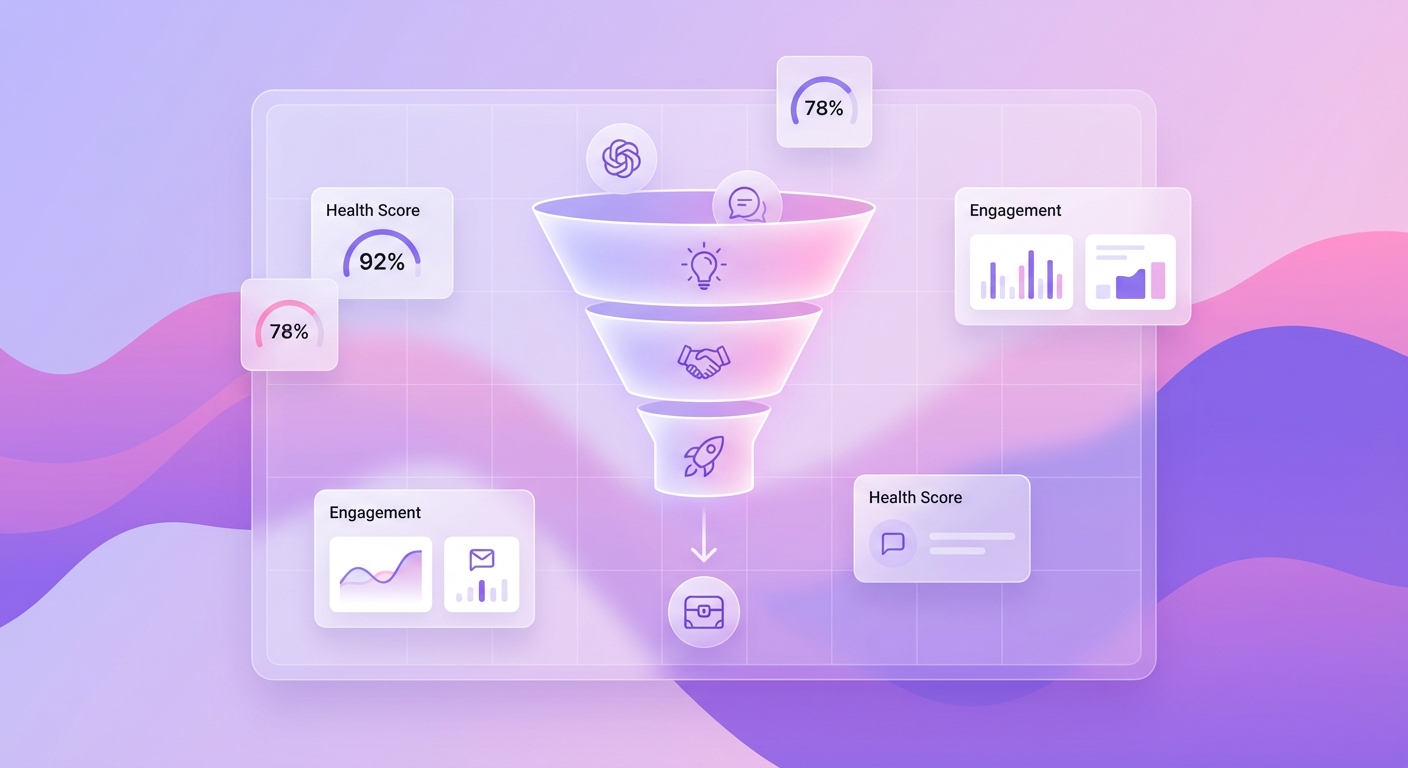
What revenue intelligence software actually does
Revenue intelligence is a category, not a single feature. Different platforms emphasize different pieces. But they all share the same core idea: aggregate every signal from your revenue process and use AI to surface what matters.
Here's what that means in practice.
Signal capture. The software ingests data from everywhere your revenue team operates. CRM records. Email threads. Calendar invites. Phone calls. Video meetings. Website visits. Product usage data. Chat logs. Most revenue teams generate thousands of these signals daily. No human can process them all. The software does.
Conversation intelligence. AI transcribes and analyzes every sales call and meeting. It flags risk signals (competitor mentions, budget objections, stakeholder drop-off), coaching opportunities (talk-to-listen ratios, question frequency), and deal progression indicators. Gong has analyzed over 3.5 billion sales interactions to build these models. That's a dataset no individual sales leader could ever process.
Pipeline analytics. Instead of relying on reps' subjective stage updates, the software scores each deal based on actual engagement signals. Is the economic buyer still responding to emails? Has meeting frequency increased or decreased? Are new stakeholders joining calls? Teams using revenue intelligence report 30% fewer slipped deals because they catch warning signs weeks earlier than manual inspection.
Forecast modeling. This is where the AI earns its keep. Traditional forecasting relies on reps' gut feel and manager judgment calls. AI-powered forecasting connects past trends with current deal signals to make predictions that are up to 89% accurate, which is 34% better than older systems. One 300-person software company reduced forecast variance from plus-minus 18% to plus-minus 7% within one quarter of implementation. That kind of accuracy changes how a CFO plans headcount, marketing spend, and cash flow.

Why 2026 is different from 2023
Revenue intelligence isn't new. Gong launched in 2015. Clari has been around since 2014. But the AI capabilities available today are fundamentally different from what existed three years ago.
Here's what changed.
Large language models made conversation analysis actually useful. Old-school keyword spotting ("prospect mentioned competitor") was crude. Modern LLMs understand context, sentiment, and nuance. They can tell the difference between "we're also looking at Competitor X" (early research) and "our team really liked the Competitor X demo last week" (serious threat).
Multi-signal fusion. Early tools analyzed calls OR emails OR CRM data. Current platforms fuse all of them into a unified deal health score. A deal where the champion is responsive over email but going silent on calls triggers a different alert than one where all channels are cooling simultaneously.
Prescriptive recommendations. The software doesn't just tell you a deal is at risk. It tells you why and suggests what to do next. "Schedule a meeting with the VP of Engineering, who hasn't been involved since the technical evaluation. Deals at this stage without engineering buy-in close at 23% lower rates."
Real-time processing. Results show up during or immediately after calls, not in weekly reports. Your rep finishes a call and gets a summary, action items, and deal impact assessment within minutes.
The revenue intelligence tools worth evaluating
I've tracked this market closely. Here's an honest look at the major platforms.
Gong is the conversation intelligence leader. Over 4,500 customers including LinkedIn, PayPal, and Shopify. It records and analyzes every sales interaction, surfaces coaching insights, and increasingly offers pipeline management and forecasting. A 150-person SaaS company reported a 17% increase in win rate and 22% reduction in sales cycle length within 6 months of implementing Gong, attributing $2.4M in additional ARR to better conversation intelligence. Pricing runs roughly $100-150/user/month.
Clari is the forecasting and pipeline visibility leader. It excels at turning messy pipeline data into accurate revenue predictions. Clari positions itself as the first "Revenue Orchestration Platform," unifying data across the entire revenue process. Best for enterprise teams where forecast accuracy is the primary pain point. Pricing starts at roughly $1,080/user/year for the Copilot module, with the full platform running higher.
Here's the thing most people miss: Gong and Clari aren't really competitors. They solve different problems. 40% of Gong customers also run Clari. Gong tells you what happened on the call. Clari tells you what's going to happen with the deal.
Avoma is the mid-market alternative. It handles conversation intelligence, note-taking, CRM sync, and pipeline analytics in one platform. An enterprise RevOps team replaced three forecasting spreadsheets with a single Avoma dashboard, improving forecast accuracy by 32%. It's significantly cheaper than the Gong + Clari stack.
Warmly approaches revenue intelligence from the website side. It identifies anonymous visitors, scores them by intent, and routes high-value prospects to sales in real-time. This is the piece most revenue intelligence stacks miss: what's happening before the first conversation. While Gong analyzes calls and Clari predicts outcomes, Warmly catches the deals you'd otherwise never know about.
Tellius is the analytics layer. It sits on top of your existing tools and uses AI to answer ad-hoc revenue questions. "Why did Q2 deals in financial services close 15% slower than Q1?" You ask in plain English. It queries your data and gives you the answer.
How to calculate revenue intelligence ROI before buying
The numbers look great in vendor case studies. But you need to run your own math. Here's the framework I use.
Start with forecast accuracy improvement. If your current forecast variance is plus-minus 15% and a revenue intelligence tool gets it to plus-minus 7%, what does that mean for your business? Better forecasting means better hiring timing, better marketing budget allocation, and fewer end-of-quarter surprises.
Calculate the value of saved deals. If the tool catches 30% more at-risk deals in time for intervention, multiply that by your average deal size and your save rate. For a team with 100 deals per quarter at $50K average, saving even 5 additional deals is $250K per quarter.
Factor in rep productivity. Sales teams using revenue intelligence save 2-3 hours per week per rep on manual CRM updates, call note-taking, and forecast preparation. For a 20-person team at $100/hour fully loaded cost, that's $200K-$300K per year in recaptured time.
Subtract the total cost. A Gong + Clari stack runs roughly $400-550/user/month. For a 20-person team, that's $96K-$132K per year. Most mid-market tools come in at $50-150/user/month. In the Forrester Total Economic Impact study, organizations saw benefits of $12.1 million over three years against implementation costs of $2 million, resulting in a net present value of $10 million. The ROI is real. But only if your team actually uses the tool, which brings us to implementation.
Five warning signs you need revenue intelligence software yesterday
Not sure if your team actually needs this? Here's how to tell.
Your forecast commits keep slipping. If more than 15% of "committed" deals don't close in the quarter they were forecasted, your pipeline visibility is broken. Revenue intelligence fixes this by replacing gut-feel staging with data-driven deal scoring.
Reps are sandbagging or over-inflating. Some reps always predict conservatively. Others are eternal optimists. Both patterns destroy forecast reliability. AI models don't have ego. They score deals based on engagement signals, not personality types.
Deals go dark without warning. If you regularly discover that a $100K deal died two weeks ago and nobody noticed, your CRM hygiene is failing you. Revenue intelligence tools flag engagement drops in real-time, usually before the rep even realizes the champion has stopped responding.
Your sales manager spends Monday mornings interrogating reps about deal status. That's a sign your pipeline inspection process is manual. A good revenue intelligence dashboard eliminates the "what's happening with Account X?" meetings entirely. The data is just there.
You can't answer "why did we lose?" If post-mortems are based on what the rep remembers rather than what actually happened, you're learning nothing from losses. Conversation intelligence gives you the tape. You can hear exactly where the deal went sideways.
If three or more of these hit home, the ROI on a revenue intelligence platform will be obvious within your first quarter.
The implementation playbook that actually works
I've seen plenty of revenue intelligence rollouts fail. Not because the tool was bad, but because the rollout was. Here's the sequence that works.
Month 1: Record everything. Just install the conversation recording. Don't change any processes. Don't build dashboards. Don't mandate adoption. Just let the data accumulate. Reps need to get comfortable being recorded before you ask them to act on the insights.
Month 2: Show, don't tell. Pull three specific examples from recorded calls where the AI caught something a manager would have missed. A competitor mention nobody flagged. A stakeholder who went silent. A pricing objection the rep didn't address. Share these in team meetings. Let the value sell itself.
Month 3: Build your first workflow. Pick one use case. "When a deal over $50K shows declining engagement, alert the account executive and their manager." One workflow. One trigger. One action. Prove it works.
Month 4+: Expand systematically. Add forecast roll-ups. Add coaching scorecards. Add pipeline health dashboards. But each addition should solve a specific problem your team is already feeling. The teams that try to deploy every feature in week one burn out their reps and kill adoption.
Revenue intelligence is a flywheel. It gets better as more data flows through it. Give it time.
One more implementation tip that gets overlooked: get your best rep on board first. Not your most junior rep. Your best performer. When the top seller says "this actually helped me close that deal," the rest of the team listens. Executive mandates create compliance. Peer endorsement creates adoption.

What revenue intelligence looks like for different team sizes
This isn't a one-size-fits-all category. Your stack should match your team.
5-15 reps (startup/scale-up). You don't need Gong and Clari and a data warehouse. Pick one tool. If your biggest problem is coaching reps, start with conversation intelligence (Gong, Avoma, or Claap). If your biggest problem is pipeline visibility, start with forecasting (Clari or Forecastio). Pair either with Warmly for website intelligence and you've got a full-funnel view for under $3K/month.
15-50 reps (mid-market). This is where stacking makes sense. Conversation intelligence plus pipeline analytics plus website identification. Budget $5K-$15K/month. The key at this stage is integration. Every tool should push data to your CRM automatically. If reps have to manually update anything, they won't.
50+ reps (enterprise). Full platform play. Gong for conversations. Clari for forecasting. Warmly for website intelligence. Tellius or your own BI layer for custom analytics. Budget $20K-$50K+/month. At this scale, the ROI math is straightforward: saving one additional enterprise deal per quarter pays for the entire stack.
The mistake I see most often: small teams buying enterprise tools because the demo was impressive. A $100K/year platform is wasted on a 10-person team that needs better call recording. Match the tool to the pain.
Revenue intelligence and website visitor data: the missing connection
Most revenue intelligence platforms have a blind spot: they only track prospects after the first interaction. But your buyers are researching you long before they book a demo. They're visiting your website, reading your case studies, comparing your pricing page to competitors.
Website deanonymization tools like Warmly fill this gap. They identify the companies and individuals visiting your site before any form fill or meeting request. When that data feeds into your revenue intelligence platform, you get a complete picture of the buyer journey.
Imagine knowing that your prospect visited your pricing page three times in the past week before they jumped on a discovery call. That changes how your rep runs the conversation.
The best revenue intelligence stacks in 2026 combine conversation data (Gong), pipeline forecasting (Clari), and pre-funnel website intelligence (Warmly). That's full-funnel visibility.
Frequently asked questions
How much does AI-powered revenue intelligence software cost?
It depends on the platform and your team size. Gong runs roughly $100-150/user/month. Clari's Copilot module starts at about $1,080/user/year, with the full platform costing more. Mid-market alternatives like Avoma and Jiminny come in at $50-100/user/month. For a 20-person sales team, expect to spend $12,000-$132,000 per year depending on which platforms you stack. The Forrester study found organizations see $12.1M in benefits over three years against $2M in costs.
Do I need a data team to implement AI revenue intelligence software?
No. Modern platforms are built for RevOps and sales leadership, not data engineers. Installation typically means connecting your CRM, email, calendar, and video conferencing tools through native integrations. Most setup takes 1-2 weeks. The AI models are pre-trained on billions of interactions and improve automatically with your data. Where you might want technical help: custom dashboard building, Salesforce workflow automation, and data warehouse integrations. But the core product works out of the box.
What's the biggest mistake teams make with AI revenue intelligence software?
Trying to change everything at once. I've watched teams launch Gong, Clari, and three other tools simultaneously, then mandate that reps use all of them from day one. Adoption craters. Reps feel surveilled rather than supported. Managers drown in dashboards they don't understand. Start with one tool, one use case, and one workflow. Prove value. Build trust. Then expand.
How accurate is AI-powered sales forecasting compared to manual methods?
AI-powered forecasting hits up to 89% accuracy, which is 34% better than traditional methods. Some teams report achieving 98% accuracy after tuning their models for 2-3 quarters. Manual forecasting averages about 78% accuracy industry-wide. The gap comes from AI's ability to analyze thousands of signals simultaneously, things like email response times, call sentiment, stakeholder engagement patterns, and historical win/loss data that no human can process at scale.
Can revenue intelligence software integrate with my existing CRM?
Yes. Every major platform integrates natively with Salesforce, HubSpot, and most other CRMs. The integration is bidirectional: the revenue intelligence platform pulls data from your CRM and pushes insights back. The CRM remains your system of record. Revenue intelligence sits on top as the analysis layer. Most teams find that CRM data quality actually improves because the AI fills in activity data that reps would normally forget to log.
Your pipeline is telling you something. Start listening.
Every email, every call, every website visit contains signals about whether a deal will close. Revenue intelligence software reads those signals at a scale and speed no human team can match. The ROI is documented. The tools are mature. The teams using them are winning more deals, forecasting more accurately, and coaching more effectively.
Pick the tool that solves your biggest pain point today. Install it. Let it run for 90 days. Then decide whether to expand. The data is already there. You're just not reading it yet.