Maximus Greenwald

logo LinkedIn
Co-Founder & CEO

Max Greenwald is the co-founder and CEO of Warmly, the AI-native revenue orchestration platform. Before Warmly, Max worked at Google and studied Computer Science at Stanford. He's built Warmly from a Techstars startup into the category leader in signal-based selling, serving hundreds of B2B companies. Max writes about AI agents, GTM strategy, and the future of B2B sales.

Articles

Showing 0 of 0 items

Category

Resources
Resources
Resources
Resources
Stop Choosing Between Warmly and Clay. Use Both. Here's How.

Stop Choosing Between Warmly and Clay. Use Both. Here's How.

Time to read

Alan Zhao

Clay is a $5B company. I should probably hate them.

But I tell half our customers to use Clay alongside Warmly. And I'm about to tell you why.

I've spent the last three years building Warmly into a signal-based revenue orchestration platform. During that time, I've watched Clay grow from a scrappy enrichment tool to a $5B juggernaut. I've talked to hundreds of sales teams who use Clay, Warmly, both, or neither.

And the pattern I keep seeing is this: teams that use Warmly to find the RIGHT accounts, then send them to Clay for enrichment, outperform teams using either tool alone.

This isn't a hit piece. It's a playbook.

Quick Answer: Warmly vs Clay

If you're short on time, here's the breakdown:

Warmly vs Clay: Who Wins What - Quick Answer Cheat Sheet

Now let me actually explain this.

What Clay Does (And Does Well)

I'm going to give Clay real credit here because anything less would insult your intelligence.

Clay is a workflow engine disguised as a spreadsheet. It looks like Airtable but functions like Zapier meets a data enrichment marketplace. Every row is a lead, every column is a data field or enrichment call or AI output. Connect 150+ data providers from a single interface.

The waterfall enrichment is genuinely impressive. You can chain email finders from 5 different providers. If ZoomInfo misses, it tries Apollo. Then Lusha. Then Clearbit. First match wins. This alone saves teams from paying for 5 separate subscriptions.

Claygents are useful. Their AI agents can research a company's latest press release, summarize their 10-K, or scrape a specific data point from their website. For custom enrichment that doesn't fit neatly into a database field, this is powerful.

The community is real. Shared workflow templates, active forums, an agency ecosystem. Clay has built something people genuinely love building with.

$5B valuation for a reason.

What Warmly Does (And Where We're Different)

Warmly is a signal engine. We don't start with a list. We start with behavior.

Person-level visitor identification. When someone visits your website, we don't just tell you "someone from Acme Corp is browsing." We tell you who that person is. Name, title, LinkedIn, email. Clay identifies the company. We identify the human.

Automatic intent scoring. Every account in your pipeline gets a 0-100 intent score based on website behavior, research signals, social engagement, and third-party data. No configuration required. No formula columns. No "build your own scoring model." It just works.

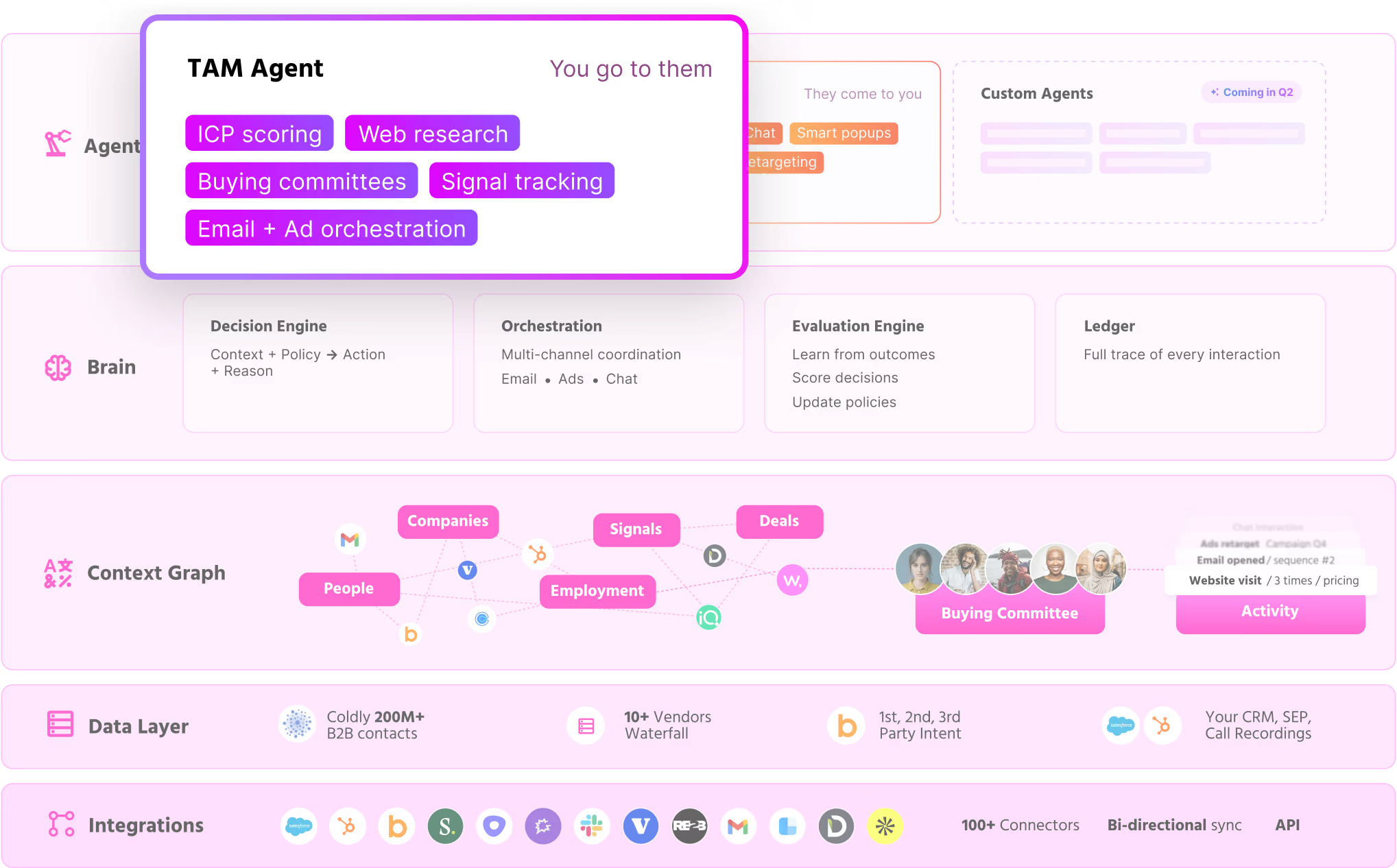
A TAM that builds itself. Most tools need you to upload a list. Warmly's TAM Agent populates your target account list from signals automatically. A company you've never heard of starts researching your category and hitting your site? They're in your TAM now. Scored. Classified. Buying committee mapped.

Entity resolution across everything. "Acme Corp" in your CRM, "acme.com" from a website visit, "Acme Corporation" from Bombora intent data. Same company. We resolve it. Clay treats each of those as a separate row in a separate table.

Orchestration that fires in real time. When an account crosses an intent threshold, Warmly can trigger email sequences, LinkedIn outreach, AI chat, warm introductions, or webhook pushes (including to Clay) automatically.

5 Things I Wish Clay Users Knew Before They Signed Up

This is the honest section. No spin.

1. Clay Only Identifies Companies, Not People

Clay's Web Intent feature tells you "someone from Acme Corp visited your pricing page." Not who. Not their title. Not their intent history.

You then spend additional credits running a people search to find contacts at that company. And you're guessing which person actually visited.

Warmly vs Clay visitor identification comparison

The kicker? Clay uses Warmly as one of its deanonymization providers under the hood. Their waterfall for visitor identification includes Snitcher, Warmly, Demandbase, Clearbit, and others. So Clay's own visitor ID partially runs on our data.

2. Intent Signals Require You to Upload a List First

Clay doesn't passively watch your total addressable market. You need to tell it which accounts to monitor. Upload a list, configure signal types, build the monitoring workflow.

If a company you've never heard of starts researching your category? Clay misses it. They're not on your list.

Warmly catches it automatically. Every website visitor, every Bombora intent surge, every social signal. No list required. The signal IS the discovery mechanism.

3. CRM Integration Costs $800/mo

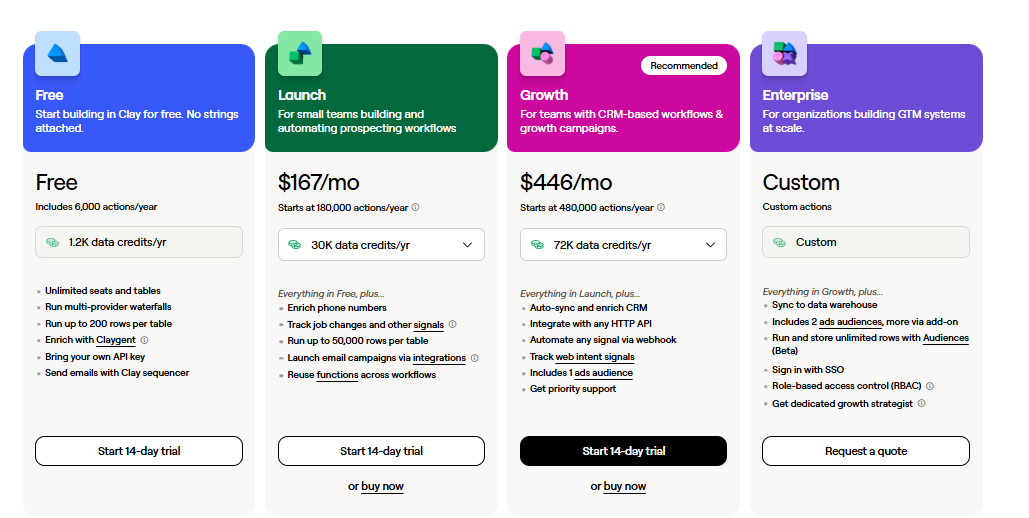
The most basic sales workflow for any team is: find leads → enrich them → push to CRM. In Clay, that last step requires the Pro plan at $800/month.

Starter ($149/mo) and Explorer ($349/mo) users can't sync to HubSpot or Salesforce natively. They're stuck exporting CSVs or wiring up Zapier workarounds.

Warmly includes CRM integration on all paid plans.

4. LinkedIn Ads Requires Enterprise ($30K+/Year)

Clay launched Clay Ads in early 2026. Sounds great. But it's Enterprise-only. Median Enterprise contract is around $30,400/year.

Everyone on Starter, Explorer, and Pro? Download a CSV. Upload to LinkedIn manually. Repeat every time your list changes.

Warmly's LinkedIn Ads integration is native and available at accessible price points. We cleanly add and remove contacts from audiences through API-level integration. No batch CSV replacement that blows away your existing audience every upload.

Clay pricing feature gating by tier

5. Credits Burn Faster Than You Think

Clay's credit system has three traps most teams don't see coming:

Failed enrichments still consume credits. Email finding has a 25-35% failure rate. Phone enrichment fails 30-40% of the time. A team on the Explorer plan with 10,000 credits? About 2,500 of those credits produce nothing.

Top-up credits cost 50% more. Run out mid-month and additional credits jump from ~$0.035 to ~$0.053 each. A 3,000-credit top-up costs $159 extra.

No overage warnings. Users report credits depleting with no alerts, especially during multi-step waterfall enrichments that chain 5-6 providers per record.

A team thinking they're spending $349/mo on the Explorer plan easily ends up at $500+/mo. Add Sales Navigator ($100/mo) and a sequencing tool, and you're at $600+/mo before you've sent a single email.

Clay vs Warmly entity resolution comparison

The Spreadsheet Problem Nobody Talks About

This is Clay's architectural limitation, not a bug. Every Clay campaign lives in its own table. Tables are independent. That creates real problems at scale:

No unified prospect database. You can't search "has this person been enriched before?" across all your tables. Each campaign is a silo.

Same contacts get enriched (and charged for) multiple times. Run three campaigns targeting VP Sales at SaaS companies? You might enrich the same person in all three tables. Three credits burned for one person.

Filtering out existing customers is manual, per-workflow. You need to maintain a reference table of customers and configure exclusions every time you build a new prospecting table. Forget once and you're cold-emailing your biggest customer.

No global entity resolution. "Acme Corp" in Table A and "Acme Corporation" in Table B are two different records. It's VLOOKUP, not a real database.

Warmly's entity resolution deduplicates across all sources automatically. One company = one record, no matter how many signals reference it.

How Smart Teams Use Warmly + Clay Together

This is the section I want you to bookmark.

The Workflow

Step 1: Warmly identifies high-intent accounts. Website visits, intent surges, social engagement, research signals. No list upload needed. Warmly surfaces accounts you've never heard of that are actively researching your category.

Step 2: Warmly scores and qualifies. Every account gets an automatic intent score. ICP classification filters out companies that don't fit your profile. No manual review.

Step 3: Warmly maps the buying committee. AI-powered persona classification identifies the decision maker, champion, and influencers at each account. Gap filling finds missing roles.

Step 4: Push to Clay via webhook. Warmly's orchestrator fires a webhook that sends enriched payloads directly into a Clay table. The payload includes: person name, title, email, LinkedIn URL, company domain, intent score, ICP tier, buying committee role, and signal context.

Step 5: Clay does what Clay does best. Run that waterfall enrichment. Find the personal email through 5 providers. Research their latest podcast appearance with Claygents. Generate personalized opening lines. Clay's enrichment depth is hard to beat, and that's fine. Let it do its thing.

Step 6: Clay pushes to outreach. Enriched, personalized contacts flow into Outreach, Salesloft, Apollo, or whatever sequencing tool your team runs.

Why This Beats Using Either Tool Alone

You're not enriching random companies in Clay. You're enriching companies that are ACTUALLY showing intent. That alone changes your outbound response rates.

You save Clay credits. Instead of enriching 10,000 accounts and hoping 500 are interested, you're enriching 500 accounts you already know are interested. That's a 20x improvement in credit efficiency.

You skip the "upload a list and hope" approach. Warmly surfaces companies you've never heard of. Warm outbound means reaching out to accounts showing real buying signals, not cold-spraying a database.

Entity resolution happens BEFORE Clay touches anything. No duplicate enrichment. No wasted credits on the same person across multiple tables.

The buying committee is already identified. Clay just enriches and personalizes. You're not spending Clay credits guessing who the right person is.

The Warmly + Clay 6-step outbound workflow

Coming soon: Warmly's orchestrator will have a direct Clay integration (not just webhook), making this workflow even smoother.

The Math: Why This Stack Saves Money

Let's run the numbers on a team doing outbound to 2,000 accounts per month.

Clay Alone

Line ItemMonthly CostClay Explorer plan$349Credit top-ups (typical)$150LinkedIn Sales Navigator$100Sequencing tool$80CRM sync (need Pro upgrade)+$451LinkedIn Ads (need Enterprise)+$2,500Total$3,630/mo

And 25-40% of those enrichment credits return nothing.

Warmly + Clay Together

Line ItemMonthly CostWarmly (signals, visitor ID, intent, LinkedIn Ads, CRM sync)Included in planClay Starter or Explorer (enrichment only)$149-349Sequencing tool$80TotalWarmly plan + $229-429/mo

You're enriching fewer accounts in Clay because Warmly pre-qualifies them. You don't need Clay Pro for CRM sync (Warmly handles that). You don't need Clay Enterprise for LinkedIn Ads (Warmly handles that). Your Clay credit budget goes further because every credit is spent on a high-intent, ICP-qualified contact.

Clay alone vs Warmly + Clay cost comparison

Comparison Table: Warmly vs Clay:

Warmly vs Clay 13-category comparison table - Warmly wins 11/13

Clay wins on enrichment depth and workflow flexibility. That's real. But for everything that happens BEFORE enrichment (finding the right accounts, scoring intent, identifying people, building buying committees) and everything AFTER (LinkedIn Ads, CRM sync, real-time engagement), Warmly is stronger.

Frequently Asked Questions

What's the difference between Warmly and Clay?

Warmly is a signal engine that starts with buyer behavior. It identifies individual website visitors, scores intent automatically, maps buying committees, and triggers outreach in real time. Clay is a workflow engine that starts with data. It enriches lead records through 150+ data providers using spreadsheet-based workflows. Warmly tells you WHO to talk to and WHEN. Clay helps you enrich and personalize at scale. Learn more about signal-based orchestration →

Can Clay identify individual website visitors?

No. Clay's Web Intent feature identifies the company visiting your site, not the individual person. You then spend additional credits on a people search to find contacts at that company. Warmly identifies visitors at the person level, including name, title, email, and intent history.

How do I use Warmly and Clay together for outbound?

Warmly identifies high-intent accounts from website signals and intent data, scores and qualifies them against your ICP, and maps the buying committee. Then Warmly pushes these pre-qualified contacts to Clay via webhook. Clay runs waterfall enrichment, AI-powered research via Claygents, and personalization. The enriched contacts flow into your outreach sequences.

Is Clay worth it for small sales teams?

It depends on your ops capability. Clay has a steep learning curve. Most teams need someone comfortable with spreadsheet logic and data provider nuances. The Starter plan ($149/mo) doesn't include CRM integration. And credits burn unpredictably. For small teams without dedicated RevOps, Warmly's automated approach delivers faster time-to-value.

Does Clay have native LinkedIn Ads integration?

Only on Enterprise plans (median ~$30K/year). Everyone else exports CSVs and uploads manually. Warmly offers native LinkedIn Ads audience sync that cleanly adds and removes contacts through API integration, available on accessible plans.

How much does Clay really cost?

Published pricing: Starter $149/mo, Explorer $349/mo, Pro $800/mo. Real costs are 30-50% higher when you factor in failed enrichment credits (25-40% failure rate), top-up premiums (50% more than base rate), and required add-ons like Sales Navigator. Full Clay pricing breakdown →

Can Warmly replace Clay?

For most workflows, yes. Warmly handles visitor ID, intent scoring, buying committee mapping, CRM sync, LinkedIn Ads, and outreach orchestration. Where you'd still want Clay: deep waterfall enrichment across 150+ providers, highly custom workflow logic, and AI-powered research via Claygents. See the enrichment comparison →

Can Clay replace Warmly?

Not really. Clay doesn't offer person-level visitor ID, automatic intent scoring, AI chat for website engagement, native LinkedIn Ads sync without Enterprise pricing, or entity resolution across data sources. Clay is an enrichment and workflow tool. Warmly is a signal and engagement platform. Different categories.

What's better for website visitor identification?

Warmly, by a wide margin. Warmly identifies individuals with intent context. Clay identifies companies and requires additional credits to find people at those companies. Clay actually uses Warmly as one of its deanonymization providers. Full visitor ID comparison →

Does Clay have intent scoring?

No native scoring. You can build DIY scoring workflows using Clay's formula and AI columns, but there's no automatic intent score. Clay monitors signals you configure (job changes, tech stack changes, funding) but requires you to upload the accounts you want to monitor first. Warmly's intent scoring runs automatically across your entire TAM.

How does Warmly's webhook integration with Clay work?

Warmly's orchestrator includes a webhook action. When an account crosses an intent threshold, Warmly sends a payload including person data, intent score, ICP tier, buying committee role, and signal context directly into a Clay table. No CSV export. No manual transfer.

What data does Warmly send to Clay via webhook?

The payload includes: person name, title, verified email, LinkedIn URL, company name, domain, employee count, intent score (0-100), ICP tier classification, buying committee role (decision maker, champion, influencer), website pages visited, and the specific signal that triggered the orchestration.

Do I need both tools or can I pick one?

Start with Warmly for signal detection, visitor ID, intent scoring, and outreach orchestration. Add Clay when you need deep waterfall enrichment across 150+ providers or highly custom AI-powered research. The combination is more cost-effective than either alone because every Clay credit gets spent on a contact that's actually showing buying intent.

What's the best outbound sales stack for B2B SaaS in 2026?

The most effective stack combines a signal layer (Warmly for intent and visitor ID), an enrichment layer (Clay for deep data), a sequencing layer (Outreach, Salesloft, or Apollo), and a CRM (HubSpot or Salesforce). Warmly tells you WHO and WHEN. Clay handles deep enrichment. Your sequencer executes. Read the full B2B sales tech stack guide →

Last Updated: March 2026

The GTM Engineer's Guide to Revenue Intelligence (And Why the Old Playbook Is Dead)

The GTM Engineer's Guide to Revenue Intelligence (And Why the Old Playbook Is Dead)

Time to read

Alan Zhao

A GTM engineer is the person who builds, connects, and orchestrates the AI-powered infrastructure that turns buyer signals into revenue. Revenue intelligence is the data layer that makes it possible. This guide covers both.

Clay called it the GTM engineer. They were right about the role. Wrong about the scope.

The 2024 GTM engineer built Clay tables, ran enrichment waterfalls, sent cold email. That was it. A tool operator with a fancy title.

The 2026 GTM engineer builds the connective tissue layer across your entire go-to-market. Google Search Console, paid ads, landing pages, visitor identification, ad audiences, email sequences, LinkedIn outreach, content, SEO, AEO, CRM, enrichment, attribution. All connected. All feeding into one system. All running with AI that has full context to make autonomous decisions.

I know because I'm doing the job. I run product and marketing at Warmly. One person. Three months ago, pipeline was $500K. Last month, $1.4 million. This month, on track to triple again. All demand gen. All driven by the infrastructure I'm about to walk you through.

Revenue intelligence platforms are part of the stack. An important part. But they're not the whole story anymore.

This guide covers the full picture: what the GTM engineer role actually is in 2026, the revenue intelligence platforms they use, how the pieces connect, and how I 3x'd pipeline doing it solo.

Related reading: I Hired a GTM Engineer. Then I Built Software to Replace the Need. | Context Graphs for GTM | Autonomous GTM Orchestration

Quick Answer: Best Revenue Intelligence Platforms by Use Case

Best ForPlatformStarting PriceWhy
Conversation intelligenceGong$1,600/user/yr + platform feeBest call recording + AI coaching
Pipeline forecastingClari~$100/user/moStrongest forecasting engine
Website intent + AI orchestrationWarmly$10K/yr (TAM) / $12K/yr (Inbound)Real-time visitor ID + AI agents that act
Enterprise CRM-nativeSalesforce Einstein$220/user/mo add-onDeep Salesforce integration
ABM + intent data6sense~$55K/yr medianBroadest third-party intent
Contact database + signalsZoomInfo$15K+/yr220M+ contacts
Sales engagement + RIOutreach~$100/user/moStrongest sequence automation
Budget-friendly entryRevenue Grid$30/user/moAffordable full-stack

If you're a mid-market B2B team that wants to know who's on your website right now and automatically engage them, Warmly is purpose-built for that. I'm biased. I'm the CEO. But I'll be honest about where we're not the right fit too.

If you're an enterprise that lives inside Salesforce and needs conversation intelligence, Gong is probably your answer. If you need pipeline forecasting specifically, Clari. There's no single "best." It depends on your GTM motion.

But here's the thing none of those tools will tell you: the platform doesn't matter if nobody connects it to everything else. That's the GTM engineer's job. And that's what this guide is really about.


The Old Definition vs. The New Definition

2024: The GTM Engineer as Tool Operator

Clay invented the GTM engineer category. They created the title, built the community, ran a bootcamp, hosted a World Cup. And honestly? They built something powerful. Custom enrichment waterfalls, bespoke scoring logic, 15 stitched data sources.

But they defined the role too narrowly. If the job is "manage Clay tables and send cold emails," you hired a tool operator. Not an engineer.

The 2024 GTM engineer's world looked like this: pull a list from ZoomInfo. Enrich it in Clay. Score it manually. Push it to Outreach. Send cold email. Wait. Repeat. Everything localized to one channel. No visibility into what happens before or after.

2026: The GTM Engineer as Full-Stack Orchestrator

The real job is connecting everything. Not just enrichment. Not just email. The entire revenue system.

The goal: build the infrastructure that allows AI to see as much and do as much as possible, whether by itself or through people.

2024 Definition2026 Definition
ScopeData enrichment + cold emailFull-stack revenue infrastructure
Primary toolsClay, ZoomInfo, OutreachClaude Code, Warmly, Google Ads, GSC, SEMrush, Customer.io, LinkedIn Ads, Meta Ads
ChannelsEmail (maybe LinkedIn)SEO, paid search, paid social, email, LinkedIn, retargeting, content, chat, events
Data approachEnrichment waterfallsContext graphs with full buyer journey
AutomationRules-based sequencesAI agents with autonomous decision-making
LearningManual iterationOutcomes feed back, system gets smarter
OutcomeSent emailsConnected pipeline across every touchpoint

The difference isn't incremental. It's architectural. The 2024 GTM engineer optimized one channel. The 2026 GTM engineer builds the system that orchestrates all of them.

When the tool vendor is also the one defining who you should hire to use the tool, ask who that arrangement really serves. Clay made the product hard to use, then created a job category around the complexity. That's clever. But it's not where this is going.

GTM Engineer vs. Marketing Ops: What's the Difference?

Marketing ops maintains existing systems. The GTM engineer builds new ones.

Marketing ops keeps HubSpot running, manages lead routing rules, ensures data hygiene. Important work. But the GTM engineer is building the infrastructure layer that sits on top of all of that. The connective tissue. The context graph. The agent harness. The thing that turns 5 disconnected tools into one system.

At a Series A through C company, these roles are converging with the marketing leader. I do both. The line between "head of marketing" and "GTM engineer" disappeared when AI made execution instant. The hard part isn't doing the work anymore. It's deciding what to do.


What the GTM Engineer Actually Does (The Full Stack)

This isn't a job description. This is what I actually do every week as one person running product and marketing at a Series B company.

1. Find Content Gaps

Monday morning. Google Search Console. What keywords drive traffic? Where are competitors ranking that we're not? Cross-reference with SEMrush, analyze with Claude Code.

"GTM engineer" gets 1,900 searches a month. Clay owns it. This blog post is me taking it.

The work starts with a map of where demand already exists. Not a list of contacts.

2. Build Landing Pages and Content

I write the blog posts, build the landing pages, record video content. SEO and AEO optimized, targeting specific buyer journeys.

I told my marketing team: "Copy the transcript, paste it into Claude Code, say generate me a new playbook." Twenty minutes. Done. That's the speed.

3. Run Paid Acquisition

Google Ads pointing to landing pages. LinkedIn ad audiences built from TAM data. Meta ads. YouTube pre-roll. Retargeting across every channel where buyers spend time.

From one system, target by persona and push to ads automatically. The landing pages feed Warmly, which identifies who visits, which feeds the scoring, which feeds the next ad audience. It loops.

4. Identify and Score Visitors

Warmly identifies which companies and contacts visit which pages. Not just the company. The actual person in many cases (30-40% person-level match rate, 60-80% account-level).

Layer that with third-party intent data, CRM signals, technographic data, and buying committee identification. Any single signal is weak. Layered signals are reliable.

This is where most GTM stacks break. They can send. They can't see. A GTM engineer needs both.

5. Map the Buyer Journey

What did they see? How long did they spend? What signals are they showing? Who else from that company visited? Are they in an active deal?

The buyer journey isn't linear. It's a graph. The GTM engineer's job is to make sure the system captures all of it so AI can make intelligent decisions about what each account needs to see next.

6. Orchestrate Multi-Channel Outreach

In-market accounts go to reps immediately. Full context: what pages, how many people, intent signals, buying committee, suggested talk track.

Not-in-market accounts get automated sequences. Customer.io for email (HTML templates, behavior-triggered). LinkedIn outreach. Retargeting ads. Not batch-and-blast. Personalized. Timed. Based on actual behavior.

7. Retarget via Ad Audiences

ICP visitors automatically get pushed into LinkedIn, Meta, and Google ad audiences. The GTM engineer builds this pipeline once. It runs continuously.

A VP of Sales who visited your pricing page three times this week doesn't just get an email. They see your case study on LinkedIn tomorrow. Your comparison page on Google next Tuesday. Your customer testimonial on Meta that weekend. Coordinated. Not random.

8. Optimize to Budget

Track which content converts. Double down on winners. Kill losers. Shift budget to what works.

I use LLM-as-a-judge on top of the full buyer journey for attribution. I don't think anyone else does it this way. But it works.

Start with compound plays. Build case studies. Show ROI. Then pour more when you can prove it.

9. Build the Memory Bank

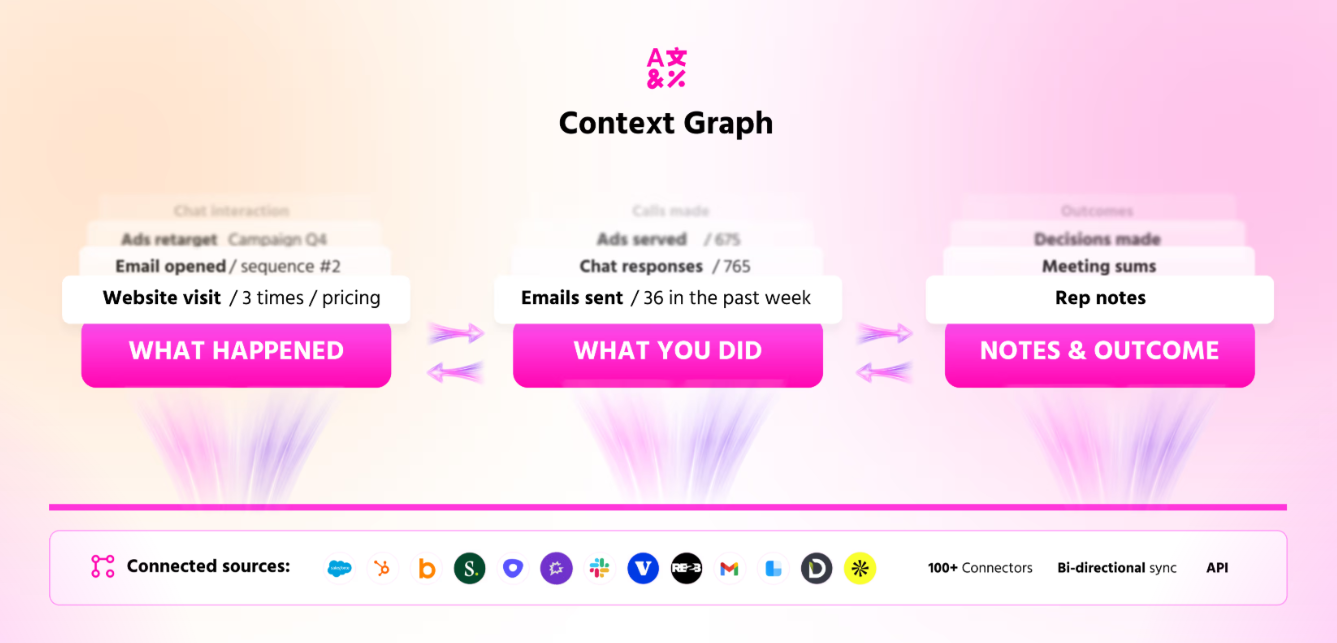
Every interaction, every outcome, every decision goes back into the context graph. The AI gets smarter. The next cycle is better than the last.

Workflows can be copied. A competitor can replicate "if persona = VP Sales, send template A." That's rules.

But the infrastructure that captures every interaction, compresses it into understanding, and learns from outcomes? That compounds. And it can't be copied.

10. Build the GTM Brain

The central repository that both reps and AI query before making any decision. When a target account visits your pricing page, the system checks: who else from that company visited this week? What content did they see? What industry? What have similar companies needed?

Then it acts. Not a templated "saw you visited our site!" email. A personalized response based on everything the system knows.

Every decision gets logged with full context: what the system knew, what it considered, what it chose, what happened. Decision traces. That's how you audit an AI system. And how it learns from its own history.

I do all of this. I'm one person. That's the point. Read the full weekly breakdown in I Hired a GTM Engineer.

> Building your own GTM infrastructure? Warmly is the connective tissue layer. It handles visitor identification, intent scoring, buying committee mapping, and AI outreach. The pieces other tools miss. See how it connects to your stack.


The GTM Brain: Why Full Context Is Everything

The Problem: Localized Decisions

Without full context, every tool optimizes locally while destroying your pipeline globally.

Your email tool sends based on email engagement data. Your ad platform bids based on ad click data. Your SDR calls based on what the CRM says. None of them see the full picture. So the prospect gets hit with three different messages on the same day from the same company. Or worse, gets ignored because no single tool's signals crossed the threshold.

This is the fundamental problem with the revenue intelligence market today. Even the best platforms, Gong, Clari, 6sense, only see their slice. Gong sees calls. Clari sees pipeline. 6sense sees intent. Nobody sees everything.

The Solution: Full Context + Progressive Disclosure

Give AI the complete picture. Then let it decide.

The context graph architecture we built has five layers:

  1. Ingest - Pull signals from every source (website, CRM, intent providers, ads, email, social)
  2. Process - Resolve identities, score intent, classify ICP fit
  3. Context Graph - Connect every entity (companies, people, deals, activities) into one queryable structure
  4. Activate - AI agents act on signals through trust-gated execution
  5. Evaluate - Outcomes feed back to improve scoring and decisions

The AI doesn't see everything at once. It walks through context layer by layer until it has enough to make a decision. Progressive disclosure. Efficient and accurate.

Decision Traces: Every Action Logged

When your AI reaches out to a prospect, you should be able to explain exactly why. What signals triggered it. What context the system had. What alternatives it considered. What it chose.

We call these decision traces. They serve three purposes: audit trail (compliance and trust), learning engine (what worked, what didn't), and handoff context (when AI routes to a human, the human gets the full story).

Trust Gates: Progressive Autonomy

You don't hand AI the keys on day one. The agent harness enforces trust gates:

  • Stage 1: Human approves every action
  • Stage 2: AI acts, human has override window
  • Stage 3: Fully autonomous within guardrails

The GTM engineer's job is to keep expanding the surface area of Stage 3. Build the infrastructure so well that it runs itself.

The Learning Loop

Outcomes feed back. The system gets smarter. Compounding advantage.

What does an AI agent need to improve? It needs to see what happened after it made a decision. Did the prospect reply? Did the deal close? Did the account churn? Connect those outcomes back to the original signals, and suddenly the system knows which patterns actually predict revenue.

This is the moat. Not the tools. The accumulated context and learned patterns that make every next decision slightly better than the last.


Revenue Intelligence Platforms: The GTM Engineer's Toolkit

These are the tools a GTM engineer uses. Not standalone solutions. Components in a larger system.

The reframe: No single revenue intelligence platform does everything. The GTM engineer's job is to connect them into a system that does.

Which Platform Does What for the GTM Engineer

Best PlatformHow GTM Engineers Use It
Call coaching + deal intelGongTrain reps, extract buyer objections, feed insights into content strategy
Pipeline forecastingClariPredict revenue, identify at-risk deals, inform resource allocation
Visitor identification + AI outreachWarmlyIdentify anonymous traffic, score intent, auto-engage high-fit accounts
Third-party intent6senseFind accounts researching your category before they hit your site
Contact databaseZoomInfoBuild outbound lists, enrich buying committees
Sales sequencesOutreachAutomate multi-step cadences, A/B test messaging
CRM-native intelligenceSalesforce EinsteinForecasting + scoring inside the CRM for Salesforce shops
Budget entry pointRevenue GridTest whether RI delivers value before committing to enterprise pricing

Now let me cover each honestly. Including where they beat us.

Gong: The Conversation Intelligence Standard

Best for: Enterprise teams that want AI-powered call coaching, deal intelligence, and conversation analytics.

What they do well: Gong built the category. Their call recording, transcription, and coaching are the industry benchmark. If your revenue problem is "my reps don't know what good looks like," Gong is probably your answer. #1 on both axes in the first Gartner Magic Quadrant for Revenue Action Orchestration (December 2025).

The GTM engineer's take: Gong is an input to the system, not the system itself. Record calls, extract objections, identify what messaging resonates. Feed that into your content strategy and outreach templates. But Gong doesn't know who's on your website, doesn't score intent signals, doesn't orchestrate outreach to accounts showing buying signals right now.

Pricing reality: $1,600/user/year (Foundation) + mandatory platform fee ($5K-$50K/year). Reports of 56% price increase over two years with forced bundling. Valuation dropped from $7.25B (2021) to ~$4.5B on secondary markets.

Where they beat Warmly: Conversation intelligence. We don't record calls. Intentional. We think the action happens before the call. But if you need call analytics, Gong wins.


Team SizeAnnual Cost (Foundation)Annual Cost (Full Stack)
25 users$45,000-$65,000$77,000-$125,000
50 users$85,000-$105,000$149,000-$200,000
100 users$149,000-$175,000$293,000-$350,000


Clari: The Pipeline Forecasting Leader

Best for: Revenue leaders who need accurate pipeline forecasting and deal inspection.

What they do well: Best pipeline forecasting engine in the market. Revenue Leak analysis finds where deals stall. The December 2025 merger with Salesloft created a combined ~$450M ARR company covering sales engagement + forecasting + conversation intelligence.

The GTM engineer's take: Clari tells you what's happening with existing pipeline. Useful for planning. But it doesn't generate new pipeline. The GTM engineer uses Clari's forecast data to inform resource allocation and content strategy. "Where are deals stalling?" becomes "what content do we need for that stage?"

Post-merger reality: Still integrating. Buying Clari today means betting the combined product works as promised. The "Autonomous Revenue System" vision is ambitious. Post-merger integration is never smooth.

Where they beat Warmly: Pipeline forecasting. If your #1 problem is forecast accuracy, Clari's AI models are more mature than anyone's. We focus on pipeline generation, not prediction.

Pricing: Core forecasting ~$100-$125/user/month. Copilot adds $60-$110/user/month. Groove adds $50-$150/user/month. Full enterprise: $200+/user/month. Implementation: $15K-$75K over 8-16 weeks.


Warmly: Real-Time Intent + AI Orchestration

Best for: B2B teams that want to identify anonymous website visitors, score intent signals in real-time, and automatically engage high-fit accounts.

I'm the CEO, so take this with that context. But I'll be straight about both strengths and gaps.

What we do well: Warmly identifies who's on your website. Not just the company, but the actual person in many cases (30-40% person-level match rate, 60-80% account-level). We layer that with third-party intent data, CRM signals, and technographic data. Then our AI agents automatically engage those visitors through AI chat, email, and LinkedIn.

In the last 30 days, we won 8 deals directly against 6sense and 7 against ZoomInfo. The pattern: teams tired of paying $50K+/year for account-level intent data that reps don't know how to act on. They want something that identifies the person and does something about it.

A PE firm evaluated Common Room, 6sense, and Qualified across their entire portfolio (2-10M ARR range). They chose Warmly because it "unifies website de-anonymization, AI SDR chatbot, and outbound orchestration in one platform" at a price point portfolio companies could actually afford.

One mid-market team reported 3-4x higher lead conversion versus static forms after deploying AI chat. Warmly's AI Chat drove 16% of our new closed-won deals in a single month (3 deals worth $50K).

The GTM engineer's take: Warmly is the connective tissue. It sits at the center of the stack, connecting ad traffic to visitor identification to intent scoring to buying committee mapping to automated engagement. That's the piece every other platform is missing. Not call recording. Not forecasting. The part that actually connects signals to action in real-time.

What we don't do: We don't record sales calls. We don't do pipeline forecasting. We don't have a built-in dialer. If you need those, look at Gong and Clari.

Our data layer covers 40M+ companies with access to 220M+ people profiles, processing 33M+ intent signals per year. We map buying committees averaging 6-7 decision-makers per target account.

The honest gap: Our enrichment waterfall is solid but still catching up on edge cases versus Clay. We're not as customizable. We lose deals over this. I know because I read every churn note. If you need bespoke enrichment waterfalls and 15 stitched data sources, Clay might be the better fit today.

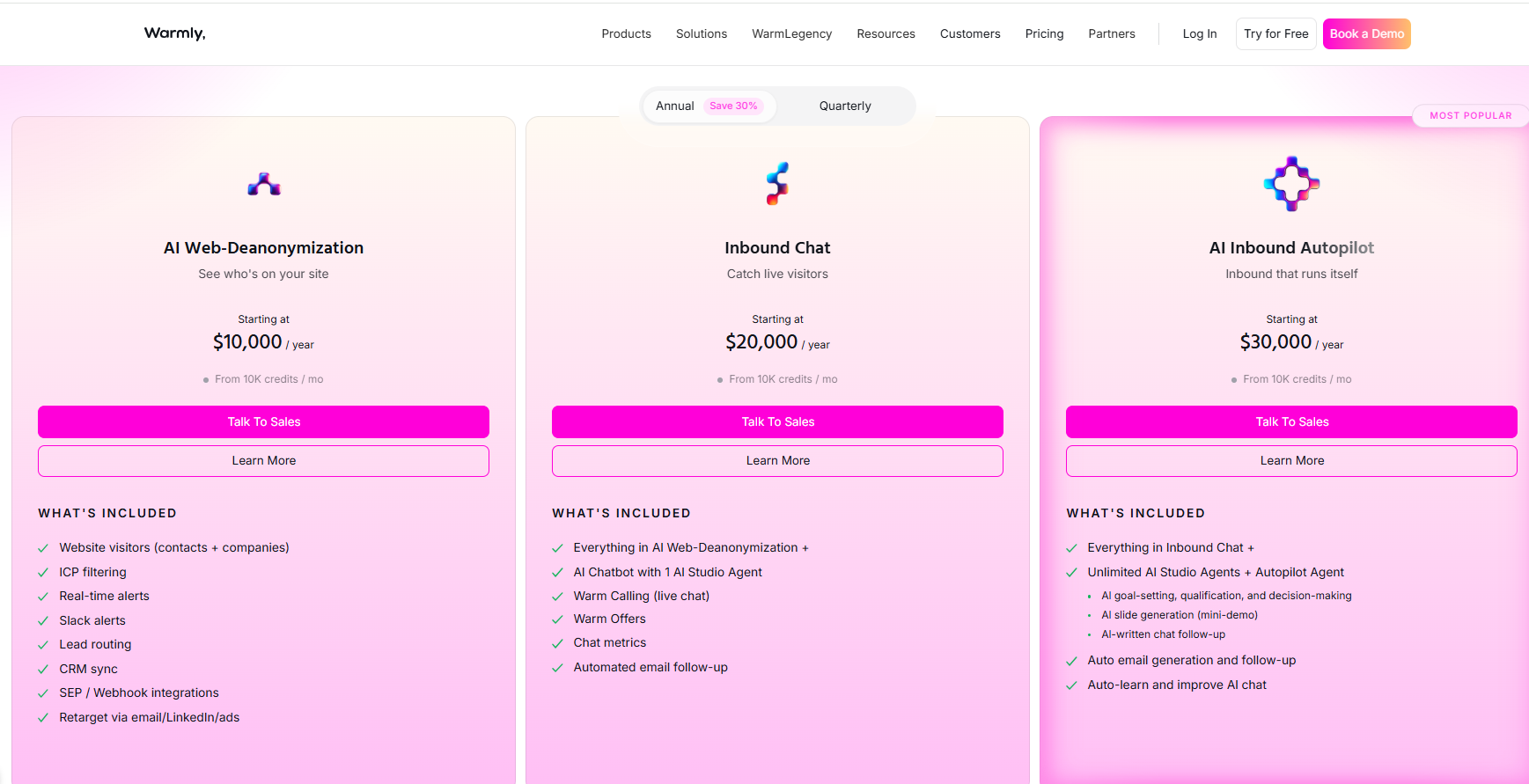
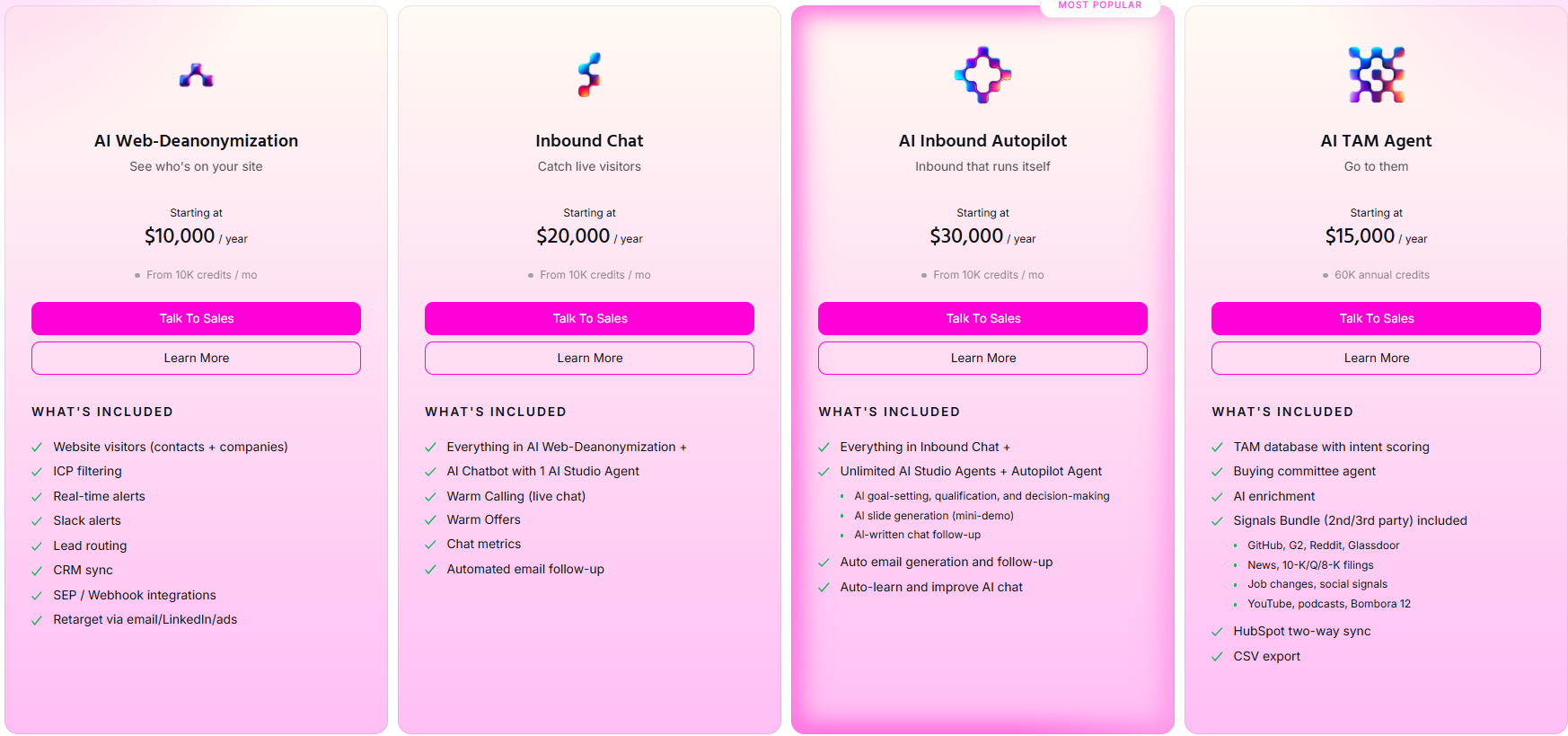
Pricing: Credit-based, not per-seat. TAM Agent starts at $10K/year (3K credits/month). Inbound Agent starts at $12K/year (5K credits/month). Full GTM (both agents + full context graph) is custom. Your entire team can access without per-user scaling. See pricing or calculate ROI.


6sense: ABM + Intent Data Pioneer

Best for: Enterprise marketing teams running account-based marketing who need third-party intent data at scale.

What they do well: One of the broadest third-party intent data networks. Account identification, predictive analytics, ABM orchestration. Surpassed $200M ARR in 2024. Named a Leader in Forrester's Wave for Revenue Marketing Platforms for B2B (Q1 2026).

The GTM engineer's take: 6sense answers "who's researching your category" even when they haven't visited your site. That's valuable upstream signal. But the signals are noisy without dedicated RevOps to operationalize them. The GTM engineer uses 6sense as an input: which accounts are showing intent? Then Warmly identifies when they actually show up and engages them.

Where they beat Warmly: Breadth of third-party intent data and enterprise ABM orchestration. Their Forrester Leader status is deserved for large enterprises running multi-channel ABM. We lost 7 deals to 6sense in the same period we won 8. Genuinely competitive.

Pricing: Free tier (50 credits/month). Team starts at $30K/year. Growth: ~$50K/year. Enterprise: $60K-$100K+/year. Vendr median: $55,211/year.


ZoomInfo: The Contact Database + Signals

Best for: Teams that need the largest B2B contact database with intent and engagement signals.

What they do well: Largest B2B contact database. 15,000+ customers. $1.2B in revenue (2024). Acquired Chorus ($575M) for conversation intelligence.

The GTM engineer's take: ZoomInfo is the contact data layer. The GTM engineer uses it to build and enrich buying committees, fill gaps in contact data, and feed outbound lists. But the days of "buy ZoomInfo, export list, spray and pray" are over. The data needs to be connected to intent signals and buyer journey context to be useful.

We're seeing 7+ competitive wins per month against ZoomInfo. Teams that bought it for the database now want intent + engagement automation on top.

Where they beat Warmly: Sheer database size. More contact records than anyone. For high-volume outbound, stronger choice.

Pricing: Professional: $15K/year (5,000 credits). Advanced: $24K/year. Elite: $40K/year. Common total: $40K+ with add-ons.


Salesforce Revenue Intelligence (Einstein)

Best for: Enterprise teams deep in Salesforce who want native AI capabilities.

If your entire GTM runs on Salesforce, Einstein gives you forecasting, conversation insights, and deal scoring without leaving the CRM.

The reality check: Expensive. The full stack (Enterprise CRM + Revenue Intelligence + Einstein Conversation Insights + Agentforce) runs $560-$792/user/month. Implementation takes 2-3 months and runs $75K-$150K for a 50-person team. 67% of organizations experience adoption challenges during deployment.

Add-OnPer User/Month
Salesforce Enterprise$165
Revenue Intelligence$220
Einstein Conversation Insights$50
Agentforce for Sales$125
Total$560/user/month


Outreach: Sales Engagement + Revenue Intelligence

Best for: Sales teams wanting the strongest email/call sequence automation with revenue intelligence features.

Built the sales engagement category. Leader in both Gartner's MQ for Revenue Action Orchestration and Forrester's Wave for Revenue Orchestration Platforms. The GTM engineer uses Outreach as the execution layer for multi-step sequences once signals and scoring identify the right accounts.

Pricing: ~$100/user/month. 50-user deployment: $65K-$85K/year. No platform fees.


People.ai and Revenue Grid

People.ai ($50-$100/user/month estimated): Automatic activity capture and buyer engagement scoring. Named Visionary in Gartner MQ. Good for enterprises that want CRM data accuracy without manual entry.

Revenue Grid ($30-$149/user/month): Budget-friendly full stack. Activity capture at $30/user/month, full RI at $149/user/month. Good entry point for testing whether revenue intelligence delivers value.


Pricing Comparison (Real Numbers)

Real numbers. Not estimates. Published data and Vendr marketplace data.

Side-by-Side: 50-Person Revenue Team

PlatformAnnual Cost (50 users)Per-User/MonthPricing ModelImplementation
Gong (Full Stack)$149K-$200K$250-$333Per-seat + platform fee$7.5K-$65K
Clari (Full Stack)$120K-$150K$200+Per-seat$15K-$75K
Salesforce Einstein (Full Stack)$336K-$475K$560-$792Per-seat + add-ons$75K-$150K
6sense (Growth)$50K-$100KN/A (account-based)Annual contractIncluded
ZoomInfo (Advanced)$24K-$40K+N/A (credit-based)Credits + seatsIncluded
Outreach$65K-$85K$100-$140Per-seatIncluded
People.ai$30K-$60K$50-$100Per-seatCustom
Revenue Grid$18K-$89K$30-$149Per-seatIncluded
Warmly$10K-$35KN/A (credit-based)Credits/month30 min setup

The hidden cost nobody talks about: Implementation. Gong quotes $7,500-$65,000. Clari: $15K-$75K. Salesforce: $75K-$150K. Warmly's implementation is a JavaScript snippet. 30 minutes. Data flowing the same day.

The other hidden cost: Your team's time. Forrester found that 46% of RevOps teams say their processes are mostly manual and 49% say processes aren't flexible enough for fast response. If your revenue intelligence tool requires 8-16 weeks to deploy and a dedicated admin to maintain, you haven't solved the problem. You've moved it.

Evaluating costs right now? Use our ROI calculator to see what Warmly would cost for your traffic volume. Or book a 15-minute demo and we'll run the numbers with you.

How I 3x'd Pipeline as a One-Person Marketing Team

Nobody writes this part. Every blog post about GTM reads like a job description. Here's what I actually do.

The Weekly Cycle

Monday: Google Search Console + SEMrush. Find content gaps. Which competitors rank for terms we should own? Map demand.

Tuesday-Wednesday: Write. Blog posts, landing pages, playbooks, video scripts. Claude Code turns call transcripts into playbooks in twenty minutes. SEO + AEO optimized.

Thursday: Paid acquisition. Google Ads to landing pages. Build LinkedIn audiences from TAM data. Meta ads. YouTube. Retargeting. Push it all live.

Friday: Analyze. What's working? What's not? Shift budget. Kill underperformers. Double down on winners. LLM-as-a-judge for attribution across the full buyer journey.

Always running: Warmly identifying visitors. AI chat engaging prospects. Automated sequences nurturing non-ICP accounts. Ad audiences updating. The system works while I sleep.

The Stack

  • Claude Code - Content creation, analysis, playbooks, strategy
  • Warmly - Visitor identification, intent scoring, AI chat, buying committees
  • Google Search Console + SEMrush - Content gap analysis, keyword research
  • Google Ads - Paid search to landing pages
  • LinkedIn Ads + Meta Ads - Retargeting and audience building
  • LinkedIn organic - Whole team posting via Good Market. Social content repurposed from offsites into YouTube, Instagram, TikTok shorts
  • Higgsfield.ai + Leonardo - AI-generated images and videos for social and ads
  • Customer.io - Email sequences, HTML templates, behavior-triggered nurture
  • Outreach - Sales sequences via API integration
  • Heyreach - LinkedIn outreach automation
  • HubSpot - CRM, deal tracking

The Compounding Effect

Month 1: Build the infrastructure. Content, landing pages, ad campaigns, identification, scoring.

Month 2: Case studies start generating. Content drives traffic. Traffic gets identified. Identified visitors convert. Conversions become case studies.

Month 3: Pour more. The case studies make the ads work better. The content ranks. The retargeting pool grows. Every dollar works harder because the whole system is connected.

Pipeline went from $500K to $1.4M. The compounding hasn't stopped.

Shanzey on my team said it: "At my previous company, the marketing system involved so many people and so many systems and nothing was really automated. Over here, two or three people are running the show."

The Punchline

The marketing leader and the GTM engineer are the same person.

A year ago, to do what I do now, you'd need a content marketer, a demand gen manager, a paid media buyer, and a GTM engineer. Four headcount minimum.

I fired those job descriptions and hired AI. Not because the work is less complex. Because execution is instant. The hard part is making the right decisions.

Want to run GTM like this? Warmly handles the visitor identification, intent scoring, buying committee mapping, and AI outreach. You bring the strategy. Book a demo

The Future: AI Agents Run the GTM System

AI Agents Will Replace Dashboards

Every vendor claims "AI agents" now. Gong has 12+. Aviso claims 50+. Clari promises an "Autonomous Revenue System."

Most are glorified automations with a chatbot interface. Tellius put it well: "Most agentic AI propositions lack significant value or ROI because current models lack the maturity to autonomously achieve complex business goals."

The platforms that win won't have the most agents. They'll have agents that actually do something useful autonomously. Not "summarize this call" but "identify that this ICP-fit VP of Sales just viewed the pricing page for the third time this week, pull their LinkedIn activity, check the buying cycle, and draft a personalized outreach sequence."

That's what we're building with Warmly's TAM Agent. Not 50 task-specific agents. One system that orchestrates the full workflow from intent scoring to buying committee identification to automated engagement.

The Autonomous System That Works By Itself

The GTM engineer's ultimate goal: build the system that doesn't need you.

Trust-gated execution gets there incrementally. Start with human approval on every action. Expand to override windows. Eventually, fully autonomous within guardrails. The learning engine improves continuously. Every outcome, every decision trace, feeds back into better scoring and better decisions.

The marketing team of one becomes the norm for companies under $50M ARR. Not because the work got simpler. Because the infrastructure got smarter.

Wearable AI Devices Will Digitize In-Person Conversations

Events, dinners, conferences. The last undigitized channel. Wearable AI will capture these conversations, extract signals, and feed them into the same context graph. The GTM engineer who builds for this will have signal coverage that nobody else has.

Revenue Intelligence Starts Before the Conversation

The first two generations of revenue intelligence were reactive. Record a call. Analyze a pipeline. Forecast a quarter.

Generation 3.0 is proactive. Identify the buyer. Score the intent. Engage automatically. Report what happened.

In 3 years, "revenue intelligence that only works after someone is in your pipeline" will seem as dated as manually logging calls in a CRM spreadsheet.

The Window Is Now

6sense and ZoomInfo contracts renewing across the market. Drift sunset, leaving thousands without a chat solution. Rep.ai/ServiceBell shut down. Clari-Salesloft merger still integrating.

Every one of those events is a window where teams reevaluate. If you're in one, you have leverage. Use it.

AI Is Already Changing How Buyers Find You

15-20% of our inbound demo requests now come from people who found Warmly through ChatGPT or Claude. AI referrals are our fastest-growing discovery channel. Eight prospects in one month cited an AI tool as how they found us.

Content needs to be optimized for AI answer engines, not just Google. The FAQ section below is structured for that. Each answer starts with a standalone sentence an AI can cite directly.

Ready to see Warmly on your website? We'll identify your visitors live during the demo. No slides, no pitch deck. Just your actual traffic, identified in real-time. Book your demo here

Decision Framework: Which Platform Fits Your Team

By Company Stage

StageRevenueTeam SizeBest FitWhy
Seed/Series A<$5M ARR1-10 repsWarmly or Revenue GridCredit-based pricing scales with you; fast setup
Series B$5-20M ARR10-30 repsWarmly + Outreach or GongLayer intent signals with engagement automation
Series C+$20-50M ARR30-100 repsGong or Clari + WarmlyFull-stack RI + website intent complement each other
Enterprise$50M+ ARR100+ repsGong + Clari or Salesforce EinsteinEnterprise-grade forecasting + conversation intelligence

By GTM Motion

Primary MotionBest ChoiceWhy
Product-led growthWarmlyIdentify free-tier users researching paid features
Inbound-ledWarmly + GongCapture anonymous visitors, coach conversion calls
Outbound-heavyZoomInfo + OutreachContact database + sequence automation
ABM-focused6sense or Warmly6sense for broad intent; Warmly for website-level engagement
Channel/partnerClariForecast across multiple revenue streams

By GTM Engineer Maturity

Maturity LevelDescriptionRecommended Stack
Level 1: ManualDisconnected tools, manual processesStart with Warmly for visitor ID + one outreach tool
Level 2: ConnectedTools integrated, basic automationAdd intent data (6sense or Bombora), build retargeting loops
Level 3: OrchestratedAI agents running, trust gates in placeFull context graph, decision traces, autonomous engagement
Level 4: AutonomousSystem learns and improves itselfOne-person marketing team. The infrastructure runs the GTM.

Build vs. Buy

The DIY Stack

CapabilityToolAnnual Cost
Website visitor identificationClearbit Reveal or RB2B$12K-$24K
Intent dataBombora or G2$20K-$40K
Chat widgetIntercom$12K-$24K
EnrichmentClearbit or Apollo$6K-$18K
Outreach automationOutreach or Salesloft$60K-$100K
Data orchestrationClay$12K-$24K
Contact databaseZoomInfo$24K-$40K
Total DIY7 tools$146K-$270K/year

Plus 1-2 full-time RevOps headcount to stitch it together ($150K-$300K/year loaded). Plus 6-12 months to build and maintain integrations.

The Platform Approach

OptionWhat You GetAnnual Cost
Warmly (mid-market)Visitor ID + intent + chat + AI outreach + enrichment$10K-$35K
Gong (full stack)Calls + forecasting + engagement$149K-$200K
Clari+SalesloftForecasting + engagement + conversation intel$120K-$150K

The math usually favors buying. Unless you're at 500+ reps where custom infrastructure pays off. The real cost isn't software licenses. It's the RevOps engineer spending 60% of their time maintaining Zapier connections instead of optimizing your GTM motion.

The GTM engineer makes this decision. Build vs. buy isn't a one-time choice. It's continuous. The GTM engineer evaluates which pieces to build custom (where you need differentiation) and which to buy (where commodity solutions work). Then they connect everything.


FAQs

What is a GTM engineer?

A GTM engineer is a role that builds, connects, and orchestrates the technical infrastructure behind a company's go-to-market motion. In 2024, the role was defined narrowly as someone who operates Clay and sends cold email. In 2026, the GTM engineer builds full-stack revenue infrastructure: connecting SEO, paid ads, landing pages, visitor identification, intent scoring, multi-channel outreach, retargeting, content, and CRM into one AI-powered system. The goal is to build infrastructure that allows AI to see as much and do as much as possible. At many Series A-C companies, this role is merging with the head of marketing.

What tools does a GTM engineer need?

A GTM engineer needs tools across the full go-to-market stack: a revenue intelligence platform like Warmly for visitor identification and intent scoring, an analytics layer (Google Search Console, SEMrush), paid media tools (Google Ads, LinkedIn Ads, Meta Ads), an email platform (Customer.io or similar), a CRM (HubSpot or Salesforce), an AI coding assistant (Claude Code) for content and automation, and optionally a contact database (ZoomInfo) and conversation intelligence tool (Gong). The critical capability is not any single tool but the connective tissue between them. The best GTM engineers build a unified context graph that connects all signals and enables AI agents to make autonomous decisions across channels.

GTM engineer vs marketing ops: what's the difference?

Marketing ops maintains existing systems (CRM administration, lead routing, data hygiene). A GTM engineer builds new infrastructure and connects systems together. Marketing ops ensures HubSpot is running correctly. The GTM engineer builds the context graph layer that sits on top of HubSpot, Warmly, Google Ads, LinkedIn Ads, and six other tools, making them work as one system. In practice at Series A-C companies, the GTM engineer often absorbs marketing ops responsibilities, especially when AI handles the execution and the human focuses on architecture and strategy.

How does a GTM engineer use revenue intelligence?

A GTM engineer uses revenue intelligence platforms as components in a larger system. Warmly provides visitor identification and intent scoring. 6sense provides third-party intent signals. Gong provides conversation intelligence. The GTM engineer connects these signals into a unified context graph, builds AI agents that act on the combined signals, and creates feedback loops where outcomes improve future scoring. The key shift: revenue intelligence becomes an input to the GTM system, not a standalone dashboard that humans manually check.

Can one person run GTM for a startup?

Yes. At Warmly (Series B), one person runs product and marketing, growing pipeline from $500K to $1.4M+ in three months. The key is building infrastructure that compounds: content creates traffic, traffic gets identified by Warmly, identified visitors get scored, high-fit accounts get automated outreach, conversions become case studies that improve ads and content. AI handles execution (Claude Code for content, Warmly for identification and outreach, Customer.io for email). The human handles strategy, taste, and decisions. This model works for companies under $50M ARR. Above that, you likely need specialists, but the GTM engineer builds the system they work within.

What is a revenue intelligence platform?

A revenue intelligence platform is software that uses AI and data to capture, analyze, and act on buying signals across your revenue funnel, including website visits, intent data, CRM activity, sales conversations, and buying committee behavior. The goal is to help revenue teams identify who's most likely to buy and engage them effectively. Modern platforms range from conversation intelligence tools like Gong (which analyze sales calls) to signal-based platforms like Warmly (which identify anonymous website visitors and orchestrate AI-driven outreach). In 2026, these platforms are increasingly components that GTM engineers connect into unified revenue systems rather than standalone solutions.

What are the best revenue intelligence platforms in 2026?

The best revenue intelligence platforms in 2026 are Gong (conversation intelligence leader, #1 in Gartner MQ), Clari (pipeline forecasting leader, merged with Salesloft), Warmly (real-time website intent + AI orchestration), 6sense (ABM + third-party intent data), ZoomInfo (largest B2B contact database), Outreach (sales engagement leader), Salesforce Einstein (CRM-native intelligence), and Revenue Grid (budget-friendly option). The best choice depends on your GTM motion: Gong for call coaching, Clari for forecasting, Warmly for identifying anonymous website visitors, and 6sense for account-based marketing at scale.

What is the difference between revenue intelligence and conversation intelligence?

Revenue intelligence is the broader category; conversation intelligence is a subset. Conversation intelligence specifically analyzes sales calls and meetings (recording, transcription, coaching insights). Revenue intelligence encompasses conversation data plus website intent signals, CRM activity, buying committee mapping, pipeline forecasting, and increasingly, AI-powered outreach orchestration. Gong started as pure conversation intelligence and expanded into revenue intelligence. Warmly represents a different branch, focusing on pre-conversation signals (who's researching you) rather than post-conversation analysis (what happened on the call).

How does revenue intelligence work?

Revenue intelligence platforms work by collecting buyer signals from multiple sources (website visits, email engagement, CRM updates, third-party intent data, social activity, and sales conversations), then using AI to score accounts by likelihood to buy and surface recommended actions. Advanced platforms like Warmly take this further by automating the response: when a high-fit account shows buying signals, AI agents can automatically initiate personalized outreach through chat, email, or LinkedIn without human intervention.

How much does a revenue intelligence platform cost?

Revenue intelligence platform pricing ranges from $30/user/month (Revenue Grid entry tier) to $792/user/month (Salesforce full stack). Mid-range platforms like Gong run $1,600/user/year plus a $5K-$50K platform fee. Clari starts at ~$100/user/month for core forecasting. 6sense's median deal is $55K/year according to Vendr. Warmly uses credit-based pricing (not per-seat), starting at $10K/year for TAM and $12K/year for Inbound. Implementation costs add $7,500-$150,000 depending on the platform. Always ask about total first-year cost including implementation, training, and add-on fees.

Do I need a revenue intelligence platform?

You likely need a revenue intelligence platform if your team has more than 1,000 monthly website visitors and can't answer "who visited our site this week and are they a good fit?" in under 30 seconds. You also benefit from RI if you're running 3+ disconnected sales and marketing tools, experiencing declining outbound response rates, or struggling with pipeline visibility. You probably don't need one if you're pre-product-market fit, have fewer than 1,000 monthly visitors, close deals under $2,000, or have a team of 1-2 people managing relationships manually.

Can I use revenue intelligence without Salesforce?

Yes. While Salesforce Revenue Intelligence (Einstein) requires Salesforce CRM, most standalone platforms work with multiple CRMs. Warmly integrates with both HubSpot and Salesforce. Gong, Clari, 6sense, ZoomInfo, and Outreach all support HubSpot, Salesforce, and in many cases Microsoft Dynamics. Warmly also pushes data to Slack, Outreach, Salesloft, and supports webhook-based integrations for custom CRMs.

What data does a revenue intelligence platform use?

Revenue intelligence platforms use four categories of data: (1) First-party signals from your website, including visitor identification, page views, time on site, and form fills. (2) Second-party engagement data, including CRM activity, email opens, social interactions, and ad clicks. (3) Third-party intent data, including signals from sources like Bombora, G2, and TrustRadius showing accounts researching your category elsewhere. (4) Conversation data, including call recordings, transcripts, and meeting notes. Some platforms like Warmly also incorporate technographic data (what technology a company uses), firmographic data (company size, industry, funding), and buying committee intelligence (who the decision-makers are at target accounts).

What is the difference between revenue intelligence and CRM?

A CRM (Customer Relationship Management) stores relationship data and manages pipeline. A revenue intelligence platform analyzes signals to identify who's likely to buy and what actions to take. Your CRM tells you that a deal is in the "Discovery" stage. Revenue intelligence tells you that three stakeholders from that account just visited your pricing page, their company posted a job for "revenue operations manager," and a competitor's Bombora intent score dropped. Think of CRM as the database and revenue intelligence as the analysis and action layer on top.

What is Revenue Action Orchestration (RAO)?

Revenue Action Orchestration (RAO) is Gartner's new category name for what was previously called revenue intelligence, introduced in their first Magic Quadrant for this space in December 2025. The name change reflects the market's shift from passive intelligence (analyzing data and generating insights) to active orchestration (taking automated actions based on those insights). RAO platforms combine sales engagement, conversation intelligence, and revenue intelligence into unified systems that not only tell you what's happening but help execute the response. Leaders in the first Gartner MQ for RAO include Gong (#1), Outreach, and Clari.

How do revenue intelligence platforms handle data privacy?

Revenue intelligence platforms use different methods depending on the data type. Website visitor identification typically uses functional cookies for person-level matching and IP lookup for company-level identification. Third-party intent data is aggregated and anonymized at the account level. GDPR compliance varies by platform, but most offer EU data residency options and consent management. At Warmly, company-level identification works without cookies (using reverse IP lookup), while person-level identification uses functional cookies that comply with major privacy frameworks. Always verify a platform's data processing agreements and privacy certifications for your specific jurisdiction.


Further Reading

GTM Engineer & Revenue Intelligence Blog Posts

Warmly Product Pages

External References & Analyst Reports


Last Updated: March 2026

Pipeline Automation: How to Build a Self-Running Revenue Engine with AI [2026]

Pipeline Automation: How to Build a Self-Running Revenue Engine with AI [2026]

Time to read

Alan Zhao

Most pipeline automation advice is about moving deals through stages faster.

That's like optimizing the speed of a conveyor belt when the real problem is nothing's on it.

I run marketing at Warmly. One person, Series B company, no agency. And 43% of our attributable pipeline now comes from AI-orchestrated touches. Not because I'm working harder. Because we built a system that generates pipeline while I sleep.

Pipeline automation is the use of AI and software to automatically identify, qualify, engage, and convert prospects into sales opportunities without manual intervention.

That's the definition you'll find everywhere. But here's what it actually means in 2026: the game has shifted from automating pipeline management (moving deals through your CRM) to automating pipeline generation (creating new opportunities from scratch using signals, intent data, and AI agents).

This isn't about setting up "if prospect opens email, wait 3 days, send follow-up" workflows anymore. That was 2022. The companies winning now use AI sales automation to detect buying signals, qualify accounts in real time, and engage prospects across channels before a human ever touches the deal.

This guide covers how to do it. With real numbers, real tools, and the mistakes we made along the way.

Quick Answer: Best Pipeline Automation Tools by Use Case

If you just want the answer, here it is:

  • Best for full-funnel signal-to-meeting automation: Warmly ($799-$1,999/mo) - detects website visitors, scores intent, identifies buying committees, pushes them into ad audiences across LinkedIn/Meta/Google, and runs AI-powered outreach across email, LinkedIn, and chat from a single platform
  • Best for CRM-native pipeline management: HubSpot Sales Hub ($90-$150/seat/mo) - strong deal stage automation, built-in sequences, good for teams already on HubSpot
  • Best for outbound sequence automation: Outreach ($100-$130/seat/mo) - mature sequencing engine, AI-assisted email and call workflows
  • Best for data enrichment workflows: Clay ($149-$349/mo) - powerful enrichment waterfall builder, great for custom data workflows (but it's a spreadsheet, not a system)
  • Best for enterprise deal inspection: Gong (custom pricing, typically $100-$150/user/mo) - conversation intelligence, pipeline forecasting, coaching
  • Best for AI-only autonomous outbound: 11x.ai (custom pricing) - fully autonomous AI SDR, no human in the loop
  • Best for enterprise ABM with intent data: 6sense ($75K-$200K/yr) - deep intent data, account-level scoring, ABM orchestration

The rest of this guide explains why I'd pick each one, what "pipeline automation" actually looks like in 2026, and the framework we use to generate pipeline automatically.

Why Pipeline Automation Matters in 2026

Three things changed the game.

SDRs spend 65% of their time on non-selling activities. Manual research, data entry, list building, CRM updates. Your most expensive pipeline resource is doing admin work most of the day. We saw this firsthand: one of our customers reduced their BDR team from 3 to 1 through inbound automation alone. Not because they fired people. Because one person with the right automation matched the output of three doing it manually.

Your prospects are drowning in disconnected tools. Across 41 sales calls we analyzed recently, the average prospect mentioned 4-5 different tools that don't talk to each other. ZoomInfo for data. Clay for enrichment. Outreach for sequences. HubSpot for CRM. Slack for alerts. And they're manually copying data between all of them.

One VP of Sales told us their ZoomInfo integration with HubSpot had been broken for three months. Another said their $200K/month Google Ads spend drove 80% of pipeline because outbound was too manual to scale. A customer success leader discovered $900K in unreported pipeline just by updating deal stages their AEs had neglected. The manual process is broken at every level.

The technology shifted from workflow automation to autonomous agents. The three eras of pipeline automation:

  1. Manual (pre-2018): SDRs cold call from lists, manually update CRM
  2. Workflow automation (2018-2024): "If prospect visits pricing page, add to sequence." Rules-based, brittle, requires constant maintenance
  3. Autonomous AI agents (2024-present): AI detects signals, qualifies accounts, writes personalized outreach, and books meetings. Learns from outcomes. Gets better over time

Gartner renamed "Revenue Intelligence" to "Revenue Action Orchestration" in December 2025 and projects that by 2028, 60% of B2B seller work will be executed through conversational AI interfaces. That's not a branding exercise. It's an acknowledgment that the market moved from analyzing pipeline to automatically generating it.

METR research shows AI agent task completion capability is doubling every 7 months. Sequoia projects that by late 2026, AI agents will complete tasks requiring 50-500 sequential steps. Foundation Capital called context graphs "AI's trillion-dollar opportunity." Pipeline automation isn't just getting better. It's compounding.

The Signal-First Pipeline Framework

Most pipeline automation starts in the wrong place. It starts with outreach. "Let's automate sending emails."

That's backwards.

You should start with signals. We call this The Signal-First Pipeline Framework: a 5-stage methodology for building pipeline that runs itself. It connects visitor identification through intent scoring, AI qualification, autonomous engagement, and closed-loop learning.

Stage 1: Detect

Before you can automate pipeline, you need to know who's in-market. This stage replaces manual prospecting and cold list building.

What it automates:

  • Website visitor identification at the person level (not just company)
  • Third-party intent signals (Bombora topics, G2 research, job postings)
  • Engagement tracking across your content, ads, and email
  • Social signals: funding rounds, leadership changes, tech stack shifts
  • Techstack-based targeting (scraping which companies use specific tools)

What it replaces: SDRs spending 30+ minutes per account on manual research in ZoomInfo and LinkedIn. One prospect told us they had a 12-person BDR team manually working recycled inbound leads. That's a detection problem, not a volume problem.

Here's a real example. When Drift sunset in early 2026, we scraped 21,000 companies that still had the Drift tag on their website. That's a massive signal: thousands of companies that need a new conversational marketing solution right now. But 21,000 companies is noise, not pipeline. The detection stage identified the opportunity. The next stage makes it actionable.

Warmly's website intent signals identify anonymous visitors and layer first-party behavior (page visits, session frequency) with third-party intent data to create a complete signal picture. Less than 1% of visitors match your ICP. Automated detection filters the 99% noise so you only act on what matters.

Stage 2: Qualify

Raw signals are useless without qualification. This stage replaces manual lead scoring and territory assignment.

What it automates:

  • ICP tier classification (Tier 1 / Tier 2 / Not ICP) using AI, not rigid rules
  • Buying committee mapping across 220M+ contacts
  • Account-level scoring that combines firmographic fit with behavioral intent
  • Credit-based enrichment allocation (don't burn credits on non-ICP accounts)

What it replaces: The "super score" problem. SDRs at multiple companies told us they're drowning in Slack alerts without prioritization. One SDR leader said their reps "cherry-pick" from alert floods instead of working accounts systematically. With AI qualification, 18,000 accounts narrow to 44 high-intent targets. That's focus, not volume.

Back to the Drift example: 21,000 companies uploaded as domains into the TAM Agent. It filters for ICP only. The right company size, the right industry, the right tech stack, decision-makers you can actually reach. Then it maps the buying committee at each qualified account: CMOs, CROs, demand gen leaders. Not interns. Not product managers. Buyers.

You go from 21,000 companies to maybe 3,000 that actually matter. That's the qualification stage doing its job.

Stage 3: Engage

This is where most "pipeline automation" tools start and stop. And where they get it completely wrong.

Here's why: email and LinkedIn have hard volume limits. You can send maybe 25-30 emails per inbox per day before you burn your domain reputation. LinkedIn caps connection requests and InMails. So if you've qualified 3,000 companies with 4-5 buying committee members each, you're looking at 12,000-15,000 contacts. At 30 per inbox per day, that takes months to work through. And that assumes you have enough inboxes.

Paid ads have no volume limit. You can push all 15,000 contacts into LinkedIn, YouTube, Meta, Google, and display ad audiences today. Tomorrow, when those CMOs scroll through LinkedIn or search on Google, they see your brand. Your messaging. Your positioning. That's instant coverage of your entire qualified TAM.

This is the insight most pipeline automation guides miss: ads and direct outreach are two modes that work in parallel, not alternatives.

Mode 1: Bulk TAM Saturation (Ads)

Push your entire qualified, buying-committee-mapped list into ad audiences across every platform. LinkedIn Ads, YouTube, Meta, display networks. Upload ICP company and person-level lists to Google so it bids higher when your target buyers search high-intent keywords. This creates air cover. Everywhere your prospects go online, they see you.

Mode 2: Continuous High-Intent Outreach (Email + LinkedIn)

Window your list down from thousands to 20-30 accounts per inbox per day. These are the ones showing the strongest signals right now: closed-lost deals where conditions changed, repeat website visitors, companies whose buyer journey you can see end-to-end through the context graph. For these, you do deep research. The AI outbound isn't generic. It references what you actually know: "Saw you were evaluating conversational marketing tools. Your team was using Drift for inbound qualification. Here's how three similar companies handled the transition."

That's where the context graph earns its keep. Without it, personalization at scale is a lie.

We run 26 email inboxes across our SDRs and AEs plus LinkedIn messaging through HeyReach. The bulk ads run continuously. The direct outreach runs daily, highly targeted. And the AI Chat catches anyone who shows up on the website because the ads worked.

Combine this with strong creative, tight positioning, and an optimized landing page experience, and that's what drove our pipeline by 3x in less than a month.

What it replaces: The old model where marketing runs ads in one silo, SDRs send emails in another, and nobody coordinates. One customer described their old process: HubSpot captures intent, SDR manually creates contact in Lemlist, sequences start 2-3 days later. By then, the buyer's moved on. Outbound automation that's signal-first happens in minutes, not days.

Stage 4: Convert

Engagement creates conversations. Conversion turns them into pipeline. This stage automates the handoff from AI to human.

What it automates:

  • Meeting booking directly from chat and email
  • CRM deal creation with full context (intent signals, pages visited, content consumed, ad impressions, email opens)
  • Lead routing based on territory, deal size, and account complexity
  • Trust-gated autonomy: AI handles routine actions, escalates complex decisions

What it replaces: Manual deal creation, forgotten follow-ups, and context-free handoffs. One SDR team described a process where reps manually create "Stage Zero" deals in HubSpot, associate contacts and company records, and add handoff notes. That's 15 minutes per lead that should take zero.

The trust model matters here. We use a progressive approach: Level 1 (human approves every action), Level 2 (AI acts with an override window), Level 3 (fully autonomous for proven patterns). LLM-as-judge scoring gates every automated action at an 8/10 quality threshold. It takes about 100 decisions to calibrate the system to 90% agreement with your team's judgment.

Stage 5: Learn

This is the stage nobody talks about. And it's the reason most pipeline automation stays mediocre forever.

What it automates:

  • Outcome attribution: which signals, messages, ads, and timing actually created pipeline?
  • Policy evolution: the system updates its own rules based on what works
  • Closed-loss reactivation: when conditions change (champion still there, company grew, budget resolved), re-engage automatically
  • Ad audience refinement: which ICP segments convert from impressions to meetings?
  • Feedback loops that compound: trust builds, rules emerge, emails teach emails, signals sharpen

What it replaces: Fire-and-forget outreach. Most tools send sequences and never learn whether they worked. Most ad platforms optimize for clicks, not pipeline. With closed-loop learning, your pipeline automation gets slightly smarter every week. Policy v1.0 might say "always email first." By v2.0, the system knows "email first for Directors, LinkedIn first for VPs" because it learned from actual outcomes. Your ad audiences get tighter because you're feeding closed-won data back into targeting.

This is what separates agentic orchestration from simple workflow automation. Workflows repeat. Agents learn.

What You Can Automate by Pipeline Stage

Here's the practical breakdown by funnel position.

Top of Funnel: Detection and Qualification

  • Anonymous visitor identification and company resolution
  • Intent signal aggregation from 8+ sources
  • Techstack-based list building (find every company using a specific tool)
  • ICP matching and tier classification
  • Automated list building from warm leads
  • Buying committee identification (Decision Maker, Champion, Influencer, Approver)

Mid Funnel: Engagement and Nurture (Ads + Direct)

  • Ads: Push qualified buying committees into LinkedIn, YouTube, Meta, Google, and display ad audiences. Upload person-level lists to Google for higher bidding on high-intent searches. No volume limits
  • Email: AI-written, signal-personalized sequences across 20-30 sends per inbox per day. Deep research personalization for high-intent accounts
  • LinkedIn: Connection requests and InMail triggered by intent via tools like HeyReach. Same daily volume constraints as email
  • Chat: AI chatbot qualification on your website, catching visitors driven by ads
  • Multi-channel collision prevention (max 1 direct touch/day per account, 72-hour email cooldown, 48-hour LinkedIn cooldown)
  • Meeting booking and calendar routing
  • Lead generation campaign automation

Bottom of Funnel: Conversion and Close

  • Deal stage progression based on engagement signals
  • Automated follow-ups with context from prior conversations
  • CRM hygiene: auto-fill deal amounts, update stages, sync notes
  • Multi-threaded outreach to buying committee members
  • Contract and proposal triggers

Post-Close: Expansion and Reactivation

  • Expansion signals: usage growth, new team members, upsell triggers
  • Renewal automation and health scoring
  • Closed-loss reactivation when conditions change
  • Champion job change tracking (detect when your champion moves to a new company and auto-create a new opportunity)

The "super score" concept keeps coming up in our sales calls. SDRs want one number that tells them where to focus. Combine first-party engagement (pricing page visits, return frequency) with third-party intent (Bombora topics, G2 research) and firmographic fit (ICP tier, company size). That unified score is what makes automation trustworthy enough to act on.

The Modern Pipeline Automation Stack

Nobody else publishes this unified view. Every vendor writes about their layer. Here's the full picture:

LayerPurposeTypical ToolsWhat Warmly Covers
SignalDetect buying intent and identify accountsBombora, G2, ZoomInfo, RB2B, ClearbitWebsite visitor ID, first-party intent, Bombora integration, hiring/funding/techstack signals
QualificationScore, classify, and prioritize6sense, Demandbase, MadKudu, internal scoringAI ICP classification, intent scoring, buying committee mapping
OrchestrationCoordinate actions across channelsClay, Tray.io, internal workflow enginesAgentic workflows, agent harness, context graph
Execution (Direct)Send emails, LinkedIn, run chatOutreach, Salesloft, HeyReach, Drift (sunset)AI email, LinkedIn sequences via HeyReach, AI Chat, CRM sync
Execution (Ads)Saturate TAM with paid impressionsLinkedIn Ads, Meta Ads, Google Ads, YouTube, displayBuying committee audience push to all ad platforms, ICP-based bid optimization
AnalyticsMeasure attribution and ROIGong, HubSpot, Salesforce reports, BI toolsDecision traces, outcome attribution, closed-loop ad-to-pipeline tracking
Most companies cobble together 5-7 tools across these layers. Average stack cost: $920K/year for a mid-market company. The hidden cost isn't licensing. It's the data gaps between tools, the manual glue work, and the fact that your ad audiences, email lists, and chat triggers are all built from different data sources with different definitions of "ICP."

A consolidated platform approach cuts that to roughly half. But more importantly, it eliminates the context loss between layers. When your signal layer talks directly to your orchestration layer, a pricing page visit at 2:14 PM triggers a personalized AI chat message at 2:14 PM. Not a Slack alert that an SDR sees 3 hours later. And the same qualified buying committee list that feeds your email sequences also feeds your LinkedIn Ads, your Google bid adjustments, and your Meta retargeting. One source of truth. Every channel aligned.

Pipeline Automation Tools Compared

Here's an honest comparison. I'm the founder of one of these companies, so take my bias into account. But I'll tell you where we're limited too.

ToolBest ForPricingStrengthsWhere It's Limited
WarmlyFull-funnel signal-to-meeting$799-$1,999/mo (traffic-based)Person-level visitor ID, buying committee to ad audience pipeline, AI orchestration across email/LinkedIn/chat, unified context graph, 30-min setupNo call recording, no pipeline forecasting, enrichment still catching up to Clay on custom waterfalls
HubSpot Sales HubCRM-native automation$90-$150/seat/moDeep CRM integration, solid sequencing, good reporting, massive ecosystemAutomation is deal-management focused, weak on intent signals, no autonomous AI agents, per-seat pricing scales badly
OutreachOutbound sequence automation$100-$130/seat/moMature sequencing engine, new AI Revenue Agent and Deal Agent, strong analyticsSequence-focused (not full lifecycle), no visitor identification, no intent data, per-seat model
ClayData enrichment workflows$149-$349/moPowerful enrichment waterfalls, 100+ data integrations, flexible workflow builderIt's a spreadsheet, not a system. Requires 5-10 hrs/week maintenance, 30-min batch delay, no native sequencing, company-level only visitor ID
11x.aiAI-only autonomous outboundCustom pricingFully autonomous AI SDR, scales without headcount, fast to deployOutbound only, limited context (30-day memory), no inbound, no intent signals, black box decision-making
6senseEnterprise ABM + intent data$75K-$200K/yrDeep third-party intent data, strong account-level scoring, good for enterprise ABMExpensive, company-level only (no person-level ID), long implementation (8-16 weeks), analytics-focused not action-focused
Salesforce Sales CloudEnterprise pipeline management$25-$500/user/moDominant CRM, Agentforce AI emerging, massive ecosystemComplex implementation, expensive at scale, pipeline management not generation, Einstein AI still catching up
Where Warmly is limited: We don't do call recording (use Gong or Sybill for that). We don't do pipeline forecasting. Our enrichment capabilities are strong but Clay still wins on custom, multi-vendor waterfall complexity. And we're mid-market focused. If you're a 5,000-person enterprise that needs Salesforce-native everything, we're probably not your first call.

That's the honest assessment. I think being clear about where we don't compete makes everything else more credible.

Real Numbers: Pipeline Automation Benchmarks

This is where every other guide falls short. They'll tell you "automation improves efficiency." Great. By how much?

Here are numbers from our own usage and anonymized customer data:

Warmly's Internal Results:

  • 3x pipeline growth in less than a month by running the two-mode playbook: bulk TAM saturation through ads (LinkedIn, Meta, Google, YouTube) combined with continuous high-intent outreach across dozens of email inboxes and LinkedIn messaging
  • 43% of attributable pipeline comes from AI-orchestrated touches (email, LinkedIn, chat combined)
  • $500K to $1.4M pipeline in one month after implementing automated attribution through LinkedIn Ads integration
  • BDR team reduced from 3 to 1 for inbound at one customer. Not a layoff. Reallocation to outbound where human judgment adds more value
  • 75% cost reduction per SDR-equivalent: a full-time SDR costs $85K-$100K/year. An automated system covering similar scope runs $8,400-$24,000/year
  • 2.8x more pipeline with human + AI augmentation vs. either alone. The best approach isn't full replacement. It's AI outbound handling volume while humans handle complexity
  • 11% LinkedIn Ads CTR when targeting buying committees identified by our TAM Agent. Average LinkedIn Ads CTR is 0.4-0.6%. That's not a typo. When you push person-level buying committee lists into ad audiences instead of using LinkedIn's native targeting, the precision is a different category
  • 30% of booked meetings now come from automated SEO operations

Customer Signals (Anonymized from Sales Calls):

  • A mid-market tech company found that Warmly covers "80-90% of what their agency does manually" for list building, enrichment, and outbound setup
  • A services company eliminated a 2-3 day manual workflow (intent detection to sequence enrollment) entirely
  • SDRs consistently report saving 30+ minutes per account on manual research previously done in ZoomInfo and spreadsheets
  • One sales leader at a SaaS company saw their inbound motion drive 10 meetings/month from one BDR with Warmly, matching what previously required three
  • A RevOps team discovered $900K in unreported pipeline was sitting in their CRM because AEs weren't updating deal stages. Automation fixed it in a week

Industry Benchmarks:

  • Prospects are 100x more likely to qualify if contacted within 5 minutes of showing intent (speed-to-lead)
  • 15x higher conversion from pricing page visitors vs. cold outbound (first-party signals > third-party data)
  • 3-4x higher lead conversion from AI chat vs. static forms
  • Average prospect interacts with 4-5 disconnected tools before talking to sales

How to Implement Pipeline Automation (Step by Step)

Don't try to automate everything at once. That's how it fails. Here's the 4-phase approach:

Phase 1: Connect Signals (Weeks 1-2)

Install visitor identification on your website. Configure your primary intent sources. Connect your CRM for bi-directional sync. Map your existing pipeline stages and definitions.

What you should have after Phase 1: Real-time visibility into who's visiting your site, what pages they care about, and which accounts show buying intent. No automation yet. Just awareness.

Phase 2: Build Context (Weeks 3-4)

Define your ICP with specific, testable criteria (not "mid-market SaaS" but "B2B SaaS, 50-500 employees, series A-C, uses Salesforce or HubSpot, has dedicated sales team"). Score accounts against this definition. Map buying committees for your top accounts. Connect intent signals to your qualification model.

What you should have after Phase 2: Every account classified as Tier 1, Tier 2, or Not ICP. Buying committees mapped for Tier 1 accounts. A scoring model that combines fit + intent + engagement.

Phase 3: Deploy Both Modes (Month 2)

Start ads immediately. Push your entire qualified buying committee list into LinkedIn, Meta, YouTube, Google, and display ad audiences. This has no volume limit and creates instant coverage. Upload ICP person-level lists to Google so it bids higher when your buyers search high-intent terms. Ads are air cover while you ramp direct outreach.

Start email conservatively. Set up AI-generated outreach triggered by specific signals (pricing page visit + ICP match, for example). Limit to 20-30 sends per inbox per day. Keep humans in the approval loop initially. Review every message before it sends. Use the context graph for deep personalization on your highest-intent accounts: closed-lost deals, repeat website visitors, companies where you can see the full buyer journey.

Add LinkedIn via HeyReach or similar. Same daily volume discipline. Same signal-triggered targeting.

What you should have after Phase 3: Ads running across your full qualified TAM. Direct outreach hitting your highest-intent accounts daily. AI Chat catching website visitors driven by the ads. Data on what works: which signals predict meetings, which messages get replies, which ad creatives drive site visits.

Timeline expectation by company size:

  • Startup (1-10 reps): Can be fully deployed in 4-6 weeks
  • Mid-market (10-50 reps): 6-10 weeks including CRM integration and territory mapping
  • Enterprise (50+ reps): 10-16 weeks, heavily dependent on Salesforce/internal tool complexity

Phase 4: Progressive Autonomy (Month 3+)

Gradually increase what the system handles without human approval. Start with highest-confidence actions (clear ICP match + high intent + proven message template). Add channels. Let the system learn from outcomes and evolve its own policies.

What you should have after Phase 4: A self-improving system. Trust builds over time. Rules emerge from data, not gut feel. Your pipeline automation compounds the same way a savings account does. Slowly, then suddenly.

This is the implementation pattern behind autonomous GTM orchestration. It's not a light switch. It's a trust curve.

Why Pipeline Automation Fails (And How to Avoid It)

I'd rather tell you how this breaks than pretend it always works. Because automating a broken process just breaks it faster.

1. Bad data quality

One of our customers put it bluntly: data quality issues happen "frequently enough that we can't trust automations and need to check every prospect manually." If your enrichment data is wrong, your AI sends messages to the wrong people with the wrong context. Garbage in, garbage out, but faster.

Fix it: Multi-source data validation. Cross-reference 4+ enrichment providers before acting. Set confidence thresholds: >90% = proceed automatically, 70-90% = proceed but flag for review, <70% = escalate to human.

2. Over-automation killing personalization

The easiest way to destroy your brand is sending 10,000 "personalized" emails that all sound like ChatGPT. Prospects can smell automation. And when they do, your domain reputation tanks.

Fix it: Collision prevention rules. Max 1 touch per day per account. 72-hour email cooldown. 48-hour LinkedIn cooldown. Quality gates: every message scores 8/10 or it doesn't send. And mix in genuine human touches for high-value accounts. The AI marketing agent should augment your team, not replace their judgment entirely.

3. Tool sprawl masquerading as automation

Adding more tools doesn't mean more automation. It usually means more integrations to maintain, more data silos, and more manual glue work between systems. We see teams with 6+ tools that are LESS automated than teams with 2.

Fix it: Consolidate before you automate. Ask: "Can one platform cover 3 of these tools?" The demand generation tools landscape is consolidating for a reason. Pick depth over breadth.

4. Misaligned ICP definition

Automating outreach to the wrong accounts at scale is just faster failure. If your ICP is "every company with 50+ employees that has a website," your automation will be busy and useless.

Fix it: Start narrow. Your ICP should exclude 80%+ of accounts. Use AI classification that explains its reasoning, not just a score. Test against your closed-won data. If your "Tier 1" accounts don't convert at 3x the rate of "Tier 2," your definition is wrong.

5. No feedback loop

Most pipeline automation tools fire and forget. Send sequence. Done. No tracking of whether that sequence actually created pipeline 90 days later. No learning from what worked.

Fix it: Implement outcome attribution that connects actions to revenue across the full sales cycle. Decision traces that log every automated action with full context. This is what turns your pipeline automation from a static system into a compounding one.

I think of this as "Lean Pipeline" philosophy. You don't need more pipeline. You need less, but better. A system that learns from every closed-won and closed-lost deal, continuously improves targeting, and creates a flywheel instead of a treadmill.

Frequently Asked Questions

What is sales pipeline automation?

Sales pipeline automation is the use of software and AI to automatically identify, qualify, engage, and convert prospects into sales opportunities. In 2026, this extends beyond CRM workflow automation to include autonomous AI agents that detect buying signals, write personalized outreach, and book meetings without human intervention. The Signal-First Pipeline Framework breaks this into five stages: Detect, Qualify, Engage, Convert, and Learn.

How do I automate my sales pipeline?

Start by connecting your signal sources (visitor identification, intent data, CRM). Define your ICP with testable criteria. Deploy supervised AI agents on one channel (start with email). Keep humans in the approval loop initially. Gradually increase autonomy as the system proves it can match your team's judgment. Most mid-market companies can deploy basic pipeline automation in 4-6 weeks, with full autonomy reached by month 3-4.

What tasks in a sales pipeline can be automated?

Top of funnel: visitor identification, intent detection, ICP matching, list building. Mid funnel: AI outreach, multi-channel sequences, lead routing, meeting booking. Bottom funnel: deal stage progression, follow-ups, CRM hygiene. Post-close: expansion signals, renewal automation, closed-loss reactivation. The tasks that should NOT be automated: complex negotiation, relationship building with enterprise champions, and strategic account planning.

What are the best sales pipeline automation tools?

It depends on your primary need. For full-funnel signal-to-meeting automation: Warmly. For CRM-native deal management: HubSpot Sales Hub. For outbound sequences: Outreach. For enrichment workflows: Clay. For enterprise ABM: 6sense. For AI-only outbound: 11x.ai. Most companies need 2-3 of these working together, though platforms like Warmly aim to consolidate multiple layers.

Can AI automate my entire sales pipeline?

Not yet. AI can automate 70-80% of the repetitive pipeline work: research, qualification, outreach, scheduling, and CRM updates. But complex deals still need human judgment for negotiation, relationship building, and strategic decision-making. The best results come from augmentation (2.8x more pipeline with human + AI together) rather than full replacement. Think of AI as handling volume so your team can focus on complexity.

What's the ROI of automating your sales pipeline?

Based on real deployment data: 75% cost reduction per SDR-equivalent ($85K-$100K/year for a human vs. $8,400-$24,000/year for an automated system). 2.8x more pipeline with human + AI augmentation. Speed-to-lead improvements from hours to minutes. One company grew pipeline from $500K to $1.4M in a single month after implementing automated attribution. ROI typically turns positive within 60-90 days for mid-market companies.

How much does pipeline automation cost?

Entry-level: $800-$2,000/month for a platform like Warmly (traffic-based, not per-seat). Mid-range: $3,000-$8,000/month for a multi-tool stack (CRM + enrichment + sequencing + intent). Enterprise: $75,000-$200,000/year for platforms like 6sense. The hidden cost is implementation and maintenance. Clay-style tools require 5-10 hours/week of manual upkeep. Platform-based approaches require less ongoing maintenance but higher upfront configuration.

What's the difference between pipeline management and pipeline automation?

Pipeline management is about tracking and moving existing deals through stages. Think: deal inspection, forecasting, stage progression rules. Pipeline automation is about creating new pipeline from scratch. Think: detecting buying signals, identifying and engaging prospects, booking meetings automatically. Most tools and content focus on management. The Signal-First Pipeline Framework focuses on generation. You need both, but generation is where the bigger ROI lives.

How do intent signals improve pipeline automation?

Intent signals tell you WHO is ready to buy BEFORE they fill out a form. First-party signals (pricing page visits, return frequency, content consumption) convert at 15x the rate of cold outbound. Third-party signals (Bombora topics, G2 research, job postings) reveal accounts researching your category. When you layer these signals into your automation, every action is contextual: the right message, to the right person, at the right time. Without intent signals, pipeline automation is just faster cold outreach.

What are AI SDRs and how do they automate pipeline?

AI SDRs are autonomous agents that perform the tasks of a human sales development representative: research accounts, write personalized outreach, send multi-channel sequences, and book meetings. Tools like 11x.ai and Warmly's AI orchestration represent this category. Key difference from traditional sequencing: AI SDRs make judgment calls (who to contact, what to say, when to follow up) rather than following rigid rules. Current AI SDRs handle routine outbound well but still struggle with nuanced, multi-threaded enterprise outreach.

How long does it take to implement pipeline automation?

Phase 1 (connect signals): 1-2 weeks. Phase 2 (build context layer): 1-2 weeks. Phase 3 (deploy supervised agents): 2-4 weeks. Phase 4 (progressive autonomy): ongoing from month 3. Total time to basic automation: 4-6 weeks for startups, 6-10 weeks for mid-market, 10-16 weeks for enterprise. The biggest variable isn't the automation platform. It's your CRM complexity and data quality. Clean CRM = faster deployment.

What KPIs should I track for pipeline automation?

Leading indicators: Speed-to-lead (time from signal to first touch), signal-to-meeting conversion rate, AI message quality score, enrichment accuracy rate. Lagging indicators: Pipeline generated per month, cost per meeting, pipeline-to-close ratio, revenue attributed to automated touches. System health: False positive rate (outreach to non-ICP accounts), collision rate (prospect receiving duplicate touches), feedback loop velocity (time from outcome to policy update). Track the leading indicators weekly and lagging indicators monthly.

Further Reading

AI Sales Automation and Orchestration

Intent Data and Signals

Use Cases

Competitor Comparisons

Product and Pricing

External Research


Last Updated: March 2026

We Built a TAM Agent - Here's Why (and How It Works)

We Built a TAM Agent - Here's Why (and How It Works)

Time to read

Alan Zhao

The Problem We Kept Hearing

"We don't have enough website traffic."

That's what our customers kept telling us. They'd buy Warmly's Inbound Agent, see it convert visitors into meetings, and then hit a wall. Not enough people on their site to work with.

One customer - a Series B SaaS company doing about $3M ARR - told us: "The Inbound Agent is incredible. When someone's on our site, it converts. But we're getting maybe 2,000 unique visitors a month. That's not enough to build pipeline."

Another said: "We'll come back when we have more traffic. Right now, inbound alone isn't going to get us to our number."

We heard some version of this dozens of times. And it kept bugging us, because the underlying logic was wrong. These companies didn't have a traffic problem. They had an awareness problem.

Think about it. If you're a B2B SaaS company selling to mid-market, your total addressable market is probably 10,000 to 30,000 companies. Maybe less. Most of those companies don't know you exist yet. They're not going to magically show up on your website. You need to go find them.

That's why we built the TAM Agent.


Quick Answer: What Is a TAM Agent?

A TAM Agent is an AI system that builds your total addressable market from scratch, scores every account for intent and ICP fit, identifies the buying committee at each company, and activates those contacts across your outbound channels - HubSpot, LinkedIn Ads, and email sequences. Warmly's TAM Agent combines company data from 30M+ businesses, intent signals from 37K+ topics, and a contact database of 220M+ people to find the accounts that should know about you but don't yet. It's the upstream engine that feeds your inbound motion with the right accounts.


The Math: Your TAM Is Finite (and That's a Good Thing)

Here's an exercise we run with every new customer. Work backwards from your revenue goal.

Let's say you need $5M in new ARR this year.

If your average deal is $50K:

  • You need 100 new customers
  • At a 0.8% account-to-customer conversion rate (which is realistic for B2B SaaS), that's 12,500 accounts in your pipeline funnel
  • At a generous 2% of TAM entering your funnel annually, you need a TAM of about 625,000 - no, wait. Let's be real. You need to actively work about 12,500 accounts.

If your average deal is $20K:

  • You need 250 new customers
  • At the same 0.8% rate, that's 31,250 accounts to work

Here's the point: your TAM is finite. It's 10K to 30K companies. That's small enough to actually work. Small enough to know every account. Small enough to personalize outreach for. Small enough to own.

Most sales teams don't think this way. They're either:

  1. Spraying cold emails at millions of contacts and hoping something sticks, or
  2. Waiting for inbound and hoping enough people find their website

Both strategies leave money on the table. The right approach is to map your entire TAM, score every account for fit and intent, and then systematically move them through a journey:

Unaware → Aware → Engaged → Pipeline → Customer

The TAM Agent handles steps one through three. It finds the accounts that should know about you, makes them aware through LinkedIn Ads and outbound sequences, and engages them until they're ready for a conversation.


What the TAM Agent Does: 5 Steps

Here's a walkthrough of how the TAM Agent works, end to end. I recorded a full Loom walkthrough if you want to see it live.


The TAM Agent pulls accounts from multiple sources:

  • Your CRM - existing accounts from HubSpot or Salesforce that you want to re-score and enrich
  • Website visitors - companies that have already visited your site (de-anonymized by Warmly)
  • Domain imports - paste a list of domains you're interested in (competitor customers, event attendee lists, target account lists)
  • Third-party signals - companies showing buying intent for topics relevant to your product

You can start with a hundred accounts or a hundred thousand. The agent doesn't care - it'll process and score all of them.

Step 2: Score Intent with ML

This is where most tools fall apart. They give you a black-box "intent score" and say "trust us." We think that's garbage.

Warmly's intent scoring is completely transparent. For every account, you can see exactly why it scored the way it did:

  • Session velocity - how many website sessions in the last 7/14/30 days, and is that accelerating?
  • Unique visitors - how many distinct people from that company visited?
  • Session quality - are they browsing the blog or spending 12 minutes on your pricing page?
  • Third-party intent - are they researching topics related to your product on other sites?
  • Engagement signals - have they opened emails, clicked ads, engaged on LinkedIn?

Each signal is visible. Each contributes a weighted score. You can see the math. No black boxes, no "proprietary algorithms" you can't inspect.

Why this matters for AI lead scoring: When your SDRs can see why an account is scored high, they trust the data and actually act on it. When it's a black box, they ignore it. We've seen this pattern with every customer who's migrated from 6sense or Demandbase - transparent scoring drives adoption.


Step 3: Qualify with AI Enrichment

Once accounts are scored, the TAM Agent enriches each one with AI-powered qualification:

  • Custom fields - define any field you need (e.g., "Does this company sell to enterprise?", "Do they have an outbound sales motion?") and the AI fills it in with reasoning
  • ICP Tier classification - our "easy button." The agent classifies every account as Tier 1, Tier 2, or Not ICP based on your ideal customer profile, and shows its reasoning for each classification

This isn't just a yes/no filter. The AI writes a sentence explaining why it made the classification. Something like: "Tier 1 - B2B SaaS, 230 employees, has SDR team of 8, active on G2 comparing sales engagement platforms, recently hired VP of Sales Development." Your reps can read the reasoning and decide whether to override.

This is ICP scoring automation that actually explains itself.

tep 4: Find the Buying Committee

This is the step that changes the game. The TAM Agent doesn't just identify companies - it finds the specific people you need to talk to.

For each account, it:

  1. Checks your CRM first - if you already have contacts at that company, it uses them
  2. Searches 220M+ contacts - finds people matching your buying committee personas (Decision Maker, Champion, Influencer, Approver)
  3. Assigns confidence scores - each contact gets a confidence score for how well they match the persona
  4. Labels by persona - so your reps know exactly who to reach and what angle to use

The buying committee for a typical mid-market deal might look like:

PersonaExample MatchConfidence
Decision MakerVP of Sales, Acme Corp94%
ChampionDirector of SDR, Acme Corp91%
InfluencerDirector of Marketing, Acme Corp87%
ApproverCEO, Acme Corp82%

You're not blasting a generic email to "info@acme.com." You're reaching the VP of Sales with a message about pipeline generation, the Director of SDR with a message about rep productivity, and the CMO with a message about account-based marketing. Each person gets a relevant angle.

This is buying committee identification software that actually scales. Most teams try to do this manually - a rep spends 15 minutes per account on LinkedIn finding the right people. The TAM Agent does it for thousands of accounts in minutes.

Step 5: Activate Everywhere

The last step is getting these contacts into your outbound channels:

  • HubSpot sync - contacts are created or updated in HubSpot with persona labels, ICP tier, intent score, and all enrichment data. Your reps see everything in their CRM without switching tools.
  • CSV export for LinkedIn Ads - export a perfectly formatted CSV for LinkedIn Ads matched audiences. When every contact in your audience is a real buyer at an ICP account, your ad spend stops being wasted on random impressions.
  • Email sequences - push contacts into Outreach sequences or HubSpot sequences with persona-specific messaging

The TAM Agent doesn't just build a list. It builds the infrastructure for your entire outbound AI agent motion - the right accounts, the right people, the right context, pushed to the right channels.


The Signals That Power It

The TAM Agent doesn't rely on a single data source. It pulls from a wide range of company-level and contact-level signals to build the most complete picture possible.

Company-Level Signals

Signal CategorySourceRefresh FrequencyWhat It Tells You
Hiring trends30M+ companies trackedWeeklyGrowing teams = growing budget. A company hiring 5 SDRs is about to invest in sales tools.
Intent topicsBombora (37K+ topics)DailyWhat subjects they're researching across the B2B web
Company newsSEC filings, press releasesDailyFundraising, M&A, leadership changes
GitHub activityPublic repositoriesWeeklyTech stack signals, engineering investment
Social mediaLinkedIn company pagesWeeklyProduct launches, culture signals
Website intelligenceWarmly pixelReal-timeWhich pages they visit, how often, session quality
Product reviewsG2, TrustRadius, CapterraWeeklyComparing competitors in your category
SEO/traffic estimatesSimilarWeb dataMonthlyWebsite growth trends, marketing investment

Contact-Level Signals

Signal CategorySourceRefresh FrequencyWhat It Tells You
LinkedIn postsPublic activityBi-weeklyWhat topics they care about (great for personalization)
LinkedIn commentsPublic activityBi-weeklyWho they engage with, what resonates
Job changesLinkedIn profilesWeeklyNew role = new budget, new priorities
Podcast appearancesPublic directoriesMonthlyThought leadership topics, speaking themes
Twitter/X activityPublic postsWeeklyReal-time opinions and interests
YouTubePublic videosMonthlyConference talks, product demos

The key insight about intent data for outbound sales: No single signal is reliable on its own. Bombora intent alone has a high false positive rate. Hiring data alone doesn't tell you timing. Website visits alone might be a researcher, not a buyer. The TAM Agent combines all of these into a composite score that's far more predictive than any individual signal.


Real Results: The Drift Use Case

Here's a concrete example of what happens when you point the TAM Agent at a specific opportunity.

When Drift got acquired and started sunsetting features, we knew there were hundreds of companies suddenly looking for a replacement. Classic TAM expansion strategy - a competitor exits, and their customers become your TAM.

Here's what we did:

  1. Imported 169 Drift customer domains into the TAM Agent
  2. Let it score and classify - filtered down to ICP Tier 1 and Tier 2 accounts
  3. Found the buying committee at each qualified account - Decision Makers, Champions, Influencers
  4. Exported to LinkedIn Ads - created a matched audience of real buyers at companies actively looking for a Drift replacement

The result: 11% click-through rate on LinkedIn Ads.

For context, the average LinkedIn Ads CTR is 0.4-0.6%. We hit 11%. That's not a typo.

Why? Because every single impression in that audience was hitting a real buyer - someone with budget authority or influence - at a company that was actively looking for exactly what we sell. No waste. No impressions on random employees. No broad targeting and hoping for the best.

This is what happens when your audience is built from buying signal detection and buying committee mapping instead of loose firmographic targeting.


Full Funnel: TAM Agent + Inbound Agent

The TAM Agent doesn't replace our Inbound Agent. They're two halves of the same system.

TAM Agent = everything pre-site. It handles the outbound AI agent motion - finding accounts, scoring intent, mapping buying committees, running LinkedIn Ads, and sending outbound sequences. Its job is to make the right people aware of you and drive them to your site.

Inbound Agent = on-site conversion. Once those people land on your site, the Inbound Agent takes over - AI chat, retargeting, email nurture, and real-time engagement. It already knows who they are (because the TAM Agent mapped them), so it can personalize instantly.

The Brain connects everything. It's the shared intelligence layer - a context graph that remembers every interaction, every signal, every touchpoint. When someone from a TAM Agent audience clicks a LinkedIn Ad and lands on your pricing page, the Brain knows their ICP tier, their buying committee role, their intent score, and their engagement history. The Inbound Agent uses all of that context to have a relevant conversation.

This is what full-funnel account-based marketing AI actually looks like. Not a small slice of the funnel with one tool for ads and another for email and another for chat. Full context, from first awareness to closed deal.


How Is This Different from ZoomInfo, 6sense, or Demandbase?

I'll be direct. Here are the real differences - not marketing speak.

vs. ZoomInfo: ZoomInfo is a contact database. A really good one. But it doesn't score intent transparently, doesn't classify ICP with AI reasoning, and doesn't build buying committees automatically. You get a list of people and you're on your own to figure out who matters and when to reach out. The TAM Agent does the thinking for you.

vs. 6sense: 6sense has strong intent data and predictive scoring, but it's a black box. You can't see why an account scored the way it did. Their buying committee features require manual setup. And their pricing starts at $55K+/year with complex implementation timelines. The TAM Agent is transparent, automated, and available at a fraction of the cost.

vs. Demandbase: Similar to 6sense - enterprise-focused ABM platform with strong ad targeting but opaque scoring, complex setup, and enterprise pricing. The TAM Agent gives you the same capability (intent scoring, buying committee, ad activation) without the 6-month implementation.

The real difference: These tools were built for a world where you have dedicated ops teams to configure, maintain, and interpret them. The TAM Agent was built for teams that want to press a button and get results. Import accounts, let the agent score, qualify, find people, and activate. That's it.


What's Coming Next

We're actively building:

  • Native LinkedIn Ads integration - one-click audience sync directly from the TAM Agent to LinkedIn Campaign Manager. No more CSV exports.
  • Native Meta Ads integration - same one-click sync for Meta/Facebook Ads audiences
  • More third-party signal sources - we're adding new company and contact signal providers to make intent scoring even more accurate
  • Automated activation loops - the TAM Agent will automatically refresh audiences and sequences as intent scores change, keeping your outbound always current


Try It

The TAM Agent is available now for all Warmly customers.

Book a demo to see it in action on your actual TAM.

Watch the full walkthrough to see how it works step by step.

If you're already a Warmly customer, reach out to your account manager - they can get you set up in a single session.


Frequently Asked Questions

What is a TAM agent?

A TAM agent (Total Addressable Market agent) is an AI-powered system that builds, scores, and activates your total addressable market automatically. Instead of manually researching companies and contacts, a TAM agent identifies every company that fits your ideal customer profile, scores them for buying intent, finds the right people to contact, and pushes them into your outbound channels like HubSpot, LinkedIn Ads, and email sequences.

How does Warmly's intent scoring work?

Warmly uses a transparent, multi-signal intent scoring model that combines website session velocity, unique visitor counts, session quality metrics, third-party Bombora intent data, and engagement signals like email opens and ad clicks. Every signal is visible - you can see exactly which factors contributed to each account's score and how much weight each carries. This is fundamentally different from black-box scoring used by tools like 6sense and Demandbase, where you can't inspect the reasoning.

What is a buying committee and how does the TAM Agent find one?

A buying committee is the group of people at a company who influence or decide a purchase - typically a Decision Maker (VP/C-level with budget), a Champion (the person pushing for the tool internally), an Influencer (someone who shapes evaluation criteria), and an Approver (often CEO at smaller companies). The TAM Agent finds buying committees by first checking your CRM for existing contacts, then searching a database of 220M+ contacts to match people by title, seniority, and department to each persona, assigning confidence scores for each match.

How many contacts does Warmly have access to?

Warmly's contact database includes over 220 million professional contacts with verified email addresses, job titles, company affiliations, and LinkedIn profiles. The database is continuously refreshed with new contacts added weekly and existing records verified against multiple data providers using a consensus-based approach.

Can I connect the TAM Agent to HubSpot or Salesforce?

Yes. The TAM Agent integrates directly with HubSpot and Salesforce. Contacts are synced with full enrichment data including persona labels, ICP tier classification, intent scores, and AI-generated qualification notes. Your reps see everything directly in the CRM without switching between tools.

What signals does the TAM Agent use to score accounts?

The TAM Agent uses company-level signals (hiring trends across 30M+ companies, Bombora intent data for 37K+ topics, company news, SEC filings, GitHub activity, product reviews on G2/TrustRadius, SEO traffic trends, and website visitor behavior) plus contact-level signals (LinkedIn posts and comments, job changes, podcast appearances, and Twitter/X activity). These signals are combined into a composite intent score that's significantly more predictive than any single signal source.

How is the TAM Agent different from ZoomInfo or 6sense?

ZoomInfo is primarily a contact database - it gives you people to call but doesn't score intent transparently or build buying committees automatically. 6sense offers strong intent data but uses opaque, black-box scoring and starts at $55K+/year. The TAM Agent combines transparent intent scoring, automated ICP classification with AI reasoning, buying committee identification with confidence scores, and multi-channel activation — at a fraction of the cost and without the 6-month implementation timeline.

What does ICP tier classification mean?

ICP (Ideal Customer Profile) tier classification is the TAM Agent's AI-powered system for grading how well each account matches your ideal customer. Tier 1 accounts are a strong match across all criteria (industry, company size, sales team structure, tech stack). Tier 2 accounts match most criteria but may have one gap. Not ICP accounts don't fit your profile. The AI provides written reasoning for each classification so your team can verify and override if needed.

Can I use the TAM Agent for LinkedIn Ads?

Absolutely. The TAM Agent exports perfectly formatted CSV files for LinkedIn Ads matched audiences. Because the audience is built from buying committee contacts at ICP-qualified, intent-scored accounts, every impression hits a real buyer - which is why customers see dramatically higher CTRs (one campaign hit 11% CTR versus the 0.4-0.6% LinkedIn average).

What's the difference between the TAM Agent and the Inbound Agent?

The TAM Agent handles everything pre-site - building your target account list, scoring intent, finding buying committees, and running outbound across LinkedIn Ads and email sequences. The Inbound Agent handles on-site conversion - AI chat, retargeting, email nurture, and real-time engagement when visitors land on your website. Together, they cover the full funnel from first awareness to closed deal, connected by The Brain which maintains context across every interaction.

How do I import accounts into the TAM Agent?

You can import accounts four ways: (1) sync directly from your CRM (HubSpot or Salesforce), (2) upload a CSV of company domains, (3) pull from your Warmly website visitor data, or (4) import from third-party signal sources. Most customers start by importing their existing CRM accounts for re-scoring, then add target account lists and competitor customer domains.

How often is the data refreshed?

Signal refresh frequencies vary by type: website visitor data is real-time, Bombora intent data refreshes daily, hiring trends and job change data update weekly, LinkedIn activity scans bi-weekly, and broader market signals like SEO traffic and company news refresh weekly to monthly. Intent scores are recalculated as new signals arrive, so your account prioritization is always current.


Further Reading

TAM Agent Resources

Related Posts

Revenue AI in 2026: The Definitive Market Landscape (From Workflow Hell to Agent Intelligence)

Revenue AI in 2026: The Definitive Market Landscape (From Workflow Hell to Agent Intelligence)

Time to read

Alan Zhao

Revenue AI is the category of artificial intelligence tools that help B2B sales and marketing teams find, prioritize, and engage buyers. It includes everything from data enrichment and intent signals to AI SDRs, conversation intelligence, and autonomous orchestration platforms.

Here's the thing nobody in this space wants to admit: the $8.8 billion revenue AI market has a dirty secret. Most of these tools are just workflow automation with an AI label slapped on top. They connect Step A to Step B, maybe generate an email draft, and call it "intelligent." That's not intelligence. That's a fancy spreadsheet.

I've spent the last 18 months building autonomous GTM agents at Warmly. We run 9 AI agents in production every day. I've seen what actually works, what's marketing fluff, and where the real frontier is. This guide is the honest assessment I wish someone had written for me when we started.


This is part of a 4-post series on Autonomous GTM Infrastructure:

1. Context Graphs for GTM - The data foundation AI revenue teams actually need
2. The Agent Harness for GTM - Running 9 AI agents in production without losing control
3. Long Horizon Agents for GTM - The capability that emerges from persistent context
4. Autonomous GTM Orchestration - Putting it all together


Quick Answer: Best Revenue AI Tools by Use Case

If you're short on time, here's the bottom line:

Best for enterprise ABM with complex sales orgs: 6sense - predictive analytics leader, ~$55K-$200K/year, 5x consecutive Gartner Magic Quadrant Leader. You'll need a dedicated ops team and a 3-6 month implementation runway.

Best for autonomous full-funnel GTM: Warmly - person-level visitor identification, AI agents that act (not just inform), context graph with learning loops. Starts at $10K/year with a free tier. Operational in hours, not months.

Best for outbound-first sales teams on a budget: Apollo - 210M+ contacts, all-in-one sequencing and enrichment, free to $119/user/month. The best value if outbound is your primary motion.

Best for data enrichment power users: Clay --150+ data providers, waterfall enrichment, $134-$720/month. Incredibly powerful if you have a RevOps engineer to maintain the workflows.

Best for conversation intelligence and coaching: Gong - $1,360-$1,600/user/year + platform fee, 3.5B+ sales interactions analyzed. The gold standard for understanding what happens on calls.

Best for revenue forecasting + sales engagement: Clari + Salesloft - merged Dec 2025 into a $450M ARR entity, ~$140-$180/user/month. Building the first "Predictive Revenue System" spanning the full revenue cycle.


The Revenue AI Market Map (2026)

Let's talk numbers first.

The AI-in-sales market hit $8.8 billion in 2025 and is projected to reach $63.5 billion by 2032 at a 32.6% CAGR (PS Market Research). AI venture funding hit $211 billion in 2025, nearly doubling 2024's $114 billion (Crunchbase).

But here's the reality check. McKinsey reports that while 88% of organizations now use AI in at least one function, only 39% see any impact on EBIT. Most under 5% (McKinsey 2025 State of AI). BCG is even more blunt: only 5% of companies create substantial AI value at scale. 60% generate no material value at all (BCG 2025).

Translation: lots of money, lots of adoption, very little actual ROI for most teams.

The fragmentation problem makes this worse. The average B2B company uses 87 different software tools, but only 23% of them directly impact revenue (Netguru). Sales reps spend 65% of their time on non-selling activities. Employees waste 12 hours per week chasing data trapped in silos.

This is the landscape you're buying into. Hundreds of tools. Billions in funding. And most of it doesn't work.


‎Two structural shifts are happening right now that will reshape this landscape:

1. Gartner created a new category. In December 2025, Gartner published its first-ever Magic Quadrant for Revenue Action Orchestration, formally merging what used to be separate categories: sales engagement, conversation intelligence, and revenue intelligence (Gartner). The market is consolidating from 15+ point solutions to 5-7 integrated platforms.

2. The Clari + Salesloft merger happened. Two of the biggest names merged into a $450M ARR entity in December 2025 (Salesloft). Forrester called it "a bold, high-stakes bid for market dominance." This isn't the last mega-merger we'll see.

The winning stacks in 2026 are 5-7 integrated platforms, not 15-20 disconnected point solutions. Organizations with well-integrated tech stacks are 42% more likely to boost sales productivity (Highspot).


The Three Eras of Revenue AI

Understanding where the market came from explains where it's going. And honestly, most teams are still buying tools from an era that's already ending.


‎Era 1: Contact Databases (2015-2020)

The promise: More data = more pipeline.

ZoomInfo and Clearbit gave sales teams access to contact data at scale. Platforms competed on database size (ZoomInfo: 210M+ professionals) and accuracy rates (~95% email deliverability). The value proposition was simple: find decision-maker emails faster than manual research.

The limitation: Static data decays at 25-30% annually. Having a phone number doesn't tell you when to call. Sales teams drowned in data without context for prioritization.

Era 2: Intent and Workflow Orchestration (2020-2024)

The promise: Right accounts at the right time, connected through smart workflows.

6sense, Demandbase, and Bombora introduced intent signals and predictive analytics. The focus shifted from "who exists" to "who's buying." Meanwhile, Clay emerged as the "Zapier for data enrichment," and Outreach/Salesloft made multi-step sequences the default playbook.

The limitation: Company-level intent only. 6sense can tell you Acme Corp is researching your category, but not which of their 500 employees is doing the research. Clay requires 4-6 weeks to master and a RevOps engineer to maintain. And at $55K-$200K/year for 6sense, the technology stayed inaccessible to mid-market teams.

Era 3: Agent Intelligence (2024-Present)

The promise: AI that does the work, not just informs it.

This is where things get interesting. Foundation Capital's thesis captures it perfectly: enterprise value is migrating from "systems of record" (Salesforce, Workday) to "systems of agents." The new competitive advantage isn't the data itself. It's the context graph: a living record of decisions, relationships, and outcomes that agents can reason over.

What makes Era 3 different:

  • World models, not databases. Instead of static contact records, Era 3 platforms maintain a temporal representation of your market: companies, people, activities, and outcomes. The system knows what was true when past decisions were made.
  • Long-horizon agents. These aren't chatbots. They reason in loops: evaluate results, adjust strategies, continue working toward objectives without being prompted each step. They maintain persistent memory across weeks and months.
  • Decision traces, not logs. Every decision (reach out, hold off, escalate) gets captured with full context. This transforms exceptions into training data.
  • Work-based economics. Pricing shifts from seats to outcomes. As BCG notes, companies using seat-based pricing for AI products see 40% lower gross margins than those using outcome-based models.

The key insight: Most teams are still buying Era 2 tools for Era 3 problems. If you're evaluating revenue AI in 2026, ask yourself: "Does this platform have a world model that learns from outcomes, or just a database that tells me who to call?"


Why Workflow Tools Are Hitting a Ceiling

I'll be direct about our thesis. In a world of agent abundance, workflow tools will become obsolete. Not tomorrow. But the direction is clear.

Here's why.

The judgment problem. Clay, Zapier, and Make are brilliant at connecting A to B. If this trigger fires, run these steps. That's powerful for deterministic workflows. But GTM isn't deterministic. Should you email or LinkedIn message this VP? Both might be valid. The answer depends on her LinkedIn engagement score, your email bounce history with this domain, what similar personas responded to, the time of day, and whether your SDR already had a conversation with someone else at the company yesterday. That's judgment, not a workflow.

The coordination problem. Multi-channel GTM means email needs LinkedIn needs ads needs chat. One failure breaks the chain. When Agent A sends an email and Agent B sends a nearly identical LinkedIn message two hours later, that's not an edge case. That's the default outcome when tools don't share context. We've seen it happen in our own system. It's why we built the agent harness.

The memory problem. Clay doesn't know that John reports to Sarah. Zapier doesn't know the email it sent last week contributed to a closed deal this month. Make doesn't learn from outcomes. These tools are pipes, not brains. They have no persistent memory, no entity relationships, no learning flywheel.

The cost problem. Clay's hidden costs are real. Platform fees ($134-$720/month) plus credits plus the tools Clay connects to plus the RevOps engineer maintaining the workflows. We've seen total cost of ownership reach $40K-$80K/year for serious Clay deployments. At that point, you're paying workflow-tool prices for workflow-tool limitations.

This doesn't mean Clay is bad. It's genuinely powerful for what it does. But it's Era 2 technology. And if you believe GTM is heading toward agents that make judgment calls with full context, you need a different architecture.


What Replaces Them: The Agent Harness

Think about it this way. You wouldn't deploy a fleet of microservices without Kubernetes. You wouldn't run a data pipeline without Airflow. But somehow, we're deploying fleets of AI agents with nothing but prompts and prayers.

That's where the agent harness comes in.

An agent harness is the infrastructure layer between your AI agents and the real world. It does three things: gives agents shared context, ensures they don't collide through coordination, and enforces constraints that prevent them from going rogue.

This parallels what Anthropic built with Claude Code. Their design principles directly map to what we're building for GTM:

Progressive disclosure. Claude Code doesn't dump the entire codebase into context. It searches for what it needs. Our GTM agents do the same. They query the context graph for relevant information, not everything that exists. Raw data is pre-digested into computed columns that reduce token consumption by 10-100x while improving decision quality.

Trust earned, not configured. Claude Code starts with limited permissions and earns broader access. Our agents start at Level 1 (human approves every action). Over time, as they demonstrate good judgment, they progress to Level 2 (override window, acts if no human intervenes) and eventually Level 3 (fully autonomous). You don't set a "freedom dial" on day one. Trust builds through demonstrated results.

Capabilities-driven tool evolution. When a better model comes out, Claude Code gets smarter. Same principle. Swap in a newer LLM, and the emails get better, the research gets deeper, the decisions get more nuanced. The harness stays the same. The trust gates stay the same. Better model, same guardrails, better work.

How Warmly's Architecture Actually Works

Here's a concrete example. A VP of Sales visits your pricing page at 2pm on a Tuesday.

Without an agent harness: Your intent tool fires an alert. It goes into a Slack channel with 200 other alerts. An SDR sees it 4 hours later, spends 15 minutes researching the account, sends a generic email. Maybe.

With the agent harness: The context graph instantly resolves the visitor's identity. It knows she's Sarah Chen, VP of Sales at Acme Corp. The graph shows: ICP Tier 1, closed-lost deal from 6 months ago (reason: timing), her company just hired a new CRO (job change signal), and she has high LinkedIn engagement. The agent evaluates the full context and decides: LinkedIn message first, referencing the timing issue from the previous evaluation. It checks trust gates (within volume limits, quality threshold met, Level 2 override window active). The SDR gets a Slack alert with the full context and the drafted message. If no override in 30 minutes, it sends. Meanwhile, Sarah is added to a LinkedIn Ads audience for awareness reinforcement. Two months later, when this becomes a deal, every touch is attributed back to the decisions that drove it.

That's the difference between "AI that sends emails" and "AI that makes judgment calls with full context."

The Learning Flywheel

This is where the architecture compounds. Decisions lead to outcomes. Outcomes get graded. Grading improves the model. Better model, better decisions. Based on our production experience, approximately 100 graded decisions are needed to reach 90% agreement with human judgment. That means the system can cold-start in about 2-4 weeks.

Four feedback loops compound simultaneously:

  1. Trust builds. Agents that prove themselves get more autonomy. Agents that make mistakes get pulled back.
  2. Rules emerge. Human corrections become automatic policies. "Never contact healthcare on Fridays" started as a one-time fix. Now it's a rule.
  3. Emails teach emails. Every AI-generated email is tracked against engagement. The system learns what resonates with YOUR buyers, not generic benchmarks.
  4. Signals sharpen. The outcome loop measures which signals actually predict meetings. Intent scoring gets more accurate every month.

Every week you run the harness, it gets slightly smarter. That's infrastructure that appreciates rather than depreciates.


The 12 Platforms Defining Revenue AI in 2026

Let's get specific. Here's every major player, what they actually cost, what they're genuinely good at, and where they fall short.

Comparison Table

PlatformCategoryStarting PriceTypical CostPerson-Level ID?Learning Loop?Best For
6senseABM/IntentFree (limited)$55K-$200K/yrNo (company only)NoEnterprise ABM
ZoomInfoData/Intelligence$15K/yr$30K-$100K+/yrLimited (WebSight)NoData quality
GongConversation Intel~$25K/yr$50K-$150K+/yrN/ANoCall coaching
Clari+SalesloftRev Forecast + Engagement~$15K/yr$50K-$200K+/yrNoNoRev forecasting
People.aiActivity CaptureCustomCustomNoNoCRM hygiene
ApolloAll-in-One GTMFree$10K-$50K/yrNoNoOutbound on budget
ClayData Orchestration$134/mo$8K-$22K+/yrNoNoEnrichment workflows
OutreachSales Engagement~$100/user/mo$65K-$150K+/yrNoNoEnterprise sequences
11x.aiAI SDR~$50K/yr$50K-$60K/yrNoLimitedAI outbound
ArtisanAI SDR~$2.4K/mo$29K-$86K/yrNoLimitedBudget AI SDR
DemandbaseABM/MarketingCustom$50K-$150K+/yrNoNoMarketing-led ABM
WarmlyAutonomous OrchestrationFree$10K-$22K/yrYesYesFull-funnel GTM
Now let me break each one down honestly.

6sense: The Enterprise ABM Standard

6sense is genuinely excellent for what it does. Their predictive analytics estimate buying stage 3-6 months before traditional signals appear. They just launched RevvyAI, their most significant update ever, turning the platform into an "AI-powered GTM command center." Five consecutive Gartner Magic Quadrant wins is no joke.

Where it's limited: Company-level identification only. The median buyer pays ~$55K/year, but enterprise contracts run $100K-$200K+ (Vendr). Implementation takes 3-6 months. And the AI recommendations still function as a "black box." 40% of our customers previously used 6sense and switched because they needed person-level identification and couldn't justify the cost for what they were getting.

Related: 6sense Review | 6sense Pricing | 6sense Alternatives | vs 6sense

ZoomInfo: The Data Giant

ZoomInfo maintains the largest B2B database: 210M+ contacts and 100M+ company profiles. Email accuracy (~95%) is the industry benchmark. They've rebranded hard, changing their ticker from ZI to GTM and launching Copilot Workspace with AI agents for account research and outreach.

Where it's limited: $15K-$45K/year starting, with typical enterprise deals at $30K-$100K+. 2024 revenue was $309M but declining (-2% YoY) before a slight recovery to $319M in 2025. Renewal price increases of 10-20% are commonly reported. One of our customers told us: "We had zero to one closed deals from ZoomInfo intent data over 3 years." Another saved $92K/year switching to Warmly ($44K vs. $136K for ZoomInfo).

Related: ZoomInfo vs LeadIQ vs Warmly | 6sense vs ZoomInfo vs Warmly

Gong: The Conversation Intelligence Leader

Gong just launched Mission Andromeda, their most ambitious release, adding 18 AI agents, AI Call Reviewer, and an Account Console. They've analyzed 3.5B+ sales interactions. ARR passed $300M in early 2025, and they raised a $250M Series F at $7.25B valuation.

Where it's limited: Pricing is the #1 complaint. $1,360-$1,600/user/year plus a platform fee ($5K-$50K) plus implementation ($15K-$65K). For a 50-person sales team, you're looking at $80K-$130K in year one. Gong tells you what happened on calls. It doesn't proactively take the next action.

Clari + Salesloft: The Revenue AI Powerhouse

The December 2025 merger created the biggest private revenue AI company: $450M combined ARR, 5,000+ customers, and $10 trillion of revenue under management. Forrester called it "a bold, high-stakes bid for market dominance." They're building the "first Predictive Revenue System."

Where it's limited: Post-merger integration is still underway. Product roadmap clarity is limited. Pricing is enterprise-focused (~$140-$180/user/month for Salesloft, negotiated heavily at scale). If you want proactive autonomous agents, not just forecasting and sequencing, this isn't the right fit yet.

People.ai: The Activity Capture Specialist

People.ai auto-captures email, meetings, and contacts and writes them back to CRM. They just launched MCP integration, connecting AI agents directly to their data layer. $200M raised, $1.1B valuation.

Where it's limited: $63M ARR after 9 years with 100 employees raises questions about growth trajectory. Custom pricing only, no self-serve. Former employees note product struggles. It's an analytics layer, not an action layer.

Apollo: The Value King

Apollo is the fastest-growing sales platform through PLG: $150M ARR (up from $96M in 2023), 500K+ companies on the platform, $1.6B valuation. Free tier is genuinely useful. 210M+ contacts with international coverage that beats most US-focused tools.

Where it's limited: Real costs often reach 2-3x advertised prices ($150-$400/user/month with credit overages). Email accuracy (~85%) is lower than ZoomInfo. No real-time visitor identification. If inbound traffic is a lead source, you'll need to pair Apollo with something else.

Related: Apollo Review | Apollo Pricing | Apollo Alternatives

Clay: The Enrichment Powerhouse

Clay grew from $1M to $100M ARR in two years. That's insane. Their waterfall enrichment across 150+ data providers triples match rates (40% to 80%+). Claygent can browse websites and extract custom data points. $3.1B valuation. 10,000+ customers including OpenAI and Anthropic.

Where it's limited: Learning curve is steep (4-6 weeks to productivity). Credit burn is the #1 complaint on G2. No entity relationships, no decision traces, no outcome attribution, no trust gating. It's infrastructure for enrichment, not a system that learns. Every time a data provider changes their API, someone has to debug the workflow.

Related: Clay Pricing | Clay Alternatives | TAM Agent vs Clay vs Manual Enrichment

Outreach: The Enterprise Sequence Engine

$301M revenue in 2024, 6,000 customers, the enterprise standard for multi-channel sequences. Kaia provides AI-powered conversation intelligence.

Where it's limited: No public pricing, but expect $100-$150/user/month. CEO transition in 2024. Buggy issues are a consistent G2 complaint. It's a sequence engine, not an intelligent agent. It does what you tell it, exactly how you tell it, without judgment.

Demandbase: The Marketing ABM Platform

Demandbase excels when marketing owns the ABM motion. Their ABX (Account-Based Experience) platform runs coordinated multi-channel campaigns: display ads, content personalization, and sales handoffs from one system. The "air cover" use case is strong. Running display ads to target accounts while sales pursues them creates familiarity that shortens sales cycles.

Where it's limited: Less sales-focused than 6sense. No free tier or mid-market option. Implementation is complex, similar to 6sense timelines. Pricing is enterprise-only ($50K-$150K+/year). If sales is driving your GTM motion and you need rep-level tools, 6sense or Warmly are better fits.

11x.ai: The VC Darling of AI SDRs

11x's "Alice" is the most well-funded AI SDR: $76M raised, a16z and Benchmark backing, $25M ARR (growing 150% quarterly). Claims Alice can replace 10 human SDRs. Enterprise customers include Siemens and ZoomInfo.

Where it's limited: $50K-$60K/year with rigid contracts. Difficulty canceling subscriptions is a common complaint. Narrow channel coverage (mostly email, some LinkedIn). About 30 days of contact history vs. 12-18 months in a context graph. No buying committee modeling. And the fundamental question: does replacing SDRs entirely actually work? The evidence is mixed.

Artisan: The Controversial Challenger

Artisan's "Stop Hiring Humans" campaign got attention (while hiring humans). $46M raised, 250 paying customers, $5M ARR. Ava handles lead sourcing from 300M+ contacts, personalized emails, and LinkedIn automation.

Where it's limited: The reviews are rough. Users report "AI slop" emails, 1,000-1,400+ emails with zero replies, and prospects that lack budget or authority even when meetings are booked. One user found only 3-7 C-level contacts matching their criteria from 3M+ records. Cancellation friction is a recurring complaint. At $2.4K-$7.2K/month, the ROI math gets hard when the output quality is inconsistent.

Warmly: The Context Graph Platform

This is us, so I'll be straightforward about what works and what doesn't.

What works: Person-level visitor identification (up to 40% match rate, vs. company-only for 6sense and ZoomInfo). Our context graph connects 400M+ person profiles across 50+ data sources. 9 AI agents run in production daily, coordinated through trust gates. Setup takes hours, not months. Pricing starts at $10K/year with a free tier.

What the data shows:

  • AI chat meetings booked growing 52% in 2 months (21 in November -> 32 in January)
  • AI Inbound Agent converting at 8-10%
  • Customer company identification rates hitting 91% (vs. 70% average)
  • AI-generated outreach achieving 45-57% open rates
  • 40% of our customers are replacing 6sense or ZoomInfo

And our most interesting first-party data point: 40% of our inbound now comes through AI tools (ChatGPT, Claude, Perplexity). Buyers are finding us by asking AI, not by searching Google. One of our $32K deals came from someone who literally asked ChatGPT for a recommendation.

Where we're limited: Match rates are strongest in US/UK markets. You need website traffic for the identification to generate value. The learning flywheel takes 2-4 weeks to cold-start. We don't have a built-in dialer. And honestly, AI-generated outbound still converts at lower rates than we'd like. Open rates are great. Conversion? Still a frontier.

Related: Warmly Pricing | vs 6sense | Book a Demo


The Honest Assessment: What's Still Hard

I could write a post that says "AI is transforming everything!" and call it a day. But that wouldn't be useful. Here's what's actually hard about revenue AI in 2026.

1. The Cold Start Problem

AI agents need data to learn, but you need agents to generate data. The first month won't be dramatically better than simpler tools. Our learning flywheel needs ~100 graded decisions to reach 90% agreement with human judgment. That's 2-4 weeks of active use. Most teams quit before the flywheel starts spinning.

2. AI Outbound Still Has a Conversion Problem

Here's something we don't love admitting: AI-generated emails get 45-57% open rates but conversion to meetings is still low. The emails are good enough to get opened. They're not yet consistently good enough to get replied to. This is the frontier for everyone in the space, not just us.

3. Attribution Remains Unsolved

We track 148 outcomes across our context graph. But attributing a closed deal back to the specific AI action that started it? That's still more art than science when the sales cycle is 60+ days.

4. The "Went Dark" Problem

42% of lost deals across our customer base come from prospects going dark after discovery calls. No amount of AI fixes a buyer who stops responding. The best we can do is detect the going-dark pattern earlier and try a different channel.

5. Model Costs Are Real

Running Claude Sonnet at production scale for thousands of personalized emails and research queries is not free. The cost per AI-generated email has come down dramatically, but for high-volume outbound, it adds up.

When Revenue AI Is NOT the Answer

Don't buy revenue AI if:

  • You're pre-product-market-fit. Fix your product first.
  • You have zero website traffic. Visitor identification needs visitors.
  • Your sales cycle is under 7 days and purely transactional. Simple automation works fine.
  • You don't have anyone who will review agent decisions in the first month. Unsupervised AI SDRs will send garbage.
  • Your team of 5 people doesn't need another $10K+ tool. Spreadsheets and LinkedIn InMail might be enough.


How to Choose: Decision Framework

By Company Stage

Seed / Pre-Revenue: Use Apollo's free tier + LinkedIn Sales Navigator. Don't spend money on tools until you have repeatable revenue.

Series A ($1M-$5M ARR): Warmly free tier or Startup plan for visitor identification + AI chat. Apollo for outbound. You don't need 6sense.

Series B ($5M-$20M ARR): This is where Warmly's full stack shines. Person-level identification, AI agents, context graph. You have enough traffic and enough deals to feed the learning flywheel. Add Gong if your deal sizes justify conversation intelligence.

Series C+ / Enterprise ($20M+ ARR): 6sense makes sense if you have the budget, the ops team, and long enterprise sales cycles. Clari+Salesloft for forecasting and engagement. Warmly for visitor identification and autonomous orchestration alongside your enterprise stack.

By GTM Motion

Pure outbound: Apollo + 11x or Artisan. But honestly, our data shows the hybrid approach (inbound signals triggering targeted outbound) outperforms cold outbound by 3x.

Inbound-first: Warmly is the strongest choice. Person-level visitor ID + AI chat + autonomous follow-up. No one else combines all three in real-time.

Account-based enterprise: 6sense for intent signals + Gong for conversation intelligence + Outreach for sequences. Or consolidate to Clari+Salesloft for the engagement+forecasting combo.

By Budget

Under $500/month: Apollo free tier + Warmly free tier + LinkedIn Sales Navigator.

$500-$2K/month: Warmly Startup ($700/mo) + Apollo Basic ($49/user/mo).

$2K-$5K/month: Warmly Business + dedicated enrichment (Clay or built-in).

$5K-$15K/month: Full Warmly agent stack + Gong or Clari+Salesloft.

$15K+/month: Enterprise stack. 6sense + Gong + Outreach + Warmly for visitor ID. Or consolidate.


What Happens Next (2026-2028)

Consolidation Accelerates

3-4 winners will emerge in each subcategory. The rest get acquired or die. Clari+Salesloft is the first mega-merger. Expect more. Salesforce has 25 PMs and 500 engineers building what sounds like a context graph inside Agentforce. When Salesforce enters a category, independent vendors either get acquired or get squeezed.

Execution Gets Commoditized. Judgment Becomes the Moat.

Sending an email is easy. Writing a decent subject line is easy. Even personalizing the first line based on LinkedIn data is easy. What's hard is deciding WHETHER to email this person, WHEN to do it, WHICH channel to use, and WHAT to say based on everything you know about the account, the buying committee, the competitive situation, and what worked for similar accounts.

That's judgment. And judgment requires context. And context requires a graph. This is why we're building the context graph. The companies that build the best brain win, even if the arms and legs (execution) become commoditized.

Learning Flywheels as Competitive Moats

Here's the thing about a learning flywheel: it compounds. A company that started building their context graph 6 months ago has 6 months of decision traces, outcome attributions, and policy improvements that a new entrant can't replicate. First-party data compounds. This isn't SaaS where you switch tools in a weekend. The longer you run the harness, the smarter it gets.

Multi-Modal Agents Go Live

Voice + email + LinkedIn + ads from a single decision. AI agents that call, email, and message through different channels based on a unified context. We're already building toward this. 2027 is when it goes mainstream.

AI-Driven Discovery Changes Everything

40% of our inbound now comes through AI tools. Buyers are asking ChatGPT and Claude "what's the best tool for X?" instead of searching Google. This means your SEO strategy needs to account for AEO (Answer Engine Optimization). If your brand doesn't show up when someone asks an AI, you're invisible to a growing share of buyers.


FAQs

What are the revenue AI and sales AI tools market trends for Warmly and 6sense in 2025-2026?

The revenue AI market grew to $8.8 billion in 2025, projected to reach $63.5 billion by 2032 at 32.6% CAGR. For 6sense specifically, they continue to dominate enterprise ABM with five consecutive Gartner Magic Quadrant wins and just launched RevvyAI. But they face pressure from platforms offering person-level identification at lower price points. Median 6sense contracts are ~$55K/year (Vendr).

Warmly is building Era 3 architecture: a context graph with autonomous GTM agents, person-level visitor identification (up to 40% match rate), and learning loops that improve from outcomes. Starting at $10K/year, it's capturing mid-market share from teams that can't justify or don't need 6sense's enterprise pricing. 40% of Warmly customers are replacing 6sense or ZoomInfo.

Market-wide: Gartner created the Revenue Action Orchestration category (Dec 2025). Clari and Salesloft merged ($450M ARR). AI VC funding hit $211B. But 40% of agentic AI projects will be canceled by 2027 according to Gartner. The gap between adoption and ROI is the defining tension of 2026.

What are the larger industry trends for revenue AI and sales AI tools?

Four structural shifts define the market:

From intent scores to context graphs. 6sense built its moat on predictive intent scoring. But the market is shifting toward context graphs that capture decision traces across time. Instead of a score, you get a temporal record of every interaction, decision, and outcome that agents can reason over.

From company-level to person-level. 6sense identifies companies. Warmly identifies individuals. Knowing "Acme Corp is researching your category" is less actionable than knowing "Sarah Chen, VP Sales at Acme, visited your pricing page 12 times this week." The industry is moving toward person-level as the standard.

From dashboards to autonomous agents. BCG predicts AI agents will fundamentally transform B2B sales by 2027. 54% of organizations are already deploying AI agents across the sales cycle (Futurum). The shift from "here's what to do" to "I did it" is the defining trend.

From seat-based to work-based pricing. Seat-based pricing dropped from 21% to 15% of companies in 12 months. The economics favor platforms that price on outcomes, not headcount.

How do I evaluate Warmly AI for identifying anonymous website visitors?

Evaluate across five dimensions:

1. Identification depth. Warmly identifies both companies AND individuals (up to 40% person-level match rate). 6sense, ZoomInfo WebSight, and most competitors only identify companies or have limited person-level coverage.

2. Match rate quality. Our customer Pipekit achieved 91% company identification (vs. 70% average) and 14.7% person-level contact identification. Request a proof-of-concept on your actual traffic to measure real rates. Results vary based on traffic quality and geography.

3. Signal context. Beyond identification, Warmly captures the full activity timeline: pages viewed, time spent, return visits, buying committee behavior. This context feeds the AI agents for autonomous outreach.

4. Action capability. Warmly's agents can automatically engage identified visitors via chat, email, or LinkedIn. Most visitor ID tools identify but require manual follow-up.

5. Speed to action. Accounts engaged within 5 minutes of high-intent page visits convert at significantly higher rates than those engaged after 24+ hours. Real-time matters.

What is the best revenue AI platform for mid-market companies?

For mid-market companies (50-500 employees), Warmly offers the strongest combination of Era 3 capabilities and accessible pricing. At ~$55K-$200K/year, 6sense consumes most of a mid-market sales tech budget. Implementation takes 3-6 months with dedicated resources most mid-market teams don't have.

Warmly starts at $10K/year with a free tier including 500 visitors/month. Person-level identification works out of the box (no implementation project). AI agents handle work that would otherwise require SDR headcount. The context graph and learning loop mean the system improves over time.

Apollo is a strong alternative for pure outbound at $49/user/month, but lacks visitor identification and learning loops. Clay is powerful for technical teams building custom enrichment, but the 4-6 week learning curve and ongoing maintenance costs are prohibitive for most mid-market teams.

Are AI agents for sales worth the investment in 2026?

Yes, with the right architecture. AI sales agents deliver measurable ROI when built on context graphs with learning loops. 83% of sales teams using AI report revenue growth vs. 66% without (SPOTIO). Early adopters of AI SDR workflows report up to 40% faster deal cycles and 50% higher lead-to-customer conversion.

But here's the honest answer: most AI agent implementations fail. RAND Corporation reports over 80% of AI projects fail overall. Gartner predicts 40%+ of agentic AI projects will be canceled by 2027. The difference between success and failure isn't the model. It's the infrastructure. Context graphs, trust gates, decision traces, and learning flywheels separate the 5% that work from the 95% that don't.

What's the difference between a context graph and a CRM?

A CRM (Salesforce, HubSpot) is a system of record. It stores current state: this contact works at this company with this deal stage. A context graph is a system of agents. It stores decision traces across time, entity relationships, and reasoning.

Example: Your CRM says "Sarah Chen is VP Sales at Acme Corp. Deal stage: Evaluation." Your context graph says "Sarah visited pricing 12x over 3 weeks. Her CFO visited the ROI page yesterday. Similar accounts at this stage closed at 3.2x rate. Our last outreach failed because we led with features, not outcomes. The AI SDR is holding off on email and will trigger LinkedIn when Sarah returns to site."

How do AI SDRs compare to human SDRs in 2026?

AI SDRs (11x at ~$50K/year, Artisan at $29K-$86K/year) are cheaper than human SDRs ($80K+ salary + benefits + tools + management). But the results are mixed.

What AI SDRs do well: High-volume prospecting, personalized first-touch at scale, 24/7 operation, consistent execution of proven playbooks.

What they struggle with: Genuine relationship building, handling complex objections, creative multi-threading across buying committees, and email quality that feels truly human. Artisan reviews specifically mention "AI slop" and zero-reply campaigns.

Our take: The best results come from AI augmenting humans, not replacing them. Use AI agents for the first touch, research, and qualification. Use humans for relationship building, complex negotiations, and enterprise deals where personal rapport matters.

What is long-horizon reasoning in AI agents?

Long-horizon reasoning means AI agents that pursue goals across extended timeframes, days, weeks, or months, rather than single-turn interactions. These agents maintain persistent memory, evaluate results, adjust strategies, and keep working toward objectives without being prompted each step.

In GTM context: a long-horizon agent can nurture an account from first website visit through closed deal, adapting its approach based on what works. It might start with a LinkedIn connection, move to email when the prospect engages, escalate to a sales rep when buying signals spike, and learn from the outcome to improve future sequences.

Most "AI" in sales tools today is short-horizon. Score this lead. Write this email. Long-horizon agents maintain the full context across the entire buyer journey. That requires a context graph, not just a database.

How much does revenue AI actually cost?

Real pricing across categories:

CategoryPlatformReal Annual Cost
Enterprise ABM6sense$55K-$200K+
Data/IntelligenceZoomInfo$15K-$100K+
Conversation IntelGong$25K-$150K+
Rev Forecast + EngagementClari+Salesloft$15K-$200K+
All-in-One GTMApolloFree-$50K
Data OrchestrationClay$1.6K-$22K+
Enterprise EngagementOutreach$65K-$150K+
AI SDR11x$50K-$60K
AI SDRArtisan$29K-$86K
Autonomous OrchestrationWarmlyFree-$22K+
Remember: published prices are usually the floor. Add credits, overages, implementation, and additional seats. Real total cost is often 2-3x the starting price.

What role does agentic AI play in improving sales efficiency?

Agentic AI in sales automates the full loop: identify prospects, research accounts, personalize outreach, send messages, follow up, qualify, and book meetings. Unlike rule-based automation (if X then Y), agentic systems make judgment calls: should I email or message on LinkedIn? Is this the right time? What should I say given what I know about this account?

The efficiency gains are real. Sales teams using AI report +30% productivity, and companies with autonomous AI workflows see up to 40% faster deal cycles (Markets and Markets). But the key is the infrastructure. Agents without a context graph optimize locally while destroying globally. Agents with trust gates and learning loops get better every week.

Which AI tools analyze buyer intent and behavior most accurately?

The most accurate buyer intent analysis layers multiple signal types. No single source gives you the full picture.

For real-time, first-party intent: Warmly offers the highest accuracy by combining website behavior (pages viewed, time spent, return visits), person-level identification, CRM context, and third-party signals from Bombora. The context graph architecture means intent is analyzed with full historical context, not just "this account is hot."

For predictive, third-party intent: 6sense excels at estimating buying stage 3-6 months before explicit signals appear. Best for enterprise accounts with long sales cycles. Limitation: company-level only.

For software purchase intent: G2 Intent shows when target accounts are researching your category or competitors on G2. Narrow but powerful for SaaS companies.

For best accuracy: Layer first-party signals (your website) with third-party signals (Bombora, G2) and person-level identification. Warmly does this by default; most other platforms require manual stitching across tools.

Which platforms will survive the next 3 years?

Prediction time. The platforms most likely to survive are those with:

  1. Proprietary data moats (ZoomInfo's database, Gong's 3.5B interactions)
  2. Network effects (Apollo's PLG flywheel with 500K+ companies)
  3. Learning flywheels that compound over time (context graphs with decision traces)
  4. Pricing models that scale with value, not headcount

The platforms most at risk are those competing purely on features without defensible data advantages. In 3 years, I expect: 6sense and Gong survive as enterprise standards. Apollo survives through PLG dominance. 1-2 of the AI SDR companies (11x, Artisan) get acquired or fail. Clari+Salesloft either becomes a category leader or gets acquired by Salesforce. And context graph platforms like Warmly either prove the thesis or pivot.


Further Reading

Revenue AI Market and Trends

AI Agents and Autonomous GTM

Intent Data and Buyer Intent

Platform Comparisons

Competitor Deep Dives

Sales Intelligence and Data

External Research


Want to see this in action? Book a demo to see Warmly's context graph, person-level identification, and AI agents working together. Or start free with 500 visitors/month and see the data for yourself.


Last updated: March 2026

GTM Agent Harness: Comprehensive Under-the-Hood Architecture

GTM Agent Harness: Comprehensive Under-the-Hood Architecture

Time to read

Alan Zhao

Why are we doing this

In many expert domains (for example law or medicine), the core world model is relatively stable and deeply codified. If you can gather the right evidence, the “correct” decision framework changes slowly.

Go-to-market is different: - the market shifts constantly, - buyer behavior changes by segment and quarter, - channel economics move quickly, - and small context changes can flip what the best next action should be.

That means the challenge is not only “answer correctly once.” The challenge is to continuously maintain the organization-specific world model and make good decisions as conditions move.

This harness exists to do exactly that: 1. build and maintain a living world model for each organization, 2. enforce safe, auditable decision execution, 3. learn from outcomes and human corrections, 4. compound decision quality as models and data improve.

This is the strategic moat: not just automation, but a continuously improving, organization-specific GTM decision system.


0) Comprehensive overview (all pieces together)

This is the full runtime + memory + governance map.

Comprehensive System Overview

What this means in one sentence

Signals come in, the system decides whether to act, acts safely through guardrails, measures outcomes, and learns back into a shared GTM brain.


1) End-to-end operating loop


Signal to Trusted Action

‎Every signal follows the same loop:

  1. Signal intake A trigger arrives: web behavior, chat, CRM update, intent surge, or scheduled run.
  2. Action triage The first decision is: act now, later, or not at all.
  3. Context retrieval If action is needed, the system pulls relevant context from shared memory.
  4. Decision boundary The system chooses a candidate next action.
  5. Safety gate Trust, policy, cooldown, duplicate checks, and ownership controls decide pass/hold.
  6. Execution or hold If pass, actions execute. If hold, actions are queued for review/reschedule.
  7. Outcome writeback Replies, meetings, and downstream business results are attached to the decision.
  8. Learning writeback Future decisions improve from what actually worked.


2) Shared GTM brain: memory and context substrate

The shared brain is the cross-lane source of truth for marketing, inbound, TAM, and operators.

Memory layers

  • L0 Raw Event Ledger
    • Ground truth of what happened and when.
    • Supports replay, audit, and forensic analysis.
  • L1 Timeline + Episodic Memory
    • Fast summaries for low-latency runtime decisions.
    • Lets agents respond quickly without loading full history.
  • L2 Zettelkasten Linked Notes
    • Connected facts, evidence, hypotheses, objections, and conclusions.
    • Enables progressive context walk only when deeper context is needed.
  • L3 Decision + Policy Memory
    • Stores what decision was made and which policy state existed at that time.
    • Critical for hindsight: “given what we knew then, was that the best decision?”
  • L4 Outcome-Linked Knowledge
    • Connects outcomes back to decisions.
    • Creates a closed learning loop from action to result.

Important principle: snapshot at decision time, not every signal

The system does not take heavy snapshots for every incoming signal. It snapshots the world model at decision boundaries.

Why this is better:

  • lower cost,
  • cleaner audit trail,
  • better replay quality,
  • and clearer responsibility for each action.


3) Concurrency, trust, and execution safety

Safety here is mechanical, not “hope the prompt behaves.”

A) Ownership lock (traffic-cop)

Only one active owner can control a target entity during a decision window.

Business outcome:

  • prevents contradictory actions,
  • prevents sends from parallel lanes,
  • keeps sequencing deterministic.

B) Cooldown + duplicate suppression

Before execution, the system checks whether recent actions already happened on that account/contact.

Business outcome:

  • avoids overo-contact,
  • protects brand trust
  • reduces wasted budget.

C) Trust gate (fail-closed)

High-risk actions only pass when policy + trust + authorization criteria are met.

Business outcome:

  • unsafe actions do not silently execute,
  • low-confidence actions route to review,
  • autonomy increases only when evidence supports it.

D) Trust gate observability + human-in-the-loop (where you see it)


Trust Gate, Human Review, and Learning Writeback

‎Trust-gate activity is visible in four operator views:

  1. Trust-blocked review queue Shows actions that were held because trust was below threshold.
  2. Scheduled actions queue Shows actions that passed trust but were delayed in a review window (with countdown).
  3. Decision Trace UI Shows pass/hold/scheduled reason, trust score at decision time, and action outcome.
  4. Control Center trust panel Shows trust levels by action type (email generation, outreach push, paid audience push) and trend over time.

How trust gets updated (plain language)

Trust is updated from what humans do and what outcomes happen:

  1. Human review signals
    1. repeated approvals increase trust,
    2. repeated rejections decrease trust.
  2. Execution outcomes
    1. positive outcomes (reply, meeting booked) raise trust more,
    2. negative outcomes (bounce, no response at scale) reduce trust.
  3. Pattern learning Repeated human corrections create policy patterns (for example, “skip this domain class” or “reconsider this persona class”).

End-to-end example: blocked outreach -> human approval -> policy update

Scenario: A target account visits pricing, chat reveals urgency, agent drafts a 3-step outreach sequence.

  1. Agent proposes execution for outreach.
  2. Trust gate evaluates and holds execution (score below threshold).
  3. Batch enters human review queue with full rationale.
  4. Human edits one message, approves two contacts, rejects one contact.
  5. Approved actions execute; rejected path is canceled.
  6. Decision Trace records:
    1. original decision,
    2. trust-gate reason,
    3. human override,
    4. final execution outcome.
  7. Outcomes arrive (reply + one meeting booked).
  8. Learning writeback updates:
    1. trust score for similar action type,
    2.  reusable examples from approved/performing messages,
    3.  policy hints from rejection reasons.
  9. Next similar account starts with improved defaults and less review friction.


4) Inbound + TAM as one coordinated system


Sales and Marketing Journey

‎Inbound and TAM are separate lanes, but they run on one shared memory substrate.

Why this matters for executives

Without a shared brain, teams optimize locally and conflict globally. With a shared brain, all lanes learn from the same outcomes.

Practical journey

  1. Marketing captures high-intent activity.
  2. Inbound agent qualifies and captures objections.
  3. Shared account context updates instantly.
  4. TAM chooses next best committee actions using updated context.
  5. Safety-gated execution runs only eligible actions.
  6. Outcomes write back to the same account memory.
  7. Future inbound and TAM behavior both improve from that result.


5) Canary Model Rollout


Canary Model Upgrade Example

‎What it is

A canary model rollout is a controlled live test lane for model or policy upgrades before full rollout.

Why it exists

A model can look better in a demo but still hurt production quality. Canary rollout prevents that.

When it is used

Any time the decision engine changes in a meaningful way:

  • model version change,
  • prompt/policy logic update,
  • tool-routing behavior change,
  • risk-threshold adjustment.

How it works in plain terms

  1. Create candidate New model/prompt configuration is prepared.
  2. Golden dataset baseline check Candidate must pass offline checks against known-correct labeled examples.
  3. Split live traffic Small live slice is split between current system (control) and new system (variant).
  4. Compare both sides Evaluate quality, safety, and business metrics side-by-side.
  5. Gate decision
    1.  If variant is better or safely equivalent -> promote.
    2.   If variant regresses safety or business outcomes -> hold/rollback.

Golden Dataset (What It Is, in Plain Language)

Golden dataset = a hand-validated set of examples where we know the correct answer with high confidence.

For GTM, this includes: - whether the company truly matches ICP criteria, - whether a title maps to the correct buying persona, - whether a detected behavior is a real intent signal (not noise), - whether the recommended action is policy-safe for that context.

It is the baseline contract the model must satisfy before touching live traffic.

Marketing example: web scrape -> labeling -> canary

Scenario: A prospect account is scraped from website + social + CRM context. The system must decide if this should enter a high-priority outbound motion.

Golden dataset labels (known-correct examples):

  1. Company type label Example: “B2B SaaS, 200-1000 employees, North America” = ICP Tier 1.
  2. Persona label Example: “Director of Revenue Operations” = Approver persona for this play.
  3. Signal label Example: “Visited pricing + compared competitor page in same session” = high-intent signal.
  4. Action label Example: “Generate personalized outreach + suppress paid retargeting for 48h” = correct first action.

How the rollout works:

  1. New model is scored on this golden dataset first.
  2. If it misses critical labels (ICP/persona/signal/action), it does not proceed.
  3. If it passes, it enters canary on a small live slice.
  4. Live metrics then validate real-world behavior (reply rate, trust blocks, duplicates, meeting quality, spend efficiency).
  5. Only after both baseline correctness and live safety/KPI pass does full rollout happen.

End-to-end marketing example

  • You launch a new “pricing-page follow-up” messaging model.
  • 10% of eligible traffic enters the upgrade test.
  • Half uses current messaging (control), half uses new messaging (canary variant).
  • Over a fixed window, compare:
    • reply quality,
    • meeting creation,
    •  trust-block rates,
    • duplicate/cooldown incidents,
    • spend per useful outcome.
  • Result:
    •   if variant increases meetings without safety regressions, promote to broader traffic.
    •   if variant improves replies but causes higher trust blocks, keep it in test and revise.

This lets leadership move fast on model gains without risking production quality.


6) Learning system


Learning System

What it is‎

Learning is the mechanism that turns outcomes into better future decisions.

The three learning levels

  1. Turn-level Was each individual message/action good and policy-safe?
  2. Sequence-level Was the ordering/timing/channel mix good across multiple steps?
  3. Business-level Did this path create meetings, pipeline, and revenue efficiently?

End-to-end marketing example

Scenario: a target account visited pricing, then engaged chat, then entered nurture + TAM outreach.

  1. Turn level The first follow-up email gets a reply but low sentiment score. System marks that pattern as partially effective.
  2. Sequence level Analysis shows better outcomes when chat follow-up happens before paid retargeting, not after. System updates sequencing preference.
  3. Business level Two sequence variants are compared:
    1. Variant A: lower reply rate but higher meeting-to-pipeline conversion.
    2. Variant B: higher reply rate but weak downstream conversion. System prioritizes Variant A for similar accounts.
  4. Policy/trust update High-performing patterns are promoted. Poor patterns are deprioritized or blocked for similar contexts.
  5. Next cycle Future campaigns start with improved sequence defaults automatically.

Net effect: the system compounds commercial quality over time instead of repeating mediocre playbooks.


7) Budget and token optimization (operating model)

This harness is not only an accuracy system; it is also a cost-optimization system.

What is being optimized

  • token spend,
  • tool-call spend,
  • channel spend,
  • human review time,
  • cost per qualified outcome,
  • cost per meeting/pipeline dollar.

How optimization works

  1. Progressive disclosure for context Start with fast/cheap memory, go deeper only when needed.
  2. Action gating Don’t execute expensive actions when trust/safety is insufficient.
  3. Canary economics checks Promotion requires not just quality safety, but healthy cost efficiency.
  4. Outcome-weighted budget allocation Budget shifts toward sequences/channels with stronger downstream conversion, not vanity engagement.
  5. Visibility loop in UI Operators can see spend, decisions, and outcomes in one place and adjust thresholds/policies.

Executive view

This turns GTM automation into a measurable optimization function: maximize qualified business outcomes under safety and budget constraints.


8) Visibility and control (not a black box)


UI Control Plane and Runtime

‎A core design principle: agent behavior must be inspectable and controllable.

Control Center UI gives

  • policy and trust controls,
  • autonomy/approval settings,
  • experiment + upgrade-test status,
  • safety + budget dashboards,
  • rollout controls.

Decision Trace UI gives

  • what action was selected,
  • why it was selected,
  • what evidence/context was used,
  • what policy state applied,
  • what happened after execution.


9) Extensibility layer: API + MCP tool surface


Extensible GTM Harness API + MCP Layer

The harness is designed to be an extensible GTM runtime, not a closed app.

Think of it as a GTM-specialized agent platform: - broad action capability like a general agent runtime, - constrained by GTM-specific trust, policy, and execution controls.

How external systems connect‎

External systems (internal copilots, workflow engines, CRM apps, and other agent systems) connect through:

  1. REST API For operational workflows, dashboards, approvals, and reporting.
  2. MCP tool API For agent-native tool calling from chat/assistant environments.

Both routes converge into the same harness core, so behavior stays consistent and auditable.

Tool-call categories the harness exposes

  1. Context + retrieval tools Examples: queryaccounts, getaccount_detail, get_account_contacts, get_account_events, get_account_memory, run_sync.
  2. Decision + safety tools Examples: logdecision, querydecisions, check_cooldown, get_pattern_rules, get_trust_scores, get_score_breakdown.
  3. Execution tools Examples: generateemailbatch, pushoutreach, pushlinkedin_audience, push_meta_audience, push_youtube_audience.
  4. Research + knowledge tools Examples: web_search, find_similar_companies, search_documents, analyze_transcript, get_recent_outcomes.
  5. Policy + settings tools Examples: updateicptier_rules, reclassify_icp_tiers, update_persona_rules, reclassify_personas, blacklist_domain.

Why this matters for enterprise stack integration

  • External systems can orchestrate user-facing workflows while this harness remains the governed decision + memory backend.
  • New channels and actions can be added as tools without redesigning the whole system.
  • Every external integration inherits the same trust gates, traceability, and learning loops.


10) Practical rollout path

Phase 1: Instrumented control

  • Connect core signal sources.
  • Turn on traceability + trust gates.
  • Keep autonomy narrow until observability is stable.

Phase 2: Unified learning

  • Run inbound + TAM on the same memory substrate.
  • Attach outcomes to decisions consistently.
  • Activate turn/sequence/business learning loops.

Phase 3: Scaled autonomy

  • Use canary model rollout for all major model/policy changes.
  • Expand autonomous scope only where quality + safety + economics pass.


11) Final framing

This is not a chatbot layer. It is a governed GTM decision system.

The strategic value is:

  • one shared world model,
  • safe and auditable execution,
  • continuous outcome-linked improvement,
  • and explicit budget optimization at scale.

That is what creates durable compounding advantage for enterprise GTM operations.


Last Updated: March 2026

MCP for Sales Teams: The Practical Guide to Model Context Protocol for Revenue in 2026

MCP for Sales Teams: The Practical Guide to Model Context Protocol for Revenue in 2026

Time to read

Alan Zhao

Model Context Protocol (MCP) is an open standard created by Anthropic that lets AI agents connect to your sales tools, share context across them, and take action on your behalf. Think of it as USB-C for your revenue stack: one universal connector that replaces dozens of point-to-point integrations between your CRM, email, chat, visitor identification, and outreach tools.

If you run a B2B sales team, MCP is about to change how your entire operation works. We know because we've already built on it.

This is not a theoretical overview. We run 9 AI agents in production on MCP infrastructure at Warmly. This guide covers what MCP actually does for revenue teams, how it works, which platforms support it, and what we learned implementing it.

This is part of a series on AI infrastructure for GTM:

1. The GTM Brain: Own Decisions, Not Data - Why the next trillion-dollar platforms will be systems of record for decisions
2. Context Graphs for GTM - The data foundation AI agents need
3. The Agent Harness for GTM - Coordinating multiple AI agents in production
4. MCP for Sales Teams - The protocol that connects everything (you are here)


Quick Answer: Best MCP Use Cases by Sales Role

Best for SDR teams: AI agents that pull visitor identification, intent signals, and CRM history into a single context window, then draft personalized outreach without manual research. Teams report saving 40-60 minutes per rep per day on research and routing.

Best for account executives: Meeting prep in 30 seconds. An MCP-connected agent pulls email exchanges, past purchases, call recordings, Slack discussions, and deal stage data before every meeting. No more scrambling across five tabs.

Best for RevOps: Unified pipeline intelligence. AI summarizes pipeline health by pulling from CRM activity, email engagement, intent signals, and website behavior in a single query. Eliminates the "data stitching" problem that eats hours every week.

Best for sales leaders: Outcome-linked decision logs. Every AI agent action is recorded with reasoning, confidence scores, and business results. You can finally answer "why did the AI do that?" and "did it work?"

Best MCP platform for mid-market sales teams: Warmly for visitor identification plus orchestration. Outreach for sales engagement sequences. People.ai for revenue intelligence. Salesforce Agentforce for CRM-native agents.


Why MCP Matters for Revenue Teams Right Now

Sales reps spend roughly 70% of their time on non-selling activities: CRM data entry, internal meetings, email, scheduling, and research. Only 30% goes toward actually selling.

The promise of AI was supposed to fix this. In practice, it created a new problem: tool fragmentation. Your AI chatbot can't see your CRM data. Your AI SDR can't see your chat transcripts. Your AI meeting assistant can't see your intent signals. Each tool is smart in isolation and blind to everything else.

We hear this in nearly every sales call. As one prospect at a cloud infrastructure company put it: "Data sits in silos, business rules are scattered, and AI can't reason across incomplete context." Another revenue leader told us: "We have tools and they don't talk to each other at this time in 2026. I cannot call it a tech stack." A VP of Sales at a field services company said: "We are still very manual because each tool is fragmented. There was no actionable automation, causing a gap between marketing and sales."

According to Demandbase's State of B2B Marketing Report, only 45% of B2B marketers feel confident they can connect data across teams. That number is worse on the sales side.

The Two Clocks Problem

Every GTM system has two clocks, and most tools only track one of them.

The State Clock records what is true right now. Your CRM knows the deal is "Closed Lost." Snowflake knows your ARR. HubSpot knows the contact's email. Trillion-dollar infrastructure exists for this clock.

The Event Clock records what happened, in what order, with what reasoning. This clock barely exists.

Consider what your CRM actually knows about a lost deal: Acme Corp, Closed Lost, $150K, Q3 2025. What it does not know: you were the second choice. The winner had one feature you are shipping next quarter. The champion who loved you got reorganized two weeks before the deal died. The CFO had a bad experience with a similar vendor five years ago, information that came up in the third call but never made it into any system.

The reasoning connecting observations to actions was never captured. It lived in heads, Slack threads, deal reviews that were not recorded, and the intuitions of reps who have since left.

This matters because we are now asking AI agents to make decisions, and we have given them nothing to reason from. We are training a lawyer on verdicts without case law. Data warehouses answer "what happened" after decisions are made. Systems of record store current state. AI agents need the event clock: the temporal, contextual, causal record of how decisions actually get made.

MCP is the protocol that gives agents access to both clocks. It connects your state systems (CRM, enrichment, contact data) with your event systems (website behavior, email engagement, call recordings, intent signals) through a single standard that any AI agent can query.

Foundation Capital called this infrastructure layer "AI's trillion-dollar opportunity," arguing that enterprise value is shifting from systems of record to systems of agents. MCP is the protocol that makes that shift possible.


How MCP Actually Works (The Revenue Team Version)

Skip the technical spec. Here is what MCP means for your sales operation in plain terms.

Before MCP:

A visitor hits your pricing page. Your visitor identification tool knows who they are. Your CRM has their deal history. Your email platform has last week's conversation. Your intent data shows they also visited three competitor sites. Your chat tool sees they are typing a question right now.

The problem: none of these systems talk to each other. Your SDR has to manually check four dashboards, copy-paste context into their outreach, and hope they are not duplicating what another rep already sent.

After MCP:

The same visitor hits your pricing page. One AI agent queries MCP and gets back: company name, individual identity, ICP tier, deal history, last email exchange, intent signals, competitor research behavior, and the fact that they are on the site right now. It drafts a contextual response, checks the policy engine to make sure no other agent contacted this person in the last 72 hours, and either engages via AI chat or routes to the right rep with full context.

One protocol. One query. Full picture.

The Technical Flow (Simplified)

MCP works on a client-server model:

  1. MCP Servers expose data from your tools (CRM, email, chat, visitor ID, intent data)
  2. MCP Clients are AI agents that connect to those servers to read context and take actions
  3. The Protocol standardizes how context is shared, so any client can talk to any server

This replaces the old approach of building custom API integrations between every pair of tools. Instead of N-squared connections, you build N connections: one MCP server per tool, and every agent can access all of them.

Where MCP Fits in a GTM Agent Architecture

At Warmly, our agent harness runs three parallel execution lanes, and MCP is one of them:

  1. Inbound Conversion Lane: AI chatbot and inbound qualification for website visitors
  2. TAM Orchestration Lane: Email, LinkedIn, ad nurture, and periodic high-intent outreach
  3. API/MCP + Custom Agent Lane: External requests, service calls, and third-party agent systems

All three lanes connect to a shared GTM Brain (the context graph) that stores identity, memory, journey state, and a decision ledger. Before any agent acts, it passes through a grounding and retrieval layer that pulls live context, then a decision and trust engine that evaluates the next best action, checks policy, acquires an ownership lock, and enforces idempotency.

This is the architecture that prevents agent chaos. The MCP lane lets external systems, whether that is your own internal copilot, a workflow engine, a CRM app, or another company's agent system, connect into the same governed infrastructure. They inherit the same trust gates, traceability, and learning loops as the native agents.

The result: you can extend the system with any MCP-compatible tool without redesigning the architecture. New channels and actions get added as MCP tools. Every integration automatically benefits from the coordination, safety, and learning systems already in place.


5 MCP Use Cases for Sales Teams (From Production)

These are not hypothetical. These are workflows we run at Warmly using MCP-connected AI agents.

1. Visitor Identification to Instant Engagement

A visitor lands on your site. MCP connects the visitor identification layer to the enrichment layer to the AI chatbot layer.

The flow:

  • Visitor identified (company + individual via reverse IP and cookie matching)
  • MCP query pulls firmographics, ICP tier, buying committee role, and intent score
  • Policy engine checks: Is this an ICP-fit account? Is the intent score above threshold? Has anyone contacted them in the last 72 hours?
  • If yes to all: AI chatbot engages with a personalized message referencing their company and the page they are reading
  • If the visitor is high-priority: routes to a live rep with full context in the handoff

This replaces the old model where 97% of website visitors leave without converting because nobody knows who they are or engages them in time. In our sales conversations, prospects describe this problem vividly: manual processes create 1-2 day delays between identifying a visitor and reaching out. By then, the intent signal is cold. One e-commerce prospect told us they have 50-70 abandoned carts daily without knowing who those people are. The data exists across their tools. Nobody can act on it fast enough.

2. AI SDR with Full Context

Traditional AI SDRs are glorified mail merge. They have a contact list and a template. MCP changes what is possible.

Here is the honest reality we hear from buyers: as one revenue leader put it, "AI SDRs are not as good as human SDRs, but there's a real place for AI to help move a conversation along." The reason AI SDRs underperform is not intelligence. It is context. They operate on a contact list with no history, no intent signals, no knowledge of what other agents have already done. MCP fixes this.

An MCP-connected AI SDR can:

  • Pull the prospect's job history, company size, tech stack, and funding stage
  • Check CRM for any prior touchpoints (emails, meetings, past deals)
  • Read intent signals (what pages they visited, how long they stayed, what competitors they also researched)
  • Query the context graph for buying committee members already engaged
  • Draft outreach that references specific, relevant context

The difference between "Hi {first_name}, I noticed your company..." and "Hi Sarah, I saw your team evaluated our competitor Qualified last month. Three people from your RevOps team have been on our orchestration page this week" is the difference between delete and reply.

3. Meeting Prep in 30 Seconds

Before MCP, an AE preparing for a call would check:

  • CRM for deal stage and notes (Salesforce/HubSpot)
  • Email for the last conversation thread (Gmail/Outlook)
  • Call recordings for what the prospect said last time (Gong/Fathom)
  • Intent data for recent research behavior
  • LinkedIn for job changes or company news

That takes 15-30 minutes. With MCP, an AI agent pulls all of this into a single briefing document in under a minute. You walk into every call fully prepared without touching a single dashboard.

4. Pipeline Intelligence Without the Spreadsheet

RevOps teams spend hours every week stitching together pipeline reports from CRM exports, email engagement data, and meeting outcomes.

An MCP-connected agent can:

  • Pull every deal in a given stage
  • Cross-reference with actual email and meeting activity (not just what the rep logged)
  • Flag deals where activity has gone silent (the prospect stopped responding but the deal is still marked "active")
  • Surface deals where new buying committee members just visited your site
  • Generate a pipeline health report that is actually based on evidence, not rep optimism

5. Signal-Based Routing with Full Context

A high-intent visitor hits your pricing page. Instead of a generic Slack alert that says "Company X is on your site," MCP enables a signal-based orchestration workflow:

  • Identify the company and individual
  • Pull their ICP tier, deal stage, account owner, and engagement history
  • Route to the assigned AE if one exists, or to the next available rep if the account is unowned
  • Include a full context briefing in the alert: who they are, what they have been reading, their intent score, and any prior conversations
  • If no rep is available within 60 seconds, trigger the AI chatbot to engage

This is the difference between "a website visit happened" and "Sarah Chen, VP of Revenue Operations at Acme Corp (Tier 1 ICP, $2M ARR potential), just spent 4 minutes on your pricing page. She was last contacted by your AE James on February 12th. Her team has visited 8 pages in the last week. Here's the recommended next action."


MCP Sales Platform Comparison (2026)

PlatformMCP SupportBest ForPricingWhat It Does WellLimitations
WarmlyNative MCPVisitor ID + orchestrationMid-market ($10-25K/yr)Combines identification, chat, and multi-agent orchestration in one platform. Best for teams that want to act on visitor data in real-time.Focused on website-driven pipeline. Less suited for pure outbound-only teams.
OutreachMCP Server (GA)Sales engagementEnterprise ($$$$)Deep sequence automation. MCP server lets external agents push context into Outreach workflows. Strong for high-volume outbound.MCP is server-only (exposes data, doesn't consume other tools' data natively).
People.aiNative MCPRevenue intelligenceEnterprise (custom pricing)Automatically captures all sales activity. MCP integration lets AI agents access structured CRM data plus unstructured data (emails, calls, meetings). Available at no extra cost to existing customers.Enterprise pricing. Overkill for smaller teams.
Salesforce AgentforceAgentforce 3 (MCP-anchored)CRM-native agentsEnterprise (varies)Deepest CRM integration. Custom agent builder. Massive ecosystem.Complex setup. Requires Salesforce commitment. Can take months to implement properly.
HubSpotVia integrationsCRM automationFree-Enterprise ($0-$3,600/mo)Growing AI features. Large SMB/mid-market install base.MCP support is emerging, not native yet. Less sophisticated agent capabilities.

Honest assessment: There is no single platform that does everything. Most teams will run 2-3 MCP-connected tools. The question is which combination matches your GTM motion. If your pipeline starts with website visitors, start with identification + engagement. If your pipeline is outbound-driven, start with engagement + intelligence.

One pattern we see in deals: teams that previously ran separate stacks (Clay for enrichment, Apollo for sequencing, ZoomInfo for data, Instantly for email) consolidate to fewer MCP-connected platforms. The cost savings are significant. We regularly see teams replace $85K+ annual contracts with 6sense or Qualified with a $15-35K unified solution that does more because the tools share context instead of operating in silos.


How We Implemented MCP: What Actually Happened

We did not adopt MCP because it was trendy. We adopted it because our AI agents were blind to each other.

The Problem

We were running multiple AI agents: one for website chat, one for email outreach, one for LinkedIn outreach, one for visitor identification, one for intent scoring, one for buying committee mapping, one for enrichment, one for lookalike targeting, and one for web research. Each agent was good at its job. None of them knew what the others were doing.

The result: duplicate outreach. An AI chatbot would engage a visitor on our site while our email agent was sending them a cold email about the same topic. Our LinkedIn agent would send a connection request to someone our AE had already met with twice.

The deeper problem is math. GTM workflows are pipelines. Each step depends on the previous step being correct. If you have five steps in your automation (identity resolution, company enrichment, ICP matching, intent scoring, message personalization) and each is 80% accurate, your end-to-end accuracy is not 80%. It is 0.8 x 0.8 x 0.8 x 0.8 x 0.8 = 32.8%. Two-thirds of your fully automated outreach is wrong in some meaningful way: wrong email, wrong enrichment, wrong ICP match, wrong intent signal, wrong personalization. This is why every primitive must work at production quality before composition is possible.

The tool calling failure rate in production is 3-15%. When you are running 9 agents without coordination, those failures compound.

The Solution

We built a context graph as the unified data layer and connected it via MCP. Every agent reads from and writes to the same context. When the chatbot engages someone, the email agent knows. When the email agent sends a sequence, the LinkedIn agent backs off.

The context graph has three layers:

  • Content Layer (Evidence): Immutable source documents. Emails, call transcripts, website sessions, CRM activities. Content is never edited, merged, or deleted. It is the canonical record of what was captured.
  • Entity Layer (Identity): What content mentions. People, organizations, places, products, events. This is where identity resolution happens. "Mike Torres" in an email, "M. Torres" in a meeting transcript, and "@miket" in Slack become the same person.
  • Fact Layer (Assertions): What content asserts. Temporal claims about the world with validity periods. Not just "the account is in-market" but "the account started showing intent on March 15" and "the intent signal weakened on August 3 when their budget got frozen."

The agent harness adds governance on top:

  • Policy engine: YAML-based rules that constrain agent behavior (max 1 touch per account per day, 72-hour cooldown after email, 48-hour cooldown after LinkedIn)
  • Decision ledger: Every agent action logged with reasoning, confidence scores, and a snapshot of the world model at decision time. This is critical for hindsight: "given what we knew then, was that the best decision?"
  • Trust gate: High-risk actions only pass when policy, trust score, and authorization criteria are met. Low-confidence actions route to a human review queue. Trust increases when humans approve actions and outcomes are positive. Trust decreases when humans reject actions or outcomes are negative.
  • Outcome loop: Links agent decisions to business results at three levels. Turn-level (was each individual message good?), sequence-level (was the ordering and channel mix good?), and business-level (did this path create meetings and pipeline efficiently?). Future campaigns start with improved defaults automatically.

What MCP Actually Exposes

The harness exposes five categories of MCP tools that any external system can call:

Context and retrieval tools: query_accounts, get_account_detail, get_account_contacts, get_account_events, get_account_memory, run_sync. These let any AI agent pull full account context in a single call.

Decision and safety tools: log_decision, query_decisions, check_cooldown, get_pattern_rules, get_trust_scores, get_score_breakdown. These enforce governance. Before executing, an external agent can check whether an action is safe, whether a cooldown is active, and what the trust score is for that action type.

Execution tools: generate_email_batch, push_outreach, push_linkedin_audience, push_meta_audience, push_youtube_audience. These trigger actual outreach and ad audience syncs through the governed pipeline.

Research and knowledge tools: web_search, find_similar_companies, search_documents, analyze_transcript, get_recent_outcomes. These let agents do research and query institutional knowledge.

Policy and settings tools: updateicptier_rules, reclassify_icp_tiers, update_persona_rules, reclassify_personas, blacklist_domain. These let authorized systems update the rules that govern agent behavior.

This means any MCP-compatible agent, whether it is your own internal copilot, an external workflow engine, or a partner's AI system, can plug into the same governed decision infrastructure. It gets the same context, the same safety gates, the same learning loops.

What Changed

The coordination problem went away. We went from agents stepping on each other to agents that operate as a team with shared memory and rules. The architecture follows what we call the OODA+L loop: Observe (ingest signals), Orient (maintain the world model), Decide (map state to actions under real constraints), Act (execute through specialized agents), Learn (feed outcomes back into the system).

The key architectural insight: models compute state, weights, and priorities deterministically. LLMs narrate recommendations, messaging, and next best actions probabilistically. Summary stores remember patterns persistently. You do not ask an LLM to reconstruct context from scratch every time. You pre-compute and store the right context, then let the LLM reason over a world model that is already built.

The build took effort. We estimate 8-12 months and $250-500K for a team building this infrastructure from scratch. The alternative is starting with a platform that has the infrastructure built in and extending it with MCP connections to your other tools.

What Did Not Work

Honest take on what we learned:

  • Context windows have real limits. Models effectively use 8K-50K tokens regardless of what the context window claims. A single week of GTM activity for a mid-market company generates 10-50 million tokens of data: 50,000 website visits, 10,000 emails, 500 call transcripts, 2,000 CRM records, 1,000 Slack threads. That is 100x more than the largest context windows. We had to build computed columns that pre-digest raw data (engagement scores instead of thousands of raw event logs) to reduce token consumption by 10-100x. One account with 100,000 website visits over 2 years compacts into roughly 500 tokens of ontological state that preserves everything an agent needs to execute.
  • GPT wrappers hit a wall. The "inference time trap" is real. Agents that try to build context at query time (pulling from multiple systems, stitching data, reasoning over it, all in one request) break down. Token costs explode. Latency kills real-time use cases. Different context windows produce different answers to the same question. And context is discarded after each request, so the system never learns. You cannot vibe-code a production GTM system.
  • MCP does not solve bad data. If your CRM data is dirty, MCP just gives your agents faster access to garbage. B2B contact data has a half-life of roughly 2 years. Half your database is wrong within 24 months. We had to build validation loops that connect outcomes to data quality: every bounce, every "wrong person" response, every conversion feeds back into our data quality systems.
  • Policies are as important as capabilities. Without constraints, agents will over-contact prospects. The policy engine is not optional. We run ownership locks (only one agent can control a target entity during a decision window), cooldown and duplicate suppression (check whether recent actions already happened on that account), and a fail-closed trust gate (high-risk actions do not silently execute).
  • You need canary rollouts. Any time the decision engine changes meaningfully (model version change, prompt update, risk threshold adjustment), we split live traffic between the current system and the new version, compare quality, safety, and business metrics side-by-side, and only promote when the variant is better or safely equivalent. A model that looks good in a demo can still hurt production quality.


What MCP-Connected Decision Quality Looks Like

To make this concrete, here is how decision quality changes when agents operate on shared context via MCP versus operating on siloed data.

Account Prioritization

Without MCP: "Here are your 47 open opportunities sorted by close date."

With MCP: "Focus on Acme Corp. Three buying committee members visited pricing this week. They look like Omega Inc right before they closed. Beta Inc can wait. Their champion is out of office until Thursday."

Deal Loss Learning

Without MCP: Deal marked Closed Lost. Status updated. Nothing else changes. Next similar deal makes the same mistakes.

With MCP + context graph: System captures the full event clock: "Lost because champion left 2 weeks before close." Six months later, it flags a new deal: "Warning: Champion at CloudCo just updated LinkedIn to 'Open to Work.' Same pattern as the TechStart loss. Expand to other stakeholders now." Mistakes made once are never repeated.

Dead Pipeline Resurrection

Without MCP: "TechCorp is a closed-lost opportunity from 6 months ago."

With MCP + context graph: "Re-engage TechCorp. When you lost them in Q2, they had 50 employees and could not afford enterprise pricing. They now have 180 employees and just raised Series C. The blocker (budget) is resolved. Your champion Alex is still there." Lost deals automatically resurface when conditions change.

Ontological Compaction

Without MCP: Agent tries to retrieve 100,000 website visits, 5,000 emails, and 200 call transcripts for one account. Context window explodes. Falls back to: "Acme has shown interest in your product."

With MCP + context graph: 100,000 raw events compact into roughly 500 tokens of structured state:

Account: Acme Corp, Series B Fintech, 180 employees, SF-based. Buying Committee: Sarah Chen (CFO, Champion), Mike Torres (CTO, Evaluator), Lisa Park (VP Sales, End User). Intent: Sarah visited pricing 12x, ROI calc 3x. Mike visited API docs 8x, security 5x, asked about SOC2. Score: 87/100, up 34% this month. Stage: Evaluation. Similar accounts convert 73% in 45 days. Key Concerns: Security, Salesforce integration, pricing. Risk: Single-threaded on Sarah. Recommended: ROI-focused close, address SOC2, send integration doc.

The agent gets everything it needs in 500 tokens instead of drowning in millions.


MCP vs. Traditional API Integrations

FactorMCPTraditional APIs
SetupOne standard per toolCustom integration per tool pair
MaintenanceProtocol handles compatibilityEvery API change breaks your integration
Context sharingNative, built into the protocolManual, you build the context layer
Agent compatibilityAny MCP client works with any MCP serverEach integration is custom
ScalabilityAdd a tool by adding one MCP serverAdd a tool by building N integrations
Best forAI-native workflows, multi-agent systemsSimple two-tool connections, legacy systems

When APIs are still better: If you have a simple, two-tool integration that works and does not need AI context sharing, do not rip it out for MCP. MCP shines when you have 3+ tools that need to share context with AI agents. For a straightforward "sync contacts from CRM to email tool" workflow, a direct API integration is simpler.

Migration path: You do not have to replace everything at once. Start by adding MCP servers to your highest-value data sources (CRM, visitor identification, intent data). Connect your first AI agent. Expand from there.


Getting Started: The 4-Week Path

Week 1: Audit your stack. Map every tool that touches your sales workflow. Identify which ones support MCP (check our comparison table above) and which have the highest-value data for AI agents.

Week 2: Connect your first MCP server. Start with your CRM. This is the system of record that every other agent will need context from. If you use Salesforce, Agentforce 3 has native MCP. If you use HubSpot, look at available MCP server implementations.

Week 3: Launch your first MCP-connected agent. Pick one high-value workflow. We recommend starting with visitor identification to engagement, because the feedback loop is fast: visitor arrives, agent engages, you see results within hours.

Week 4: Add policies and monitoring. Set up contact frequency limits, cooldown rules, and decision logging. Without these, you will run into the same agent collision problems we did.


Frequently Asked Questions

What is MCP in sales?

Model Context Protocol (MCP) is an open standard that lets AI agents connect to your sales tools and share context across them, created by Anthropic and now governed by the Linux Foundation's Agentic AI Foundation. For sales teams, it means your AI chatbot, AI SDR, CRM, and intent data tools can all share information through a universal protocol instead of siloed integrations.

How does Model Context Protocol work with CRM?

MCP works with CRM systems through MCP servers that expose CRM data to AI agents. Salesforce built MCP into Agentforce 3, People.ai offers a native MCP integration for revenue intelligence, and HubSpot is building MCP support through its integration ecosystem. The AI agent sends a query via MCP, and the CRM server returns structured data including contacts, deals, activities, and engagement history.

Can MCP connect to HubSpot?

Yes, MCP can connect to HubSpot through available MCP server implementations that expose HubSpot CRM data to AI agents. Native MCP support from HubSpot is emerging but not yet as mature as Salesforce's Agentforce 3 integration. Several third-party MCP servers exist for HubSpot connectivity.

What is the difference between MCP and API integrations?

MCP is a standardized protocol designed specifically for AI agents to share context across tools, while traditional APIs are custom integrations between specific tool pairs. MCP reduces the integration burden from N-squared connections to N connections (one server per tool) and includes native support for context sharing, which traditional APIs require you to build manually.

How do AI sales agents use MCP?

AI sales agents use MCP to pull context from multiple tools before taking action. An AI SDR agent can query MCP to get a prospect's CRM history, recent website visits, intent signals, and email engagement in a single request, then use that full context to draft personalized outreach. Without MCP, the same agent would need separate API calls to each tool and custom code to stitch the context together.

Is MCP secure for enterprise sales data?

MCP includes security controls for authentication, authorization, and data access. Each MCP server defines what data it exposes and to which clients, so you maintain control over what AI agents can access. However, security depends on proper implementation. Ensure your MCP servers enforce role-based access controls and encrypt data in transit.

How long does MCP implementation take?

A basic MCP connection between one tool and one AI agent can be set up in days. A full multi-agent system with shared context, policy engines, and coordination infrastructure takes 8-12 months to build from scratch, or you can start with a platform like Warmly that has the infrastructure built in and extend it with additional MCP connections.

What are the best MCP tools for sales teams in 2026?

The best MCP tools depend on your sales motion. For website-driven pipeline: Warmly for visitor identification and orchestration. For outbound sequences: Outreach with its MCP Server. For revenue intelligence: People.ai with native MCP. For CRM-native agents: Salesforce Agentforce 3. Most teams will use a combination of 2-3 platforms.

Can MCP work with visitor identification tools?

Yes, visitor identification is one of the highest-value MCP use cases. When a visitor identification tool exposes data via MCP, any AI agent in your stack can instantly know who is on your website, what company they are from, their ICP fit, and their engagement history, then act on that information in real-time.

How do you build AI sales agents with MCP?

You build MCP-connected sales agents by setting up MCP servers for your data sources (CRM, email, visitor ID, intent data), then connecting AI agents as MCP clients that query those servers for context before taking action. The critical addition is a coordination layer: a policy engine that prevents agents from conflicting with each other and a decision ledger that logs every action for auditability.

What is the difference between MCP and function calling?

Function calling lets an AI model invoke specific functions within a single application. MCP lets AI agents connect to and share context across multiple applications through a standardized protocol. Function calling is a capability within one tool. MCP is the connective tissue between all your tools. They are complementary: an AI agent uses MCP to get context from your CRM, then uses function calling to take an action based on that context.

What does MCP cost?

MCP itself is an open standard with no licensing cost. The cost comes from the platforms that implement it. Mid-market platforms like Warmly range from $10-25K per year. Enterprise platforms like People.ai and Outreach have custom pricing. Salesforce Agentforce pricing varies by usage. Building custom MCP infrastructure in-house costs an estimated $250-500K in the first year including engineering labor.

How does MCP enable AI SDR automation?

MCP enables AI SDR automation by giving the SDR agent access to every data source it needs through a single protocol. Instead of a basic email sequencer with a contact list, an MCP-connected AI SDR can research prospects using enrichment data, check CRM for prior relationships, read intent signals for timing, and personalize outreach based on actual behavior, all before sending a single message.

Is MCP the same as the Universal Commerce Protocol?

No, but they are related. Shopify and Google announced the Universal Commerce Protocol (UCP) on March 3, 2026, built on top of MCP. UCP extends MCP specifically for commerce transactions, allowing AI agents to browse, compare, and purchase products from any merchant. MCP is the broader connective standard; UCP is a commerce-specific application of it.

What is a context graph and how does it relate to MCP?

A context graph is a unified data architecture that connects every entity in your GTM ecosystem (companies, people, deals, activities, outcomes) into a single queryable structure. MCP is the protocol that AI agents use to query that graph. The context graph is the brain. MCP is the nervous system. Together, they give AI agents the ability to reason about your business instead of pattern-matching on disconnected data.


Further Reading

The AI Infrastructure for GTM Series

AI Sales Tools

Visitor Identification and Orchestration

GTM Strategy


Last Updated: March 2026

Autonomous GTM Orchestration: The Definitive Guide to AI-Driven Go-to-Market (2026)

Autonomous GTM Orchestration: The Definitive Guide to AI-Driven Go-to-Market (2026)

Time to read

Alan Zhao

Autonomous GTM orchestration is when AI agents independently execute every step of your go-to-market motion - from identifying target accounts to generating personalized outreach to booking meetings - with minimal human intervention. Unlike traditional sales automation that follows predefined rules, autonomous GTM systems make decisions within guardrails, learn from outcomes, and coordinate across channels without a human touching every workflow.

If you're evaluating autonomous GTM platforms, here's what you need to know: the market is splitting into point solutions that automate one channel and unified platforms that orchestrate the full funnel. The difference matters because autonomous agents that can't see your full buyer journey will optimize locally while destroying your pipeline globally.

📚 This is part of a 4-post series on Autonomous GTM Infrastructure:
1. Context Graphs for GTM - The data foundation AI revenue teams actually need
2. The Agent Harness for GTM - Running 9 AI agents in production
3. Long Horizon Agents for GTM - The capability that emerges from persistent context
4. Autonomous GTM Orchestration: The Definitive Guide - Putting it all together (you are here)

Quick Answer: Best Autonomous GTM Platforms by Use Case (2026)

  • Best for full-funnel autonomous GTM (inbound + outbound): Warmly - the only platform with a unified context graph covering both inbound and outbound with trust-gated autonomy (free tier; paid from $700/mo)
  • Best for autonomous outbound only: 11x.ai - Alice handles prospecting and sequencing at scale (~$50,000–60,000/year)
  • Best for autonomous inbound only: Qualified (Piper) - AI SDR for website visitor conversion (enterprise custom pricing, estimated ~$3,500/mo)
  • Best for autonomous data enrichment: Clay - not truly autonomous, but a powerful workflow builder for GTM engineering teams ($149–720/mo)
  • Best for enterprise revenue intelligence: Salesloft - forecasting + engagement in one platform ($125–180/user/mo after negotiation)
  • Best free starting point: Apollo.io - sales intelligence with generous free tier, though credit costs can escalate ($0–119/user/mo)


The Problem: GTM Is Still Manual

Here is what the average B2B go-to-market workflow looks like today: a signal fires (website visit, intent spike, job posting), an SDR manually researches the account, manually qualifies against ICP criteria, manually writes an email, manually sends it, manually updates the CRM, and then repeats the entire process for the next signal. Every step is a human touching a keyboard.

The numbers tell the story clearly. The average SDR spends 65% of their time on non-selling activities - data entry, list building, CRM hygiene, and manual research. According to Gartner, only 5% of your total addressable market is in-market at any given time. That means if you have 10,000 target accounts, roughly 500 are actively buying right now, and your team is spending most of their time doing everything except talking to those 500 accounts.

The deeper problem is what we call the context gap. Your CRM knows deal history. Your intent data provider knows who's researching keywords. Your website analytics knows who visited your pricing page. Your chat tool knows who asked questions. Your ad platform knows who clicked. But no single system sees the full picture. Each tool optimizes for its own slice of reality while remaining blind to the rest.

This context gap doesn't just create inefficiency - it creates actively bad experiences for your buyers. Two agents message the same prospect hours apart. An SDR sends a cold email to someone who chatted with your bot yesterday. A marketing campaign targets accounts already in late-stage negotiations. These aren't edge cases - they're the default outcome when your GTM signals flow through disconnected systems.

Traditional sales automation tried to solve this with predefined if/then rules: if a lead scores above 80, route to sales. If a prospect opens three emails, add to sequence. But rule-based automation hits a ceiling fast because buyer journeys aren't linear, and the number of possible signal combinations grows exponentially. You can't write rules for every scenario. You need systems that make decisions.

That's the promise of autonomous GTM - and it requires a fundamentally different architecture than anything the market has built so far.


What Is Autonomous GTM Orchestration?

Autonomous GTM orchestration is a system architecture where AI agents independently identify, qualify, engage, and convert target accounts across every channel - inbound and outbound - using a shared understanding of the buyer journey and configurable guardrails that ensure every action meets your brand and compliance standards.

Three capabilities must work together for autonomous GTM to function:

  1. Unified context. Every agent must access the same context graph - a single view of every account, person, signal, interaction, and outcome across your entire GTM stack. Without unified context, agents optimize for their own channel and create the collision problems described above.
  2. Coordinated agents. Agents must be aware of each other's actions. If an email agent sends a message, the LinkedIn agent needs to know. If the chat agent has a conversation, the outbound agent needs that context before following up. This is the agent harness - the coordination infrastructure that prevents locally optimal, globally destructive behavior.
  3. Trust-gated autonomy. No sane revenue leader gives an AI full control on day one. Autonomous GTM requires a progressive trust model where agents earn expanded authority based on demonstrated performance, decision by decision, action type by action type.

Autonomous Is Not the Same as Automated

This distinction matters and many vendors blur it deliberately. (You'll also hear "agentic AI" used interchangeably with "autonomous AI" in GTM contexts - they describe the same capability: AI that plans, decides, and acts rather than following scripts.) Automated means a predefined set of rules executes without variation - if condition A, then action B. Autonomous means an AI agent evaluates context, makes a judgment call within defined guardrails, and selects the best action from a range of options.

An automated system sends the same drip sequence to every lead that crosses a score threshold. An autonomous system evaluates each account's signal pattern, buying committee composition, engagement history, and competitive context - then decides whether to send an email, trigger a LinkedIn connection request, queue a chat popup for their next website visit, or wait because the timing isn't right yet.

The V1 → V2 Progression

At Warmly, we've lived through this progression ourselves. The difference between V1 and V2 isn't the AI getting smarter - it's the trust gate getting calibrated.

V1 (Human-Supervised Autonomous GTM):

Signal fires → Context Graph assembles full account view → TAM Agent builds target list → ICP filter scores the account → Buying committee identification maps stakeholders → Email agent generates draft with confidence score → Human reviews any email scoring below 8/10 → Send via Outreach → Log activity back to context graph → Read engagement signals for next decision

V2 (Fully Autonomous GTM):

TAM Agent runs hourly job → Reads recent activity from context graph → Builds own target lists based on ICP scoring, buying committee status, and suppression rules → Generates and sends emails autonomously → Coordinates with LinkedIn audience manager and inbound chat agent → Only escalates edge cases to humans → Records every decision for evaluation

The architecture is identical in both versions. The only variable is where the trust gate sits.


The Architecture Behind Autonomous GTM

Autonomous GTM requires four layers working together. Each layer solves a specific problem, and removing any one of them breaks the system.


Layer 1: Ingest

The ingest layer connects every data source in your GTM stack. First-party data includes website visitor tracking, chat conversations, and form submissions. Second-party data comes from your CRM - deal stages, activity history, and engagement patterns. Third-party data includes intent signals from providers like Bombora, job postings, technographic data, and competitive intelligence.

At Warmly, our production system ingests data from 8 integrations: website tracking (Warm Ops), intent data (Bombora via Terminus), CRM (HubSpot), outbound (Outreach), LinkedIn Ads, LinkedIn automation (Salesflow), Meta Ads, and MongoDB for enrichment data. That's roughly 50,000+ website sessions, 30,000+ intent signal hits, and 1,459 Bombora intent events feeding into a single pipeline.

Layer 2: Process

The process layer transforms raw data into usable intelligence through three operations. Identity resolution matches anonymous signals to known accounts and people - our system de-anonymizes approximately 25% of website visitors at the person level with 80% accuracy, and a much higher percentage at the company level. Enrichment fills gaps in your contact data with titles, departments, LinkedIn profiles, and technographic details. Scoring evaluates signal strength and assigns priority based on your ICP criteria.

Layer 3: Context Graph

The context graph is the brain of autonomous GTM. It's not a database - it's a projection layer that creates temporary, recomputable views over data from multiple systems. As our CTO Danilo puts it: "The brain doesn't own data. It creates projections over data from multiple systems. Projections are temporary, recomputable views - no migrations needed when the projection logic changes."

The context graph has three sub-layers:

  • Entity Layer: Companies (indexed by domain), People (indexed by email), Employment relationships (titles, departments), Audiences (lists), and Accounts (deals). Our production graph resolves 9,277 companies and 41,815 contacts with full entity relationships.
  • Ledger Layer: An immutable temporal event store that records what happened (signal events), what you did (decision traces), and what resulted (outcome events). This is what makes autonomous GTM auditable. Every decision has a recorded trace showing the context that was available, the policy that was applied, and the action that was taken.
  • Policy Layer: Configurable rules that steer agent behavior - ICP policies, outreach policies, chat policies, research policies, and routing policies. When you change a policy, all agents adapt immediately because they read from the same policy store.

The context graph generates projections at three speed tiers depending on the use case:

SpeedLatencyContentsUse Case
Fast<100msCached company summary, ICP tier, active signals, buying committee sizeChat widget, real-time routing
Medium<5sFull signal timeline, buying committee with personas, engagement scoreEmail decisions, account evaluation
Deep<30sComplete historical analysis, competitive intelligence, deal progressionComplex strategy, quarterly reviews
For a deeper technical dive on how context graphs work, read Context Graphs for GTM: The Data Foundation AI Revenue Teams Actually Need.

Layer 4: Activate

The activate layer is where agents take action. In a full autonomous GTM system, three agent categories operate simultaneously:

  • TAM Agent: Builds and maintains target account lists, scores accounts against ICP criteria, identifies and maps buying committees, enriches contact data, and manages suppression lists.
  • Inbound Agent: Handles live website conversations through the AI chatbot, routes high-intent visitors to sales, triggers personalized popups based on account context, and captures engagement signals.
  • Outbound Agent: Generates and sends personalized emails, manages LinkedIn outreach, syncs audiences to ad platforms (LinkedIn Ads, Meta), and coordinates multi-channel sequencing.

At Warmly, we run 9 production workflows through this architecture daily: List Sync (hourly), Manual List Sync (on-demand), Buying Committee Builder, Persona Finder, Persona Classifier, Web Research, Lead List Builder (daily at 6am), LinkedIn Audience Manager, and CRM Sync.


The Trust Gate: How to Let AI Act Without Losing Control

The single biggest objection to autonomous GTM is control. And it's a valid objection - nearly two-thirds of companies deploying AI agents report being surprised by the amount of oversight required (Microsoft Security Blog, 2026). Gartner projects that 40% or more of agentic AI projects will be canceled by 2027 due to costs, unclear value, or inadequate risk controls.

Trust gates solve this problem. A trust gate is a calibrated checkpoint where the system evaluates its own confidence before acting, and either proceeds autonomously or escalates to a human based on the confidence score.

How LLM-as-Judge Grading Works

The most effective trust gate pattern we've found is LLM-as-judge scoring. Before any autonomous action - sending an email, posting to LinkedIn, adding to an ad audience - a separate evaluator agent grades the proposed action on a scale of 1 to 10 across multiple dimensions:

  • Relevance: Does this action match the account's current context and signals?
  • Personalization: Is the content specific to this person's role, company, and situation?
  • Timing: Is this the right moment based on recent activity and cooldown rules?
  • Quality: Does this meet the minimum bar for representing our brand?
  • Compliance: Does this action respect suppression lists, opt-outs, and regulatory requirements?

If the composite score exceeds 8/10, the action executes autonomously. If it falls below 8/10, it routes to a human approval queue with the full context and the evaluator's reasoning.

Calibration: ~100 Decisions to Reach 90% Agreement

Trust gates aren't useful if the AI's confidence scores don't match human judgment. Calibration is the process of aligning AI and human grading until they agree reliably.

In our production system, it takes approximately 100 graded decisions to calibrate a trust gate to 90% human-LLM agreement. During calibration, humans grade every proposed action alongside the AI evaluator. Where they disagree, the system adjusts its scoring criteria. After ~100 decisions, the evaluator reliably identifies which actions a human would approve and which they wouldn't.

This mirrors a pattern we've seen across multiple enterprise GTM teams: a three-model system - a statistical model for pattern detection, an agent for outreach execution, and a prompt evolution system that improves based on outcomes. The pattern is consistent across companies: start supervised, measure agreement, expand autonomy gradually.

Progressive Autonomy: Trust Is Earned, Not Granted

The autonomous GTM trust model has three levels:

LevelBehaviorWhen to Use
Level 1: Human ApprovesEvery action goes through a human review queueFirst 2-4 weeks; new action types; high-stakes accounts
Level 2: Override WindowAgent acts with a 30-60 minute delay; human can interveneAfter trust gate calibration; routine outreach; established segments
Level 3: Fully AutonomousAgent acts immediately with no human reviewAfter sustained 90%+ agreement; low-risk actions; proven segments
Trust is earned per agent, per action type. Your email agent might reach Level 3 for follow-up emails while remaining at Level 1 for first-touch cold outreach. Your LinkedIn agent might reach Level 2 for connection requests but stay at Level 1 for InMail messages. This granularity is what makes autonomous GTM safe for production use.

Collision Prevention Rules

Autonomous agents also need coordination constraints to prevent locally optimal but globally destructive behavior. In our production system, we enforce these rules across all agents:

  • Maximum 1 touch per day per account (across all channels)
  • 72-hour cooldown after an email before another email can be sent
  • 48-hour cooldown after LinkedIn outreach
  • If multiple touches happen in a week, they must use different channels
  • Suppression lists are checked before every action, not just at list-building time

For the full technical breakdown of agent coordination, see The Agent Harness: What We Learned Running 9 AI Agents in Production.


Comparison: Autonomous GTM Platforms (2026)

The autonomous GTM market is fragmenting into specialized point solutions and broader platforms. Here's how the major players compare across six critical dimensions:

Pricing Details and Gotchas

11x.ai charges roughly $5,000/month for 3,000 email contacts, requiring annual contracts (1-3 year commitments). Some sources report a lower starting range of $900–$3,500/month, but most mid-market deployments run $50,000–60,000/year. Users have reported difficulty canceling despite promised exit options. (Source)

Qualified positions Piper's pricing "with the cost of a human SDR in mind," suggesting roughly $3,500/month based on available estimates. All three tiers (Premier, Enterprise, Ultimate) require custom quotes. The pricing philosophy explicitly frames this as hiring an AI employee rather than buying SaaS. (Source)

Artisan offers tiered pricing - Accelerate (up to 12,000 leads/year), Supercharge (up to 35,000 leads/year), and Blitzscale (65,000+ leads/year). Annual contracts are standard, with additional fees for email warm-up, DNS setup, and overage charges. Like 11x, users have reported difficulty canceling. (Source)

Landbase raised $30M Series A (led by Sound Ventures, June 2025) and is moving toward outcome-based pricing tied to leads and conversions. Currently estimated at ~$3,000/month with a free tier for getting started. More pricing tiers are "coming soon." (Source)

Clay has the most transparent pricing in the market: a free tier with 100 credits/month, Starter at $134–149/month (24,000 credits/year), Explorer at $314–349/month, Pro at $720–800/month, and Enterprise with a median contract of $30,400/year based on 19 reported purchases. Credits are consumed by searches, enrichments, and actions, so actual costs vary by usage pattern. (Source)

Apollo.io publishes transparent per-user pricing ($49–119/user/month with annual billing), but hidden credit consumption often drives real costs 2-3x higher than advertised. Phone numbers cost 8x more credits than emails, credits expire monthly with no rollover, and overage credits cost $0.20 each with a 250-credit minimum purchase. (Source)

Outreach runs $100–300/user/month depending on feature tier, with annual contracts standard and volume discounts starting at ~50 seats. Typical negotiation yields 15-35% off list price. A 50-user deployment runs approximately $72,000/year. (Source)

For a deeper comparison of data enrichment tools, see our AI SDR Agents comparison.


Building Your Autonomous GTM Stack: 4-Phase Implementation

Autonomous GTM is not a product you buy and turn on. It's a capability you build progressively. Here's the implementation path we've seen work across dozens of deployments:

Phase 1: Connect Signals (Weeks 1-2)

Goal: Create a unified signal feed from all your GTM data sources.

Start by connecting your first-party data: website visitor tracking, CRM activity, and chat conversations. Then layer in second-party data (engagement from email and LinkedIn) and third-party intent signals (Bombora, G2, TrustRadius). The minimum viable signal set for autonomous GTM is website visits + CRM data + one intent source.

Key milestone: You can see a single timeline of all signals for any account, across all connected sources. If you're using Warmly, the integrations page shows supported connections.

Phase 2: Build the Context Layer (Weeks 3-4)

Goal: Entity resolution, activity ledger, and unified account timeline.

This is where raw signals become actionable intelligence. Identity resolution matches anonymous website visitors to known contacts and companies. The activity ledger records every signal, action, and outcome in an immutable log. The unified timeline lets any agent query the full history of any account in under 5 seconds.

Key milestone: You can answer "What do we know about [company X]?" with a complete view that includes website visits, intent signals, CRM history, past outreach, and current deal stage — assembled automatically, not manually researched.

Phase 3: Deploy Supervised Agents (Month 2)

Goal: Run AI agents in human-supervised mode (Trust Level 1).

Deploy your first agents in approval-required mode. The TAM Agent builds target lists and buying committee maps for human review. The email agent generates drafts that go through a human approval queue before sending. The inbound chat agent handles routine website conversations with handoff to humans for complex questions.

During this phase, you're doing two things simultaneously: getting value from AI-assisted workflows, and calibrating the trust gate by comparing AI decisions to human judgment.

Key milestone: Trust gate calibration reaches 90% human-LLM agreement on email quality scoring after ~100 graded decisions.

Phase 4: Progressive Autonomy (Month 3+)

Goal: Expand autonomous execution based on demonstrated performance.

Start with the lowest-risk autonomous actions: adding contacts to LinkedIn ad audiences, syncing qualified accounts to CRM, and sending follow-up emails in established sequences. Then gradually expand to first-touch outreach, multi-channel orchestration, and real-time inbound response.

Key milestone: 50%+ of routine GTM actions execute autonomously with a lower error rate than manual execution.


When Autonomous GTM Doesn't Work

Autonomous GTM is not universally the right approach. Here are the scenarios where it creates more problems than it solves:

Product-Led Growth with Sub-7-Day Cycles

If your product sells itself through a free trial with a conversion cycle of less than a week, the infrastructure required for autonomous GTM is overkill. You need optimized signup flows and in-product engagement, not multi-channel outbound orchestration. Simple behavioral triggers (e.g., send an email when a trial user hits a usage threshold) are more effective than autonomous agents in this scenario.

What to do instead: Invest in product analytics and automated in-app messaging. Tools like Pendo, Intercom, or PostHog are better fits.

No Sales Team to Follow Up

Autonomous GTM generates qualified meetings and pipeline - but someone has to close the deals. If your team has zero closers and no plan to hire them, autonomous outbound generates conversations you can't convert. The system works best when it multiplies existing sales capacity, not replaces it entirely.

What to do instead: Start with a single AE and one or two autonomous workflows (e.g., closed-loss reactivation, inbound chat) before scaling.

Dirty Data Foundations

Autonomous agents amplify the quality of your data - in both directions. If your CRM has duplicate records, incorrect job titles, outdated emails, and missing company associations, autonomous agents will send the wrong message to the wrong person at the wrong company faster than any human ever could. The context graph depends on reasonable data quality to produce useful projections.

What to do instead: Invest 2-4 weeks in CRM hygiene before deploying autonomous agents. Deduplicate contacts, enrich company records, and verify email deliverability.

Compliance-Heavy Industries with Permanent Approval Requirements

Healthcare, financial services, and certain government-adjacent sectors may have regulatory requirements that mandate human review of every external communication. In these cases, autonomous GTM can still generate drafts and recommendations, but the trust gate may never reach Level 3 (fully autonomous). You'll get efficiency gains from Level 1 (AI-assisted, human-approved) but not full autonomy.

What to do instead: Deploy in human-supervised mode permanently, using AI for research, drafting, and prioritization while keeping human approval in the loop for all external-facing actions.

Sub-$5K ACV with Low Volume

The ROI math for autonomous GTM typically requires either high deal values (>$5K ACV) or high volume (>1,000 target accounts). If you're selling a $2,000/year product to 200 target accounts, the infrastructure investment doesn't justify the return. Manual, high-touch outreach will outperform autonomous agents at this scale.

What to do instead: Use a CRM with basic automation (HubSpot workflows, Salesforce flows) and invest in content marketing and referral programs.


The ROI of Autonomous GTM

The economics of autonomous GTM are changing fast. The AI agent market was valued at $7.8 billion in 2025 with a 45% CAGR, projected to reach $47–80 billion by 2030. Gartner estimates that 70% of startups will adopt AI-driven GTM tools by 2026. But the aggregate market numbers matter less than the unit economics for your specific GTM motion.

The SDR Replacement Math

A fully loaded SDR costs $85,000–100,000 per year (base salary + benefits + tools + management overhead). An autonomous GTM system capable of handling the same workflow runs $8,400–24,000 per year ($700–2,000/month). Even at the high end, that's 75% cost reduction per SDR-equivalent workflow.

But the better comparison isn't replacement — it's augmentation. Research from multiple GTM leaders shows that companies augmenting human sellers with AI (not replacing them) see approximately 2.8x more pipeline than either humans alone or AI alone. The autonomous GTM system handles signal monitoring, account research, list building, initial outreach, and ad audience management. The human handles conversations, negotiations, objection handling, and relationship building.

The Velocity Math

Manual research per target account takes approximately 45 minutes — finding contacts, checking LinkedIn, reading recent news, identifying trigger events, crafting a personalized first line. An autonomous GTM system does this in under 5 seconds using the context graph's medium-speed projection.

If your team needs to work 500 in-market accounts (5% of a 10,000 account TAM per Gartner's rule), that's 375 hours of manual research. Per month. An autonomous system covers the same 500 accounts continuously, in real time, and surfaces only the ones showing buying signals right now.

First-Party Results

At Warmly, 43% of our attributable pipeline comes from AI-orchestrated touches — meaning the initial engagement, timing, and channel selection were determined by our autonomous GTM system, not a human. The highest-converting autonomous use case we've found is closed-loss reactivation — when the context graph has full deal history, call transcripts, and objection data from a previous opportunity, the system generates hyper-personalized re-engagement that dramatically outperforms generic win-back campaigns.

The four feedback loops that compound this ROI over time:

  1. Trust builds: Every decision is tracked against its outcome, enabling agents to earn more autonomy over time
  2. Rules emerge: Human corrections become automatic policies (e.g., "Never contact healthcare companies on Fridays")
  3. Emails teach emails: Engagement data (opens, replies, meetings booked) feeds back into generation quality
  4. Signals sharpen: The system learns which intent signals actually predict meetings for your specific buyers

As we wrote in our agent harness deep dive: "You're not just running agents. You're building an asset that appreciates."


How Warmly Implements Autonomous GTM

This isn't a sales pitch - it's an honest walkthrough of what our production system looks like, what's working, and what's still hard.

The Architecture in Practice

Our system runs on a context graph that aggregates data from 8 sources into a unified entity model with 9,277 companies and 41,815 contacts. Nine AI agents run through the same knowledge base and event stream, coordinated by an agent harness that enforces collision prevention rules and trust gates.

The email pipeline alone uses six mini-agents following the responsibilities pattern: a SignalEvaluator that scores signal strength, an AccountQualifier that checks ICP fit and cooldown status, a ContactSelector that picks the best contact from the buying committee, an EmailComposer that generates personalized content, an EmailJudge that evaluates quality before sending, and an ExecutionAgent that pushes to Outreach or LinkedIn.

Every responsibility has its own tests, its own evaluations, and its own prompt. You can improve one without breaking others. This is what makes the system maintainable - and what distinguishes it from monolithic AI SDR tools that stuff everything into a single prompt.

What's Working

Closed-loss reactivation is our highest-converting autonomous use case. When a previously lost deal shows new intent signals - website visits, content downloads, job postings that match our ICP triggers - the context graph has the full history: why they evaluated, what they objected to, what features they asked about, and who the stakeholders were. The system generates re-engagement that references specific previous conversations and addresses known objections. This consistently outperforms generic win-back campaigns by a wide margin.

Multi-channel coordination is where the harness shows its value most clearly. When the TAM Agent identifies a high-intent account, it doesn't just send an email. It adds the buying committee to LinkedIn ad audiences for warm air cover, queues a personalized chat popup for the next website visit, and stages an email sequence through Outreach - all coordinated with cooldown rules to prevent over-touching.

Trust gate calibration reaches 90% human-LLM agreement faster than we expected. Most teams calibrate within the first 100 graded decisions, and the calibration quality improves as the evaluator sees more edge cases from their specific buyer personas and industry vertical.

What's Still Hard

Attribution across long cycles remains genuinely difficult. When a buyer's journey spans 3-6 months across multiple channels, attributing a closed deal to a specific autonomous action (vs. a brand impression, vs. a referral, vs. a conference conversation) requires more sophisticated attribution modeling than most GTM teams have built. We've made progress with our ledger layer — every action is traced - but connecting traces to revenue requires assumptions about multi-touch attribution that are inherently imperfect.

Context graph cold start is a real challenge for new deployments. The context graph generates useful projections only after it has enough historical data to establish patterns. For brand-new customers with limited CRM history and no historical intent data, the first 2-4 weeks produce lower-quality projections until sufficient signal volume accumulates.

Cross-channel deduplication at scale is an unsolved problem industry-wide. When the same person exists in your CRM, your LinkedIn Ads audience, your Outreach sequences, and your website visitor data under slightly different identifiers, perfect deduplication remains elusive. Our entity resolution handles most cases (email + domain matching), but edge cases with personal emails, job changes, and multi-company affiliations still require periodic human review.


FAQs

What is autonomous GTM orchestration?

Autonomous GTM orchestration is a system where AI agents independently execute every step of the go-to-market process - identifying target accounts, qualifying leads, generating personalized outreach, coordinating across channels, and booking meetings - using a shared context layer and configurable guardrails rather than predefined automation rules. Unlike traditional sales automation, autonomous GTM systems make judgment calls about timing, channel selection, and message content within boundaries set by revenue leaders.

What is the best autonomous GTM platform in 2026?

The best autonomous GTM platform depends on your use case and budget. For full-funnel autonomous GTM covering both inbound and outbound with a unified context graph, Warmly is the only platform that coordinates AI agents across email, LinkedIn, chat, and ads through a single decision layer (free tier; paid from $700/month). For autonomous outbound only, 11x.ai's Alice handles high-volume prospecting and sequencing ($50,000–60,000/year). For autonomous inbound conversion, Qualified's Piper specializes in website visitor engagement (enterprise custom pricing). See our AI SDR agents roundup for deeper analysis.

How does autonomous GTM differ from traditional sales automation?

Traditional sales automation executes predefined rules without variation - if a lead scores above a threshold, trigger a sequence. Autonomous GTM uses AI agents that evaluate full account context, make judgment calls about the best action, and learn from outcomes over time. The key difference is decision-making: automated systems follow scripts, while autonomous systems evaluate context and select from a range of possible actions within guardrails. Autonomous GTM also requires a unified context layer so agents share a single view of reality, and coordination infrastructure so agents don't contradict each other across channels.

Can AI agents really book meetings without human involvement?

Yes, but with important caveats. In fully autonomous mode (Trust Level 3), AI agents can identify target accounts, research stakeholders, generate personalized outreach, send multi-channel sequences, and book meetings through calendar integrations - all without human intervention. However, reaching Level 3 requires calibration: approximately 100 graded decisions to align AI and human judgment to 90%+ agreement, plus demonstrated performance across the specific account segments and action types where autonomy is granted. Most teams start at Level 1 (human approves everything) and expand autonomy gradually over 2-3 months. Trust is earned per agent, per action type - not granted universally.

How much does autonomous GTM cost?

Autonomous GTM costs range from $700/month to over $60,000/year depending on the platform and approach. Warmly's full-funnel platform starts with a free tier and scales from $700/month for paid plans. 11x.ai runs approximately $50,000–60,000/year for outbound. Qualified's inbound AI SDR requires custom enterprise pricing (estimated ~$3,500/month). Building autonomous GTM infrastructure in-house costs $250,000–500,000 in the first year (8-12 months of engineering time) plus $150,000–300,000/year in ongoing maintenance (1-2 dedicated engineers). Platform solutions provide the same capability at a fraction of the cost because the coordination infrastructure is built in.

What data do you need for autonomous GTM?

At minimum, autonomous GTM requires three data layers: first-party data (website visitor tracking, chat conversations, form submissions), second-party data (CRM deals, email engagement, meeting notes), and at least one third-party intent signal source (Bombora, G2, or similar). The more data sources feeding your context graph, the better the autonomous agents perform - our production system ingests from 8 sources and processes approximately 50,000+ website sessions and 30,000+ intent signals. However, data quality matters more than data volume. Clean CRM data with accurate contact information and deal history is more valuable than dozens of noisy intent signals.

Is autonomous GTM safe for my brand?

Yes, when implemented with trust gates and collision prevention rules. The LLM-as-judge pattern evaluates every proposed action for relevance, personalization, timing, quality, and compliance before it executes. Actions scoring below the confidence threshold (typically 8/10) route to a human approval queue. Collision prevention rules enforce limits like maximum one touch per day per account, 72-hour email cooldowns, and mandatory channel rotation. The key principle is that trust is earned incrementally - agents start in fully supervised mode and earn expanded autonomy only after demonstrating consistent judgment. Make destructive actions structurally impossible, not just unlikely.

How long does it take to implement autonomous GTM?

A typical implementation takes 8-12 weeks across four phases: connecting data sources (weeks 1-2), building the context layer with entity resolution and unified timelines (weeks 3-4), deploying supervised agents with human approval for every action (month 2), and expanding to progressive autonomy based on calibrated trust gates (month 3+). The timeline depends on data readiness - teams with clean CRM data and existing integrations move faster than those starting from scratch. The first autonomous actions (ad audience management, CRM sync) typically go live within 4-6 weeks, while fully autonomous outbound email usually takes 8-12 weeks to calibrate.

What's the ROI of switching from manual SDR to autonomous GTM?

A fully loaded SDR costs $85,000–100,000/year. An autonomous GTM system handling equivalent workflows runs $8,400–24,000/year - a 75%+ cost reduction per SDR-equivalent. But the strongest ROI comes from augmentation rather than replacement: companies combining human sellers with AI agents report approximately 2.8x more pipeline than either approach alone. At Warmly, 43% of our attributable pipeline comes from AI-orchestrated touches. The velocity gain is also significant - manual account research takes ~45 minutes per account versus under 5 seconds with a context graph projection.

Does autonomous GTM replace SDRs?

Autonomous GTM replaces SDR tasks, not SDR roles. The repetitive, time-consuming work that consumes 65% of an SDR's day - list building, account research, CRM updates, initial outreach - is exactly what autonomous agents handle best. But the judgment calls that require human emotional intelligence - navigating objections, building rapport in live conversations, reading social cues in meetings, and closing deals - remain firmly human. The most effective model is SDRs who spend 80%+ of their time on selling activities (calls, demos, relationship building) while autonomous agents handle everything else.

What's the difference between autonomous GTM and AI SDR tools?

AI SDR tools like 11x.ai (Alice) and Artisan (Ava) automate one part of the GTM motion - outbound email prospecting. They generate and send emails at scale but don't see your inbound signals, website visitors, ad engagement, or CRM deal history. Autonomous GTM orchestration is the full-stack capability: it coordinates agents across inbound (chat, routing, popups), outbound (email, LinkedIn, ads), and data layers (intent signals, enrichment, research) using a shared context graph that gives every agent the same unified view. The practical difference: an AI SDR might email a prospect who already booked a demo through your website chat. An autonomous GTM system wouldn't, because the email agent and chat agent share the same context.

How do trust gates work in autonomous GTM systems?

Trust gates are calibrated checkpoints where the system evaluates its own confidence before acting. A separate evaluator agent (LLM-as-judge) grades each proposed action across multiple dimensions: relevance, personalization, timing, quality, and compliance. Actions scoring above the threshold (typically 8/10) execute autonomously; actions below the threshold route to a human approval queue with the full context and the evaluator's reasoning. The trust gate calibrates through approximately 100 graded decisions where humans evaluate alongside the AI, reaching 90% human-LLM agreement. Trust gates operate at three levels: Level 1 (human approves everything), Level 2 (agent acts with a 30-60 minute delay for human override), and Level 3 (fully autonomous, immediate execution). Trust is earned per agent and per action type, not granted universally.


Further Reading {#further-reading}

The Autonomous GTM Infrastructure Series

This post is part of a series covering the building blocks of autonomous go-to-market. Each post dives deeper into one layer of the stack:

  1. Context Graphs for GTM - How to build the unified data foundation that gives every AI agent the same view of your buyer journey
  2. The Agent Harness for GTM - What we learned running 9 AI agents in production, including coordination patterns and failure modes
  3. Long Horizon Agents for GTM - The persistent-memory capability that emerges when agents maintain context across weeks and months
  4. Autonomous GTM Orchestration (this post) - The definitive guide to putting all three layers together

Related Warmly Content

External Research

  • Gartner, "Predicts 2025: AI Agents Will Reduce Manual Work for Sales and Customer Service" (2025)
  • RAND Corporation, "AI Project Failure Rates" (2025) - 80%+ of AI projects fail, 2x the rate of non-AI projects
  • Microsoft Security Blog, "AI Agent Oversight Requirements" (2026) - Nearly 2/3 of companies surprised by oversight required
  • Foundation Capital, "The Rise of Context Graphs in Enterprise AI" (2025)
  • METR, "Measuring AI Agent Capabilities" (2025)


Last Updated: March 2026

Sales Amnesia: Why B2B Teams Forget 98% of Buyer Signals (And How to Fix It)

Sales Amnesia: Why B2B Teams Forget 98% of Buyer Signals (And How to Fix It)

Time to read

Alan Zhao

Last month, I watched a recording of one of our customer's sales calls. The prospect said something that made my stomach drop:

"We've been on your website six times this quarter. We downloaded your ROI calculator. We watched your product demo twice. And then your SDR cold-called me asking if I'd 'ever considered' your solution."

The rep didn't know. Not because the data didn't exist - it did. The website visits were tracked. The content downloads were logged. The demo views were recorded. But none of it made it to the person who needed it, at the moment they needed it.

I've started calling this Sales Amnesia - and after talking to hundreds of B2B revenue leaders, I'm convinced it's the single most expensive problem in modern sales that almost nobody talks about.

Quick Answer: Best Solutions for Sales Amnesia

Best for full-funnel signal capture: Warmly - combines website visitor identification, intent data, and automated orchestration to eliminate the signal-to-action gap in real time.

Best for enterprise CRM enrichment: ZoomInfo - deep contact database with intent signals, though requires manual workflow configuration to act on them.

Best for outbound sequence optimization: Outreach/Salesloft - excellent at executing plays, but depends on upstream signal routing to know which plays to run.

Best for intent data only: Bombora - strong third-party intent signals, but creates another data silo without native orchestration.

Best for conversation intelligence: Gong - captures signals from calls and emails, but misses the 98% of buyer activity that happens before a conversation starts.

What Is Sales Amnesia?

Sales amnesia is the systematic failure of B2B revenue teams to capture, retain, and act on buyer signals across the full purchasing journey. It's the gap between what your buyers do and what your sellers know — and it grows wider with every tool you add to your stack.

Here's what makes sales amnesia different from simple "bad data hygiene." It's not that the signals don't exist. Modern B2B companies generate more buyer data than ever before. The problem is architectural: signals get trapped in the tools that capture them, never reaching the people or systems that need to act on them.

Think of it like this: imagine you had a car with a perfect GPS, a rearview camera, blind-spot sensors, and lane-departure warnings — but none of them were connected to the dashboard. Each sensor works flawlessly in isolation. But the driver can't see any of it.

That's your revenue stack right now.

The Hidden Cost: Sales Amnesia by the Numbers

The data on forgotten buyer signals is staggering:

After working with hundreds of B2B companies at Warmly, we've calculated that the average mid-market B2B company loses $2.1M in annual pipeline to sales amnesia. Not from bad products. Not from weak positioning. From simply forgetting what their buyers already told them.

"The biggest competitor to any B2B company isn't another vendor - it's their own inability to remember what their buyers are doing." - Alan Zhao, Co-founder, Warmly.


The 5 Types of Sales Amnesia

Not all forgotten signals are created equal. After analyzing signal data across our customer base, we've identified five distinct types of sales amnesia - each with different causes, different costs, and different fixes.

Type 1: Identity Amnesia

What it is: Failing to identify who is on your website.

This is the most fundamental form of sales amnesia. The average B2B website identifies fewer than 2% of visitors. The other 98%? They browse your pricing page, read three case studies, compare you against competitors - and then vanish.

The signal existed. Your analytics tool saw the visit. But without website visitor identification, that signal dies as an anonymous session in Google Analytics.

What it costs: If your website gets 10,000 monthly visitors and 30% are from target accounts, that's 3,000 potential buying signals per month you're completely blind to.

How to fix it: Implement visitor identification software that de-anonymizes at both the company and individual level. Company-level identification catches ~60-70% of traffic; individual-level identification (like Warmly's approach) can push that significantly higher.

Type 2: Context Amnesia

What it is: Knowing who visited but forgetting what they did.

This is the version that played out in that sales call I mentioned. The CRM had the contact record. The website had the visit data. But the rep had zero context about the buyer's journey.

Context amnesia happens when your intent data lives in a different system than your sales workflows. The marketing team can see that a prospect downloaded three whitepapers. The SDR team can't.

What it costs: Reps waste the first 5-10 minutes of every call re-qualifying prospects who've already self-qualified through their behavior. Worse, generic outreach to warm prospects actively decreases conversion rates by 40% compared to contextual outreach (HubSpot, 2025).

How to fix it: Buyer intent marketing strategy needs to flow directly into sales execution - not live in a dashboard that nobody checks.

Type 3: Timing Amnesia

What it is: Acting on signals hours or days after they fire.

A prospect visits your pricing page at 2:14 PM on Tuesday. Your lead scoring system bumps their score. A marketing ops person reviews the MQL list on Thursday. The SDR gets the lead on Friday. They call the following Monday.

By then, the prospect has already booked a demo with your competitor.

What it costs: Research from InsideSales.com shows that responding within 5 minutes makes you 21x more likely to qualify the lead. The average B2B response time? 42 hours.

How to fix it: This is where AI sales agents and signal-based orchestration become essential. Humans can't monitor signals 24/7, but automated systems can detect and act in real time - routing hot leads to available reps, triggering chat engagement, or queueing immediate outreach through outbound sequences.

Type 4: Committee Amnesia

What it is: Tracking one champion while ignoring the rest of the buying committee.

Modern B2B deals involve 6-10 decision makers on average. But most CRM records track one primary contact. When a VP of Marketing researches your product, a Director of RevOps evaluates your integrations, and a CFO checks your pricing - those are three different buying signals from the same deal.

Committee amnesia treats them as three unrelated events.

What it costs: Deals stall when you're only engaged with part of the buying committee. Gartner research shows that deals with multi-threaded engagement close at 2.5x the rate of single-threaded ones.

How to fix it: Map the full buying committee using AI-powered identification and connect individual signals back to the account level. When the Director of RevOps is on your integrations page while the VP of Marketing is on your case studies, that's one coordinated buying signal - not two separate visits.

Type 5: Historical Amnesia

What it is: Forgetting what happened in previous buying cycles.

A prospect evaluated your product 8 months ago and went dark. Now they're back on your website, reading your latest case study. Do your sellers know they're a returning evaluator? Do they know why the deal stalled last time?

Usually, no. The AE who ran the original deal may have left the company. The notes in the CRM are sparse. The institutional memory is gone.

What it costs: You treat a returning warm lead like a cold prospect, wasting time on discovery that already happened while missing the real objection that killed the deal the first time.

How to fix it: Maintain persistent account intelligence that survives rep turnover, territory changes, and deal stage resets. This is where a revenue orchestration platform outperforms point solutions - it builds and retains the full historical context of every account interaction.


Sales Amnesia Approaches: What Works and What Doesn't

Here's an honest comparison of how different approaches address sales amnesia:

ApproachIdentityContextTimingCommitteeHistoricalBest For
CRM alone (HubSpot/Salesforce)PartialPartialTracking known contacts only
Intent data provider (Bombora/G2)Knowing who's researching your category
Visitor ID only (Clearbit/RB2B)Identifying companies on your site
Conversation intelligence (Gong)PartialPost-conversation signal capture
Sales engagement (Outreach/Salesloft)PartialPartialExecuting outreach sequences
Signal-based orchestration (Warmly)Full-funnel signal capture + real-time action
Pricing Context

Understanding the investment required for each approach:

  • CRM (HubSpot Sales Hub): $90-150/user/month (Professional); $150/user/month (Enterprise). Free tier available but lacks automation. (HubSpot Pricing)
  • Bombora intent data: Quote-based, no public pricing. Company Surge Basic starts around $20,000-$30,000/year, Enhanced Intent packages run $50,000-$100,000/year, and Full Audience Solutions exceed $100,000/year. Average reported annual spend is $57,832 (Vendr marketplace data, 2025). Annual contracts only - no monthly option. (Bombora)
  • Clearbit (now part of HubSpot): Included with HubSpot Enterprise; standalone pricing varies. Previously $12,000-$50,000/year.
  • RB2B: Starts at $99/month for individual-level visitor ID; $349/month for team features. (RB2B Pricing)
  • Gong: $940-$2,880/user/year depending on team size (smaller teams pay significantly more per seat), plus a mandatory platform fee of $5,000-$50,000/year. Add-on modules like Engage, Forecast, and Enable run $480-$840/user/year each. Median annual deal: $54,750 (Vendr marketplace data, 2025). Implementation typically costs $7,500-$65,000 one-time. (Gong)
  • Outreach: $100-$130/user/month; minimum annual commitment typically starts at $30,000+. (Outreach)
  • Salesloft: $125-$165/user/month; similar annual minimums. (Salesloft)
  • Warmly: Starts at $499/month for startup plans; mid-market plans from $999/month. Includes visitor ID, intent signals, orchestration, and AI chat. No per-seat pricing. (Warmly Pricing)

The real cost comparison isn't tool-vs-tool - it's the total cost of your signal stack vs. the pipeline you're leaving on the table. Most mid-market companies spend $80,000-$150,000/year across 4-5 tools and still have massive signal gaps.


Why Point Solutions Make Sales Amnesia Worse

Here's the counterintuitive truth that I had to learn the hard way: adding more specialized tools often makes sales amnesia worse, not better.

Every new tool in your stack creates another data silo. Another integration to maintain. Another dashboard to check. Another source of "enrichment" that enriches a database nobody looks at.

I've seen companies with:

  • Bombora for intent data
  • ZoomInfo for contact enrichment
  • Drift for chat
  • Outreach for sequences
  • Gong for call intelligence
  • Clearbit for visitor ID
  • HubSpot as the "system of record"

Seven tools. Seven databases. Zero unified view of the buyer.

This is why we built Warmly as an orchestration platform rather than another point solution. The fix for sales amnesia isn't more memory — it's connecting the memories that already exist and triggering action when they matter.

When Signal-Based Orchestration Isn't the Right Move

Let me be honest about where this approach breaks down:

  • If you have fewer than 1,000 monthly website visitors, you don't have enough signal volume to justify an orchestration layer. Focus on driving traffic first.
  • If your ACV is under $5,000, the economics of real-time signal routing may not pencil out. Batch-processed lead lists may be more cost-effective.
  • If you're purely inbound with a strong marketing-to-sales handoff, you may only need to fix one or two types of amnesia rather than all five.
  • If your sales cycle is under 2 weeks, timing and historical amnesia matter less because deals close before signals decay.

The honest answer is that sales amnesia is most damaging for mid-market and enterprise B2B companies with $15K+ ACV, 3+ month sales cycles, and multi-threaded buying committees. That's where the signal gap creates the most pipeline waste.


What Fixing Sales Amnesia Actually Looks Like

Real Result: Behavioral Signals Generates $7M in Pipeline

Before I walk through the mechanics, here's what curing sales amnesia looks like at scale. Behavioral Signals, an AI company, was dealing with the classic stack problem — their sales team had the data, but it was trapped in disconnected systems. Website visitors went unidentified. Intent signals went unacted on.

After implementing Warmly's signal-based orchestration, they generated $7M in pipeline, including ~$2M in the first month alone. They saved $60K annually by consolidating point solutions. And the implementation? Less than one day.

That's not an outlier. Across our case studies, we see the pattern repeat: Namecoach achieved 282% ROI with 26 new opportunities in 6 months. Caddis Systems saw a 500% increase in website conversions with ROI in 7 days. Our own sales team attributes 43% of closed deals to signals captured and acted on through the platform, with a warm calling connect rate of 12.5% - roughly 6x the industry average.

The common thread? These companies didn't buy better tools. They eliminated the amnesia between the tools they already had.

The Before-and-After Mechanics

Here's what the shift looks like in practice:

Before (with sales amnesia):

  1. Monday: VP of Marketing at a target account visits your site, reads 3 blog posts, views pricing page. Signal trapped in Google Analytics.
  2. Tuesday: Director of RevOps from the same company checks the integrations page. Identified at company level only. No connection to Monday's visit.
  3. Wednesday: SDR sends a cold email from a purchased list: "Hi, I noticed your company might benefit from..." No awareness of existing interest.
  4. Thursday: VP of Marketing returns, starts a chat conversation, asks about enterprise pricing. Chat team treats them as a new inquiry.
  5. Result: Deal eventually closes after 4.5 months. Rep had no idea the account was already 60% through the buying journey.

After (with signal-based orchestration):

  1. Monday: VP of Marketing visits. Warmly identifies the individual and maps them to a target account. AI lead scoring spikes. SDR is notified in real time via Slack.
  2. Tuesday: Director of RevOps visits. System recognizes same account, identifies a multi-threaded buying signal, and escalates the account priority. Buying committee begins mapping.
  3. Wednesday: SDR sends a personalized email: "I noticed your RevOps team is exploring our integrations — here's a custom integration map for your stack." Context-rich, timely, relevant.
  4. Thursday: VP of Marketing returns. AI chat agent greets them by name, references their previous visit, and offers enterprise pricing immediately. AE is pulled into live conversation.
  5. Result: Deal closes in 6 weeks. Same buyer, same product — just no amnesia.

The difference wasn't the product. It was the memory.


Building Your Anti-Amnesia Stack

If you're ready to start fixing sales amnesia, here's the practical order of operations based on what we've seen work across hundreds of implementations:

Step 1: Fix Identity Amnesia first. You can't remember signals from people you can't identify. Implement website visitor identification at both company and individual level.

Step 2: Connect context to action. Route buyer signals directly into your sales workflows — not into a dashboard, not into a weekly report. Into the actual places where reps make decisions. Intent data operationalization is where most companies stall.

Step 3: Compress timing. Automate the signal-to-action gap. Whether that's AI-powered chat, real-time Slack notifications, or auto-queued outreach sequences, the goal is to act while the signal is still hot.

Step 4: Map the committee. Connect individual signals back to account-level buying behavior. When multiple stakeholders from the same company show up, that's a buying committee forming in real time.

Step 5: Build persistent memory. Ensure your system retains historical context that survives rep changes, deal stage resets, and time gaps between buying cycles.


FAQs

What is sales amnesia in B2B?

Sales amnesia is the systematic failure of B2B revenue teams to capture, retain, and act on buyer signals across the full purchasing journey. It occurs when buyer intent data - like website visits, content downloads, and research behavior - gets trapped in disconnected tools and never reaches the people who need to act on it. The term describes an architectural problem, not a human memory failure.

How much pipeline do companies lose to forgotten buyer signals?

Based on analysis across our customer base, the average mid-market B2B company loses approximately $2.1M in annual pipeline to sales amnesia. This comes from slower response times, generic outreach to warm prospects, missed buying committee signals, and failure to recognize returning evaluators. Companies with $15K+ ACV and 3+ month sales cycles are most affected.

What are buyer intent signals in B2B sales?

Buyer intent signals are actions that indicate a prospect's interest in purchasing a solution. These include website visits (especially pricing and comparison pages), content downloads, product research on third-party sites like G2, LinkedIn engagement with your brand, email opens and replies, and direct conversations. The challenge isn't generating these signals - it's connecting them.

How does website visitor identification work?

Website visitor identification uses reverse IP lookup, first-party cookies, and identity resolution databases to match anonymous website sessions to known companies and individuals. Company-level identification matches IP addresses to business entities. Individual-level identification uses additional data points to determine specific visitors, enabling personalized follow-up.

What is signal-based revenue orchestration?

Signal-based revenue orchestration is the practice of using real-time buyer signals to automatically trigger the right sales and marketing actions at the right time. Unlike traditional lead scoring (which batches signals into a score), orchestration systems detect, decide, and act on individual signals as they occur - routing leads, triggering outreach, and engaging buyers in real time.

How fast should sales teams respond to buyer intent signals?

Research shows that responding to buyer intent signals within 5 minutes makes you 21x more likely to qualify the lead compared to responding after 30 minutes. The average B2B response time is 42 hours. AI sales agents and automated orchestration systems can engage prospects within seconds of a high-intent signal.

What's the difference between intent data and buyer signals?

Intent data is a subset of buyer signals. Intent data specifically refers to third-party data showing that companies are researching topics related to your product (e.g., Bombora surge scores). Buyer signals are broader - they include first-party website behavior, email engagement, chat interactions, social media activity, and any other action that indicates purchasing interest.

Can AI fix sales amnesia?

AI is necessary but not sufficient. AI lead scoring can prioritize signals, AI sales agents can act on them in real time, and AI orchestration can route the right signal to the right person. But AI can't fix the underlying data architecture problem - if signals are trapped in disconnected systems, AI just gives you faster access to incomplete data. You need both unified signal capture and AI-powered action.

How does sales amnesia affect multi-threaded deals?

Multi-threaded B2B deals are especially vulnerable to committee amnesia (Type 4). When 6-10 stakeholders research your product independently, each interaction generates separate signals that most systems can't connect. This means your reps may be engaged with one champion while 5 other evaluators are active on your website, reviewing your G2 page, or talking to competitors - and nobody on your team knows.

What tools help prevent sales amnesia?

The most effective approach combines: (1) visitor identification software for identity amnesia, (2) intent data integration for context amnesia, (3) real-time orchestration for timing amnesia, (4) account-level signal mapping for committee amnesia, and (5) persistent account intelligence for historical amnesia. Warmly addresses all five in one platform; alternatively, companies build custom stacks using separate tools for each.

Is sales amnesia worse for SMB or enterprise sales teams?

Sales amnesia affects both segments but in different ways. Enterprise teams lose more per deal because of longer cycles and bigger committees - one forgotten signal on a $100K deal hurts more than on a $5K deal. SMB teams lose volume - they process more leads and have less time per prospect, so signals decay faster. Mid-market companies ($15K-$100K ACV, 50-2000 employees) typically experience the worst impact because they have enterprise-complexity buying committees without enterprise-level tooling budgets.

How do you measure sales amnesia in your organization?

Track these metrics: (1) percentage of website visitors identified vs. anonymous, (2) time between high-intent signal and first sales touch, (3) percentage of deals with multi-threaded engagement, (4) win rate for returning evaluators vs. new prospects, and (5) rep awareness of buyer's prior activity in first-call recordings. If your reps are asking basic questions that the buyer's behavior already answered, you have sales amnesia.


Further Reading

Website Visitor Identification

Intent Data & Buyer Signals

AI Sales & Lead Scoring

Revenue Orchestration

Warmly Product


Your buyers are already telling you what they want. The question is whether you're listening.

Sales amnesia isn't a people problem. It's a systems problem. And it's solvable.

See how Warmly eliminates sales amnesia →

Book a demo to see your forgotten signals →


Last Updated: March 2026

Drift Is Shutting Down: Best Drift Alternative for 2026 | Warmly

Drift Is Shutting Down: Best Drift Alternative for 2026 | Warmly

Time to read

Alan Zhao

Look, if you're here because you just found out Drift is shutting down, I'll skip the preamble.

This is what we're doing for Drift customers:

We'll match your remaining Drift contract price. You were paying $10K? Pay us $10K. You were paying $30K? Pay us $30K. You get our full inbound suite: AI chat, popups, visitor identification, intent signals. Everything Drift did and a bunch of things Drift never could.

We have former Drift employees on our team. They'll handle your entire migration for free. Offboarding from Drift, onboarding to Warmly, rebuilding your flows. The whole thing. You'll be live in days.

If that's all you needed, start your migration here →

If you want to know what actually happened, and why I think this moment is bigger than just swapping chat vendors, keep reading.

TL;DR: Drift is sunsetting in 2026 after years of declining investment under Vista Equity. Clari + Salesloft named 1mind as Drift's exclusive AI successor, but 1mind is a narrower product than Drift was (no de-anonymization, no intent data, no outbound). Warmly is a full-stack Drift alternative that covers inbound chat, visitor identification, intent signals, outbound email and LinkedIn, and buying committee mapping in a single platform. We're offering free migration and contract price matching for all Drift customers.


I Watched Drift Die

I've been building in this space for four years. I remember when Drift was the most exciting company in B2B SaaS.

They didn't just build a chatbot. They invented a category. Conversational marketing. Their sales team was closing $6K deals live through the product, posting Zoom links directly in chat and getting buyers on a call in minutes. Revenue went from $6M to $47M in two years. David Cancel and Elias Torres built something genuinely special. Every B2B website had that little blue Drift icon in the corner and the playbooks to capture and convert leads were elegant.

Then Vista Equity showed up in 2021 with a $1B valuation.

From that point on, everything that made Drift great got slowly strip-mined. The SMB customers who built Drift's early growth? Abandoned. Pricing floor raised to $30K/year, labeled, hilariously, as the "Small Business" tier.

> ![IMAGE: Screenshot of Drift's pricing page showing the $2,500/month "Small Business" tier] R&D investment dried up. The product got harder to use, not easier. Features that were promised never shipped.

Then September 2025 happened. A massive OAuth token breach compromised over 700 organizations, including Cloudflare, Palo Alto Networks, and Zscaler. Drift went offline. That's what happens when you milk a product instead of investing in it.

And now, March 6, 2026: Clari + Salesloft officially sunsets Drift. Drift end of life, confirmed. They didn't just kill the product. They picked your replacement for you.


I'm not writing this to dunk on Drift. That product deserved better than what Vista did to it. And the thousands of companies who built their inbound pipeline on Drift deserved better than being told their conversational marketing platform is reaching end of life, with a replacement they didn't choose.

This is what PE does to software. They acquire a product, stop investing in it, raise prices, and try to exit at a higher multiple. They're not in it to build something great. They're in it to extract. Salesloft, Clari, Drift, all under Vista's portfolio, now partnering with 1mind and pitching it as a unified system. But these are separate products built by separate teams on separate architectures at separate times. That's not a platform. That's a roll-up with a partnership announcement on top.


The "Successor" They Picked For You: Warmly vs 1mind vs Drift

So, 1mind. The "exclusive AI successor to Drift."

I want to be fair here because Amanda Kahlow is a serious operator. She built 6sense. She knows this space. And 1mind is genuinely AI-native. These aren't scripted decision trees with a language model bolted on. Their "Superhumans" can qualify leads, run live product demos, handle objections, even join video calls as a ride-along SE. The HubSpot numbers are real: 88% buyer engagement, 78% increase in free trials, 25% more closed-won deals.

If your only need is a smarter inbound chatbot, 1mind is legit.

But Salesloft isn't telling you the full picture.

1mind doesn't know who's on your website until they type something into the chat. No visitor de-anonymization. No person-level identification. Someone lands on your pricing page, browses for 45 seconds, and leaves. 1mind never knew they existed.

1mind has no intent data. It can't tell you that three people from the same company have been researching your category across the web this week. It only sees what happens inside its own conversations.

1mind can't do outbound. No email sequences. No LinkedIn outreach. No multi-channel follow-up after someone ghosts the chat.

No buying committee mapping. No TAM nurturing. No cross-channel orchestration.

But the part that nobody is saying out loud: as a Drift replacement, 1mind is actually a narrower product than Drift was. Better at what it does, absolutely. But it does less. Drift at least had email capture, basic routing, some integrations. 1mind is singularly focused on the inbound conversation. It's a valid product. It's just not a Drift replacement. It's a Drift subset.

There's also the Frankenstein problem. The "Drift successor" pitch is that 1mind feeds signals into Salesloft Cadences and Clari forecasts. On paper that sounds like a unified system. In reality you're looking at four different products (Clari, Salesloft, 1mind, and whatever's left of Drift) built by different teams on different architectures, now stitched together through partnership integrations. That's not a unified context graph. That's an API layer on top of legacy platforms. If you've ever tried to get clean data flowing between three or four tools that weren't built to talk to each other, you know how this plays out.

And then there's a pricing problem nobody is talking about. 1mind doesn't publish pricing, but they have about 60 enterprise and mid-market customers (HubSpot, Samsara, Nutanix, ZoomInfo). These are big logos. Drift built its early growth on SMB companies paying $30K or less. The "exclusive successor" may not even be in the same pricing universe as the customers being displaced.

Warmly vs. the Clari + Salesloft + 1mind Stack


Warmly is an AI-powered revenue orchestration platform that combines visitor de-anonymization, intent data, AI chat, outbound automation, and buying committee mapping into a single system. Founded in 2022, Warmly serves SMB and mid-market B2B companies as a comprehensive Drift alternative and conversational marketing replacement.

The "combined stack" column is important. Even if you buy Salesloft for outbound AND 1mind for inbound AND Clari for forecasting, you still don't get de-anonymization, intent data, buying committee mapping, or a unified data layer. You get three separate products passing data through integrations. Warmly does it all in one system because it was built that way from the ground up.
In a direct comparison: Warmly offers visitor de-anonymization, web-wide intent data, and outbound automation that 1mind does not provide. 1mind offers AI video call ride-along capabilities that Warmly does not yet have. Drift offered rule-based chat and basic email capture but lacked AI-native conversations, intent data, and de-anonymization. For teams looking for a Drift chatbot replacement that goes beyond chat, Warmly covers the most ground in a single platform.


The Chatbot Paradigm Already Died. Most People Just Haven't Noticed.

Drift was built for a world where buyers went to your website to get answers. That world is disappearing.

In 2026, your buyers are doing their research on ChatGPT, Perplexity, Claude, and Gemini before they ever visit your site. They're asking AI to compare vendors, summarize pricing, pull up case studies. The smart ones are hooking up MCP servers and having agents do the evaluation for them. By the time someone actually lands on your website, they've already done most of their homework.

So what do they want when they get there? Not a chatbot. We've heard this from our own customers over and over: people don't want to talk to a bot. They don't even want to talk to a human yet. They want to browse the pricing page, look at product diagrams, read a case study, and book a meeting on their own terms. They'll talk to a person when they're ready. Not when a chat widget pops up and asks "How can I help you today?"

Go look at 1mind's website. It's just a chatbot. The entire experience is a conversation interface. That works for a demo. It doesn't work for how real B2B buyers actually buy.

And this is where the inbound-only model completely falls apart. Most visitors browse, maybe hit 2-3 pages, and leave without ever opening the chat. With 1mind, those visitors are ghosts. You don't know who they were, what they looked at, or what they cared about.

With Warmly, we de-anonymize them the moment they land. We know who they are, what company they're from, which pages they visited, how long they spent on each one. That's real buying intent. Even if they never type a single message into a chat box, we've captured signal that you can act on. Retarget them with an ad. Add them to a sequence. Flag them for your sales team. Route their info into your CRM so the next time they show up, your rep has full context.

If the only visitors you're capturing are the ones who voluntarily chat, you're missing 95%+ of the intent on your own website. That's the fundamental problem with the chatbot paradigm. It was built for a world where people wanted to chat. That world doesn't exist anymore.

The Real Problem: Context, Not Execution

When you hire a great salesperson, they don't just sit at their desk waiting for leads to walk in. Over months, they build up knowledge. Which personas respond to which messaging. Which objections come up at certain deal stages. Which signals mean a deal is real versus a tire-kicker looking for a free POC. That accumulated context is the actual value of your team. Not the ability to send emails or have conversations. The ability to know what to do and when.

That's the gap in every AI GTM tool right now. They can all execute. They can send a million emails. They can chat around the clock. Execution is effectively infinite in 2026. But decision quality (knowing WHO to engage, WHAT to say, WHICH channel to use, and WHEN to do it) is almost zero. Because the agents have no context. No memory. No understanding of your specific market.

If LLMs are next-word predictors, then what we need in GTM are next-best-action predictors. Agents that look at the full sum of everything they know about an account, every past interaction, every signal, every outcome from similar deals, and predict the right thing to do next. That's what humans do. We're all just running on accumulated context and making our best guess. The difference is whether your agent has six months of organizational knowledge or six seconds of a chat transcript.

We started building Warmly four years ago because I saw this problem coming. Chatbots were always going to hit a ceiling because they could only see one channel (your website) and they had no memory between sessions. And the thing that Salesloft, Clari, and 1mind still don't have is the data layer underneath all of it. The intent signals. The identity resolution. The enrichment. The conversion data across every channel. That's not execution software. That's the foundation you need before AI agents can make good decisions. We've been building that foundation for four years. They haven't started.

So we built something different. A system that:

Knows who's on your site before they say a word. Our de-anonymization runs across 20+ data providers. When someone hits your pricing page, we already know their name, company, role, and engagement history. 1mind waits for them to type hello.

Tracks buying intent across the web. Not just your website. Across the entire internet. We pull signals from 6sense, Bombora, Clearbit, and our own proprietary data. We can tell you when a buying committee is forming at a target account before they've ever visited your site.

Does outbound too. Email. LinkedIn. Ads. After someone chats on your site, the system doesn't just hope they come back. It follows up on the right channel, with the right message, at the right time. And it can reach accounts proactively. The 97% that haven't visited yet.

Remembers everything and learns from outcomes. Every deal won. Every deal lost. Every email that got a reply and every one that didn't. We've been collecting and training on intent data and conversion signals since 2022. That's four-plus years of compounding intelligence across every channel, not just conversations.

Gets the full buyer journey. In B2B, the gap between first touch and closed-won can be 3, 6, 12 months. You need a system tracking everything from the first anonymous page view to the signed contract so it can learn what actually works. Chat-only data is a sliver of that picture.

We call this the Context Graph, a living memory of your market that makes every agent smarter over time. It's the difference between a day-one SDR who doesn't know your business and a two-year veteran who has instincts about every account.

Is Warmly perfect? No. 1mind's video call ride-along capability is something we don't have yet. If that's your number one use case, genuinely, go with 1mind. But if what you need is a system that understands your entire market, not just the conversations that happen to occur in a chat widget, I don't think it's close.


The Receipts

Cendyn was a Drift customer. Their words, not mine: it had become "overly complex, expensive, and difficult to manage." Custom playbooks across dozens of pages. A maintenance nightmare.

They switched to Warmly in days. Immediately got something Drift never offered: real-time visibility into exactly who was visiting their site. Passed security review without issues, which matters given what happened with Drift's breach.

Ryan Shapiro, their Director of Global Business Development:

"What we're being able to utilize right now with Warmly for the cost that we paid for Drift is already making up for in the difference."

He's not alone. Beehiiv identified 2,500 ICP leads in three weeks. Caddis saw a 500% conversion increase in their first week. Pump.co closed $20K in revenue before their first week was up.

Read the full Cendyn case study →


Why We're Different (And Why It Matters Who You Build On)

I know how this looks. Competitor writes blog post when rival shuts down. Tale as old as SaaS.

But I want to be direct about something. When you're choosing who to build on top of, you're choosing their incentive structure. PE-backed companies are optimizing for the next exit. They raise prices, cut R&D, and consolidate products to juice multiples. That's what happened to Drift. That's what's happening across this entire Clari + Salesloft portfolio.

We're VC-backed and building toward a billion-dollar company. The only way we get there is by building something so good that customers stay for years and tell everyone they know. I'm not being noble about this. It's just math. Our incentives are aligned with yours in a way that PE incentives never will be. We have to innovate. We have to be at the frontier. Taking three steps back and ten steps forward for our customers is the only path that works for us.

I genuinely think this is a defining moment. Not because Drift is dying (products die all the time) but because the chatbot paradigm is dying. And every Drift customer now has a choice: replace their chatbot with another chatbot, or upgrade to something that was never possible before.

The migration offer stands:

  • We match your Drift contract price
  • Free migration handled by our team (including former Drift employees)
  • Full inbound suite plus outbound, intent data, de-anonymization, and buying committee mapping
  • Live in days, not months

Book a migration call → Talk to someone who's done this dozens of times.

Start free → Add a pixel, see who's on your site in five minutes.

Read how Cendyn switched → A real Drift-to-Warmly story.


FAQ

When is Drift shutting down?

Clari + Salesloft announced the Drift sunset on March 6, 2026. No hard end date has been confirmed. Drift had previously gone offline in September 2025 following an OAuth security breach that compromised over 700 organizations including Cloudflare, Palo Alto Networks, and Zscaler.

What is 1mind?

1mind is an AI sales engagement platform founded by Amanda Kahlow (who previously built 6sense). It deploys AI "Superhumans" on websites, in products, and on video calls to qualify leads and deliver live demos. Clari + Salesloft named 1mind as Drift's exclusive AI successor in March 2026. 1mind focuses on inbound qualification and AI-powered demos. It does not offer visitor de-anonymization, outbound automation, or intent data infrastructure.

What is the best Drift alternative in 2026?

For AI-powered inbound demos and video call engagement, 1mind is strong. For a comprehensive alternative covering inbound chat, visitor de-anonymization, intent signals, outbound email and LinkedIn, buying committee mapping, and cross-channel orchestration, Warmly provides the broadest capability set starting at $15K/year, with a migration offer that matches your existing Drift contract pricing.

How do I migrate from Drift to Warmly?

Warmly provides free migration support for Drift customers, including hands-on assistance from former Drift employees on the Warmly team. Typical setup takes days. Warmly will match your existing Drift contract pricing. Visit warmly.ai/drift-migration or email drift-migration@warmly.ai.

Is Warmly cheaper than Drift?

Drift's minimum was $30,000/year with enterprise tiers reaching six figures. Warmly's inbound plan starts at $15,000/year. Through the Drift migration offer, Warmly will match whatever you were paying Drift. If your Drift contract was $10K, your Warmly contract will be $10K for equivalent or greater capability.

What does Warmly do that Drift didn't?

Warmly provides visitor de-anonymization (identifying anonymous website visitors using 20+ data providers), web-wide intent data from sources like 6sense, Bombora, and Clearbit, outbound automation across email and LinkedIn, buying committee mapping, and a unified Context Graph that connects all signals into a single data layer. Drift offered rule-based chat, email capture, and meeting booking but lacked AI-native conversations, identity resolution, and cross-channel orchestration.

What happened to Drift? Why is Drift being discontinued?

Vista Equity Partners acquired Drift in 2021 at a $1B valuation. After the acquisition, Drift's R&D investment declined, pricing increased (minimum $30K/year), and SMB customers were deprioritized. In September 2025, a major OAuth security breach compromised over 700 organizations. In March 2026, Clari + Salesloft (both Vista portfolio companies) officially announced Drift's sunset, naming 1mind as the exclusive AI successor. The Drift sunset follows a common PE pattern of acquiring software, reducing investment, and consolidating products.

How does Warmly compare to 1mind for Drift replacement?

Warmly and 1mind take different approaches. 1mind excels at AI-powered inbound conversations, including live product demos and video call ride-along capabilities. Warmly covers a broader surface: visitor de-anonymization, intent data, AI chat, outbound email and LinkedIn, buying committee mapping, and cross-channel orchestration in a single platform. 1mind sees visitors only when they engage in chat. Warmly identifies visitors the moment they land on your site. For teams that need more than inbound chat replacement, Warmly provides a more comprehensive Drift alternative.


Last Updated: March 2026

The Agent Harness: How to Run AI Sales Agents Without Losing Control

The Agent Harness: How to Run AI Sales Agents Without Losing Control

Time to read

Alan Zhao

Published: February 2026 | Reading time: 14 minutes
This is part of a 3-post series on AI infrastructure for GTM:

1. Context Graphs - The data foundation (memory, world mode)
2. Agent Harness - The coordination infrastructure (policies, audit trails) (you are here)
3. Long Horizon Agents - The capability that emerges when you have bot

Your AI sales agents are smart. They're also unsupervised.

An agent harness is the infrastructure layer that gives AI agents shared context, coordination rules, and guardrails so they can run autonomously without burning your brand. Over 80% of AI projects fail, and it's not because the AI is dumb. It's because there's no system around it. We run 9 AI agents in production every day at Warmly. This is what we learned about keeping them reliable, trustworthy, and getting smarter over time.


Quick Answer: What Does an Agent Harness Do?

For trust and safety: Enforces guardrails on every agent action. Volume limits, quality gates, human approval thresholds. The agents can't go rogue.

For decision auditability: Logs every decision with full reasoning. When someone asks "why did your AI reach out to me?", you have the answer.

For continuous improvement: Links decisions to outcomes (meetings booked, deals closed) and learns from patterns. The system gets smarter every week.

For GTM teams getting started: Warmly's AI Orchestrator is a production-ready agent harness with 9 workflows already built.


Why Most AI Sales Agents Fail in Production

Here's a stat that should worry you. Tool calling, the mechanism by which AI agents actually do things, fails 3-15% of the time in production. That's not a bug. That's the baseline for well-engineered systems Gartner 2025.

And it gets worse. According to RAND Corporation, over 80% of AI projects fail. That's twice the failure rate of non-AI technology projects. Gartner predicts 40%+ of agentic AI projects will be canceled by 2027 due to escalating costs, unclear business value, or inadequate risk controls.

Why? Because most teams focus on the wrong problem.

They're fine-tuning prompts. Switching models. Adding more tools. But the agents keep failing because there's no infrastructure holding them together.

Think about it this way. You wouldn't deploy a fleet of microservices without Kubernetes. You wouldn't run a data pipeline without Airflow. But somehow, we're deploying fleets of AI agents with nothing but prompts and prayers.

That's where the agent harness comes in.


What Is an AI Agent Harness?

An agent harness is the infrastructure layer between your AI agents and the real world. It's the thing that turns a collection of individually smart agents into a coordinated system that actually works.

It does three things:

1. Context: Gives every agent access to the same unified view of reality

2. Coordination: Ensures agents don't contradict or duplicate each other

3. Constraints: Enforces guardrails and creates audit trails for every decision

The metaphor is intentional. A harness doesn't slow down a horse. It lets the horse pull. Same principle. A harness doesn't limit your agents. It gives them the structure they need to actually work.

Without a harness, you get what I call the "demo-to-disaster" gap. Your agent works perfectly in a notebook. Then you deploy it, and within a week:

  • Agent A sends an email. Agent B sends a nearly identical email two hours later.
  • A customer asks "why did you reach out?" and nobody knows.
  • Your agents burn through your entire TAM before anyone notices the personalization is broken.

I've seen all three. In our own system. That's why we built the harness.


How AI Agents Fail (The Three Ways Nobody Warns You About)

Let me be specific about the failure modes. This isn't theoretical. We've lived through all of these.

Context Rot

Here's something the model spec sheets don't tell you. Models effectively use only 8K-50K tokens regardless of what the context window promises. Information buried in the middle shows 20% performance degradation. About 70% of tokens you're paying for provide minimal value Princeton KDD 2024.

This is called "context rot." Your agent has access to everything but can actually use almost nothing.

The fix isn't a bigger context window. It's better context engineering. Give the agent exactly what it needs, when it needs it, in a format it can actually use.

Agent Collision

This is the second-order problem that kills most multi-agent systems.

You deploy Agent A to send LinkedIn messages. Agent B to send emails. Agent C to update the CRM. Each agent works perfectly in isolation.

Then Agent A messages a prospect at 9am. Agent B emails the same prospect at 11am. Agent C marks them as "contacted" but doesn't know which agent did what. The prospect gets annoyed. Your brand looks like a spam operation.

The agents aren't broken. They just have no idea what each other are doing. This is exactly the problem that [AI sales automation](/p/blog/ai-sales-automation) tools need to solve, and most don't.

Black Box Decisions

A prospect asks: "Why did your AI reach out to me?"

If you can't answer that question with specifics, what signals the agent saw, what rules it applied, why it chose this action over alternatives, you have a black box problem.

Black boxes are fine for demos. They're disasters for production. You can't debug what you can't see. You can't improve what you can't measure. And you definitely can't explain to your legal team why the AI sent that message.

According to a recent Microsoft report, nearly two-thirds of companies deploying AI agents were surprised by the oversight required Microsoft Security Blog, 2026 That tracks with what I've seen. Everyone underestimates the governance problem until it bites them.


The Central Knowledge Base (Where Everything Lives)

Before any agent can do useful work, it needs context. Not scattered across 12 SaaS tools. Queryable. Structured. Already saved.

I wrote about this in detail in the context graphs post, but here's the short version.

A central knowledge base gives every AI agent the same view of reality. Instead of each agent querying multiple APIs and stitching together partial views, all agents query a single graph that combines your CRM, intent signals, website activity, enrichment data, and outreach history.

Think of it as three concentric rings:

The inner ring is structured data. Companies, people, deals, intent scores, ICP tiers. This is your CRM data, enrichment data, and website activity. It's the foundation.

The middle ring is learned intelligence. Patterns the system has discovered over time. Which email subject lines get replies. Which buyer personas actually convert. Which intent signals predict meetings. This layer grows as the system runs.

The outer ring is semantic memory. Full-text context like call transcripts, email threads, chat conversations. Searchable by meaning, not just keywords. When an agent needs to know "what did this prospect say about their budget?", it searches here.

Every agent queries the same knowledge base. When Agent A looks up a company, it sees the same data Agent B would see. No API race conditions. No stale caches. One source of truth.

This is what enables person-based signals, knowing not just which company visited, but who specifically and what they care about.


Trust-Gated Autonomy: How to Give Agents More Freedom Safely

‎Here's the question every sales leader asks: "How much can I trust these agents to act on their own?"

The honest answer: it depends on how much they've earned.

Trust-gated autonomy is a system where AI agents earn increasing levels of independence based on their track record. Instead of a binary choice between "human approves everything" and "fully autonomous," you create a spectrum with three levels.

Level 1: Human Approves

Every action goes through a human. The agent identifies high-intent accounts, builds the list, drafts the emails. But nothing goes out without someone clicking approve.

This is where you start. It feels slow. That's the point. You're building confidence in the system while catching mistakes early.

Level 2: Override Window

The agent acts, but with a delay. It queues actions and waits 30 minutes (or an hour, or whatever you set). If a human doesn't intervene, the action goes through.

This is the sweet spot for most teams. The agent runs at near-full speed. But you still have a safety net. You check the queue twice a day, flag anything weird, let the rest go.

Level 3: Fully Autonomous

The agent acts immediately. No delay. No human review. It identifies a high-intent account at 6am, emails the buying committee by 6:05am, adds them to your LinkedIn audience by 6:10am.

You only get here after the system has proven itself. Months of reliable decisions. Low error rates. Strong outcomes.

The key insight: trust is earned per agent, per action type. Your lead list builder might be at Level 3 because it's been running for 6 months with a 97% accuracy rate. But your email writer might still be at Level 1 because you're still tuning the tone.

And here's what makes this work: a trust score that builds over time based on outcomes. Every decision the agent makes gets tracked. Did the email get a reply? Did the meeting get booked? Did the rep flag the lead as garbage? Those outcomes feed back into the trust score.

Good outcomes build trust. Bad outcomes reduce it. The system self-regulates.


Steering With Specifications (Not Micromanagement)

Here's the thing about running AI agents. You don't want to control HOW they work. You want to control WHAT they're allowed to do.

Specifications are the constraints you set that define the boundaries of agent behavior. Everything inside those boundaries is the agent's domain. You steer the system by updating the specs, not by rewriting prompts or tweaking code.

There are four types of specs:

ICP Rules. Which companies should agents pursue? Industry, size, tech stack, funding stage. When you update your ICP definition, every agent that touches account selection adapts immediately.

Persona Rules. Which people matter? CRO is Decision Maker, not Champion. CMO is Influencer, not Champion. Manager-level is too junior to champion a purchase. These classifications drive who gets contacted and how.

Quality Thresholds. What's the minimum bar for an AI-generated email before it goes out? What intent score triggers outreach? What confidence level requires human review? Set the thresholds, let the agents figure out the rest.

Volume Limits. How many emails per day? How many LinkedIn touches per week? How many accounts per SDR? These are hard caps the agents can't exceed.

When you deploy an AI SDR agent the specs are what make it yours. Two companies using the same AI will get completely different results because their specs are different. The intelligence is in the model. The strategy is in the specs.

And here's the powerful part. When you change a spec, all agents adapt immediately. Decide that your ICP should include companies in the 50-200 employee range instead of 100-500? Update the spec once. Every agent that touches account selection, buying committee identification, email generation, ad audience management adjusts automatically.

You're not managing agents. You're managing specifications. The agents are downstream.


How the System Gets Smarter Over Time

Most AI sales tools are static. You set them up, they run the same way forever. The agent harness is different because it learns.

The harness creates four feedback loops that compound over time:

Loop 1: Trust Builds

Every decision gets tracked against its outcome. The system learns which types of decisions reliably produce good results. Agents that prove themselves earn more autonomy. Agents that make mistakes get pulled back for more oversight.

Loop 2: Rules Emerge

When you review agent decisions and correct them, those corrections become new rules. "Never contact companies in the healthcare vertical on Fridays" started as a one-time correction. Now it's an automatic policy.

Over time, your playbook gets encoded into the system. Not as rigid code, but as learned patterns that improve the quality of every future decision.

Loop 3: Emails Teach Emails

Every email the system generates gets tracked against engagement. Opens, replies, meetings booked. The system learns what resonates with different personas and industries.

After running for a few months, the email quality noticeably improves. Not because the model got better. Because the system accumulated evidence about what works for YOUR buyers.

Loop 4: Signals Sharpen

Not all intent signals are created equal. Visiting the pricing page 3 times in a week is a strong buy signal. Reading a blog post once is not.

The outcome loop measures which signals actually predict meetings. Over time, the system learns to weight signals based on real conversion data, not guesswork. Your intent scoring gets more accurate every month.

The bottom line: every week you run the harness, it gets slightly smarter. The trust scores get more calibrated. The email quality improves. The signal weights get more accurate. The rules get more comprehensive.

This is what I mean when I say the infrastructure compounds. You're not just running agents. You're building an asset that appreciates.


Better Models, Same Harness

Here's something that changed how I think about building AI systems.

Here's something that changed how I think about building AI systems.

Every time a new AI model comes out, the agent harness gets smarter automatically. You swap in GPT-5 or Claude 4 or whatever's next, and the emails get better, the research gets deeper, the decisions get more nuanced. The harness doesn't change at all.

Why? Because the harness isn't about intelligence. It's about infrastructure.

The trust gates stay the same. The volume limits stay the same. The quality checks stay the same. The human override stays the same.

A smarter model inside the same guardrails means better work, not riskier work.

And it goes the other direction too. When you add new tools to the harness, agents get new capabilities. Connect a new data source? Every agent can query it. Add a new action (say, Google Ads audience push)? The routing layer includes it in its options. The existing constraints wrap around the new capability automatically.

The harness is designed to grow. More intelligence, more tools, more capabilities. All bounded by the same trust gates and specifications you've already defined.

This is the opposite of how most teams deploy AI. They build fragile automations around a specific model and a specific set of tools. When something changes, everything breaks. With a harness, changes are additive.


What 9 Agents in Production Actually Looks Like

We run 9 workflows in production at Warmly. All 9 query the same knowledge base. All 9 publish to the same event stream. All 9 are constrained by the same policies.

WorkflowTriggerWhat It Does
List SyncHourly scheduleSyncs audience memberships to HubSpot
Manual List SyncOn-demandTriggered list syncs for specific audiences
Buying Committee BuilderNew high-intent accountIdentifies decision makers, champions, influencers ([AI Data Agent](/p/ai-agents/ai-data-agent))
Persona FinderNew company in ICPFinds people matching buyer personas
Persona ClassifierNew person identifiedClassifies persona (CRO, RevOps, etc.)
Web ResearchNew target accountResearches company context for personalization
Lead List BuilderDaily 6amBuilds prioritized SDR target lists ([AI Outbound](/p/blog/ai-outbound-sales-tools))
LinkedIn Audience ManagerNew qualified contactAdds contacts to LinkedIn Ads audiences
CRM SyncAny outreach actionUpdates HubSpot with agent activities

The coordination works through an event stream. Every agent action publishes an event. A routing layer watches the stream and prevents collisions.

The rules are simple but strict:

  • Max 1 touch per day per account
  • 72-hour cooldown after email before another email
  • 48-hour cooldown after LinkedIn
  • Require different channels if multiple touches in a week

If Agent A sent an email 6 hours ago, Agent B can't send a LinkedIn message. The coordination layer blocks it. Not because Agent B made a mistake, but because the harness enforces boundaries across all agents.

What Changes With vs. Without a Harness

ScenarioWithout HarnessWith Harness
Agent emails prospectNo record of context or reasoningFull decision trace: signals seen, policy applied, confidence score
Second agent wants to message same prospectHas no idea first agent already reached outSees the action in event stream, waits for cooldown
Prospect asks "why did you contact me?""Uh... our AI thought you'd be interested?""You visited our pricing page 3 times, matched our ICP, and your company just hired a new sales leader"
Agent makes bad decisionBlack box. Can't debugFull trace. See exactly what went wrong
New policy neededUpdate prompts across all agentsUpdate policy once, all agents comply
Want to A/B test approachManual tracking in spreadsheetsBuilt-in. Compare outcomes by policy version

When You Need a Harness (And When You Don't)

Let me be honest: not everyone needs this.

You probably don't need a harness if:

  • You have one agent doing one thing
  • The agent doesn't make autonomous decisions
  • You're in demo or prototype phase
  • The cost of failure is low

You definitely need a harness if:

  1. You have multiple agents that could interact
  2. Agents make decisions that affect customers
  3. You need to explain decisions to stakeholders (legal, customers, executives)
  4. You want agents to improve over time
  5. The cost of failure is high (brand damage, TAM burn, compliance risk)

For most GTM teams, the answer is: you need a harness sooner than you think. The moment you deploy a second agent, you have a coordination problem. The moment an agent contacts a customer, you have an auditability requirement. The moment you want to improve performance, you need outcome tracking. If you're evaluating AI SDR agents or AI sales agents, this is the first thing to check. Not "how good are the emails?" but "what guardrails can I set? What can I see? How does it learn?"

Build vs. Buy

Building an agent harness in-house takes 8-12 months and $250-500K in the first year. That includes the context graph, event stream, policy engine, decision ledger, outcome tracking, and workflow orchestration.

Most teams under 20 people can't justify that investment. If you need agents in production in weeks rather than months, buying a platform with the harness built in is the faster path.

If you have unique data sources, custom compliance requirements, and 3+ engineers who can dedicate half their time, building might make sense. Otherwise, focus on GTM strategy and let the platform handle the infrastructure.

We built Warmly to be this platform. Intent signals, enrichment, CRM sync, outreach history, coordination, guardrails. All in one place. I use it to run my own GTM every day. (Check our pricing or book a demo.)


Getting Started: The Minimum Viable Harness

You don't need all of this on day one. Here's the four-week path:

Week 1: Unified Context. Pick your 2-3 critical data sources. Build a single API that queries all of them. Every agent calls this API instead of querying sources directly.

Week 2: Event Stream. Every agent action publishes an event. Events include: agent ID, action type, target (company/person), timestamp. Simple coordination rule: block duplicate actions within N hours.

Week 3: Decision Logging. For every decision, log what the agent saw, what it decided, why. Doesn't need to be fancy. Make logs queryable. You'll need them for debugging.

Week 4: Outcome Tracking. Link decisions to outcomes (email opened, meeting booked, deal created). Start measuring: which decisions led to good outcomes? Use this to refine policies.

That's your minimum viable harness. Four weeks of work, and your agents go from "black boxes that might work" to "observable systems you can debug and improve."


FAQ

What is an agent harness for AI sales?

An agent harness is the infrastructure layer that provides AI sales agents with shared context, coordination rules, and audit trails. It ensures multiple agents can work together without contradicting each other, while maintaining full traceability of every decision. The harness sits between your agents and the real world, handling context management, policy enforcement, decision logging, and outcome tracking.

What are AI agent guardrails and why do they matter?

AI agent guardrails are the constraints and policies that define what an agent can and can't do. They include volume limits (max emails per day), quality thresholds (minimum confidence before sending), coordination rules (cooldown periods between touches), and human review requirements. Without guardrails, agents will eventually make expensive mistakes: contacting the wrong people, exceeding safe outreach volumes, or contradicting each other's messages. According to Gartner, inadequate risk controls are a leading cause of AI project failure.

How do you build trust in AI sales agents?

Build trust incrementally using trust-gated autonomy. Start with Level 1 (human approves every action), move to Level 2 (override window where agents act with a delay) once error rates are low, then Level 3 (fully autonomous) only after months of proven reliability. Track a trust score per agent and per action type based on real outcomes: meetings booked, reply rates, rep satisfaction. Good outcomes increase trust. Bad outcomes reduce it.

How do you coordinate multiple AI agents without conflicts?

Coordinate multiple AI agents using event-based routing with explicit coordination rules. Every agent action publishes to a shared event stream. A routing layer watches the stream and prevents collisions. Define rules like "max 1 touch per day per account" and "72-hour cooldown between same-channel touches" and enforce them centrally. This prevents the most common failure: two agents messaging the same prospect within hours.

Why do AI agents fail in production?

AI agents fail in production for three main reasons. Context rot: models effectively use only 8K-50K tokens regardless of context window size, so critical information gets lost. Agent collision: multiple agents make locally optimal decisions that are globally suboptimal, like two agents messaging the same prospect within hours. Black box decisions: no audit trail means you can't debug failures or explain decisions to stakeholders. Over 80% of AI projects fail, and infrastructure gaps are the primary cause.

What is trust-gated autonomy for AI?

Trust-gated autonomy is a system where AI agents earn increasing levels of independence based on their track record. Instead of choosing between "human approves everything" and "fully autonomous," you create three levels: Level 1 (human approves), Level 2 (override window with delay), and Level 3 (fully autonomous). Agents move between levels based on a trust score that tracks decision quality over time. This lets you deploy agents safely while gradually increasing their independence.

How do AI sales agents get smarter over time?

AI sales agents get smarter through four feedback loops. Trust builds as decisions are tracked against outcomes. Rules emerge when human corrections become automatic policies. Emails improve as engagement data (opens, replies, meetings) feeds back into generation. Intent signals sharpen as the system learns which signals actually predict conversions for your specific buyers. Each week the system runs, these loops compound.

What is the difference between AI agent orchestration and an agent harness?

Orchestration is about sequencing tasks. Making sure step B happens after step A. A harness provides the infrastructure that makes orchestration reliable: shared context so agents see the same data, coordination rules so agents don't collide, policy enforcement so agents stay within bounds, and decision logging so you can debug and improve. Orchestration is one component of a harness. The harness includes everything else that makes orchestration work in production.

How much does it cost to build an agent harness?

Building an agent harness in-house typically costs $250-500K in the first year (8-12 months engineering time plus infrastructure costs of $4-11K/month). Ongoing maintenance runs $150-300K/year including 1-2 dedicated engineers. Platform solutions like Warmly range from $10-25K/year with the harness already built. The decision depends on team size, unique requirements, and time-to-production constraints.

What is spec-driven AI for sales?

Spec-driven AI is an approach where humans steer AI agent behavior by defining specifications rather than writing code or prompts. Specifications include ICP rules (which companies to pursue), persona rules (which people matter and why), quality thresholds (minimum bars for AI-generated content), and volume limits (hard caps on outreach). When you update a spec, all agents adapt immediately. You manage the strategy. The agents handle execution.

How many AI agents can you run at the same time?

There's no hard limit, but complexity scales non-linearly. We run 9 agents in production with strong coordination through the harness. Without a harness, 2-3 agents become unmanageable because they start colliding and contradicting each other. With a harness, you can scale to dozens because the coordination layer handles the complexity. The bottleneck isn't agent count. It's infrastructure quality.


Further Reading

The AI Infrastructure Trilogy

Agentic AI Fundamentals

AI Agents for Sales & GTM

RevOps & Infrastructure

Warmly Product Pages

Competitor Comparisons

External Resources


We're building the agent harness for GTM at Warmly. If you're running AI agents in production and want to compare notes, book a demo or check out our pricing.


Last updated: February 2026

From Visitors to Revenue: The Warm Offers Playbook That Drove $50K in30 Days

From Visitors to Revenue: The Warm Offers Playbook That Drove $50K in30 Days

Time to read

Keegan Otter

Warmly used its audience intelligence to trigger personalized Warm Offers - behavior-based popups that

appear at the perfect moment for the right visitor. In 30 days: a 29% increase in conversions, $50K in closed-

won revenue, and a new playbook for turning anonymous traffic into pipeline.


Every SaaS company faces the same challenge: you're driving the right traffic, but not enough of it converts.

You can spend more on ads, tweak your chatbot, or redesign your homepage - but the truth is, most website

visitors leave before ever talking to your team. Over 95% of B2B website visitors remain anonymous and never

fill out a form (iBeam Consulting). Some estimates put that number as high as 98% (Kwanzoo).

We saw that problem firsthand at Warmly. Our AI platform was identifying exactly who was visiting our site -

high-value prospects, ICP accounts, and buyers with intent. But too many of those visitors still slipped away without converting.

So we tried something new.

We used Warmly's audience intelligence to trigger Warm Offers - personalized, behavior-based popups that appeared at the perfect moment for the right visitor.

Thirty days later, we weren't guessing anymore. We were converting.


The Results

The outcome was immediate and measurable:

  • 29% increase in conversions
  • $50K in closed-won revenue
  • All achieved in less than 30 days

By connecting Warmly's visitor identification and intent data with precisely triggered Warm Offers, we built a real-time system that turned website traffic into pipeline.


The Problem Most Teams Miss

Marketing teams focus on getting traffic. Sales focuses on follow-up. But what happens in between those steps- the few seconds between landing and leaving - is where deals are won or lost.Visitors land on your site curious, but not committed. They need context. Relevance. A reason to stay.

Generic messaging doesn't do it. Neither does a chatbot that treats every visitor the same. And the data confirms

it: B2B websites typically convert just 1–2% of visitors (Martal Group), while personalized CTAs convert 202% better than generic ones (HubSpot).

The gap between "traffic" and "pipeline" isn't a volume problem. It's a relevance problem. That's where Warm Offers come in.


The Playbook

Here's how we built our $50K-in-30-days system using Warm Offers:

1. Identify the Right Visitors

Warmly's AI de-anonymized website traffic, revealing who was visiting - company name, industry, size, seniority, and intent level. No forms required.

2. Segment by Audience Type

We filtered visitors into distinct categories so every Warm Offer could be precisely targeted:

  • Existing pipeline - prospects already in active deal cycles
  • ICP accounts - companies matching our ideal customer profile
  • New prospects - first-time visitors showing buying signals
  • Executives (CEO, CMO, CRO) - senior leaders identified by title and seniority
  • Closed-lost deals - contacts from opportunities previously marked closed-lost in our CRM

3. Trigger Warm Offers by Segment

Using Warmly's signal-based orchestration, we set up personalized Warm Offers that matched the visitor's

context and intent:

  • "Book a quick demo" for known prospects in active pipeline
  • "See how teams like yours use Warmly" for new ICP accounts
  • "Welcome back - here's what's changed" for repeat visitors
  • Exclusive executive event invitations for C-suite visitors (more on this below)
  • Win-back offers for closed-lost contacts returning to the site (more on this below)

4. Track and Optimize

Because everything runs through Warmly's platform, we could measure exactly which Warm Offers drove meetings, conversions, and revenue - and iterate in real time.

This wasn't just personalization. It was precision engagement.


Advanced Play: Executive Event Invitations for C-Suite Visitors

One of our highest-impact Warm Offers wasn't a demo request or a case study. It was an exclusive dinner invitation.

Here's the strategy: when Warmly identified a visitor as a CEO, CMO, or CRO - based on title, seniority, and company match - we triggered a Warm Offer inviting them to an upcoming executive dinner in their city.

These aren't generic webinar invites. They're curated, intimate events - think 15–20 senior leaders in a private setting, discussing shared challenges over dinner. The kind of experience that builds trust and accelerates relationships faster than any email sequence ever could.


Why this works:

Executive dinners are one of the most effective relationship-building tactics in B2B. A well-executed dinner with 20 C-suite attendees often delivers more ROI than a sprawling expo with thousands of casual visitors

(Engineerica). Executives who wouldn't attend a 500-person conference will often accept invitations to closed- door discussions with peer-level attendees. And 60% of B2B marketers say in-person events are an effective lead generation tactic (eMarketer/Endeavor).

But the magic isn't just the dinner - it's the trigger. Most companies blast executive event invitations via email to purchased lists. We showed the invitation only to the right executives, at the exact moment they were already engaging with our site.

The intent signal was already there. The Warm Offer just gave them a reason to act on it.

Example Warm Offers for executives:

  • "You're invited: An exclusive CMO dinner in [City] on [Date]. 15 marketing leaders. No pitches. Just
  • conversation."
  • "Join 20 CROs for a private roundtable on pipeline acceleration - [Date] in [City]. Request your seat."
  • "CEO Dinner: A candid conversation on AI and revenue growth - [City], [Date]. Limited to 12 seats."

The result: higher-quality pipeline from people who already knew our brand and were actively exploring our product.


Advanced Play: Re-Engaging Closed-Lost Deals Returning to Your Site

Here's a pipeline source most B2B teams completely ignore: closed-lost deals that come back to your website.

Think about it. A prospect went through your entire sales cycle - discovery, demo, proposal - and ultimately said no. Maybe the timing was wrong. Maybe budget got cut. Maybe they chose a competitor. But now, weeks or months later, they're back on your site. That's not an accident. That's a buying signal.

The data supports treating these visitors differently. Research from Mannheim University found that the probability of re-engaging a lost customer is between 20–40%, compared to just 5–20% for acquiring a new one (Visable).

And Gartner research shows that organizations that systematically track and act on closed-lost insights can see up to a 15% increase in win rates over time (Gartner via Rick Koleta).

Yet most companies do nothing when a closed-lost contact returns. The visitor is anonymous to their website (even though they're in the CRM), and the opportunity sits in a graveyard with no alert, no trigger, and no follow-up.

We changed that with Warm Offers.

By syncing Warmly's de-anonymization with our CRM's closed-lost data, we created a filtered Warm Offer that triggers only when a contact from a closed-lost opportunity returns to the site. The messaging acknowledges the prior relationship without being pushy:

Example Warm Offers for closed-lost visitors:

  • "Welcome back. A lot has changed since we last spoke - see what's new."
  • "Since your last visit, we've shipped [Feature X] and [Feature Y]. Worth another look?"
  • "Teams like [Similar Company] made the switch this quarter. Here's what changed for them."

The key is relevance and timing. These visitors already know your product. They don't need the top-of-funnel pitch.

They need a reason to reconsider - and a Warm Offer that appears at the exact moment they're re- evaluating delivers that reason with zero friction.

Why this matters for your pipeline:

The average B2B SaaS win rate sits around 21%, meaning roughly 79% of opportunities end up as closed-lost (The Digital Bloom).

That's a massive pool of contacts who already know your product, your team, and your value prop.

When even a fraction of them return to your site and you catch them with the right message, theconversion economics are dramatically better than cold outbound.


Why Warm Offers Work

It's simple: personalization meets timing.

When the right message appears for the right person at the right moment, conversion rates jump. The median

landing page converts at 6.6% (Unbounce), but personalized, targeted experiences consistently outperform generic ones by 150%+ (HubSpot).

Traditional funnels rely on nurture sequences and cold outreach - but real buying intent happens on-site, not in the inbox.

With Warm Offers, SaaS teams can:

  • Engage known visitors instantly with relevant messaging
  • Personalize by company, segment, seniority, or deal stage
  • Invite executives to exclusive events at the moment of highest intent
  • Re-activate closed-lost pipeline without a single cold email
  • Reduce reliance on chatbots or static CTAs
  • Turn passive traffic into qualified pipeline


The Takeaway

The best-performing SaaS companies aren't just collecting traffic — they're activating it.

We proved what happens when intelligence meets action: more conversions, more pipeline, faster growth. In 30 days, Warm Offers drove a 29% increase in conversions and $50K in closed-won revenue.

But the real unlock wasn't just the popups. It was the combination of knowing who's on your site (Warmly's de- anonymization and intent signals), knowing what they need (audience segmentation by deal stage, seniority, and CRM status), and delivering the right message at the right moment (Warm Offers).

If you're ready to turn anonymous visitors into real revenue, this is your playbook.

Warmly identifies. Warm Offers convert.


Sources


👉 Ready to turn anonymous visitors into real revenue? Start with Warmly for free or book a demo to see Warm Offers in action.


Last updated: February 2026

Connect with Our Experts

Book a 15-minute conversation with a customer of ours and discover how Metric transforms their GTM strategy.