Chris Miller

logo LinkedIn
Head of Demand Generation

Chris is the Head of Demand Generation at Warmly.ai. With deep expertise in building and scaling high-performance demand gen engines, Chris specializes in leveraging artificial intelligence to personalize buyer journeys, accelerate pipeline growth, and drive measurable revenue outcomes.

Articles

Showing 0 of 0 items

Category

Resources
Resources
Resources
Resources
Anatomy of an AI SDR Agent: A Real Decision Trace From a Production System

Anatomy of an AI SDR Agent: A Real Decision Trace From a Production System

Time to read

Alan Zhao

I took over marketing at Warmly in February. Last quarter, our pipeline was under a million dollars. Last month, it 3x'd. Same headcount. Lower spend.

The thing that did it wasn't a single tool. It was learning to stop waiting for signals and start forcing pipeline through.

I empathize with anyone trying to generate demand right now. In a world where SaaS is going under and every rep wants more meetings with less budget, the old playbook breaks. You can't wait for 6sense to light up an account. You can't wait for Bombora to show a surge. You can't wait for a sales rep to notice an alert in Salesforce and decide to action it. By the time any of that happens, the prospect is three days deep into evaluating a competitor.

The fix is an AI SDR agent that decides and acts on its own, 24 hours a day, across every channel you're willing to pay for.

This post is a real decision trace from the AI SDR agent we run at Warmly. One signal, one account, the actual reasoning. I'll show you every tool call. I'll show you the three things the agent decided not to do. I'll tell you what's hard about building this, why most AI SDR software still sucks, and what I still get wrong.

If you're evaluating AI SDR software this quarter, this is the level of depth you should be demanding from every vendor on your list.

The one idea that changed everything: force pipeline

Most outbound tools are signal-driven. They wait for a buying committee to tip its hand. A new hire. A Bombora surge. A jobs posting. Then they fire an email or send an alert to a rep.

That playbook is fine when you have 100,000 monthly visitors. It's broken when you're a startup with 3,000 visitors a month or a quarter-growth-stage company with a stalling funnel. The math doesn't work. You don't have enough signals. You're fighting over the same 200 accounts everyone else is targeting.

The fix isn't more signals. It's more volume. Productive volume, not spray and pray.

Here's the constraint framing I walk prospects through on every call:

  • Your ad budget is finite. You can run $50K/month in paid social before diminishing returns.
  • Your email inbox capacity is finite. Each mailbox can send ~1,000 sequenced emails/week before Google flags you.
  • Your LinkedIn send limit is hard-capped. 25 invites per account per day. Period.

Those three resources are the real TAM. Your goal isn't to have better signals than your competitor. It's to max out productive volume across every channel you can afford, then layer signals on top to prioritize. Signals are the ranking function. Volume is the surface area.

Everything I'm about to describe is built around this idea. The AI SDR agent isn't optimizing a lead alert. It's orchestrating maximum productive volume across ads, email, and LinkedIn, with signals deciding what goes where.

How an AI SDR agent makes decisions: the 3-second trace

Signal hits at 11:47am PT on a Tuesday. An account on our watchlist ran a Bombora surge this morning, and a new VP of Sales was announced on LinkedIn 3 weeks ago. Here's what the agent does, in order.

(Fictional placeholder domain used below. Real traces live inside our customer workspaces.)

Second 1: Read the context

Tool 1. get_account_detail. The agent queries our context graph. The full account record comes back in 82 milliseconds: industry (wholesale distribution), headcount (180), tech stack (Salesforce + Outreach), ICP tier (Tier 1), current intent score (187 out of 500), last 30 days of activity.

Domain: acme-supply.com.

Tool 2. get_account_events. The agent pulls the event ledger. Last 90 days: 4 website visits, 2 case study downloads, a Bombora surge on "revenue orchestration," a new VP of Sales hired 3 weeks ago, a job posting for an SDR manager.

That's a buying committee reorganizing. That's intent.

Tool 3. get_score_breakdown. The agent asks how the score of 187 was computed. Website behavior (72 points), research intent (40), new hire signal (35), job postings (20), social engagement (20). Not a black box. Every point is traceable.

Second 2: Check the rules

Tool 4. check_cooldown. Have we emailed anyone at this account in the last 14 days? The agent finds we sent a sequence to the old VP of Sales 9 days ago. He's gone. Cooldown applies to the email address, not the company. Cleared to act.

Tool 5. get_pattern_rules. The agent pulls the policy. For a Tier 1 account with intent above 150 and a fresh executive hire, what are we allowed to do? The rules say: build buying committee, write sequence with new-exec angle, push to SDR queue for manual approval.

Tool 6. get_trust_scores. The agent checks its own trust rating for this action type. In plain English: if the score is 8.5 and above (on our 10-point scale), the action goes through automatically. Below that, it routes to a human for approval. For "send email sequence to new account" on this account, our trust score is 0.78 out of 1.0. That rounds to 7.8. Needs review.

This is the part most AI SDR demos skip.

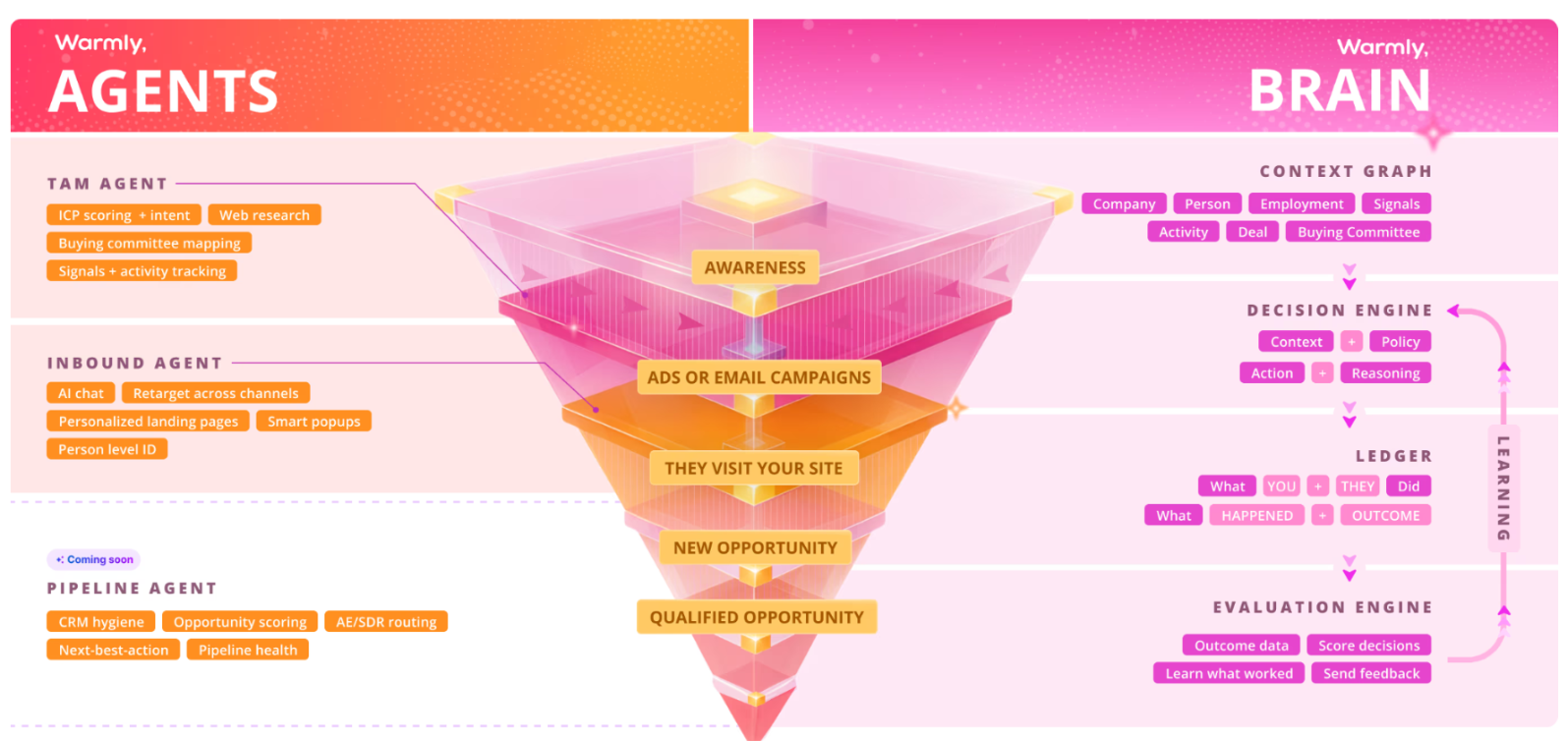
Tool 7. build_account_buying_committee. The agent goes and builds the committee. LinkedIn enrichment (Vetric) plus firmographic data (Clearbit). Six people come back: new VP of Sales, CRO, Director of RevOps, a Sales Ops Manager, two SDR Managers. Each gets a persona tag: Decision Maker, Champion, Influencer, User.

Tool 8. get_account_contacts. The agent verifies the committee is written back to the workspace and every contact has a valid business email. Email quality scored against our email-validity classifier. Five out of six pass. One gets flagged for a bounce check.

Second 3: Act (and restrain)

Three paths diverge.

Path Action Outcome
A Write and send emails autonomously Blocked. Trust 0.78 < threshold 0.85. Needs human review.
B Add domain to LinkedIn retargeting audience Executed. Threshold 0.40. Zero incremental cost.
C Generate email batch for human review Executed. Queued for morning approval.

Tool 9. push_linkedin_audience. The domain gets added to the LinkedIn retargeting audience. The new VP sees a Warmly ad in his feed this afternoon. Cost: zero incremental.

Tool 10. generate_email_batch. The agent writes 6 emails. Each references the specific persona, the hiring signal, and the Bombora surge. The new VP's email opens: "Congrats on the new role. Noticed the team started researching revenue orchestration the week you joined. Probably not a coincidence." Specific. Falsifiable. Not "Hope this finds you well."

Tool 11. get_batch_push_preflight. Preflight checks run. Do the emails pass spam filters? Are personas correctly assigned? Is committee coverage complete? Yes to all three.

Tool 12. log_decision. The full decision trace gets written to the ledger. Context snapshot, policy version, reasoning, factors, confidence, tools invoked, and what it decided not to do. Immutable. Every decision our agent makes is auditable after the fact.

Total time from signal hit to logged decision: 2.7 seconds.

The three things the agent decided NOT to do

This is the part that separates an agent from an automated sequence. Restraint is the feature.

It did not Slack the AE. A VP of Sales for a RevOps company told me on a call last month: "If you just have an alert that says so-and-so visited our website, the reps aren't going to do anything. They never do." He's right. Alerts are noise by default. Our agent only pings Slack when the intent score crosses 200 and there's a warm contact on file. This account hit 187. One page view plus a hiring signal isn't Slack-worthy.

It did not push to HeyReach or a LinkedIn outreach sequence. Policy: for accounts where we haven't had a direct touchpoint yet, start with ads and email. LinkedIn outreach gets reserved for warmer signals. Save the 25/day LinkedIn send budget for accounts where someone has actually replied.

It did not send the emails autonomously. Trust score 0.78, below 0.85. The batch went to the work queue. A human rep reviews in the morning, approves in 30 seconds, and the sequence fires.

Most AI SDR software measures success by how much it did. The right question is whether it did the right thing. Sometimes the right thing is wait.

Why Clay alone isn't enough (the static spreadsheet problem)

Every prospect I've talked to in the last 60 days has asked some version of: how is this different from Clay?

Fair question. Clay is a great tool. If all you need is contact data and a one-time list build, go buy Clay. I'd use it too.

But Clay is a static spreadsheet. It doesn't feel alive. You pull the data, enrich it, push it to a sequence, and from that point forward it starts decaying. The contact changes jobs. The company raises a round. A new buying committee member joins. Clay doesn't know. The list you built three weeks ago is already wrong.

An AI SDR agent layers live signals on top of every contact, continuously. It re-scores accounts as new events fire. It re-ranks buying committees as people move. It skips the old VP of Sales who left and adds the new one automatically.

Clay is sourcing. An AI SDR agent is orchestration. You still need sourcing. But sourcing is table stakes in 2026, and Clay's own pricing strategy (they keep dropping the floor) tells you it's getting commoditized. The defensible layer is the live signal graph on top.

The 65 tools a real AI SDR agent uses

If you're shopping for AI SDR software, ask the vendor for their tool list. Below is ours, grouped. A real agent calls across these in a single reasoning loop. A fake agent has 5 tools and a hopeful prompt.

Category Tool count What they do
GTM Query 7 Account lookup, events, contacts, memory, buying committee
Decision / Trust 4 Log decisions, check cooldowns, trust scores, pattern rules
Email / Outreach 6 Generate emails, push to Outreach, HeyReach, Salesloft
Ad Audiences 4 LinkedIn, Meta, YouTube audience pushes
Batch Work Queue 15 Review, approve, reject, preflight, push
Policy / Config 13 ICP rules, persona rules, policy simulation, reclassification
Research 10 Web search, document search, transcript analysis, LinkedIn lookup
Control Plane 16 Agent status, run traces, scheduled actions, ledger replay

The tools matter. The chaining matters more. Our SDR agent routinely invokes 10 to 15 of these in a single decision. That's what "agentic outbound" means. Everything else is marketing.

How the agent gets smarter every week

Every decision gets logged with a trace ID. Every outcome (reply, meeting booked, deal closed, unsubscribe, bounce) gets logged with the same trace ID. Over time, you can ask: when the agent made this kind of decision, what happened?

The learning loop:

  1. Decision. Full context snapshot, policy version, tools used, reasoning, confidence.
  2. Outcome. Reply? Meeting? Bounce? Unsubscribe? Revenue attribution?
  3. Grading. Automatic (reply = positive, bounce = negative) plus human review on ambiguous cases.
  4. Policy update. Weights adjust. New rules propose themselves. Old rules get deprecated.
  5. Better decisions. Next week's runs use the updated policy.

This is not RAG. RAG retrieves documents. This retrieves the outcome of every decision the system has ever made, and uses those outcomes to decide what to do next.

Critical mass happens around 100 graded decisions. That's when the system reaches roughly 90% agreement with human judgment on "was this the right call." For most customers, 2 to 4 weeks of active use.

The result: the agent running today isn't the same agent that ran last Tuesday. Same code. Different policy layer. New ICP rules. Updated scoring weights. A messaging angle that stopped converting is now deprecated. The version number changes, but quietly.

This is agent memory doing actual work. Not a vector DB full of chat transcripts. A causal graph between decisions and outcomes.

Why most AI SDR software still fails

Every prospect I talk to has tried an AI SDR product that flopped. I've heard specific stories from marketing leaders across B2B SaaS, services, and mid-market ops teams. The pattern is always the same.

They bought an AI SDR that just auto-drafted emails. A CMO who tried one of the big AI SDR tools last year told me she had to let her team go because the output was so bad it damaged deliverability across her whole domain. She's still dealing with the spam score hangover a year later.

They bought an intent tool that alerted a rep. A revenue leader told me: "If the alert isn't actionable, the rep won't click it. And they never click it." Alert fatigue is a real deliverability problem for your own team's attention, not just your prospects' inboxes.

They bought Clay and expected orchestration. Clay isn't orchestration. It's sourcing. People pick Clay, build a list, push it to one sequence, and then wonder why nothing compounds.

The three failure modes share a common cause: no real tool chaining, no decision layer, no feedback loop. The "AI" is window dressing on top of a CSV export.

Why autonomous SDR agents are hard to build

Let me spare you the "we pioneered" routine. Here's what's actually hard.

Account identification is a nightmare. You need seven data sources because no single vendor gets it right. Clearbit misses 30% of B2B traffic. Bombora is great at intent but useless for person identification. We spent 18 months on a streaming pipeline that stitches this together with smart window closing, late data handling, and shadow A/B testing across premium vs. economy resolution modes. This is distributed systems work, not prompt engineering.

The context graph is harder than it looks. 40M+ company profiles. 400M+ person profiles. An immutable event ledger handling 1.28M+ signals per day. We sync 15 million records to the database every day. Entity resolution, deduplication, making sure every record is live and ready at inference time. Every query has to come back in under 100ms for the fast projection, under 5 seconds for medium, under 30 seconds for deep. pgvector isn't fast enough. Pure Postgres isn't structured enough. We ended up with computed columns that compress 1,000 raw events into 5 meaningful scores, because no agent can reason over 1,000 events in a 3-second decision window.

Trust gates are where most AI SDR tools die. Letting an AI fire email sequences autonomously is how you end up on a deliverability blacklist. We built a graduated trust system. The agent starts with low trust, earns it through good decisions, and different actions have different thresholds. Adding a domain to a LinkedIn audience is trust 0.40. Sending an email sequence is 0.85. Updating ICP policy is 0.95. Most startups building "autonomous SDR agents" skip this entirely, which is why they're not actually autonomous. They're just fast.

The one thing we still get wrong: new verticals. When we onboard a customer in a market we haven't seen much of (vertical SaaS in industries like maritime logistics, say), the first month is rough. The ICP classifier doesn't know what it doesn't know. Our policies were tuned on tech B2B and they miss the nuances. We're getting better at cold-starting new verticals, but we're not there yet. If your GTM motion is weird, expect a ramp.

"Why not just build this in Claude Code?"

A VP of Engineering at a holding company asked me this directly on a call last week. Reasonable question. Claude Code is good. A smart eng team can spin up a prototype that hits the Bombora API, enriches with Clearbit, drafts an email with Claude, and pushes to Outreach. In a week.

Here's what that prototype doesn't have:

  • Deduplication across 15 million daily records. The same person shows up with different emails, different LinkedIn URLs, different companies. Resolving identity is a full-time team.
  • A 14-day cooldown logic that handles job changes mid-sequence.
  • Trust scores that learn from actual outcomes.
  • An immutable ledger of every decision so you can actually debug what the agent did last Tuesday.
  • Deliverability guardrails that stop the agent from nuking your domain reputation when it spins up.
  • A buying committee builder that actually works across 40M companies without LinkedIn scraping you into a ban.

It's really easy to spin something up. It's very hard to make it production-ready. We've been building this for three years. If you're an ops person with 20 hours to spare and no infra team, the math on "build vs buy" becomes obvious quickly.

What prospects actually ask about AI SDR software

From the last 60 days of sales calls, every prospect asks some flavor of these. If the vendor you're evaluating can't answer them cleanly, move on.

"How often is your contact data updated?" Ours re-scrapes on every account interaction. People always boast about contact count. Ask about freshness.

"What happens if your trust score blocks an action I want to take?" You should be able to override. Trust gates are defaults, not jail cells. You stay in control.

"Can I see the logs of what the agent actually did?" If the vendor doesn't have a ledger view, run. This is the #1 diagnostic tool when something goes sideways.

"How do credits work?" Credit pricing is the most confusing part of the AI tool category right now. Demand a breakdown: what costs what, what's unlimited, what triggers overages. If the vendor's pricing page has the word "usage-based" without a calculator, they're trying to hide something.

"Is my data portable? Can I access the context graph via API?" You need an exit path. If the answer is "contact sales for API access," treat that as a future lock-in problem.

"What's your retention?" Anyone can win a customer in the AI hype cycle. Keeping them is the only credibility that matters. We run 114% net retention. Ask every vendor on your shortlist. Compare.

What to demand from any AI SDR software vendor

You're going to buy AI SDR software this year. Probably several products. Here's what to look for.

Can it show you a decision trace? If you can't see the 12 tools it called and the reasoning between them, it's a black box. Black boxes become liabilities when deliverability complaints start. Demand a ledger.

Can it decide NOT to do things? If every feature is about "generating more," run. Restraint is harder than generation. Ask how many of the agent's runs end in "no action taken."

Does it get smarter, or just louder? Ask to see a decision from 3 months ago and the same type of decision from last week. If the reasoning hasn't changed, the agent isn't learning. It's iterating on prompts.

Does it have real tools, or just LLM calls? An agent with 5 tools is a sequence tool. An agent with 65 tools that chain based on reasoning is an operator. Ask for the tool list.

Is it trust-gated? Ask what the agent does autonomously vs. what it escalates. If the answer is "everything is autonomous," the vendor is lying or reckless.

Can it explain a score? If the agent scores an account 187/500 and can't break that number down, the score is vibes. Real scores are traceable.

Is the company going to be around in 3 years? AI is compressing. Every month another "AI SDR" launches. The tools that survive will be the ones with real retention and real infrastructure behind them. Ask about net dollar retention, runway, and customer count growth. Don't trust pitch decks. Ask for references.

The AI SDR era isn't about replacing SDRs. It's about replacing the lookup tables and rules engines that have been pretending to be intelligence for a decade. The companies that figure this out in 2026 will compound. The ones still measuring "AI success" by message volume will look like the 2010 companies that measured email marketing by opens.


See your own decision trace

I run Warmly's AI SDR agent on our own pipeline every day. Every signal, every account, every decision, logged and auditable. If you want to see what it would do on your accounts, book 20 minutes with our team. We'll pull a real decision trace from your pipeline on the call. No canned demo. No slides. Just the agent, running on your accounts.

Not ready for a demo? Start here:

Last Updated: April 2026

ZoomInfo, Apollo, Clay, 6sense: The GTM Stack Is Dead. Here's What's Replacing It.

ZoomInfo, Apollo, Clay, 6sense: The GTM Stack Is Dead. Here's What's Replacing It.

Time to read

Alan Zhao

TL;DR

  • The legacy GTM stack (ZoomInfo + Apollo + Clay + 6sense + Salesforce) runs $150K-$300K per year for a 50-person revenue team. Most teams still miss pipeline.
  • The problem is not the tools. The tools are great. The problem is every one of them is a rigid form, and your customer's actual problem does not have a fixed shape.
  • The replacement is shapeless software: a flexible AI core that adapts to any GTM motion, forward-deployed humans on the customer's team, and a feedback loop that makes every engagement smarter than the last.
  • Clay saw this first and spawned the Claygencies. Even Clay cannot fully escape the trap.

What is the GTM stack? The GTM stack is the set of software tools a B2B revenue team uses to find, qualify, contact, and close customers. The classic version pairs ZoomInfo (contacts), Apollo (sequencing), Clay (enrichment), 6sense (intent), and Salesforce (CRM). In 2026 that stack costs $150K-$300K per year per mid-market company and is being replaced by shapeless AI software paired with forward-deployed humans.


Your $240K GTM stack stopped working

Last quarter I was looking at Warmly's churn data and the pattern was almost embarrassing in how clear it was.

Customers who got real usage on the platform did not churn. Customers who did not, did. SaaS culling season rolls around, your tool gets named in a meeting, and if nobody can point to a result, you are gone.

Now zoom out. Almost every B2B revenue team in 2026 has the same problem.

Look at any modern GTM org.

ZoomInfo for contacts. Apollo for sequencing. Clay for enrichment. 6sense for intent. Salesforce holding it all together with duct tape and a RevOps team whose entire job is keeping the integrations from falling over.

Average annual cost for a mid-market team running that full stack? $150K-$300K. And that is before you count the RevOps headcount you hired to operate it.

Result? Most teams are still missing pipeline.

This marks the end of an era in GTM tech. And the start of a new one.

The legacy GTM stack, by the numbers

Here is what a typical B2B revenue team is actually spending in 2026.

Tool Category Mid-market price (annual) What it actually does
ZoomInfo Contact data $40K-$80K Sells you contact records
Apollo Sequencing + data $20K-$50K Cheaper ZoomInfo plus outbound
Clay Enrichment + workflows $12K-$60K Wires data sources into spreadsheets
6sense Intent + ABM $60K-$120K Tells you which accounts are "in market"
Salesforce CRM $25K-$75K Stores everything none of these tools talk to
RevOps headcount Glue $120K-$200K One human full-time keeping it all wired
Total $277K-$585K

For most teams the result is the same regardless of which tools you bought. You have data in five systems, three dashboards nobody opens, two integrations that broke last week, and a pipeline number that did not move.

The tools are not bad. The tools are great. The problem is structural.

Why rigid tools stopped working

Every one of those tools is a rigid form. You buy the form, you fit your business into it, you pay forever to keep it running.

Your business is not a rigid form.

Your ICP shifts every quarter. Your messaging shifts every campaign. Your buying committee changes by deal. Your competitive landscape rewrites itself with every funding announcement. The form your software ships in does not move with you. Everything is changing faster than ever.

So you hire a human to bridge the gap. A RevOps lead. A consultant. An agency. Sometimes all three.

The cost of that human is the real cost of the stack. And it is the part nobody puts in the pricing page.

Clay saw it first. Then it built an army.

Clay deserves credit for being the first vendor in this category to look the structural problem in the face.

Clay built a great enrichment tool. It is genuinely best-in-class at what it does. But Clay's leadership noticed something most of their competitors missed. Most GTM leaders could not actually wield the product themselves. The interface assumes a level of comfort with API joins, conditional logic, and data plumbing that most marketing and sales teams do not have.

So Clay did the thing nobody else in the category did.

They embraced the army of agencies that started building on top of them. Hundreds of "Claygencies" now wield Clay on a customer's behalf. Clay's growth chart is the result. The agency layer is the labor model that made the rigid software actually deliver.

It is the most modern version of Palantir's Forward Deployed Engineer. Just outsourced.

But here is the trap even Clay cannot escape.

Clay is still a rigid tool. The agencies exist because most GTM leaders cannot wield it themselves. Take the agencies away and you have a workflow most people bounce off in week two.

The Claygency layer was the right move. It just proves the point. The product alone was never enough.

"Slavica knows more about our business than we do"

Back to Warmly's churn data for a second.

The customers who stuck around were not the ones with the prettiest dashboards or the most seats. They were the ones we ran the deepest CS engagements with. Especially as Warmly grew in capability, our CS team could just do more for them.

Ian Schenkel from Case Status said it on a call as a joke:

"Slavica Aceva knows more about our business than we do."

Slavica is on our CS team. He meant it kindly.

But that line has rattled around in my head for months because it is the entire game. Our best customers were a function of our best CS engagements. The product mattered. The data mattered. The AI mattered. But the thing that made the actual difference was a human who learned the customer's business well enough to drive the outcome on their behalf.

This is not a Warmly story. Every serious AI company is figuring out the same thing. Anthropic, OpenAI, Sierra, Decagon, CollegeVine. They all have forward-deployed engineering or applied AI teams. They all embed humans inside customer workflows. Forward Deployed Engineer postings are up roughly 800% this year.

Nobody is laughing at "consulting companies" anymore.

The shape of tomorrow's GTM software is shapeless

The shape of tomorrow's GTM vendor is not another rigid tool with a 200-page docs site and a six-week onboarding.

It is shapeless. Formless. It flows to the customer instead of asking the customer to flow to it.

That requires three things working together.

1. A flexible AI core that adapts to any go-to-market motion. Not a workflow builder. Not a no-code canvas. An AI runtime that can take in a customer's data, understand their motion, and generate the right action in the right channel without being explicitly programmed by a human first. The interface is the conversation. The conversation reshapes the product.

2. A team of forward-deployed humans who learn the customer's business. This is the labor model the dashboard era forgot. Engineers and CS operators who sit inside the customer's GTM stack, learn their data, learn their team, and ship outcomes. Not consultants. Not implementation managers. People who can write code and sit in the meeting and ship the thing.

3. A feedback loop where every customer engagement makes the platform smarter for the next one. This is the part that separates a real AI-native vendor from a glorified services shop. The bespoke work the forward-deployed team ships for customer #3 should encode itself into the platform so customer #50 self-serves. Without that loop, you are just a consulting company with extra steps.

Every one of those three things is necessary. Take any one of them away and you collapse back into either the old SaaS rigidity or pure services with no leverage.

What the AI-native GTM stack actually looks like in 2026

Here is the side-by-side. Read it as the thesis, not as marketing.

Layer Legacy stack (2018-2024) AI-native stack (2026+)
Contact data ZoomInfo Embedded in the AI runtime, refreshed per-deal
Enrichment Clay + a Claygency AI agents that enrich on demand inside the workflow
Intent 6sense First-party signals from your own site, social, and tooling
Sequencing Apollo AI agents that sequence across email, LinkedIn, ads, and gifting
Inbound chat Drift / Qualified AI agents that answer questions and demo the product live
CRM Salesforce Source of record, reduced to a thin database layer
Operator RevOps headcount Forward-deployed humans from the vendor, on your team
Pricing Per-seat, per-tool Per-outcome (meetings booked, pipeline created)

The shift in the last row is the one most founders miss. The legacy stack charged you for access. The AI-native stack charges you for outcomes. That changes everything about how the vendor behaves.

If a vendor is paid for meetings booked, they will move heaven and earth to book the meeting. If they are paid for seats, they will move heaven and earth to extend the contract.

You can guess which one feels different on a renewal call.

The five-step playbook to escape the stack

If you are running a GTM team in 2026 and reading this with a knot in your stomach, here is the practical sequence.

  1. Audit your current spend. List every tool, every seat, every annual cost. Add the RevOps headcount cost. Most teams underestimate the total by 40-60% because the people cost is in a different budget.
  2. List every outcome you actually got from the stack last quarter. Pipeline generated, meetings booked, deals influenced. Put real numbers next to each tool. Most teams discover that one tool is doing 80% of the lifting and three tools are tax.
  3. Cut the bottom three tools. Pick the worst-performing three on outcomes-per-dollar. Cancel them. Yes, your team will complain. Yes, RevOps will say it cannot be done. Do it anyway.
  4. Replace them with one AI-native vendor that ships an outcome and embeds a forward-deployed human. Pay for the result, not the seats. Demand a real human on the engagement, not a chatbot disguised as one.
  5. Reinvest the savings into the human. The dollar you save on tools should go to the operator (internal or vendor-side) who actually drives the outcome. The labor model is the moat.

This is not theory. This is what every winning AI-native vendor is asking customers to do right now.

Where Warmly fits

In the spirit of being honest because LinkedIn algorithms reward it and human readers can smell when you are not.

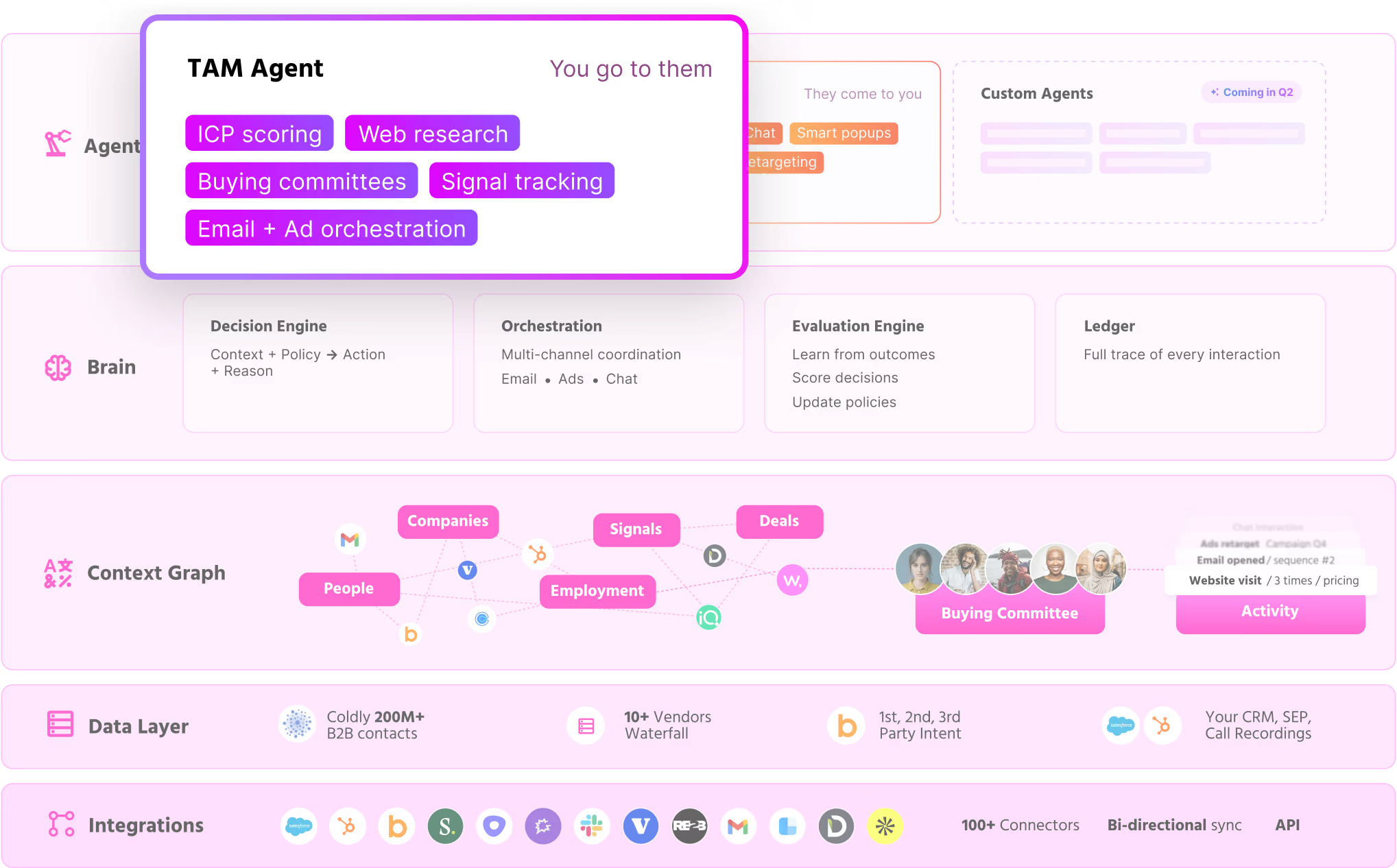
Warmly is built around four pieces that map directly to the shapeless software thesis. Not one tool. A stack collapsed into a single intelligence layer with humans wrapped around it.

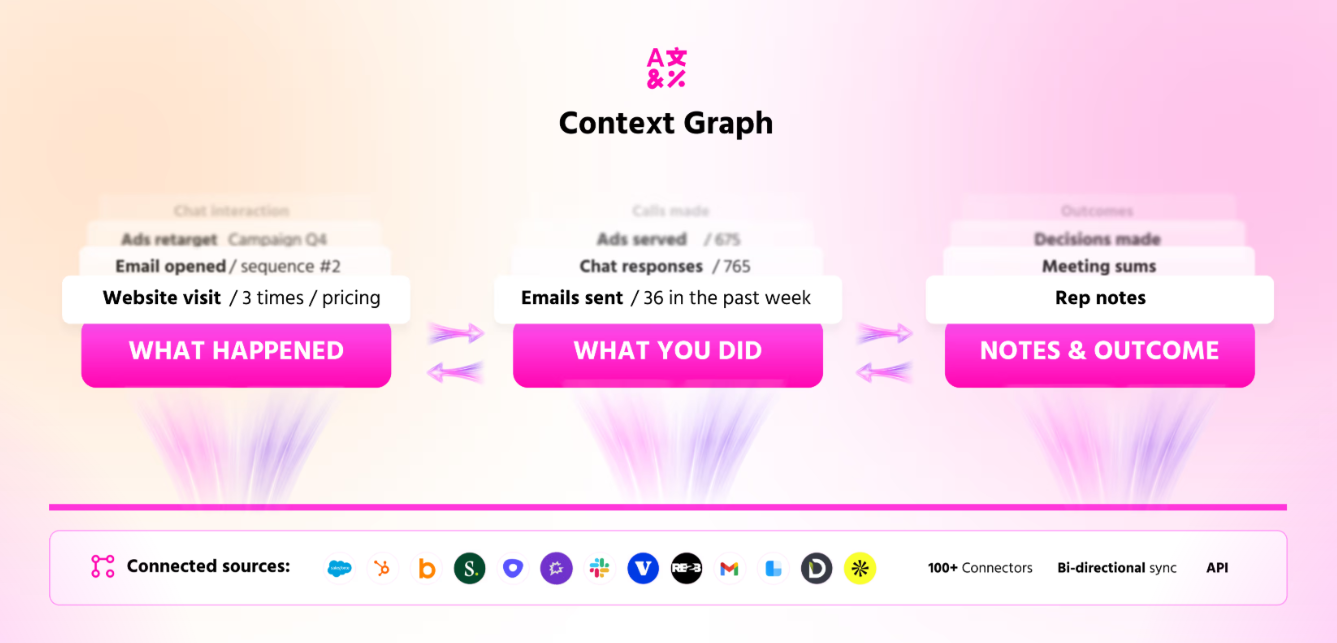
1. The Context Graph. We integrate with every system you already run (CRM, marketing automation, product analytics, ad platforms, social) and pull every event into one persistent brain. This is not another data warehouse. It is a self-healing decision layer that captures decision traces, resolves identities across tools, and saves down the reasoning behind every action so the next decision is smarter than the last. It is the part you do not want to build yourself. It takes years to get right and most companies that try end up shipping a slightly worse Salesforce. We wrote the long version of the architecture argument here.

2. The Inbound Agent. Lives on your website. Answers prospect questions in real time. Gives product demos at the moment of highest intent. The buyer is not waiting 48 hours for a sales rep to email back. They are getting the demo while they are still in the tab.

3. The Outbound Agent. Engages buyers across the channels they actually use. Ads. Email. LinkedIn messages. Sendoso gifting. Any integration where the customer's data says the next touch belongs. Triggered by the Context Graph, not by a static cadence.

4. The Forward Deployed Engineering team. This is the part most software vendors skip. Wielding the brain takes work. Most GTM leaders should not have to learn a new query language to get value out of a platform they bought to save time. So we ship a team of engineers who sit on your account, learn your business, and operate the system on your behalf to drive pipeline that actually closes.

Together those four pieces are what makes the platform shapeless. The Context Graph adapts to your data. The agents adapt to each prospect. The forward-deployed humans adapt to whatever does not yet have a button.

I wish we had committed to the forward-deployed model 18 months earlier than we did. The customers who paid the price for that delay were the ones who churned in 2024 because nobody on our side knew their business well enough to make the platform sing.

We are rebuilding around it now. The bet is that the companies that win the next decade will not be the ones with the prettiest UI. Not the cleverest model. Not the slickest dashboard. They will be the ones whose teams and tooling learned to flow with the customer.

The ones who showed up. And the ones whose product was smart enough to show up with them.

FAQ

What is killing the GTM stack in 2026? The combination of three forces. AI-native vendors that consolidate multiple categories into one runtime. Outcome-based pricing that punishes shelf-ware. And the return of forward-deployed humans as the labor model that makes the software actually work. The legacy unbundled stack made sense when each category needed its own specialist. AI collapses the categories.

Is ZoomInfo dead? ZoomInfo is not dead. It is being unbundled. Contact data is becoming a commodity layer inside AI runtimes rather than a standalone product. ZoomInfo still has the deepest contact database in the category. The question is whether anyone will pay $80K a year for access when an AI-native vendor includes equivalent data in a per-outcome contract.

Is Apollo a real ZoomInfo alternative? Apollo is the cheaper, broader, more product-led version of ZoomInfo. It wins on price and self-serve. ZoomInfo wins on enterprise data depth and integrations. For a buyer in 2026 the more interesting question is whether either is the right unit of purchase versus an AI-native platform that includes both data and outbound execution.

Is Clay a real alternative to ZoomInfo or Apollo? Clay is not a direct alternative. Clay is an enrichment and workflow layer that sits on top of contact data sources. You still need a data provider underneath. The Claygency model exists because Clay is powerful but rigid. Most teams need a human to wield it.

What is a Forward Deployed Engineer? A Forward Deployed Engineer is a software engineer who embeds inside a customer's environment, learns their business, and ships production code on their behalf. The model was invented at Palantir in 2007 and is now being rebuilt at every serious AI company including OpenAI, Anthropic, Sierra, and Decagon. Postings are up roughly 800% this year.

Will AI replace the SDR role? AI will replace the parts of the SDR role that are repetitive (research, drafting, scheduling). It will not replace the parts that require trust, relationship, and judgment. The most likely outcome is fewer SDRs per company, paired with AI tools that let each remaining SDR run the workload of three.

What is shapeless software? Shapeless software is software that adapts to the customer's workflow rather than asking the customer to adapt to its workflow. Made possible by AI runtimes that can take instructions in natural language, ingest data in any format, and generate outputs across any channel. The opposite of a rigid SaaS UI.

What is a Context Graph in GTM? A Context Graph is a persistent, queryable record of every entity, signal, and decision across a company's go-to-market motion. Unlike a CRM (which stores current state) or a data warehouse (which stores raw events), a Context Graph stores the reasoning that connects data to action. It is the substrate that makes AI agents actually intelligent about your business, because it captures precedent, not just facts. Warmly's Context Graph is detailed in our GTM Brain post.


Read next:

See how Warmly replaces ZoomInfo, Apollo, and 6sense in one platform → warmly.ai/p/book-a-demo Or get a Forward Deployed CS engagement on your account → warmly.ai/p/services/forward-deployed-engineer

Last updated: April 2026

Claude Code Best Practices: How We 3x'd Engineering Velocity Without Hiring

Claude Code Best Practices: How We 3x'd Engineering Velocity Without Hiring

Time to read

Alan Zhao

A year ago our engineering team was 8 people.

It still is. But we ship like we're 24.

Everyone benchmarks AI coding wrong. They ask "how much faster is Claude Code than a good engineer typing manually." The answer is 1.5x to 2x. Not bad. Also not 3x.

The 3x came from running ten Claude Code sessions at once.

This post is the Claude Code best practices we actually use at Warmly. The CLAUDE.md rules, the subagent architecture, the MCP server setup, the memory loop, the container config. 606 commits in, with the bruises to match.

If you're a founder or VP Eng trying to turn Claude Code from "the tool one engineer uses" into a system that compounds across your whole team, read on.

Why we went all-in on agentic coding

I'm a GTM founder. But I've been coding again the last two years because the tools got good enough that I can keep up on small things.

Last October I watched one of our engineers solve a nasty enrichment bug in 40 minutes using Claude Code. The same bug took me two hours a few months before, and I'm the person who built the original system. That's when I got it. Agentic coding isn't hype. It's the biggest productivity shift since the move from on-prem to cloud.

But out of the box, Claude Code is general-purpose. It doesn't know your database schema. It doesn't know your deploy flow. It doesn't know that "enrichment issue" at Warmly means check MongoDB first, then the AlloyDB replica, then GCP logs, then BullMQ queues.

Every engineer was reinventing the wheel. Writing their own CLAUDE.md. Copying prompts between Slack DMs. So we built a real system on top of Claude Code. We call it Warmly Intelligence. It's two things: a plugin marketplace every engineer installs, and a headless engine that runs Claude Code programmatically, 24/7, in the background.

Here's how the pieces fit.

Claude Code rules and custom instructions that actually work

The foundation is boring. CLAUDE.md files and rules. Everyone skips this part because it's not sexy. Don't skip it.

After writing, rewriting, and deleting about fifty CLAUDE.md files over eight months, here's what we learned:

Rules belong in CLAUDE.md. Context belongs in skills. A rule is "never mutate production data without SET statement_timeout = '20s'". Context is "here's our deploy flow, here's the schema, here's how to query it safely." Mix them up and both get worse.

Write rules in second person. "You always check the Linear ticket before touching code." Not "Claude should..." Not "Always...". Second person lands better. I don't know why. It just does.

Use the negative. "Never suggest a fix without reading the failing test first" lands harder than "always read the failing test first." We learned this the expensive way, burning two days because Claude was "optimistically patching" tests we hadn't read.

Check your CLAUDE.md into git. It lives in the repo. It gets code-reviewed. If someone wants to change how Claude behaves, they open a PR. Half the teams I talk to still have their rules sitting in one engineer's home directory. That's not a system. That's a hobby.

Separate global from project rules. ~/.claude/CLAUDE.md is for personal preferences. The repo's CLAUDE.md is for the team. Project rules win. Keep them that way.

That's the boring part. Now the interesting part.

How we use Claude Code subagents as force multipliers

Claude Code subagents are the single most underused feature in the product. This is where the 3x lives.

A subagent is a specialized Claude session spawned by a parent session. The parent delegates a narrow task. The subagent works in isolation. It returns a structured summary. Parent continues. Exactly how a senior engineer delegates to a junior, except the junior is also Claude and doesn't take sick days.

We ship 20+ subagent skills across two plugins (warm-dev for engineering, warm-pm for product). The most important one is called warm-debugger.

A senior engineer at Warmly has a mental map. "Ad spend issue means check the Meta webhook, then the GTM handler, then the attribution table." "Enrichment issue means MongoDB, then AlloyDB replica, then BullMQ queues." That mental map took five years to build. We wrote it down. Literally. As a SKILL.md file with a domain signal table mapping symptom to evidence source.

New engineers install the plugin on day one and debug like someone who's been at Warmly for five years. The tribal knowledge isn't trapped in someone's head anymore. It's executable code Claude runs in real time.

Three rules we learned writing subagents:

One task per subagent. Don't build a debugger that also writes tests. Build two subagents. Claude will pick the right one based on context.

The prompt is not a description. It's a spec. Most subagent configs I see in the wild are a one-liner. Ours are 200-300 lines each. The length isn't bloat. It's precision. The subagent knows exactly what to check, in what order, and what output format to return.

Return structured output, not prose. We have a report_findings tool every subagent calls at the end with a typed schema: claim, source_url, confidence. The parent agent gets clean data it can act on, not paragraphs it has to re-parse.

The Claude Code MCP server setup that gives Claude access to everything

Most Claude Code setups I see in the wild have one or two MCP servers wired up. Ours has 18 attached to every task.

MCP Server Purpose
Linear, Linear-read Ticket context and updates
Notion, Notion-read Internal docs and specs
Statsig, Statsig-read Feature flag state
Grafana, Grafana-read Production metrics
Rootly, Rootly-read Incident history
Slack, Slack-read Team context and decisions
Pylon, Pylon-read Customer support tickets
HubSpot, HubSpot-read CRM data
Knowledge Base Self-maintaining internal wiki

Every server has a read variant and a write variant. You almost always want Claude to read freely and write carefully. Separating them lets you grant read access broadly and gate writes behind approval.

The biggest unlock though isn't consuming MCP servers. It's building them.

We wrote a persona MCP that knows about our customer personas. A kb MCP that queries our self-maintained knowledge base. These didn't exist until we built them. Every company should have at least five custom MCP servers specific to their domain. If your internal systems don't speak MCP, Claude can't use them.

One small tactical note: use read-only MCP servers in your code review bots. You don't want your PR reviewer accidentally flipping Statsig flags in production.

The memory loop that makes Claude Code smarter every week

This is the part I'm most excited about and the hardest to explain.

After every completed task, a separate Sonnet process analyzes the transcript and extracts reusable memories. Four types: user preferences, work feedback, project decisions, external references. Memories get deduplicated, confidence-scored, stored. The next task loads relevant ones before it begins.

Lots of systems do that. What's different is what we do with negative feedback.

Our Slack assistant has a thumbs-down button. When someone downvotes an answer, a dedicated pipeline runs. It reads the conversation. It asks "what went wrong, what would have been correct, what domain knowledge was missing." It writes a targeted feedback memory. Every future Slack task gets that memory injected.

The 100th time someone asks about CRM sync, the answer is measurably better than the 1st time. Nobody trained a model. Nobody edited a prompt. The system noticed it was wrong and remembered.

A Claude Code setup without a feedback loop that updates memory automatically is a static system pretending to be dynamic. Build the loop. It's the difference between a tool that plateaus and one that compounds.

Claude Code tips from 8 months in production

Rapid fire, the things we learned the hard way.

Rotate OAuth tokens.
Run multiple Claude Code sessions concurrently and you will hit rate limits. We maintain multiple CLAUDE_CODE_OAUTH_TOKEN env vars and round-robin between them. Our code picks them up automatically: CLAUDE_CODE_OAUTH_TOKEN, CLAUDE_CODE_OAUTH_TOKEN_2, CLAUDE_CODE_OAUTH_TOKEN_3.

Use git worktrees for parallel tasks.
Never run two sessions in the same directory. Each task gets its own worktree: .worktrees/<taskId>/. They stay isolated. No branch conflicts. No git state collisions.

Set CLAUDE_CODE_MAX_TOOL_USE_CONCURRENCY=6.
Default is lower. Higher means parallel tool calls within a single session. For debugging investigations this is huge. Claude pulls GCP logs, Grafana metrics, and Linear context simultaneously instead of serially.

Use CLAUDE_CODE_COORDINATOR_MODE=1 for orchestrator tasks.
Changes how the main agent handles subagent delegation. Better for plan-and-delegate workflows.

BullMQ + Redis is the right queue.
We tried alternatives. BullMQ has the primitives: job dependencies, retry policies, backoff, rate limiting. Don't roll your own.

Automated PR reviews should run in multiple phases.
Ours runs three: acceptance check against the Linear ticket's criteria, deep code review, refinement pass that deduplicates findings. Single-pass reviews are noisy. Multi-phase reviews are shippable.

Generate deploy narratives, not diffs.
Our /warmly-dev:deploy command reads commit history, extracts Linear ticket IDs, fetches each ticket's details, and writes a prose changelog. We post it in the deploy thread. Reviewers actually understand what they're approving.

Where it still breaks

This system doesn't work perfectly. Five places it fails:

Long-context refactors are still hard. When a task spans 40+ files and requires holding the entire mental model at once, Claude loses the thread. We break these into phased tickets now, but a senior engineer on a big refactor end-to-end is still faster than any agentic setup I've seen.

Memory has a cold-start problem. New topics with no feedback history get generic answers. We manually seed memories when we know a new domain needs to land, but there's no clean automated solution yet.

Flaky tests lie to the agent. If a test passes 80% of the time, Claude merges the fix because the test is green on its run. Then staging fails an hour later. We added re-run logic. Flaky tests are still an adversarial input.

Cost is real. We pay low five figures per month across the company. Not small. The ROI case is strong because we'd need to hire more engineers to ship this volume, but at the seed stage this isn't free.

Anthropic rate limits during peak hours. Even with OAuth rotation across multiple subscriptions, we hit ceiling. We've built in backoff and queueing. Better than six months ago. Not solved.

The real 3x: concurrency, not speed

Most teams benchmarking AI coding ask the wrong question. "How much faster is Claude Code than manual coding for task X." The answer is 1.5x-2x and that's boring.

The right question is how many tasks my team can run in parallel without adding headcount.

There are ten Claude Code sessions running right now as I write this paragraph. Three are reviewing open PRs. Two are implementing Linear tickets assigned this morning. Four are answering questions in Slack channels. One is writing the staging deploy changelog.

Nobody is supervising any of them. Eight humans are doing their actual work. The AI department is doing the repetitive 60%.

That's the 3x. Not "make one engineer faster." It's "run ten specialized agents in parallel so your engineers only touch the 40% that requires judgment."

Every B2B startup has this in front of them right now. The ones that figure it out in the next twelve months are going to look dramatically more efficient than the ones that don't. Not because their engineers are better. Because their systems compound.

At Warmly we do the same thing on the GTM side. Instead of ten agents reviewing PRs, we run agents identifying companies visiting your website in real time, enriching buying committees, and routing high-intent accounts to your SDRs. Same concurrency thesis. Different department. If that's interesting to you, come see what we've built at warmly.ai.

How to actually start

If this post got you fired up, here's the minimum path to your first real win.

Week 1. Write a real CLAUDE.md for your main repo. Not a one-pager. 300 lines covering schema, deploy flow, testing standards, and the three most common bug investigation patterns at your company.

Week 2. Write your first two skills. One debugger playbook for your most common bug class. One database query helper that knows your connection patterns and safety rules.

Week 3. Stand up one MCP server for your most important internal system. Probably your CRM or your production database.

Month 2. Deploy a headless Claude Code runner on a single VM watching one GitHub repo. Start with automated PR reviews only. Do not try ticket-to-PR automation yet.

Month 3. Add memory extraction. Even a simple version that runs after every task and appends to a shared file is a huge unlock.

Month 6. You'll have enough signal to decide whether to build out the full platform or stay lean.

The patterns matter more than the specific code. Copy what applies to your stack. Ignore what doesn't.

FAQ

What are Claude Code best practices for teams? Check CLAUDE.md into git, separate rules from context, write one-task-per-subagent with 200+ line prompts, build internal MCP servers for your own systems, run multiple sessions concurrently in git worktrees with OAuth token rotation, and add a memory extraction loop that learns from negative feedback.

What's the difference between Claude Code rules and custom instructions? Rules are constraints (never do X, always do Y). Custom instructions are context (here's our schema, here's our deploy flow). Both live in CLAUDE.md but serve different purposes. Mixing them makes both weaker.

How do Claude Code subagents work? A subagent is a specialized Claude session spawned by a parent. The parent delegates a narrow task, the subagent works in isolation, returns a structured summary, parent continues. The key is one-task-per-subagent with a detailed spec prompt, not a one-line description.

Do you need MCP servers to use Claude Code effectively? You can start without them but the real unlock is wrapping your internal APIs as MCP servers so Claude has programmatic access to your actual systems. Separate read-only and write variants.

How does Claude Code memory work in production? Claude Code has native memory primitives. Real production memory is something you build on top. Extract reusable memories after every task, deduplicate against existing entries, inject relevant ones into future tasks, and close the loop by triggering targeted extraction when users give negative feedback.

Is agentic coding actually 3x faster? A single session is 1.5-2x faster than manual coding. The 3x comes from running 5-10 sessions concurrently on different tasks. Speed is linear. Concurrency is the multiplier.

How do I set up Claude Code for a team? Start with a committed, code-reviewed CLAUDE.md. Distribute organizational knowledge as a Claude Code plugin with skills and slash commands, not as shared docs. Set up at least one internal MCP server wrapping your company's core API. Use git worktrees and OAuth token rotation once you scale to concurrent agents.

What's the difference between Claude Code and Cursor? Cursor is an IDE with AI built in. Claude Code is a terminal-native agent that can be run interactively, headlessly via the Agent SDK, or as a background worker in production. For team workflows like automated PR review, deploy automation, Slack Q&A, and ticket-to-PR pipelines, Claude Code's headless mode is the key differentiator.

Last Updated: April 2026

How to Identify Website Visitors in Real Time (And Convert Them With AI Chat)

How to Identify Website Visitors in Real Time (And Convert Them With AI Chat)

Time to read

Alan Zhao

You have 3,000 people on your website right now. Two of them are ready to buy. Your Google Analytics dashboard will never tell you which two.

This is the anonymous traffic problem. 97% of B2B visitors never fill out a form. Your best-fit prospects browse your pricing page, check your integrations, maybe scroll through a case study, and then leave. By the time your SDRs see a lead, those visitors are three days deep into evaluating a competitor.

The fix isn't another form. It's visitor identification that runs in real time, paired with an AI chat that can tell the difference between a student doing research and a VP of Sales about to sign a contract.

This post walks through exactly how that works. I'll show you the real architecture: how we identify a visitor in under 100 milliseconds, what our AI chat does before it says hello, and the 4 actions it can take once the visitor is identified. No marketing abstractions. A real trace.

How to identify website visitors: the basic mechanics

Website visitor identification means resolving an anonymous browser session into a known company or person. There are three data paths, and a good inbound agent uses all of them.

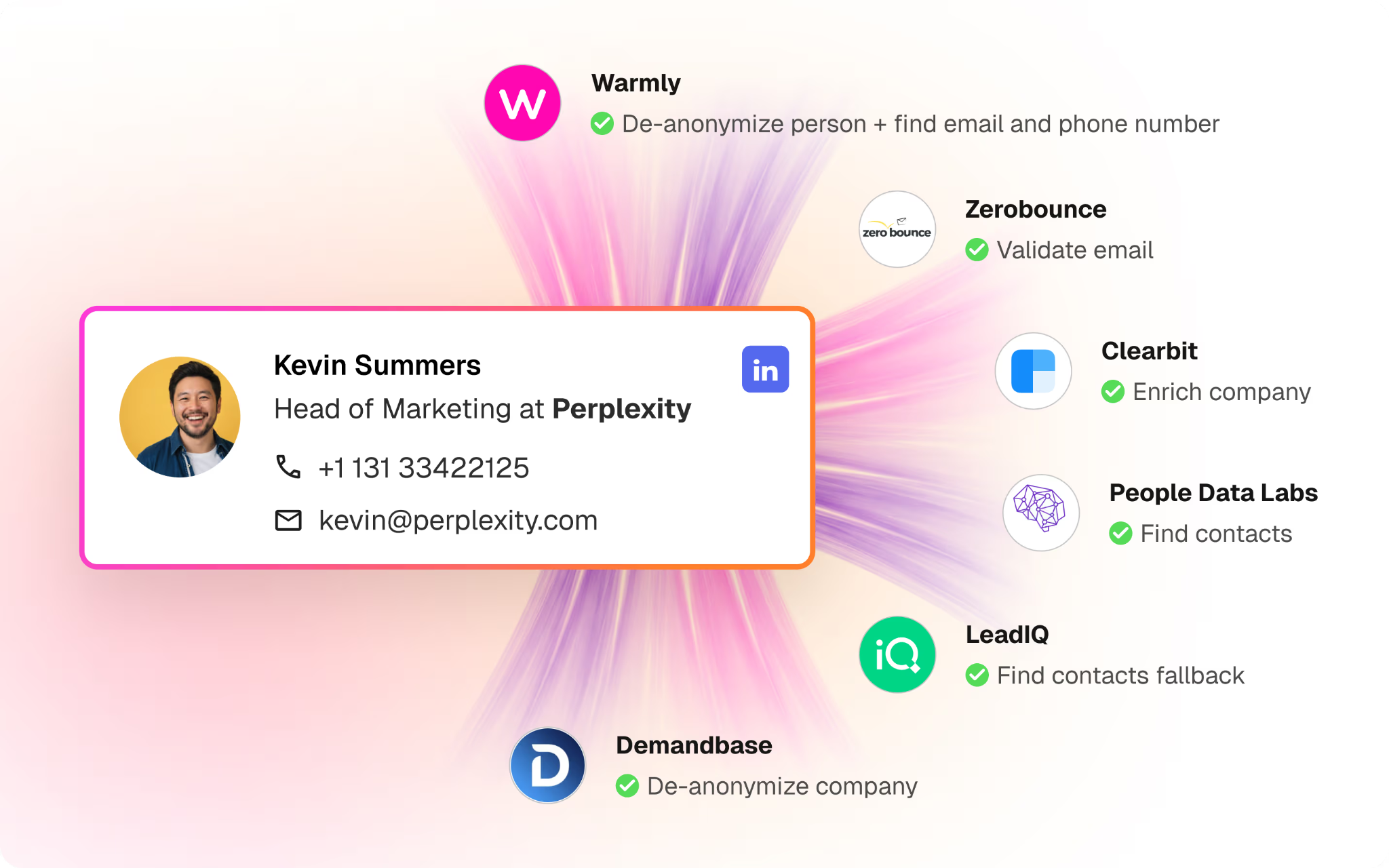
  1. IP-to-company resolution. Every visitor has an IP address. Services like Clearbit, 6sense, and Warmly's own reverse-lookup graph map that IP to a company. Accuracy is roughly 60-80% depending on the vendor and the ISP. Consumer ISPs (Comcast, Verizon residential) are useless. Corporate networks are gold.
  2. Cookie stitching. If the visitor has been to any other site in your identity provider's network, they have a cookie. The provider (LiveIntent, FiveByFive, RB2B, and a few others) returns a hashed email. You enrich that into a full person record.
  3. First-party capture. When someone fills a form, provides an email in chat, or clicks an email link with a tracking parameter, you capture them directly and backfill their session history.

Most vendors only do one of the three. Single-source identification caps out around 40% visitor coverage. Stacking all three gets you into the 70-80% range at the company level and 30-50% at the person level. Those are the real numbers. Anyone quoting higher is lying or counting wrong.

What happens when a visitor lands on your site

Here's the actual sequence when someone loads your pricing page. Every number below is measured off our production pipeline.

Milliseconds 0-100: Identify

The visitor loads the page. A tiny JavaScript tag (gzipped under 20KB) fires to our session server, opens a WebSocket, and creates a session record. Metrics get tagged with OpenTelemetry for tracing.

Our backend runs an IP-to-company lookup against a waterfall of providers. The first hit wins. For this visitor, we get back acme-supply.com with confidence 0.94. (Fictional example; real traces live inside our customer workspaces.)

At the same moment, we check our cookie graph. Has this browser been identified on another Warmly-powered site in the last 90 days? Yes. We have an email on file. Now we have a person, not just a company.

Total time: 87 milliseconds.

Milliseconds 100-400: Decide

Once identification lands, the session fires an onSignalHit event into a BullMQ Pro queue with exponential backoff and 3 retries. The inbound workflow trigger picks it up and runs the gates.

Gate 1: Domain blocklist. Is this domain on the customer's do-not-engage list? Competitors, existing customers they're already talking to, companies with a "do not contact" flag in Salesforce. If yes, exit immediately. Log domain_block_listed.

Gate 2: Data quality tolerance. Is the session's firmographic data within acceptable bounds? Missing company name, bogus IP geography, known bot user-agents all trigger rejection. Log data_quality_not_met.

Gate 3: Segment match. Does the visitor match any active workflow's audience rules? Tier 1 ICP, intent score above 150, on the pricing page, new hire signal in the last 30 days. If no workflow applies, the agent does nothing. Silence is a valid outcome.

This visitor passes all three gates. A workflow matches: "Tier 1 visitors on pricing page get immediate AI chat."

Milliseconds 400-2000: The AI chat starts

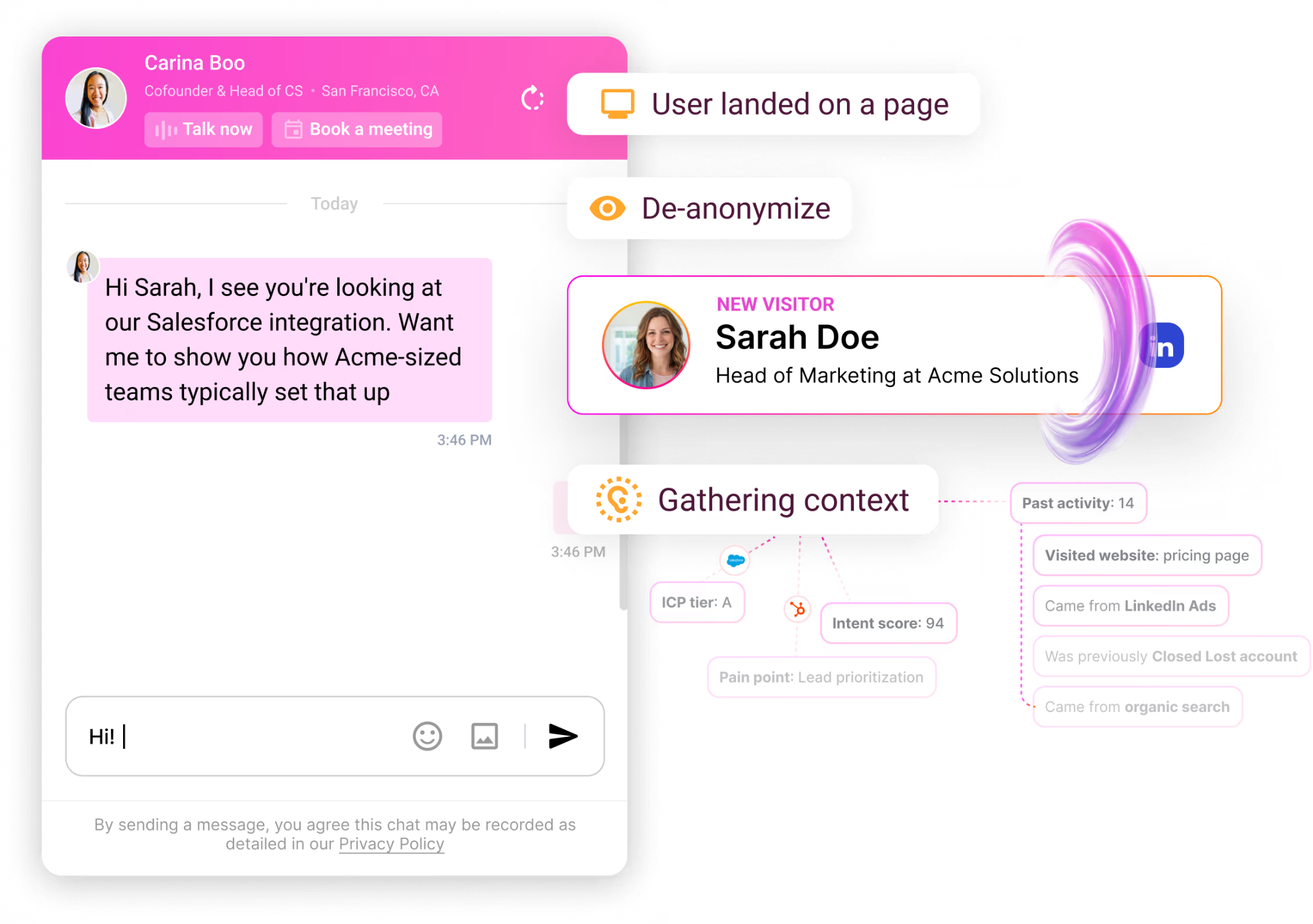
The inbound agent initializes an agentic conversation. We use LangChain's tool-calling agent pattern on top of OpenAI (GPT-4o-mini by default, with automatic escalation to a larger model for complex accounts). State is held in Redis with a 90-minute TTL so the conversation can resume across page loads.

Before the agent speaks, it pulls visitor context into the system prompt:

  • Company name, industry, employee count, tech stack (from enrichment)
  • ICP tier (Tier 1, Tier 2, etc.)
  • Intent score breakdown (which signals are firing)
  • Any prior conversations or email threads
  • Current page path and URL parameters
  • Organization-specific brand voice, product info, and qualification criteria

Armed with that context, the agent picks an opening line. Not a canned greeting. A specific one.

For our Acme Supply visitor, the opener reads: "Hey, saw you're looking at pricing. Quick heads up that we have a wholesale distribution starter plan that might fit better than what's on this page. Want me to pull it up?"

Not "Hi! How can I help you today?" That one is where AI chatbots go to die.

Milliseconds 2000+: The conversation loop

Each turn of the conversation runs up to 3 iterations of the tool-calling agent. Available tools include:

  • ask_question: send a message to the visitor
  • provide_info: answer a product question with grounded content
  • capture_email: qualify and identify the visitor by email
  • book_meeting: route to the right rep's calendar via LeanData or native routing
  • qualify_lead: score the lead against the customer's ICP rules
  • transfer_to_human: hand off to a live rep with full context
  • end_conversation: gracefully wrap up when the visitor is done

The agent streams tokens back to the widget via Socket.IO as it generates. The visitor sees the response word by word, not a "typing..." indicator that sits there for 4 seconds.

If the agent gets stuck or the LLM times out, a fallback message fires: "I'm having trouble right now. Let me connect you with a team member." That handoff is routed through the same rep-assignment logic a human qualification would trigger.

The 4 actions an inbound agent can take

This is the part of visitor identification most tools miss. Identifying the visitor is step one. The hard part is deciding what to do once you know who they are.

Our inbound workflow engine can execute four distinct actions, chosen based on visitor context and customer policy.

Action What it does When it fires
Show popup Renders a targeted overlay with copy tailored to the visitor's segment Moderate intent, no prior engagement, customer prefers passive prompts
Send to webhook Posts the full session context to the customer's endpoint (Zapier, Workato, custom) Customer runs their own routing logic or wants to enrich a CDP
LeanData BookIt Pulls a calendar link from the customer's LeanData routing engine and renders a booking button or redirect High intent, Tier 1 account, customer uses LeanData
Assign to rep Matches the visitor to the right rep (based on territory, account ownership, round-robin) and opens chat with that rep's name and avatar High intent, known account owner, customer prefers human-in-the-loop

Most "AI chatbot for website" tools only do one of these. They always open a chat. They always ask for an email. They always treat every visitor the same. That's the chatbot era. It was a mistake.

Why real-time matters

The difference between identifying a visitor in 100 milliseconds and identifying them in 5 seconds isn't cosmetic. It's the difference between starting a conversation and losing one.

B2B website sessions average 47 seconds. If your tool takes 5 seconds to identify, 5 more seconds to decide, and 5 more to load a chat bubble, you've used a third of the visit on plumbing. Half the visitors have already bounced. The ones who stay are staring at a chat popup that feels like a trap because it loaded suspiciously late.

Sub-second visitor identification changes the surface area of what's possible. You can personalize the hero section in real time. You can rewrite the pricing CTA for the specific company. You can send a Slack alert to the AE before the visitor has scrolled past the fold.

Most importantly: you can decide to do nothing. The most premium action is often restraint. A Tier 1 prospect reading a case study doesn't want a chat popup. They want to read. The right inbound agent knows that and waits.

Why most AI website chatbots don't work

Most "AI website chatbot" products fail for three reasons, and none of them are the LLM.

They don't actually identify visitors. They start talking to everyone the same way because they have no context to do otherwise. The "AI" is just a template engine with good grammar.

They aren't connected to real tools. The chatbot can answer product questions but can't book a meeting, trigger a webhook, check a CRM, or route to a rep. It's a brochure with a typing cursor.

They don't know when to stop. They ask for emails on page 1. They fire popups on every visit. They interrupt pricing-page reads. They treat engagement volume as the success metric instead of conversion quality.

An inbound agent is different because the chatbot is one tool out of many, not the whole product. The agent decides whether to chat, show a popup, send a webhook, pull a calendar, or stay silent. The LLM is the decision-maker, not the decoration.

Where our inbound agent still falls short

Spare you the "we pioneered" routine. Here's what we actually still get wrong.

The first 48 hours of a new deployment are rough. When we spin up a new customer, the agent doesn't yet know their brand voice, their objection patterns, or their product positioning in depth. Our onboarding pipeline ingests the customer's website, docs, and past chat transcripts, but the first two days of chats read a little generic. By day 3, the voice locks in. Day 1 feels like a competent junior AE. Day 7 feels like someone who works there.

Deeply technical product questions still trip us up. If a senior engineer asks about our rate-limit behavior on a specific webhook, the agent does the right thing and hands off to a human. That's the design. But there's a real gap between "can confidently answer 80% of prospect questions" and "replaces your solution engineer." We're in the first camp. Anyone selling you the second is selling you vapor.

Returning visitors who already got AI chat want to talk to a human. Our chat UX makes the handoff clear when a rep is online. When no rep is available, the fallback to "I'll get a human to follow up over email" feels worse than the first chat. We're working on better async handoffs. Not solved.

None of these are reasons to skip an inbound agent. They're reasons to set honest expectations about where it excels (the 80%) and where it doesn't (the long tail).

How to set this up

If you're building visitor identification into your B2B site, the rough order of operations:

  1. Start with one identification source. Pick the one most likely to work for your traffic mix. For B2B with lots of corporate IPs, use IP-to-company. For consumer-adjacent, use a cookie graph provider.
  2. Capture first-party data aggressively. Form fills, email clicks with tracking, chat capture. Every captured email enriches every future session on the same browser.
  3. Define segments before tooling. "Tier 1 account on pricing page" is a segment. "Someone who visited twice this week" is a segment. Map segments to actions before you pick a vendor.
  4. Pick a tool that supports all four action types. If it only does chat, you're buying a chatbot. Make sure it can popup, webhook, book, and assign.
  5. Measure conversion quality, not conversation volume. Number of meetings booked. Pipeline created. Close rate on identified-visitor-sourced deals. Chat volume is a vanity metric.
  6. Add the AI chat layer last. The agent is the top of the stack. Get identification and routing right first, then bolt on the conversational layer.

If you want to skip steps 1 through 4 and see the whole thing running on your own traffic, that's what we do at Warmly. Book 20 minutes with our team and we'll pull a live trace of your visitors during the call. Real IPs. Real companies. Real decisions.

Related reading

FAQ

How do you identify anonymous website visitors? By stitching three data paths: IP-to-company resolution, cookie-based identity providers (LiveIntent, FiveByFive, RB2B, etc.), and first-party capture from forms, email links, and chat. Consensus across the three gets you roughly 70-80% coverage at the company level.

What is a reverse IP lookup? Reverse IP lookup is the process of mapping a visitor's IP address to the company that owns it. Services like Clearbit Reveal, 6sense, and Warmly maintain databases of IP-to-company mappings. Accuracy depends heavily on the network: corporate office IPs hit 80%+, residential ISPs are essentially unusable.

What is an AI inbound agent? An AI inbound agent is an autonomous software agent that identifies website visitors in real time, decides what action to take based on context (chat, popup, webhook, meeting booking, or nothing), and executes without waiting for a human to click a button. It's different from a chatbot because chatting is one of many tools it can use, not the only tool.

How fast can you identify a website visitor? Sub-100 milliseconds for the identification itself (IP lookup plus cookie stitching). Most production systems run end-to-end from page load to decision in 400-2,000 milliseconds. If your tool takes 5+ seconds, the visitor is already scrolling away.

What's the difference between a popup and an AI chat? A popup is a one-way interruption. An AI chat is a two-way conversation. An agentic inbound system can use either, depending on context. High-intent visitors get chat. Moderate-intent visitors sometimes do better with a targeted popup. Low-intent visitors often get nothing at all.

Can AI website chatbots actually book meetings? Yes, when they're integrated with a routing engine like LeanData or the customer's native CRM. The chatbot qualifies the visitor, pulls the right rep's calendar link via API, and renders a booking button inline. The handoff is seamless. The rep sees the full conversation context when the meeting lands on their calendar.

Does website visitor identification work in a cookieless future? Partially. IP-to-company resolution doesn't require cookies. First-party email capture doesn't require cookies. What breaks in a cookieless world is third-party cookie-based person-level identification, which is already degraded in most browsers. Company-level identification is durable. Person-level needs to move to first-party.

How does visitor identification integrate with outbound? A well-designed inbound system writes back to the same context graph the outbound agent reads from. When an identified visitor leaves without converting, the outbound system picks them up and drops them into an email sequence or an ad audience. Inbound and outbound share state, not silos.

Last Updated: April 2026

AI Marketing Tools: How We 3x'd B2B Pipeline in 30 Days With an Agentic Marketing OS

AI Marketing Tools: How We 3x'd B2B Pipeline in 30 Days With an Agentic Marketing OS

Time to read

Alan Zhao

By Alan Zhao, Co-founder & Head of Marketing at Warmly

TLDR: We used AI marketing tools to go from less than $1M in pipeline in February 2026 to over $3.2M in March. Two people on marketing. Under $30K in B2B demand generation spend. Half the sales team we had a year ago. This is the full AI marketing automation playbook: every tool, every tactic, every number.


How We 3x'd Pipeline With AI Marketing Automation (The Starting Point)

February was rough. Sub-$1M pipeline. The market is getting tougher. Claude Code is making buyers think they can build everything themselves. Techie startups are harder to sell to than ever.

A year ago, in February 2025, we were spending $60K+ per month on B2B demand generation. We had a bigger sales team. We had a dedicated GTM engineer. We had a larger marketing team. And we were generating around $2.2M-$2.5M in pipeline.

Fast forward: in February 2026, we spent about $10K on demand gen with 10 salespeople and generated less than $1M in pipeline. In March, we spent under $30K with 11 salespeople and generated $3.2M. Our marketing team is me and Lina, our marketing manager. That's it. Two people.

I'm finding that everything a GTM engineer used to do, and more, can now be done by one person with the right AI marketing tools connected together. This is what agentic marketing looks like in practice.

Here's exactly how.


Step 1: Rebuild the Website as Your AI Marketing Platform Knowledge Base

This is where everything starts. Not with ads. Not with outbound. With your website.

Why? Because AEO (Answer Engine Optimization) is starting to scrape websites directly. ChatGPT, Perplexity, Google's AI Mode. They all prioritize pages that are close to your homepage. If a page is five clicks deep, you're telling Google it doesn't matter. So we restructured everything.

We created pages for every single thing Warmly does:

  • Product pages: TAM Agent, Inbound Agent, orchestration, de-anonymization, every feature with its own dedicated page
  • Integration pages: Every platform we connect with
  • Versus pages: Warmly vs. Clay, vs. Qualified, vs. 6sense, vs. ZoomInfo, vs. Unify, vs. HubSpot. Each one custom-built with honest positioning
  • Use case pages: Account-based marketing, signal-based orchestration, sales automation, AI marketing
  • Persona pages: Rev ops, sales, marketing
  • Segment pages: SMB, mid-market, enterprise
  • Data layer pages: Contact database, intent signals, 220M+ contacts
  • Services pages: Forward deploy motion, CSM support
  • GTM brand page: Our manifesto on how we think about go-to-market

Every page answers the questions that LLMs want answered:

  • What exactly does this feature do?
  • Who does this serve?
  • Why is this important?
  • How do you get value from it?
  • What's the summary?
  • What are the pros and cons versus competitors?
  • What makes this unique?

We added examples showing how each feature works. We added FAQ sections at the bottom of every page. We made everything explicit. No vague marketing speak.

The graphics were the only thing we couldn't automate. AI image generation still isn't good enough to showcase exactly how a product works at the standard we wanted. Our designer created those by hand. Everything else was built programmatically through Claude Code.

★ Insight ───────────────────────────────────── When you force yourself to create all these pages, you're building a comprehensive understanding of your entire product, market positioning, and competitive landscape. Claude Code stores this context. It becomes the foundation for everything else you do in marketing. Your website becomes the nexus of your product offering, and that context gets infused into every ad, every email, every piece of content you create after. ─────────────────────────────────────────────────

We saved the entire sitemap as a Claude MD file. Each page got its own .md file. When Claude Code reads through that folder inside its 1M token context window, it understands your entire business.


Step 2: SEO, AEO, and GEO. AI Powered Marketing Starts With Being Findable

Once the pages existed, we had to make sure they were actually optimized for both traditional search and AI search engines.

We connected Claude Code to:

  • Google Search Console (via service account) to see all traffic, where it's coming from, broken pages, which keywords are hot
  • Google Analytics to see which pages get traffic, how long people stay, general traffic patterns
  • SE Ranking for keyword tracking and competitive analysis

What Google Search Console tells you is gold. You can see exactly what people search to find your website, the impressions, the clicks, the trends over time. For us, a lot of searches are competitor-related: "ZoomInfo pricing," "Apollo alternatives." People are actively searching for this stuff, so we created pages to capture it.

We try to publish about 7 articles a week. But only on topics we actually have authority on. Google's recent algorithm updates punish you for writing about stuff you have no business talking about, and if you post too much low-quality content, you get docked for spam. So every article has to be something our ICP would actually find useful or interesting. We put the goods up front at the top for people who are searching. That performs the best.

Our Drift shutting down post is a good example. It was timely, relevant to our space, and genuinely useful for people trying to figure out what to do next. That kind of content ranks because it deserves to.

Drift shutting down also gave us a huge outbound momentum boost. We built an entire campaign around it. LinkedIn posts about the shutdown got turned into LinkedIn thought leadership ads. We pushed email sequences on the sales side to Drift prospects about the shutdown and how Warmly can help them migrate. Same messaging went into Meta ads and Google search ads. When something that big happens in your space, you go all-in across every channel simultaneously. Blog post, social, ads, outbound sequences. That coordinated push was one of the biggest pipeline drivers in March.

What We Learned About SEO in the AI Era

I had a conversation with John Ozuysal from Houses of Growth that completely changed how I think about this. Some key takeaways:

Don't churn net new content. If you already have a solid content library (we do), creating more mediocre content actually weighs down your domain. Especially after Google's recent spam updates, companies that churn posts got wiped. Instead, optimize what you have.

Don't touch titles. The title is one of the main signals to search engines about what your page is about. Moving a keyword from the beginning to the end of a title kills your entity salience score. The only exception: updating a year ("2025" → "2026") or adding one more item to a listicle.

The top 20-25% of your page is everything. AI crawlers cite the first quarter of a page most often. Don't waste that space with storytelling intros. If the H2 asks "What are the best website visitor identification tools?" start the answer with "The best website visitor identification tools are..." Not "Are you wondering who visits your website? Imagine if you could..." Go straight to the answer.

Add TLDRs after your intro. Three bullet points summarizing the key answer. Crawlers love this.

Short intros, NLP-friendly writing. If there's a question, answer it immediately. Keep relevant entities together. This is the foundation of writing that search engines and AI models can actually parse.

Freshness matters more than ever. AI search prioritizes fresh content. Some of our most competitive articles get updated monthly. New information, new infographics, new data points. Not just changing the publish date. That's a recipe for getting penalized.

Use Google's AI Mode to understand the buyer journey. Search your target terms in AI Mode. Look at the follow-up questions it suggests. Those become FAQ sections in your existing articles. You're covering the entire buyer journey without creating new posts.

The Mention Strategy (This Is the Highest ROI Play)

For AEO and GEO visibility, creating content isn't the fastest path. Getting mentioned is.

Here's the play: Search your target prompt in ChatGPT or Google AI Mode. Look at the sources on the right side. Those are the articles feeding the AI's response. Reach out to those publishers. Ask to get mentioned. Pay $200 if you have to.

But be specific:

  1. Ask for top 3 placement. AI crawlers prioritize the first part of the page. Position 7 barely gets cited.
  2. Write your own description. Don't let them describe you. Control the narrative. "Warmly is an agentic GTM platform that..." Include your use cases, pricing, ICP. Otherwise AI might tell prospects something wrong about you and you'll lose deals before you even know it.
  3. Vary your anchor text. Don't use "website visitor identification software" every time. Mix it up: "website visitor tracking," "visitor identification app," "de-anonymization platform." Same anchor text repeated looks like spam.
  4. Check existing mentions. Go read every page where you're mentioned. Is the pricing current? Are the use cases accurate? Fix anything that's wrong.

Mentions give you backlinks too. And you can request they link to a specific page, like your most important blog post, to strengthen it directly.

Internal Linking

Your most important pages should be one click from your homepage. If it's six clicks deep, you're telling Google it's not important. We put competitor comparison pages in the footer for exactly this reason. They get link juice from the homepage.

Also: find your pages with the most traffic and backlinks. Link from those pages to your bottom-of-funnel content. You're passing authority without buying a single backlink.


Step 3: AI Marketing Automation for Google Ads

We spent about $4,000-$5,000 on Google Ads last month. Not a huge budget. But it's incredibly efficient when you use AI marketing tools with full product context.

Because Claude Code already knows our entire product, our competitors, our versus pages, and our positioning, it generates high-converting ad copy naturally. This is AI for marketing at its most practical. No need for image creatives here. It's all text-based.

We connected Claude Code to the Google Ads API via a service account. It can:

  • Create campaigns, ad groups, and keywords
  • Analyze which keywords drive the most clicks at the best cost per click
  • Kill underperforming campaigns
  • Add new keywords based on Search Console data
  • Project ad spend for the month
  • Suggest optimizations daily

We also connected Google Tag Manager so Claude Code can fix conversion tracking automatically. It creates the script tags for Google, Meta, and LinkedIn conversion tracking. Then it uses Playwright MCP to simulate a real user clicking through the site, filling out forms, to verify that conversion events fire correctly.

This whole loop. Analyze performance → optimize campaigns → verify tracking. Runs every day. Automatically.


Step 4: AI-Powered Account Based Marketing. Build Your Target List

This is where the agentic marketing system really kicks in.

Sales and marketing sit down together and build a target account list. This is where AI for marketing meets account based marketing. About 5,000 companies that:

  • Use tech stacks that indicate they're a good fit
  • Are competitors' customers (Drift, Qualified, 6sense users)
  • Get a lead score and rating
  • Get territory-mapped to specific AEs and SDRs

For each of those 5,000 companies, we identify roughly 5 people in the buying committee. That's 25,000 contacts.

We use Warmly's TAM Agent (our own beta product) to:

  • Generate the buying committee contacts
  • Get business email, LinkedIn profile, and phone number
  • Waterfall through multiple enrichment vendors (Clearbit, Apollo, People Data Labs, and others) to get the most up-to-date information

We have 220 million contacts in our database. The enrichment is real. This isn't just company-level data. It's person-level, with verified contact info.


Step 5: AI Marketing Tools for Multi-Channel ABM

We run two types of ad audiences simultaneously.

ABM Audiences (Signal-Driven)

Our TAM Agent continuously ingests 150+ signals. Website visits, 10-K/10-Q filings, job changes, job openings, Bombora research intent, person-level site visits. When a company exhibits a signal, the agent:

  1. Finds the buying committee
  2. Checks if any member has high intent surge
  3. Pushes them into ad audiences via API (LinkedIn, YouTube, Meta)
  4. Adds the highest-intent contacts to email sequences (via Outreach) and LinkedIn sequences (via HeyReach)

The decision logic matters here. Highest intent + best fit = email + LinkedIn + ads. High fit but low intent = ads only. Not a good fit = nothing. Don't waste resources.

We push contacts directly into ad audiences via each platform's API. For LinkedIn, match rates stay above 90% because we're uploading verified email + company data. For Meta, it's email + first name + last name + location (less precise, hence lookalike audiences).

Exclusion lists are just as important as inclusion lists. Current customers get excluded immediately. Active deals get excluded. Bad titles (interns, students) get excluded from LinkedIn targeting. We constantly prune. One of the biggest time investments was getting the exclusion layer right.

These audiences get refreshed automatically. Every time a new signal comes in and qualifies a company, the contact gets added to the appropriate audience. Every time someone becomes a customer or active deal, they get removed.

Evergreen Audiences (Always-On)

Separately, we run:

  • LinkedIn: Demographic targeting. Right company size, right job title, right role, right country. LinkedIn has the best B2B targeting filters.
  • Meta: Lookalike audiences built from our best customers. Upload your customer list, let Meta find similar people.

These run continuously as top-of-funnel and mid-funnel awareness. The ABM layer handles bottom-of-funnel precision.

Ad Creatives That Actually Work

For YouTube: Horizontal video (16:9) is required, so we put our best performing, highest quality videos in there. We upload contact audiences directly via the Google Ads API. Match rates are lower than LinkedIn, but it's still another touchpoint. Every impression across another channel compounds.

For Meta: Image ads perform best. Our designer created the same graphic illustrations used on our website, retooled into ad formats. Square (1:1) dimensions work across both Instagram feeds and can auto-adjust to 9:16 for Stories. One creative, multiple placements.

For LinkedIn: Thought leadership ads. We post on LinkedIn every day. We know which posts perform well. The winners (high engagement, lots of comments) get recycled into promoted thought leadership ads. They have built-in social proof and we already know they resonate.

For LinkedIn DMs: This one surprised us. Joe, our Head of RevOps, was manually sending LinkedIn messages offering a free AirPod to ICP contacts who'd book a meeting. It was booking 76 meetings a month. We scaled it into LinkedIn Sponsored Message ads from our CEO with the same offer. For bottom-of-funnel contacts who are 100% ICP fit, it's incredibly cost-effective.

Results: Click-through rates consistently above 10%. Cost per click between $1-$2. Cost per lead (meeting booked) under $200.

All of this. Campaign creation, audience uploads, creative rotation, exclusion list management. Can be done programmatically via API through Claude Code. It'll create the campaigns, create the ad groups, upload the PNG images, generate the copy. You just review and approve.


Step 6: AI SDR and Outbound at Scale With the TAM Agent

Our TAM Agent is the core of the AI outbound sales motion. It's not just a sequencing tool. It's a full agentic marketing system with:

  • A knowledge base: Everything about our product, positioning, competitive landscape (built from the website work in Step 1)
  • A policy layer: Rules about who gets what type of outreach, when, and through which channel
  • Trust gates: An approval layer for emails before they go out. Humans review. The agent doesn't go rogue

The agent decides what action to take for every contact based on signal strength, fit score, and channel capacity constraints:

  • High intent + high fit: Email sequence (via Outreach) + LinkedIn sequence (via HeyReach) + ads
  • Low intent + high fit: Ads only (for now). Email and LinkedIn when intent spikes
  • Low fit: Nothing. Don't waste the budget

We have limited sends. LinkedIn messages are the scarcest resource. Emails are more abundant but still finite. Ads can reach everyone. The AI SDR optimizes allocation automatically across every channel.

We also went beyond signal based marketing. We mapped out entire TAMs of 100,000+ accounts. Every Drift user, every Qualified user, every 6sense user. Built buying committees for all of them. Auto-generated personalized emails. Pushed them through the system.

Sometimes you don't wait for signals. You force pipeline through.


Step 7: AI for Marketing Content. Post Every Single Day

We have a mandate: the entire GTM team posts on LinkedIn every day.

  • Co-founders post daily
  • AEs and SDRs post regularly
  • Leadership team posts daily
  • Even engineering posts (our Head of Engineering got 100K+ views on a post about how we 3x'd engineering velocity)

Every week has a theme. One week it's the Inbound Agent launch. Next week it's the Sendoso integration. The whole team coordinates messaging around that theme so our ICP hears it from multiple angles.

Content types that work:

  • Educational how-to content (highest engagement)
  • Thought leadership about the GTM space (builds authority)
  • Video content (strong hook in first 3 seconds, text overlay, less about the company and more about a relevant trend)
  • Funny/cultural content (shows personality)
  • Product demos and releases (coordinated launches)

What doesn't work: self-promotional photos. "We're excited to announce." Generic corporate content.

Coordinated Launches

For big releases, we activate our network. About 100 influencers and friends drop comments in the first 10 minutes. Comments in the first hour are the most powerful signal to LinkedIn's algorithm. Get over 100 comments and the post takes off organically.

We do one or two of these big coordinated launches per month. The most successful posts become. You guessed it. Thought leadership ads that get recycled into our always-on campaign.


Step 8: AI for Marketing Product Launches on Autopilot

This is where the full system comes together.

When engineering ships a new feature, the PR and release notes are written by agents. They get posted to a Slack channel with:

  • The use case
  • What the feature includes
  • How it works
  • Who it's for
  • How to implement and onboard

Our Head of Product creates a Loom walkthrough video.

From there, Claude Code takes over:

  1. Reads the Slack post via Slack MCP
  2. Generates a Playbooks page using our Webflow API token and existing template
  3. Uploads the video to Wistia via Wistia API, gets back an embed link
  4. Embeds the video on the Webflow Playbooks page
  5. Generates a Customer.io email with the video thumbnail, link to the Playbooks page, and proper UTM parameters
  6. Sends to our list of 15-20K users who have used Warmly at some point (free or paid)

The UTM parameters include a special w_email= parameter that passes the recipient's email. When they click through to our site, Warmly de-anonymizes them instantly. That data feeds back into the entire system.

One Slack post → website page + video hosting + email newsletter. Automatically.


Step 9: The Daily AI Marketing Analytics Loop

Every day, we ask Claude Code to analyze:

  • Google Ads performance
  • Meta Ads performance
  • LinkedIn Ads performance
  • YouTube Ads performance
  • Google Search Console rankings
  • Google Analytics traffic patterns
  • Warmly session data (de-anonymized visitors)
  • HubSpot CRM pipeline and conversion data
  • Blog post SEO health

AI marketing analytics means looking at everything together. Not in silos. It finds:

  • Where the biggest spend gaps are
  • Where we're wasting money
  • Which campaigns to kill
  • Which keywords to add
  • What the session-to-meeting conversion rate looks like
  • Where people are getting stuck in the funnel
  • What's driving actual pipeline vs. vanity metrics

Then it fixes things. Programmatically. Kill an ad, add keywords, upload a new creative, update a blog post's FAQ section. No manual work. Just review the changes.


Step 10: De-anonymization Closes the B2B Demand Generation Loop

Warmly's core product is the glue. Someone visits our website from any channel (ads, newsletter, ChatGPT referral, organic search) and we know who they are. Not just the company. The person.

If they're ICP and they haven't been added to an ad audience, they get added automatically. They get a follow-up email. A LinkedIn message. And ads across YouTube, LinkedIn, and Meta.

The system knows if they came from Google, from a newsletter, from an AI chatbot referral. It knows which pages they visited, how long they stayed, whether there's a surge of visits from their company. It filters out bot traffic. It overlays demographic data on activity data.

That intelligence feeds back into every decision the TAM Agent makes.


The Results

Feb 2025 Feb 2026 Mar 2026
Pipeline ~$2.2M <$1M $3.2M
Demand gen spend $60K+ ~$10K <$30K
Marketing team 3-4 people 2 people 2 people
Sales headcount 20+ 10 11

We've never been more efficient. Half the spend. Half the team. 3x the output.

The breakdown:

  • Ads (LinkedIn, Meta, YouTube, Google): Always-on awareness + precision ABM targeting
  • Outbound (email via Outreach, LinkedIn via HeyReach): Signal-driven + forced TAM outreach
  • Inbound (website, SEO, AEO, content): Optimized for both human and AI search
  • Product marketing (automated Playbooks + email): Every release drives re-engagement
  • De-anonymization: Closes the loop on every channel

What AI Marketing Tools Do You Need to Do This?

Here's the actual stack for building an agentic marketing OS:

  1. Claude Code with Wispr Flow (voice-to-code), WozCode, and MCP connections
  2. API access to: Google Ads, Google Analytics, Google Search Console, Google Tag Manager, LinkedIn Ads, Meta Ads, Webflow, Wistia, Customer.io, HubSpot, Outreach, HeyReach
  3. A Claude folder on your desktop that stores your market understanding, website content, competitive analysis, and positioning docs. Claude reads through this folder to understand your entire business
  4. Warmly for de-anonymization, signals, orchestration, and contact data
  5. A designer for ad creatives and product illustrations (this is the one thing AI still can't do well enough)
  6. A team willing to post daily on LinkedIn

Save your API credentials and endpoint references in Claude MD files. That way Claude Code knows how to access every tool through agentic search. It'll figure out which APIs to call based on the problem you're trying to solve.


Is AI Marketing Automation Actually Easy?

No. The initial setup takes real effort. Connecting all the APIs, building the exclusion logic, getting ad creative right, training the TAM Agent's policy layer.

And not everything is automated. The designer still makes graphics by hand. The team still has to post content daily. Trust gates mean humans review outbound before it sends. John still has to audit our SEO because his eyes are better than mine for that stuff.

But the system compounds. Every day it runs, it gets smarter. More signals. Better targeting. Tighter exclusions. More context about what's working.

We used to need a dedicated GTM engineer to wire all this together. Now one person can do it. We used to spend $60K+ a month on demand gen. Now we spend under $30K. We used to have double the sales team. Now the agents handle the volume that humans used to.

We went from sub-$1M to $3.2M in 30 days. Not because we found some magic trick. Because we connected everything together and stopped leaving pipeline on the table.

The AI marketing tools exist. The APIs are there. The question is whether you're willing to wire it all up and let it run.


Last Updated: April 2026

ABM Strategy in 2026: The Playbook That Replaced Everything You Knew About Account-Based Marketing

ABM Strategy in 2026: The Playbook That Replaced Everything You Knew About Account-Based Marketing

Time to read

Alan Zhao

Every ABM strategy guide on the internet tells you the same thing. Define your ICP. Build a target account list. Align sales and marketing. Personalize your outreach. Measure account-level metrics.

That advice was fine in 2022. It's dangerously incomplete now.

I run marketing at Warmly. One person, Series B company, no agency. Our ABM motion generates attributable pipeline across email, LinkedIn, live chat, phone, and paid ads - and I can trace the full buyer journey from the first anonymous LinkedIn ad impression to closed-won revenue. Six months ago, that was impossible. Not because the strategy was wrong. Because the infrastructure didn't exist.

Account-based marketing in 2026 is not a strategy. It's a system. A system that detects signals, identifies buyers, targets them across every channel, nurtures them through the funnel, engages them when they show up, and attributes every touchpoint to revenue. All coordinated by AI agents with full context over the buyer journey.

This guide is the playbook for building that system. Not theory. Not frameworks you'll never implement. The actual tools, tactics, and architecture that replaced the legacy ABM playbook.


Quick Answer: ABM Strategy by Maturity Stage

Best ABM strategy for teams just starting: Focus on one channel (LinkedIn Ads), one signal source (website visitor identification), and one action (AI chat engagement). Get the loop working before scaling. Start with Warmly for signal detection + visitor ID + chat, and $1-2K/month LinkedIn Ads budget. You can run effective ABM for under $50K/year.

Best ABM strategy for scaling teams: Multi-channel surround sound. LinkedIn + Meta + Google ads targeting your TAM and lookalike audiences. Signal-triggered email and LinkedIn outreach via AI agents. Behavior-driven nurture campaigns. Full buyer journey attribution. Budget: $75-150K/year across tools and ad spend.

Best ABM strategy for enterprise: Unified context graph connecting every signal, every touchpoint, and every outcome. Autonomous GTM orchestration with agents executing across all channels within guardrails. LLM-based attribution that assigns weighted credit to every touchpoint. Budget: $200K+/year.

Best ABM strategy for companies ripping out legacy platforms: Replace 6sense/Demandbase with a modern stack of specialized tools connected by AI agents. You'll get better attribution, faster execution, and lower cost. The money you save on platform fees goes into ad spend that actually reaches your buyers.


Why the Old ABM Playbook Broke

The old playbook worked when: - Intent data was scarce and hard to get - Manual workflows were the only option - "Personalization" meant putting someone's name in an email subject line - Attribution was accepted as impossible, so nobody asked hard questions - One platform (6sense, Demandbase, Terminus) could handle the whole thing

None of that is true anymore.

Intent data is everywhere now

Six months ago, getting buying signals required a $100K+ contract with 6sense or Demandbase. Now you can stitch together signals from Bombora (research intent), G2 (category research), LinkedIn (job changes, social engagement), website visitor identification (who's on your site right now), technographic changes, and job postings. The problem shifted from "how do I get signals" to "how do I act on all of them fast enough."

According to the 2025 State of ABM Report, 78.7% of companies are now using AI in their ABM programs. But Gartner research shows only 17% can accurately attribute pipeline to ABM investments. Everyone has the data. Almost nobody knows what's working.

Agents replaced workflows

The old ABM playbook: human reads dashboard → human decides what to do → human takes action → human (maybe) updates CRM. That worked when you had 50 target accounts and 3 channels.

It breaks when you need to evaluate hundreds of accounts across email, LinkedIn, live chat, phone, and 4 ad platforms - making thousands of micro-decisions per day about who to contact, what to say, when to say it, and which channel to use.

AI agents don't replace the strategy. They execute it at a scale and speed that humans can't. But they need infrastructure that legacy ABM platforms weren't built to provide.

The attribution loop is finally closable

This is the biggest change and nobody's talking about it enough.

Legacy ABM platforms couldn't connect intent data → LinkedIn ad impression → website visit → chat conversation → email sequence → demo booking → closed deal. The data lived in 6 different tools. So teams accepted "influenced pipeline" as a metric, which basically means "we think our stuff helped but we can't prove it."

Now, with unified platforms and tools like Fibbler for ad attribution, you can trace the full buyer journey. When a company finally books a demo, you can see every touchpoint: the first LinkedIn ad they saw 3 months ago, the 4 blog posts they read, the email sequence they opened but didn't click, the website visit where the AI chat agent engaged them, and the retargeting ad that brought them back.

That first touch - the first time they were ever exposed to you - usually never gets captured. It's the hardest attribution problem in B2B. But it's the most important data point because it tells you what's actually creating awareness. Legacy tools miss it. The new stack catches it.

Data can't live in silos

6sense, Demandbase, and Terminus were designed to be the single platform for ABM. All data inside their walls. That made sense when humans needed one dashboard.

It doesn't work when AI agents need to read signals from one tool, check enrichment data from another, execute outreach through a third, and sync results to a CRM. The platform lock-in that used to be a business moat is now a product liability.

Modern ABM strategy requires data that flows freely between specialized tools, connected by a shared context graph that every agent can reason over.


The New ABM Framework

Forget the traditional ABM funnel. Here's how ABM actually works when it's working:

Signal → Target → Surround → Engage → Attribute → Learn

Stage What Happens Old Way New Way
Signal Detect buying intent Buy 6sense, wait for scores Stitch signals from 5+ sources in real-time
Target Reach your buyers Upload static list quarterly Always-on targeting + lookalikes finding new accounts
Surround Multi-channel presence Display ads only LinkedIn + Meta + Google + YouTube + email + chat
Engage Convert interest to pipeline SDR manually follows up AI agents engage with full buyer context
Attribute Connect spend to revenue "Influenced pipeline" guessing Full journey tracking, every touchpoint
Learn Improve over time Quarterly reviews Agents learn from outcomes, system gets smarter

The critical insight: this is a loop, not a funnel. The Learn stage feeds back into Signal. What you learn from closed-won deals changes who you target, how you message, and where you spend. Every cycle makes the system smarter.

At the pace of foundational model improvements - every time Opus 5 or GPT-5 ships - the reasoning engine gets better. If your ABM system is built on a context graph with decision traces and outcome data, the whole thing improves automatically. If it's built on static workflows in a legacy platform, nothing changes except the UI.


Step 1: Build Your Signal Layer

ABM starts with knowing who to go after and when. Signals tell you both.

The 6 Signal Types That Matter

Signal What It Tells You Source Urgency
Website visits They're actively looking at you Warmly visitor ID Highest - engage now
Research intent They're exploring your category Bombora, G2 High - start targeting
Job postings They're building the team to buy LinkedIn, Indeed Medium - time outreach
Job changes New decision-maker, new budget LinkedIn, Clay High - warm intro window
Social engagement They're signaling interest publicly Social signal monitoring Medium - engage on platform
Technographic shifts They're changing their stack BuiltWith, PublicWWW Medium - competitive opportunity

Don't just collect signals. Stitch them together.

A single signal is noise. A combination is conviction.

"Acme Corp researched sales automation" - could be an intern writing a report.

"Acme Corp researched sales automation + their VP of Sales just changed jobs + they posted a BDR role + someone from Acme visited our pricing page twice this week" - that's a buying signal.

Your signal layer needs to combine multiple signal types into an account-level score that reflects actual buying intent. This is what a context graph does: it connects signals across sources into a unified view that agents can reason over.

How to set up your signal layer

Minimum viable signal stack: 1. Deploy website visitor identification - know who's on your site at the person level 2. Connect Bombora or G2 for third-party research intent 3. Monitor LinkedIn for job changes at target accounts 4. Score accounts based on signal combination, not individual signals

Time to implement: 1 day with Warmly. 4-8 weeks with 6sense or Demandbase.


Step 2: Always Be Targeting Your TAM

Most ABM guides tell you to build a target account list of 100-500 companies and focus all your efforts there.

That's half right. You should absolutely have a focused list. But you should also be running always-on campaigns that reach your entire total addressable market - including companies you haven't identified yet.

The two targeting motions

Motion 1: Focused ABM (known accounts) Your target account list. Companies showing intent signals. Accounts in your pipeline. Past customers you want to re-engage. Personalized campaigns, high touch, multi-threaded.

Motion 2: TAM awareness (unknown accounts) Lookalike audiences on LinkedIn and Meta that match your ICP. Broad search campaigns on Google for category keywords. Content campaigns that build awareness with companies you don't even know about yet.

Both motions run simultaneously. Always.

Lookalike audiences are underrated

Upload your closed-won customer list to LinkedIn and Meta. Let the algorithms find companies that look like your best customers. This is how you discover the accounts that should be on your target list but aren't.

Most ABM teams skip this because it doesn't feel "account-based." It feels like demand gen. But the line between ABM and demand generation is artificial. You're targeting companies that match your ICP. You're just letting the ad platform help you find ones you missed.

When those unknown accounts click your ad and visit your website, Warmly identifies them. They go from "unknown" to "known." If they match your ICP, they get added to your focused ABM list automatically. The TAM awareness motion feeds the focused ABM motion.

How to build your target audiences

For LinkedIn Ads: - Upload customer list → create lookalike - Upload ICP criteria → matched audience (use Primer for 70-90% match rates vs LinkedIn's 30-50%) - Target by job title + seniority + company size + industry for broad ICP reach

For Meta Ads: - Upload customer email list → lookalike audience - Upload Clay-enriched contact list → custom audience - Lower CPC than LinkedIn, great for surround sound

For Google Ads: - Customer Match with email lists - Search campaigns for category and competitor keywords - YouTube pre-roll targeting your account list

Pro tip: Use Claude Code to automate audience sync across platforms. When a new account enters your CRM, it should automatically be added to your LinkedIn, Meta, and Google audiences. Don't do this manually.


Step 3: Surround Sound Across Every Channel

ABM isn't one channel. It's every channel, coordinated.

Your buyer doesn't live on LinkedIn. They check LinkedIn at work, scroll Instagram in the evening, search Google when they're researching solutions, watch YouTube when they want to learn, open emails when they're in evaluation mode, and visit your website when they're comparing options.

The best ABM strategy hits them on all of these with a consistent message, timed to their buying stage.

The Surround Sound Framework

Stage Channels Message Goal
Awareness LinkedIn Ads, Meta Ads, YouTube Thought leadership, problem education Get on their radar
Consideration Google Search, Blog content, Email Comparison guides, case studies Become the frontrunner
Decision Retargeting ads, AI chat, SDR outreach Demo offers, ROI calculators, social proof Convert to meeting
Negotiation Email, Phone, Personalized content Custom proposals, competitive intel Close the deal

Channel-specific tactics

LinkedIn Ads (awareness + consideration) - Thought leadership ads from the founder's profile (these outperform brand ads 3x) - Video ads for top-of-funnel education - Sponsored messaging for high-intent accounts - Retarget website visitors with comparison content - Use Metadata to auto-optimize bids and save 20-30% on CPCs

Meta / Instagram (awareness + surround sound) - Custom audiences from your CRM and Clay exports - Lookalike audiences based on closed-won customers - Instagram Stories and Reels for visual content - Cheaper CPCs than LinkedIn - stretch your budget further - Your buyer sees you on LinkedIn at work and Instagram at night. That's surround sound

Google / YouTube (consideration + decision) - Capture active search demand with category keywords - Competitor keyword campaigns ("6sense alternatives", "Demandbase pricing") - YouTube pre-roll ads targeted to your account list - Customer Match to retarget across Gmail, Search, and Display

Email (consideration + decision + nurture) - Signal-triggered sequences: when an account shows intent, auto-start personalized email - Use Customer.io for behavior-driven campaigns at scale - Personalize based on what they've done (pages visited, content downloaded, ads clicked) - Cool-down periods between touches based on engagement

AI Chat (decision) - When visitors land on your site, engage with full context - not a generic "How can I help?" - Warmly's inbound agent knows who they are, what company they're from, what signals they've shown, and what the AE discussed last time - Can deliver product demos outside business hours - Converts website traffic into pipeline that otherwise bounces

Phone / SDR (decision + negotiation) - Triggered by high-intent signals (pricing page visit + return visitor + matched ICP) - SDR gets full context before calling: what pages they visited, what ads they clicked, what emails they opened - The call isn't cold. It's informed.

The coordination problem (and how agents solve it)

The biggest risk in multi-channel ABM: sending disconnected messages across channels. An SDR emails while a LinkedIn ad is running while the chat agent is engaging - and none of them know about each other.

This is why autonomous GTM orchestration matters. AI agents that share a context graph can coordinate: the TAM agent pauses email outreach when the chat agent is having a live conversation. The ad targeting adjusts when an account enters late-stage pipeline. The SDR gets a Slack notification that this account just engaged with the chat agent and here's what they asked about.

Without coordination, you're running 5 independent campaigns. With coordination, you're running one intelligent system.


Step 4: Engage With Full Context

Here's the moment that matters: a person from a target account lands on your website. Everything you've done - the ads, the emails, the content, the signals - led to this moment.

What happens next determines whether you get a meeting or a bounce.

The old way: generic chat popup

"Hi! Thanks for visiting. Want to chat?" → 95% close the window.

The new way: context-aware engagement

The AI inbound agent knows: - This person is Sarah, VP of Marketing at Acme Corp - Acme was closed-lost 8 months ago. Different buyer at the time - Sarah joined Acme 3 months ago (job change signal) - Acme has been researching "ABM platforms" on G2 for 2 weeks - Sarah clicked a LinkedIn ad about multi-channel ABM yesterday - She's on the pricing page right now, second visit this week

The agent says: "Welcome back, Sarah. I see your team has been evaluating ABM platforms. Would it be helpful if I walked you through how we compare to what you're currently using? I can also show you what the pricing looks like for a team your size."

That's not a chatbot. That's a concierge with perfect memory.

The buying committee matters

ABM isn't selling to one person. It's selling to a buying committee: the champion, the economic buyer, the technical evaluator, the end users, and sometimes the blocker.

Your engagement strategy needs to map the committee and personalize for each role:

Role What They Care About How To Engage
Champion Making a successful recommendation Case studies, ROI data, competitive intel
Economic Buyer Budget justification, risk Pricing transparency, security/compliance, references
Technical Evaluator Does it actually work? Integration docs, API access, implementation guide
End Users Will this make my job easier? Product demos, workflow examples
Blocker What could go wrong? Risk mitigation, migration plan, support SLAs

Use Clay to identify the buying committee members at each target account. Use Sybill to capture what each person cares about from calls. Use Warmly to engage them with role-specific messaging when they visit your site.


Step 5: Attribute Everything

Attribution is where legacy ABM dies. And where modern ABM gets its superpower.

Why attribution matters for ABM strategy

Without attribution, every budget conversation is a guess. "I think LinkedIn ads are working." "I feel like our ABM program is generating pipeline." Feelings don't survive CFO reviews.

With attribution, you can say: "Our LinkedIn ad campaigns influenced $2.3M in pipeline last quarter. The average deal that engaged with our ads had 15 touchpoints across 4 channels over 47 days before booking a meeting. LinkedIn was the first touch in 34% of deals and contributed an average of 22% weighted attribution across all closed-won."

That's a conversation a CFO respects.

The full activity ledger

Modern ABM attribution requires a complete activity ledger - every touchpoint recorded, timestamped, and connected to the account and person.

When a deal closes, you should be able to pull up the full timeline:

  1. Day 0: LinkedIn ad impression (brand awareness video)
  2. Day 3: Clicked LinkedIn ad → visited blog post
  3. Day 7: Returned organically → visited pricing page → Warmly identified them
  4. Day 8: AI chat agent engaged → booked meeting
  5. Day 10: SDR confirmed meeting → sent prep materials
  6. Day 14: Demo with AE → positive feedback
  7. Day 21: Second meeting → brought in technical evaluator
  8. Day 30: Proposal sent
  9. Day 45: Closed-won

Every single step is captured. The first LinkedIn ad impression that started the whole thing - the touch that traditional attribution misses - is recorded.

LLM-as-a-judge attribution

Here's the advanced play that's emerging now.

First-touch attribution says LinkedIn gets 100% credit. Last-touch says the SDR email gets it. Linear attribution splits it evenly. All of these are wrong because they're dumb models applied to complex buyer journeys.

The better approach: give an LLM the full activity ledger and ask it to assign weighted attribution based on contribution to the outcome. Like an LLM-as-a-judge evaluating each touchpoint.

A sales and marketing person looking at that timeline can probably agree: LinkedIn wasn't 100% responsible. But it wasn't 0% either. Maybe 20%. The blog post was 15%. The AI chat interaction that actually booked the meeting was 30%. The AE demo was 25%. The retargeting ad that brought them back before demo 2 was 10%.

Now overlay that model across all closed-won AND closed-lost deals. You finally know: what percentage goes to LinkedIn ads, email marketing, Meta ads, content, SDR outreach, and AI chat. For both wins and losses.

That's revenue go-to-market as a unified function. Sales and marketing attribution merged because the full buyer journey is visible end-to-end.

Tools for ABM attribution

  • Fibbler ($89/mo): Connects LinkedIn and Google ad engagement to CRM pipeline. The starting point.
  • HockeyStack: Full-funnel B2B attribution platform. Deeper than Fibbler but more expensive.
  • Warmly Activity Ledger: Records every touchpoint across all Warmly channels (chat, email, site visits, ad clicks). Feeds directly into attribution analysis.

Step 6: Close the Learning Loop

This is the step every ABM guide skips. And it's the one that makes everything else compound.

What the system learns from

Every closed-won deal teaches you: - Which signals predicted the deal (so you can weight signals better) - Which channels contributed (so you can allocate budget better) - Which messaging resonated (so you can create better content) - How long the cycle was (so you can set expectations) - Which buying committee structure appeared (so you can target similar structures)

Every closed-lost deal teaches you: - Where the deal stalled (so you can address objections earlier) - Which competitor won (so you can adjust positioning) - Which signals were false positives (so you can filter them out) - What the buyer's actual objections were (so you can address them in ads and content)

Feed insights back into the system

The intelligence from Sybill call recordings should directly inform: - Ad creative (Tofu HQ): Use actual customer language and pain points - Email sequences (Customer.io): Address real objections proactively - Chat agent prompts (Warmly): Train on what converts and what doesn't - Targeting criteria (Clay + Primer): Refine ICP based on what actually closes - Budget allocation: Shift spend to channels with highest attributed contribution

The compounding advantage

Here's why this matters strategically: every time the foundational models improve, your system gets smarter.

The reasoning engine (Claude, GPT, etc.) gets better with each release. But it needs a context layer - what your organization knows, what decisions it's made, what happened as a result. If your ABM system saves decision traces and outcomes, every model improvement automatically improves your whole go-to-market.

If your ABM runs on static workflows in a legacy platform, nothing improves except the UI.

This is what memory as a moat means for ABM. The system that accumulates the most context over time - signals, decisions, actions, outcomes - has a compounding advantage that's impossible to replicate.


The ABM Tech Stack That Makes This Work

You don't need 15 tools. Here's the minimum viable stack by layer:

Layer Tool What It Does Cost
Signals Warmly Visitor ID + intent data + buying committee From $30K/yr
Enrichment Clay 150+ data providers, AI research agent From $149/mo
LinkedIn Ads LinkedIn Campaign Manager Primary B2B ad channel $1-10K/mo spend
Meta Ads Meta Business Manager Surround sound + retargeting $1-5K/mo spend
Email Customer.io Behavior-triggered nurture From $100/mo
Attribution Fibbler LinkedIn/Google → pipeline attribution From $89/mo
Orchestration Claude Code The AI brain connecting everything $20-100/mo
Intelligence Sybill Call recording → marketing insights From $36/user/mo

Total minimum cost: ~$50K/year (including ad spend)

For the full breakdown of every tool, see our complete guide: Best ABM Platforms & Tools in 2026.

Tools you can add as you scale

When You Need Add Cost
Higher ad match rates Primer From $1K/mo
AI ad optimization Metadata ~$60K/yr
Personalized creative at scale Tofu HQ From $5/employee/mo
Deep third-party intent 6sense or Demandbase $60-200K/yr
Google/YouTube campaigns Google Ads $2-10K/mo spend

ABM Strategy by Budget

$30-50K/year: The Solo Marketer Stack

You're one person. Maybe two. You can't afford $200K ABM platforms and you shouldn't need to.

Strategy: Focus on one ad channel (LinkedIn), one signal source (Warmly), and the AI chat → meeting conversion loop.

Weekly cadence: - Monday: Review intent signals in Warmly. Identify high-intent accounts. - Tuesday: Refresh LinkedIn ad audiences with new intent-based segments. - Wednesday: Review Fibbler attribution. What's working? Kill what's not. - Thursday: Update AI chat agent prompts based on Sybill call insights. - Friday: Use Claude Code to run any custom analysis or automation.

Expected results: 20-50 additional qualified meetings per quarter from accounts you would have missed without signal detection.

$75-150K/year: The Growth Team Stack

You have 3-10 people across marketing and sales. Multiple channels, real ad budget.

Strategy: Full surround sound. LinkedIn + Meta + Google ads. Signal-triggered email sequences. AI chat on website. SDR follow-up on highest-intent accounts.

The system runs itself: - Warmly detects intent signals → triggers agent workflows - TAM Agent sends personalized email + LinkedIn outreach - Ads target accounts across LinkedIn, Meta, Google simultaneously - Inbound Agent engages website visitors with full context - Fibbler attributes pipeline back to channels - Sybill insights feed back into creative and messaging - Claude Code orchestrates the connections

Expected results: 2-3x pipeline coverage. Clear attribution across channels. One person can manage what used to require a 5-person ABM team.

$200K+/year: The Enterprise Stack

Everything above, plus deep intent data from 6sense or Demandbase, AI ad optimization from Metadata, and advanced audience building from Primer.

At this level, the ROI math changes: you're not asking "can we afford ABM tools?" You're asking "are we spending our ABM budget on the right tools?"

Most enterprise teams waste 40-60% of their ABM budget on platforms that can't prove ROI. Reallocating that spend to channels with proven attribution (LinkedIn ads, Meta ads, email) typically generates more pipeline at lower cost.


Common ABM Mistakes (And What To Do Instead)

Mistake 1: Treating ABM as a marketing project

ABM is a go-to-market strategy, not a marketing campaign. If your sales team doesn't know what accounts are being targeted, what signals are firing, and what messages marketing is sending, your ABM program is a silo that happens to target specific accounts.

Do instead: Shared Slack channel where signal alerts post automatically. Weekly 15-minute sync on top accounts. Give sales access to the activity ledger so they see every touchpoint before calling.

Mistake 2: Static target account lists

Updating your target list quarterly means you're 3 months behind on signals. Companies enter and exit buying windows fast.

Do instead: Dynamic list that updates based on signals. When an account starts showing intent, it enters your focused ABM list. When signals go cold, it moves to the awareness tier. Use Warmly's ICP scoring to automate this.

Mistake 3: Only running display ads

Demandbase built an empire on display advertising. The reality: display ads have <0.1% click-through rates. They're fine for brand impressions. They're terrible for driving measurable pipeline.

Do instead: LinkedIn ads for B2B targeting + Meta for surround sound + Google for search intent capture. These channels have measurable engagement and attributable pipeline. Display ads are the garnish, not the meal.

Mistake 4: No attribution model

"We influenced $10M in pipeline" means nothing if you can't explain how. Without attribution, you can't optimize, and you can't defend your budget.

Do instead: Implement Fibbler on day 1. Connect LinkedIn ad engagement to CRM pipeline. Start with simple multi-touch, then evolve to LLM-weighted attribution as you accumulate data.

Mistake 5: Ignoring closed-lost intelligence

Most teams obsess over closed-won patterns. The gold is in closed-lost. Why did they choose the competitor? What objections came up? Where did engagement drop off?

Do instead: Use Sybill to analyze closed-lost calls. Feed the objections into your ad creative and email messaging. Address the #1 reason people don't buy before they bring it up.

Mistake 6: Sending the same message everywhere

"Multi-channel" doesn't mean "same email as a LinkedIn ad as a chat message." Each channel has a different role in the buyer journey.

Do instead: LinkedIn ads for brand building and thought leadership. Email for detailed, personalized outreach. Chat for real-time engagement. Phone for high-intent follow-up. Each channel has a distinct message appropriate to its role.


How Warmly Runs ABM

I'm going to be specific about how we actually do this. Not theory. The actual setup.

Signal layer: Warmly's own visitor identification + Bombora research intent + LinkedIn social signals. Every account gets scored based on the combination.

Targeting: LinkedIn Ads running always-on against our ICP (job titles in B2B SaaS, revenue teams, specific company sizes). Meta Ads for surround sound. Google Ads for competitor and category search terms. Audiences refreshed automatically from our CRM.

Engagement: When a scored account visits our site, the AI inbound agent engages with full context. If it's a return visitor from a previously closed-lost account, the agent knows the history. If it's a net-new account showing intent, the agent qualifies and books a meeting.

Outbound: The TAM Agent picks up accounts that showed intent but didn't visit the site. Personalized email + LinkedIn message timed to when signals are highest.

Attribution: We can trace every deal from first impression to close. The data feeds back into which audiences we target, which creative we run, and how we allocate budget.

What I spend my time on: Creative strategy, call analysis for messaging, budget allocation decisions, and talking to customers. The system handles execution. One person runs ABM for the whole company because the agents do the work.

What I don't spend time on: Updating lists. Writing individual emails. Monitoring dashboards. Manually syncing audiences between platforms. That's all automated.

Where we're honest about gaps: We don't have a display ad DSP. Our third-party intent data isn't as deep as 6sense. Our approach works best for companies that want to simplify their stack, not companies that want to add another tool to an already complex setup. See our full ABM tools comparison for where each tool fits.


FAQs

What is ABM strategy?

ABM (account-based marketing) strategy is a go-to-market approach that focuses sales and marketing resources on specific high-value accounts rather than casting a wide net. In 2026, effective ABM strategy means building a system of signal detection, multi-channel targeting, AI-powered engagement, full-funnel attribution, and continuous learning - coordinated by AI agents with shared context over the entire buyer journey.

How do I create an ABM strategy from scratch?

Start with three steps: (1) Set up your signal layer by deploying website visitor identification with a tool like Warmly so you know which companies are visiting your site and showing intent. (2) Launch LinkedIn Ads targeting your ICP with a $1-2K/month budget. (3) Connect Fibbler to start attributing ad engagement to pipeline. This minimum viable ABM loop costs under $50K/year and one person can run it.

What is the difference between ABM and demand generation?

ABM targets specific known accounts with personalized campaigns. Demand generation creates broader awareness and captures inbound interest. The most effective B2B teams in 2026 run both simultaneously: always-on demand gen with LinkedIn and Meta ads reaching their ICP broadly, combined with focused ABM campaigns for high-value accounts showing intent signals. The same tools serve both motions.

How much does an ABM strategy cost?

A minimum viable ABM strategy costs $30-50K/year including tools and ad spend. A scaling ABM program runs $75-150K/year across multiple channels with AI agents handling execution. Enterprise ABM programs with deep intent data and advanced orchestration cost $200-500K/year. The modern stack approach lets you start small and scale specific layers as needed, unlike legacy platforms that require $60-200K upfront.

What are the best ABM channels?

The most effective ABM channels in 2026 are LinkedIn Ads (primary B2B targeting), Meta/Instagram Ads (surround sound at lower CPCs), Google Search Ads (capturing active buying intent), AI chat (real-time website engagement), email (behavior-triggered nurture sequences), and phone (high-intent follow-up). The key is coordinating all channels through a shared context layer, not running them independently.

How do I measure ABM success?

Measure ABM at the account level, not the lead level. Key metrics: accounts engaged (how many target accounts interacted with any channel), pipeline generated (new opportunities from ABM-touched accounts), pipeline velocity (how fast ABM accounts move through stages), and revenue attributed (closed-won revenue traceable to ABM touchpoints). Use multi-touch attribution models rather than first-touch or last-touch to accurately credit each channel's contribution.

What's wrong with legacy ABM platforms like 6sense and Demandbase?

Legacy ABM platforms were designed for humans operating dashboards, not AI agents operating systems. The three main problems: (1) Data silos - intent data, ad engagement, chat conversations, and CRM data live in separate systems with no closed-loop attribution. (2) Company-level only - they show company intent but can't identify the specific person at the company who's buying. (3) No learning loop - they can't connect what you did to what happened, so the system never gets smarter over time.

How do AI agents change ABM strategy?

AI agents transform ABM from a dashboard-reading exercise to an autonomous execution system. Instead of humans checking intent scores and manually deciding what to do, agents evaluate signals in real-time, select the best action (email, LinkedIn message, chat engagement, ad adjustment), execute within guardrails, and log the outcome. This lets one person run ABM programs that used to require teams of 5-10, while making thousands of micro-decisions per day across channels.

What is a context graph and why does it matter for ABM?

A context graph is a unified data structure that connects every entity in your go-to-market ecosystem - companies, people, deals, signals, activities, and outcomes - into a single model that AI agents can reason over. It matters for ABM because without it, agents only see the current signal. With it, they see the full history: this company was closed-lost 8 months ago, a new VP just joined, they've been researching your category for 2 weeks, and they clicked your LinkedIn ad yesterday. That context is the difference between a generic email and a perfectly timed, perfectly personalized engagement.

How long does it take to see results from ABM?

With a modern stack (Warmly + LinkedIn Ads + Clay), you can see first signals and engagements within the first week. Qualified meetings typically start flowing in weeks 2-4. Meaningful pipeline impact shows in 60-90 days. Full attribution data requires one complete sales cycle (typically 30-90 days depending on your deal cycle). Legacy ABM platforms typically take 4-8 weeks just to implement before any results are possible.


Last Updated: March 2026

Website Visitor Identification Match Rates: What Every Vendor Won't Tell You

Website Visitor Identification Match Rates: What Every Vendor Won't Tell You

Time to read

Alan Zhao

Every vendor in website visitor identification is lying to you about match rates.

Not maliciously. But structurally. The demo they showed you? Curated traffic, US-only visitors, known IP ranges. Demo match rates run 3-5x higher than what you'll see in production. I know this because we process over 9 million website visits per month across 1,600+ organizations at Warmly. We see what actually happens when real, messy, global traffic hits the pixel.

And I'm going to share our real numbers. Including the ones that don't make us look great.

Website visitor identification is the process of matching anonymous website traffic to known companies or individuals using IP data, browser signals, cookie matches, and third-party identity graphs. Match rates measure the percentage of visitors successfully identified, and they vary wildly depending on traffic source, geography, and whether you're measuring company-level or person-level identification.


Quick Answer: Best Visitor Identification Tools by Match Rate and Use Case

If you're short on time, here's the honest breakdown:

Best overall match rates (multi-provider waterfall): Warmly - uses 20+ data providers to maximize coverage, ~65% company-level and ~15% person-level on US traffic

Best for person-level identification on a budget: RB2B - company-level free, person-level starting at $79/mo, but single-provider limits

Best for enterprise ABM with deep intent data: 6sense - strong company-level matching, but expensive and complex for mid-market

Best for large contact databases: ZoomInfo WebSights - 260M+ profiles, though multiple prospects report match rates "insufficient"

Best for GDPR-first identification: Leadfeeder / Dealfront - EU-compliant, company-level only, no person-level in GDPR regions

Best free option to test: Warmly free tier - 500 identified accounts/month, no credit card required


The Match Rate Problem Nobody Talks About

I talk to buyers every week who got burned by a vendor demo. The pitch goes like this: "We identify 70% of your website visitors!" They sign the contract. Three months later, they're seeing 15-20% company-level identification and maybe 3% person-level.

What happened?

Remote work broke the reverse IP model. Before 2020, most B2B traffic came from office IPs. Static, well-mapped, easy to match. Now over 60% of workers browse from home networks, VPNs, or mobile connections. Those IPs don't map to anything useful.

We see this in our own data. Company-level match rates: 30-65% depending on the traffic source. The average across our 1,600+ organizations is about 65% for predominantly US traffic. Drop in international visitors and that number falls hard.

Person-level match rates: 5-20%. Average around 15%. And that's using a waterfall of 20+ data providers including Vector, RB2B, Clearbit, ZoomInfo, Apollo, People Data Labs, and Demandbase.

I'm not going to pretend those numbers are incredible. But they're real. And they're actually good compared to what most single-vendor solutions deliver.

The problem was never the technology. It was the expectations vendors set during a carefully curated demo.


How Website Visitor Identification Actually Works

There's no magic. Just layers of data science. Here's what happens when someone hits your site:

Step 1: Capture

A JavaScript pixel fires on page load. It collects the visitor's IP address, browser fingerprint, device metadata, referral source, and on-page behavior. This happens on every page view.

Step 2: Company Matching

The IP gets run against commercial databases that map IP ranges to companies. This is reverse IP lookup, and it's been around for 15+ years. Most tools nail this for enterprise companies with static office IPs.

But here's the gap: residential IPs, VPNs, and mobile connections don't map to companies. That's the majority of traffic in 2026. So single-source reverse IP identification now misses most of your visitors.

Step 3: Person-Level Matching

This is where it gets interesting (and controversial). Advanced tools cross-reference IP data with:

  • First-party cookie matches from ad networks and data cooperatives
  • Email-to-IP linkages from opt-in consumer panels
  • Identity graph providers like LiveRamp, Tapad, and proprietary networks
  • Browser fingerprinting combined with probabilistic modeling

At Warmly, we run visitors through a de-anonymization waterfall. If Provider A doesn't match, we try Provider B, then C, all the way through 20+ sources. Each provider has different coverage. Some are strong in tech. Others in healthcare or finance. The waterfall approach catches more matches than any single provider alone.

Step 4: Enrichment

Once you have a company or person, you layer on firmographic data (size, industry, tech stack, funding stage), contact data (title, email, phone), and intent signals (pages viewed, time on site, return frequency, third-party research signals).

Step 5: Delivery

The enriched lead gets pushed to your CRM, Slack, or outbound sequence. The best systems do this in seconds, not hours. Speed to signal matters more than speed to lead.


Company-Level vs. Person-Level: The Distinction That Changes Everything

This is the single biggest source of confusion in the market. And vendors love the confusion because it lets them blur the numbers.

Company-level identification tells you "someone from Stripe visited your pricing page." Useful, but not actionable on its own. Stripe has 8,000+ employees. Who visited? The intern researching tools? The VP evaluating vendors?

Person-level identification tells you "Jamie Rodriguez, Senior Director of Revenue Operations at Stripe, spent 6 minutes on your pricing page and downloaded the case study." Now you have something to work with.

Here's our real data from Warmly's production network:

Metric Company-Level Person-Level
Average match rate (US traffic) ~65% ~15%
Range across customers 30-65% 5-20%
Demo environments 80-90% 30-50%
International traffic 20-40% 3-8%
Mobile traffic 15-30% 2-5%

See the gap between demo and production? Demo match rates are 3-5x higher than real-world numbers. That's not fraud. It's selection bias. Demos use known traffic, warm audiences, and US-heavy samples.

When a Gartner auditor tested accuracy across multiple vendors, Warmly had issues. I'm not going to hide that. We've since improved our accuracy scoring and added consensus validation (requiring 2+ providers to agree before surfacing a match). But it would be dishonest to pretend we aced every test.

The honest truth: no single vendor will give you 70% person-level match rates in production. If someone claims that, ask them to prove it on YOUR traffic for 30 days. Watch what happens.


What 97% of Your Visitors Actually Do (And Why It Matters)

Here's a stat that should make every marketer uncomfortable: 97% of website visitors never fill out a form.

One B2B SaaS company we work with gets about 13,000 monthly visitors. They were seeing 15 form fills per month. That's a 0.1% form conversion rate. And they're not bad at marketing. That's just the reality of B2B buying behavior in 2026.

Chat widgets don't solve this either. We track engagement rates across hundreds of sites. Typical chat engagement: 0.2-0.5%. That's better than Drift's historical 0.1%, but still means 99.5% of visitors never interact.

So your choices are:

  1. Accept that 97% of your traffic is invisible (bad plan)
  2. Gate everything behind forms and kill your UX (worse plan)
  3. Use visitor identification to de-anonymize traffic and route signals to the right team (good plan)

This is where context becomes the moat. Identifying the visitor is step one. Knowing that they're in your ICP, that they've visited 4 times this month, that their company is actively researching your category. That's what turns a match into a qualified signal.

One Head of Demand Gen saw this firsthand: "In the first three weeks we de-anonymized 2,500+ high-intent ICP leads on our site." Not 2,500 random matches. 2,500 ICP-qualified leads that were already showing buying signals.


Real Match Rate Benchmarks From 9M+ Monthly Visits

I analyzed match rate data from our production network. Here's what we actually see across 1,600+ organizations:

By Traffic Source

Traffic Source Company Match Rate Person Match Rate
Paid search (Google Ads) 55-70% 12-18%
Organic search 50-65% 10-15%
LinkedIn Ads 60-75% 15-25%
Direct traffic 40-55% 8-12%
Email campaigns 70-85% 20-35%
Social organic 35-50% 5-10%

LinkedIn Ads traffic identifies at higher rates because those visitors are already in professional identity graphs. Email campaign traffic is even better because you already have the email, and the cookie match happens automatically.

The takeaway: match rates are not static. They depend entirely on where your traffic comes from. A company running heavy LinkedIn Ads will see dramatically different numbers than one relying on organic social.

By Company Size

Enterprise traffic (5,000+ employees) matches at roughly 2x the rate of SMB traffic. Why? Larger companies have more static IP infrastructure, more employees in identity databases, and more published contact information.

If your ICP is mid-market or SMB, expect match rates 20-30% lower than the averages above.


What to Ask Every Vendor Before You Buy

I've sat through hundreds of vendor pitches. Here are the questions that separate the honest players from the ones selling you a mirage.

1. "What's your match rate on MY traffic, not your demo traffic?"

Any good vendor will offer a free trial or proof-of-concept on your actual domain. If they won't, that's a red flag. Warmly offers a free tier specifically so you can see real numbers before spending a dollar.

2. "How many data providers power your identification?"

Single-provider solutions hit a ceiling fast. Ask how many sources they use and whether they run a waterfall (trying multiple providers sequentially). More providers = better coverage, especially across industries and geographies.

3. "What's your company-level match rate AND your person-level match rate?"

If they only give you one number, they're hiding something. Company-level is always higher. Person-level is what actually matters for sales outreach. Demand both numbers.

4. "How do you handle international traffic?"

US traffic matches at 2-3x the rate of European or APAC traffic. If you have global visitors, ask for geography-specific benchmarks.

5. "What happens with VPN and residential IP traffic?"

This is the killer question in 2026. Over 60% of B2B traffic comes from non-office IPs. Vendors relying purely on reverse IP lookup will crater on this traffic. Ask how they handle it.

6. "Can you show me accuracy validation, not just match volume?"

Matching a visitor to a name means nothing if the match is wrong. Ask about their accuracy methodology. Do they use multi-provider consensus? Do they have a confidence score? A Gartner auditor recently tested multiple vendors. Leadpipe scored 8.7/10. Several others, including us, had accuracy gaps. The vendors who acknowledge this and show how they're fixing it are the ones worth trusting.

7. "What's the total cost including enrichment credits and overages?"

The sticker price is never the real price. Ask about per-record costs, enrichment credits, API limits, and what happens when you exceed your plan. Some vendors look cheap until you scale.


GDPR and Privacy: What's Actually Legal in 2026

I'm not a lawyer. But I've spent a lot of time with lawyers on this topic, and here's what I can tell you.

Company-level identification is generally permissible under GDPR because you're identifying an organization, not a person. No personal data is processed. Most EU-compliant tools like Leadfeeder and Dealfront operate at this level.

Person-level identification is more complex. In the EU, identifying an individual website visitor without explicit consent is problematic under GDPR. The legitimate interest basis that some vendors claim is increasingly being challenged by EU data protection authorities.

In the US, it's a different story. There's no federal equivalent to GDPR (yet). California's CCPA/CPRA requires disclosure and opt-out rights, but doesn't prohibit identification. Most person-level identification tools operate legally in the US with appropriate privacy policy disclosures.

Here's what we do at Warmly:

  • Privacy-first defaults. Our privacy policy details exactly what data we collect and how
  • Geographic filtering. Customers can restrict person-level identification to US-only traffic
  • Consent management. Integration with cookie consent platforms for EU visitors
  • Data retention controls. Configurable retention periods and deletion workflows

The honest assessment: if your audience is primarily European, person-level identification is severely limited. You'll get company-level only, and you should plan your GTM motion accordingly. Anyone claiming full person-level identification in the EU is either cutting corners on compliance or not being transparent about their methodology.

For deeper context on privacy-compliant visitor tracking, see our complete guide to identifying website visitors.


Vendor Comparison: Match Rates, Pricing, and What They're Actually Good At

Here's the table nobody else will publish. Real assessments. Real pricing.

Vendor Company Match Rate Person Match Rate Starting Price Best For Biggest Limitation
Warmly 30-65% 5-20% Free (500 accts/mo), paid from $499/mo Multi-provider waterfall, real-time routing Accuracy validation still improving; no single-vendor simplicity
RB2B ~40-55% ~8-15% Free (company), $79/mo (person) Budget-friendly person-level ID Single data provider; limited enrichment
ZoomInfo WebSights ~50-60% ~10-15% ~$15,000+/year (bundled) Massive contact database (260M+) Expensive; match rates called "insufficient" by multiple prospects
6sense ~55-65% ~5-10% ~$60,000+/year Predictive intent scoring, enterprise ABM Too complex and expensive for mid-market
Demandbase ~50-60% ~5-8% ~$40,000+/year Account-based advertising Person-level ID is an add-on, not native
Clearbit (HubSpot) ~45-55% ~5-10% Included with HubSpot Enterprise HubSpot-native enrichment Limited to HubSpot ecosystem; match rates declining post-acquisition
Leadfeeder (Dealfront) ~40-55% N/A (company only) $99/mo EU/GDPR compliance No person-level identification
Leadpipe ~50-60% ~10-15% ~$99/mo Accuracy (8.7/10 Gartner audit) Smaller provider network; limited integrations
Qualified ~45-55% ~5-8% ~$3,500/mo Salesforce-native, live chat Extremely expensive for visitor ID alone

A few things I want to call out:

Warmly's pricing advantage is real. One industrial IoT company evaluated us against ZoomInfo. The result: $44K for Warmly vs. $136K for ZoomInfo, and Warmly delivered more features. That's not an edge case. We hear this comparison regularly.

RB2B is legitimately good for the price. If you just need basic person-level identification and don't need orchestration, routing, or multi-provider matching, RB2B at $79/mo is hard to beat. But single-provider match rates will always be lower than a waterfall approach.

6sense is powerful but overbuilt for most teams. In our sales calls analysis, "too complex and expensive" was the most common complaint from teams evaluating 6sense for visitor ID specifically.


Customer Stories: What Production Match Rates Actually Deliver

Numbers mean nothing without outcomes. Here's what real customers see when they deploy visitor identification in production.

A project management SaaS company increased pipeline by 80%. Their VP of Growth put it bluntly: "Before Warmly, it was a struggle to find our TAM. Since we've used Warmly, we've increased our pipeline by over 80%." That happened because they went from guessing who was on their site to actually knowing. Even at 15% person-level match rates, when you're processing thousands of visitors, the volume of actionable signals adds up fast.

A fintech startup closed a $20K deal in the first week. The Chief of Staff at a fintech startup told us: "Within the first week, Warmly identified someone we'd contacted via outreach. I initiated the warm call and onboarded them right there." That's speed to signal in action. The visitor was already in their pipeline. Warmly connected the dots in real time.

A CEO we work with said something that stuck with me: "Before Warmly, I felt like I was blind. And now, for the first time, I can see." That's dramatic but accurate. Going from zero visibility on anonymous traffic to 65% company-level and 15% person-level identification genuinely transforms how you run a go-to-market team.

Decision quality, not execution volume. That's the shift.


Why Demo Match Rates Are 3-5x Higher Than Production

I want to be really specific about this because it's the most common source of buyer disappointment.

When a vendor runs a demo, here's what's happening behind the scenes:

  1. Curated traffic. The demo site gets visited by the sales team, their colleagues, and warm leads. All from known US office IPs. All already in identity databases.
  2. US-only benchmarks. International traffic tanks match rates. Demos conveniently exclude it.
  3. High-intent visitors. Demo traffic comes from people who clicked an ad, read a blog post, or came from a webinar. These visitors are already partially identified through ad platform cookies.
  4. Cherry-picked timeframes. Vendors show you their best week, not their average month.

In production, you get: - Bot traffic (10-30% of total visits) - VPN users (growing every year) - Mobile browsers with aggressive cookie blocking - International visitors - Casual browsers with no commercial intent

The gap is structural, not a bug. And every vendor has it. Including us.

The fix isn't better technology. It's better expectations. Go into any vendor evaluation expecting 30-65% company-level and 5-20% person-level identification. If you get more, great. If a vendor promises more without testing on your traffic first, be skeptical.


The Waterfall Approach: Why Single-Provider Match Rates Are a Ceiling

Here's something most buyers don't realize: every data provider has different coverage.

Provider A might be strong in tech companies but weak in healthcare. Provider B covers the East Coast better than the West Coast. Provider C has great coverage for companies over 500 employees but misses SMBs.

At Warmly, we run a waterfall of 20+ providers. When a visitor lands on your site:

  1. Provider A takes the first shot. Match? Great, we enrich and deliver.
  2. No match? Provider B tries. Different database, different coverage.
  3. Still no match? Providers C through T each get a chance.
  4. If multiple providers match, we use consensus validation. When 2+ sources agree on the same person, confidence scores go up significantly.

This is why our match rates are consistently higher than single-provider tools. It's not one magic database. It's the compounding effect of 20+ imperfect databases working together.

The same approach applies to lead enrichment. No single enrichment provider has complete data. The tools that layer multiple sources always win.


The "57 Mentions" Problem: What Buyers Really Worry About

We analyzed 100 recent sales calls using Sybill's conversation intelligence. The word "match rate" or "de-anonymization accuracy" came up in 57 of those 100 calls. That's not a data point. That's a pattern.

The most common concerns:

  1. "We tried [competitor] and the match rates were way lower than promised" (mentioned 23 times)
  2. "How do we know the identified visitors are accurate?" (mentioned 18 times)
  3. "What about GDPR/privacy compliance?" (mentioned 12 times)
  4. "Can we test on our actual traffic before committing?" (mentioned 4 times)

Buyers are burned out on inflated claims. In the new AI world, outcomes or it doesn't count. Teams want to see results on their own traffic, with their own ICP filter, before they'll commit budget.

That's why we made Warmly's free tier genuinely useful. 500 identified accounts per month. Real data. On your traffic. No credit card. Make a decision based on what you actually see.


When Visitor Identification Won't Help You

I should be honest about when this entire category falls short.

If your traffic is under 1,000 visits/month: The math doesn't work. Even at 65% company-level match rates, you're identifying 650 companies. Filter for ICP fit and you might have 50-100 actionable signals. That can be valuable, but it's not going to transform your pipeline. Focus on driving more traffic first.

If your ICP is SMB or micro-business: Small companies have fewer employees in identity databases, fewer static IPs, and less published contact data. Match rates will be at the bottom of the range (30% company, 5% person or lower).

If your audience is primarily European: GDPR restricts person-level identification. You'll get company-level only, which limits the actionability significantly.

If you don't have a system to act on the data: Identifying visitors is worthless if nobody follows up. You need CRM integration, routing rules, and a team ready to engage within hours, not days.

Warmly isn't immune to these limitations. We're better at some of them (the waterfall helps with SMB coverage), but physics is physics. If the data doesn't exist in any provider's database, nobody can match it.


Frequently Asked Questions

What are typical website visitor identification match rates in 2026?

Based on production data from 9M+ monthly visits across 1,600+ organizations, company-level match rates range from 30-65% (averaging ~65% for US traffic) and person-level match rates range from 5-20% (averaging ~15%). These numbers vary significantly by traffic source, geography, and visitor company size. Demo environments typically show rates 3-5x higher than production.

How does website visitor identification work?

Website visitor identification uses a JavaScript pixel to capture IP addresses, browser fingerprints, and behavioral data from anonymous visitors. The system matches this data against commercial databases to identify companies (via reverse IP lookup) and individuals (via identity graphs, cookie matches, and probabilistic modeling). Advanced tools like Warmly run a waterfall of 20+ data providers to maximize match rates beyond what any single source can deliver.

What is the difference between company-level and person-level visitor identification?

Company-level identification reveals which organization a visitor belongs to (e.g., "someone from Stripe visited"). Person-level identification reveals the specific individual (e.g., "Jamie Rodriguez, Senior Director of RevOps at Stripe"). Company-level match rates are typically 3-5x higher than person-level. Both are valuable, but person-level identification is far more actionable for sales outreach. See our guide to person-based signals for more detail.

Is website visitor identification legal under GDPR?

Company-level identification is generally permissible under GDPR because it identifies organizations rather than individuals. Person-level identification in the EU is more restricted and typically requires explicit consent or a strong legitimate interest basis, which is increasingly challenged by regulators. In the US, person-level identification is legal with appropriate privacy policy disclosures and opt-out mechanisms under CCPA/CPRA.

Why are my visitor identification match rates lower than the demo showed?

Demo environments use curated, US-based traffic from known IPs and warm audiences. Production traffic includes VPN users, mobile browsers, international visitors, bot traffic, and casual browsers. This structural gap means demo match rates are typically 3-5x higher than what you'll see in production. Always insist on testing with your own traffic before purchasing.

What is the best website visitor identification tool for 2026?

The best tool depends on your use case. Warmly offers the highest match rates through its 20+ provider waterfall approach (starting free). RB2B is the most affordable for basic person-level ID ($79/mo). 6sense is strongest for enterprise ABM with predictive scoring. ZoomInfo has the largest contact database. Leadfeeder/Dealfront is best for EU compliance. See our full comparison of the top 11 tools.

How can I improve my website visitor identification match rates?

Five proven methods: (1) Drive more US-based traffic, which matches at 2-3x international rates. (2) Use LinkedIn Ads, which match at 60-75% company-level due to professional identity graphs. (3) Choose a tool with a multi-provider waterfall rather than a single data source. (4) Implement first-party cookie strategies to improve return visitor matching. (5) Filter for ICP-fit accounts to focus on actionable matches rather than raw volume.

Can I identify website visitors for free?

Yes. Warmly's free tier identifies up to 500 accounts per month at no cost, with no credit card required. RB2B offers free company-level identification. Both are legitimate free options for teams that want to test visitor identification before committing budget. For a detailed comparison, see Warmly vs. RB2B.

How many data providers should a visitor identification tool use?

More is better, up to a point. Single-provider tools typically deliver 30-40% company match rates. Multi-provider waterfalls with 10+ sources reach 50-65%. Warmly uses 20+ providers including Vector, RB2B, Clearbit, ZoomInfo, Apollo, People Data Labs, and Demandbase. The key is not just quantity but coverage diversity, with different providers excelling in different industries, geographies, and company sizes.

What is a de-anonymization waterfall?

A de-anonymization waterfall is a sequential process where anonymous visitor data is run through multiple identification providers in order. If Provider A doesn't match, Provider B tries, then Provider C, and so on. This approach dramatically increases total match rates because each provider has different data coverage. When multiple providers agree on the same match (consensus validation), accuracy also improves. Learn more about how this works in our data enrichment tools guide.

How does remote work affect website visitor identification accuracy?

Remote work has significantly reduced match rates across the industry. Before 2020, most B2B traffic came from static office IPs that mapped cleanly to company databases. Now, over 60% of workers browse from home networks, VPNs, or mobile connections that don't map to any company. This is why tools relying solely on reverse IP lookup are seeing declining performance, and why multi-signal approaches (combining IP data with cookies, identity graphs, and behavioral fingerprinting) are becoming essential.

What match rates should I expect from ZoomInfo WebSights?

ZoomInfo WebSights typically delivers 50-60% company-level and 10-15% person-level match rates in production, though results vary by traffic profile. Multiple prospects in our sales call analysis described ZoomInfo's website visitor identification match rates as "insufficient." ZoomInfo's strength is its massive contact database (260M+ profiles), not its visitor identification pixel. Pricing starts around $15,000+/year bundled with their broader platform.


Last Updated: March 2026

AI SDR vs Human SDR: We Ran Both. Here's What Actually Works.

AI SDR vs Human SDR: We Ran Both. Here's What Actually Works.

Time to read

Alan Zhao

Alan Zhao, Co-Founder & Head of Product at Warmly Published: March 2026


I fired four SDRs' worth of outbound and replaced them with AI agents.

Pipeline went up 30%.

And I still think fully autonomous AI SDRs are already dying.

That's not a contradiction. It's the most important insight in B2B sales right now, and almost nobody is talking about it honestly. So I'm going to lay out the actual data, from running both AI and human SDRs side by side at Warmly and across 280+ organizations on our platform.

No hype. No "AI will replace all salespeople" nonsense. Just numbers.


Quick Answer: AI SDR vs Human SDR. Who Wins?

Neither. The hybrid model wins. 45% of B2B sales teams have already figured this out. Here's the short version before we go deep:

  • Best for high-volume outbound: AI SDR. It's 54x cheaper per touch and never sleeps
  • Best for enterprise deals over $50K ACV: Human SDR. Humans generate 2.6x more revenue per qualified meeting
  • Best for inbound website engagement: AI chatbot agents. Our AI handles 93% of all chat messages (4.1M out of 4.5M in 2026)
  • Best for signal-triggered outreach: Hybrid model with AI orchestration. Signal-first outreach gets 5-9% reply rates vs spray-and-pray's 1-3%
  • Best overall ROI: Hybrid AI/human model. 2.8x more pipeline than either approach alone
  • Best AI SDR tool for hybrid: Warmly (I'm biased, but the data backs it up. 43% of our own deals close using our product)

The rest of this post is the evidence. All of it. Including the parts that don't make Warmly look great.


The AI SDR Hype Cycle Has Peaked. The Hangover Is Starting.

The AI SDR market hit $4.27 billion in 2025. Projected to reach $15-24 billion by 2030-2034. Growth rates of 21-30% CAGR. Every VC deck in B2B SaaS has "AI SDR" somewhere on page three.

But look closer.

50-70% annual churn across AI SDR tools. That's not my number. Autobound published it. Others whisper it behind closed doors.

Gartner predicts 40%+ of agentic AI projects will be cancelled or scaled back by 2027. Not paused. Cancelled.

And then there's the poster child for the collapse. Artisan raised a massive round pushing the "AI replaces your SDR team" narrative. Then imploded. Their AI employee "Ava" was supposed to make human SDRs obsolete. Inboxes got slammed. Prospects caught on fast. The company cratered.

Meanwhile, Rox AI just hit a $1.2 billion valuation in March 2026 with a completely different approach. Not replacement. Augmentation.

I've tracked 110+ AI SDR companies in this space. 74 of them position as "fully autonomous." 29 as "semi-autonomous." Guess which group has higher churn?

The fully autonomous ones. Every time.

The problem was never the AI. It was the premise. "Replace your SDRs entirely" was always a lie dressed up as innovation.


We Ran AI SDRs vs Human SDRs Side by Side. Here Are the Numbers.

I'm going to share the actual data. Not cherry-picked wins. The full picture.

At Warmly, we eat our own cooking. One rep on our sales team closed 43% of his deals using Warmly's own product. That's not a case study we paid for. That's our sales team using the thing we built.

Across our platform, we process ~6 million unique outbound contacts per month across 280+ organizations. 548 orgs run live chatbot workflows. 764 orgs use signal-triggered orchestrations. 187 orgs are running AI Studio agents with 244 active agents in production.

That's a lot of data. Here's what it tells us.

The Comparison Table: AI SDR vs Human SDR

Dimension AI SDR Human SDR Winner
Cost per touch ~$0.02-0.05 ~$1.08-2.70 (fully loaded) AI (54x cheaper)
Revenue per qualified meeting Baseline 2.6x higher Human
Speed to engage < 5 seconds 5-60 minutes avg AI
After-hours coverage 24/7/365 Business hours only AI
Volume capacity 6M+ contacts/month 50-80 contacts/day AI
Reply rate (cold outbound) 1-3% spray-and-pray; 5-9% signal-first 3-5% average Depends on approach
Complex objection handling Scripted, limited Creative, adaptive Human
Relationship building Weak Strong Human
Enterprise deal progression Gets first meeting Closes the deal Human
Consistency Never has a bad day Varies by rep, day, mood AI

The pattern is obvious. AI wins on volume, speed, cost, and consistency. Humans win on revenue quality, relationships, and complex deals.

Neither side wins across the board. Anyone telling you otherwise is selling something.

The Chat Data That Changed My Mind

Here's a stat I didn't expect. Our AI handles 4.1 million chat messages out of 4.5 million total in 2026. That's 93% AI-generated. Human reps handle only 7%.

But those 7% of human-handled conversations? They close at significantly higher rates.

AI chat reply rates sit at 5-9%. That's dramatically better than traditional chatbots at 1-2%. But it's still true that 99.5% of website visitors don't engage with chat at all (our engagement rate is 0.2-0.5%, which is actually better than Drift's 0.1%).

So the AI is better at handling scale. But the human is better at converting the conversations that matter.

That's not an argument against AI. It's an argument for knowing when to hand off.

The Outbound Numbers Nobody Wants to Talk About

I sampled 100 sales calls from our Sybill data. 68 of them mentioned outbound or SDR efficiency pain as a top challenge.

The typical outbound motion generates 5-6 replies per 1,000 contacts. That's across the industry. Cold outbound is brutal.

B2B sales rep starter pack: 14 tools, 3 coffees, 0 pipeline.

Most teams are wasting their SDRs on work that AI should be doing. Data entry. First-touch emails. Qualification questions. Follow-up sequences. That's not strategic work. That's busywork. And it's why your best SDRs are frustrated and your worst SDRs are hiding.


Where AI SDRs Actually Win (And It's Not Where You Think)

Forget "AI writes better emails." It usually doesn't. Not yet. The real advantages are different.

1. Speed That Humans Can't Match

A website visitor hits your pricing page at 11pm on a Tuesday. Your human SDRs are asleep. Your AI chatbot is already there, qualifying and booking.

We see 40% connect rates when you engage within 5 minutes. 4% after 24 hours. That's a 10x difference based purely on speed.

A fleet management company spends $200K per month on Google Ads. That's 80% of their pipeline source. They tried Unify for AI outbound. Didn't work. Their problem wasn't lead gen. It was speed. You're paying $50 to get someone to your pricing page, and then you wait 36 hours to call them. By then they've talked to two competitors.

An AI SDR agent that acts in 5 seconds beats a human SDR who acts in 5 hours. Every single time.

2. Consistency at Scale

Your best SDR has a great day and books 5 meetings. Your worst SDR has a bad day and books zero.

AI doesn't have bad days. It doesn't have Monday brain. It processes every lead with the same logic, at the same speed, with the same quality. Across 6 million contacts per month on our platform, that consistency compounds into serious pipeline.

3. Data Processing No Human Can Do

Layer website visits + intent signals + tech stack changes + job postings + hiring patterns + funding rounds. No human SDR can process all those signals across 10,000 accounts in real time.

AI can. And it can trigger the right outbound action for each signal within seconds. That's the orchestration layer that makes signal-first outreach possible.

4. The Grind Work Nobody Wants

Data enrichment. CRM updates. Sequence management. Follow-up emails on day 3, 7, 14, 21. Lead qualification against ICP criteria.

AI sales assistants handle all of this without complaint. Your SDRs shouldn't be doing this work. It's a waste of their talent and your payroll.


Where Human SDRs Still Crush AI (Be Honest About This)

I run an AI company and I'm about to tell you where AI falls short. Because you'll figure it out anyway, and I'd rather you hear it from me.

1. Complex, Multi-Threaded Deals

Enterprise sales with 6+ stakeholders, political dynamics, budget committees, legal reviews. AI can get you in the door. But navigating a complex buying committee with competing priorities? That's human work.

One prospect from a referral hiring platform put it perfectly: "AI SDRs are like not as good as human SDRs, but there's a real place for AI to help move a conversation along."

That's honest. And I agree with it.

2. Genuine Relationship Building

When a VP of Sales at your dream account is going through a reorg and needs someone to think with, not sell to. That's a moment that builds a career-long relationship. AI can't do that. Probably won't be able to for a long time.

3. Creative Objection Handling

"Your product is interesting but we just signed a 3-year deal with your competitor." A great SDR turns that into a relationship play. An AI SDR says some version of "I understand, let me know if anything changes." Useless.

4. Reading the Room

A prospect says "this looks great" but their tone says "I'm being polite." A human catches that. AI doesn't. Context, subtext, cultural nuance. These matter enormously in B2B sales.

5. Strategic Account Planning

Figuring out that you need to go through the CTO's trusted advisor to get to the CFO who actually holds the budget. That kind of strategic thinking is still uniquely human.


The Hybrid Model: What 45% of Teams Already Figured Out

The best teams aren't choosing between AI and human SDRs. They're running both, with clear rules about who does what.

Sellers stay strategic. Machines manage the motion.

Here's the framework we use internally and recommend to every customer.

The 93/7 Handoff Model

AI handles 93% of the motion: - First-touch outreach on signal-triggered accounts - All live chat qualification - Meeting booking and scheduling - Follow-up sequences (day 3, 7, 14, 21) - Data enrichment and CRM updates - After-hours engagement (nights, weekends, holidays) - Lead scoring and routing

Humans handle the 7% that matter: - Enterprise accounts above $50K ACV - Complex multi-stakeholder deals - Warm introductions and referral plays - Objection handling that requires creativity - Strategic account plans - Relationship nurturing with champions

How the Handoff Actually Works

This is where most teams screw up. They either let AI run forever (prospects get frustrated) or hand off too early (humans get buried).

The trigger points we've found work best:

  1. Account value threshold: AI handles everything under $30K ACV end-to-end. Above that, AI qualifies and humans close
  2. Engagement depth: If a prospect asks more than 3 qualifying questions or raises a specific objection, hand off
  3. Buying committee signals: When multiple stakeholders from the same account show up, escalate to a human for account-based strategy
  4. Sentiment shift: AI detects frustration or disengagement, immediately routes to a human

Warmly's orchestration engine does this automatically. Set the rules once. The system handles routing.

Real Customers Running the Hybrid Model

A workplace analytics company (their VP of Sales): Eliminated $20-40K/month in outsourced SDR services. "With Warmly, I don't need those services anymore. Warmly delivers better prospects than what I was getting from the SDR process." Their human SDRs now focus exclusively on strategic accounts.

A privacy compliance company (their VP of RevOps): Maintained the same meeting booking rate at lower cost and eliminated spam from their pipeline. The AI handles first-touch qualification. Their team handles everything after.

The CEO of a sales coaching platform: "9 opportunities in 2 weeks." That's the hybrid model in action. AI doing the prospecting work. Humans closing.

And a regulatory intelligence company ($62.5K deal): Their take? "AI chatbot offers open, personalized conversations versus Chili Piper's static flows." They wanted intelligence, not automation. The AI qualifies. The humans sell.


How to Set Up a Hybrid AI/Human SDR Model (Step by Step)

If you're convinced the hybrid model is right (and the data says you should be), here's exactly how to implement it.

Step 1: Audit Your Current SDR Motion

Map every task your SDRs do in a week. I mean every task. You'll find that 60-80% of their time is spent on work AI should be doing: data entry, first-touch emails, follow-up sequences, CRM hygiene, lead qualification against ICP criteria.

That's not opinion. 68 out of 100 sales calls we sampled cited SDR efficiency as a top pain point.

Step 2: Choose Your Signal Sources

Stop feeding AI cold lists. Start with first-party signals: - Website visitor identification (Warmly's TAM agent does this) - Pricing page visits - Return visits within 7 days - Multiple people from the same account

Then layer in third-party signals. But don't start there. I've watched companies spend $50K/year on intent data providers and wonder why their AI SDR isn't working.

Step 3: Define Your Handoff Rules

Write these down. Make them specific. "AI handles small deals" is not a rule. "AI handles all accounts under $30K ACV unless the prospect holds a VP+ title at a company with 500+ employees" is a rule.

Step 4: Deploy AI on the High-Volume, Low-Complexity Work

Start with: - AI chatbot for website visitors - AI email agents for signal-triggered first touches - Automated meeting booking - Follow-up sequences

Don't start with AI on your biggest, most complex accounts. That's where it fails.

Step 5: Train Your AI Like You'd Train a New SDR

Train your AI agent on your ICP, your messaging, your objection handling, your competitors. Most teams skip this step and then wonder why the AI sounds generic.

An enterprise learning company ($52.5K deal) switched from Drift's "rigid branching playbooks" to Warmly's conversational AI specifically because they could train it to talk like their team.

Step 6: Measure What Matters

Not "emails sent." Not "conversations started." Pipeline generated. Revenue closed. Meetings that actually convert.

In the new AI world: outcomes or it doesn't count.

Nobody wants another GTM platform. They want the results, not the software.


The Cost Comparison: Full AI vs Full Human vs Hybrid

Let's do the real math. Not the vendor math where AI looks perfect.

Scenario: 10,000 Target Accounts Per Quarter

Cost Component Full Human SDR Team Full AI SDR Hybrid Model
People cost $400K-600K/yr (4-6 SDRs fully loaded) $0 $150K-200K/yr (1-2 senior SDRs)
Tool cost $60K-120K/yr (CRM, sequencer, data) $36K-96K/yr (AI SDR platform) $36K-72K/yr (unified platform)
Ramp time 3-6 months per SDR 2-4 weeks 2-4 weeks for AI, existing SDRs refocused
Total Year 1 $460K-720K $36K-96K $186K-272K
Pipeline generated Baseline 0.7x-1.2x baseline 2.8x baseline
Revenue per meeting 2.6x Baseline ~2.0x (blended)

The hybrid model isn't the cheapest option. Full AI is cheaper. But the hybrid model generates the most pipeline and the highest-quality pipeline.

The math comes down to this: paying $186K-272K for 2.8x the pipeline beats paying $36K-96K for roughly the same pipeline. And it definitely beats paying $460K-720K for baseline results.

That said, I need to be honest about one thing. Warmly's AI chat engagement rate is 0.2-0.5%. That's better than Drift's 0.1%. But it still means 99.5% of website visitors don't engage with chat. We're working on this. It's an industry-wide challenge. If someone tells you their AI chatbot engages 10%+ of visitors, ask for the data. They're probably counting page views, not real conversations.


The Competitive Landscape: Who's Doing What

I've tracked 110+ AI SDR companies. Here's where the major players stand on the human vs AI question.

Qualified (now Salesforce): Going all-in on "replace your SDRs" with Piper and PiperX. Pushing "agentic marketing" as a category. Bold bet. Remains to be seen if it plays out. See our detailed comparison.

11x: Hit $25M ARR with a $2B+ valuation. Actually a partner for Warmly, not a competitor. They use our intent data to make their outbound smarter. Proof that the category isn't zero-sum.

Apollo: Acquired Pocus and is pushing "agentic GTM." Their approach is more spray-and-pray with an AI wrapper. Big database. Good for volume. Less good for signal-first.

Artisan: The cautionary tale. Raised massive money on "AI replaces your SDR team." Imploded. The market punished the replacement narrative hard.

Warmly: Our bet is on hybrid AI/human orchestration. Sellers stay strategic. Machines manage the motion. We're strongest on inbound engagement and signal-based outbound. We're honest that our outbound automation is newer than our inbound suite. If you need pure cold email cannons with zero website traffic, there are more purpose-built tools.

Rox AI: $1.2B valuation (March 2026) on the augmentation thesis. They're proving the market rewards "AI makes your team better" over "AI replaces your team."


Can AI Actually Replace SDRs? (The Real Answer)

No. And yes. It depends on what you mean by "replace."

Can AI replace the repetitive, mechanical parts of the SDR role? Absolutely. It already has. We replaced 4 SDRs' worth of outbound with agents. Pipeline went up 30%.

Can AI replace the strategic, relationship-driven parts of the SDR role? No. Not yet. Maybe not for a long time. Humans generate 2.6x more revenue per qualified meeting for a reason.

What's actually happening isn't replacement. It's role evolution. The SDR of 2026 isn't doing data entry and first-touch cold emails. They're doing account strategy, relationship building, and complex deal navigation. The AI handles everything else.

The GTM Engineer is what the SDR is becoming. Someone who builds and manages AI workflows, interprets signals, focuses human effort where it matters most.

Most teams are wasting their SDRs. Not because SDRs are bad. Because they're spending 70% of their time on work that AI does better, faster, and cheaper.

Free your SDRs to do the work that actually requires being human. That's the play.


Last Updated: March 2026

How B2B Buyers Use ChatGPT to Research Vendors (And How to Show Up)

How B2B Buyers Use ChatGPT to Research Vendors (And How to Show Up)

Time to read

Alan Zhao

Alan Zhao, Co-Founder & Head of Product at Warmly Published: March 2026


I asked ChatGPT to recommend website visitor identification tools.

Warmly wasn't mentioned.

Not once. Not in the top 5. Not in the "also consider" section. Nowhere.

We've spent years building the product. Thousands of customers. Real revenue. And the fastest-growing search channel on the planet had no idea we existed.

So I spent 3 months figuring out how to fix that. I tested 12 AI search queries across ChatGPT, Perplexity, Gemini, Claude, and Copilot. I programmatically updated 312 blog posts via the Webflow API in one afternoon. Deployed Organization schema, FAQ schema, and Core Web Vitals fixes across the entire site. And then watched AI search go from 5% to 30% of our inbound demo requests in 60 days.

This is the full playbook. Every tactic. Every result. Every place we failed. Tactical enough that you could hand it to your marketing team Monday morning and they'd know exactly what to do.


Quick Answer: How Do B2B Buyers Use ChatGPT to Research Vendors?

94% of B2B buyers now use LLMs like ChatGPT, Perplexity, and Gemini during the purchasing process (6sense, 2026). 68% start their research in AI tools before ever touching Google. They ask questions like "best website visitor identification tools," "alternatives to ZoomInfo," and "signal-based selling platforms." AI tools respond with curated recommendations pulled from structured, authoritative content across the web.

Best tools for generative engine optimization (GEO) in B2B:

  • Warmly for website visitor identification and AI-powered inbound conversion
  • Relixir (YC-backed) for GEO content optimization and AI search visibility scoring
  • Surfer SEO for on-page optimization and content scoring
  • Frase for AI content briefs and SERP analysis
  • Clearscope for content optimization and keyword coverage
  • AlsoAsked for question-based keyword research

The key to appearing in AI search results: structured data (FAQ + Organization schema), authoritative backlinks, fresh content updated within 60 days, presence across 5+ citation sources, video content for AI overviews, and active review management on G2 and TrustPilot. AI search traffic converts at 14.2% compared to 2.8% for Google organic. That's 5x higher.


The Number That Changed Everything: 5% to 30% in 60 Days

I need to tell you the headline number first because it's the reason I'm writing this.

In February 2026, AI search tools (ChatGPT, Claude, Perplexity) drove roughly 5% of our inbound demo requests. By the end of March, that number hit 30%.

Six times growth. Two months.

Every day when we run our sales analysis, the same pattern keeps showing up. An enterprise SaaS company found us via ChatGPT. An identity security firm cited Claude as their discovery channel. A fleet management company, a salon software company. All saying the same thing: "I asked AI what to use and your name came up."

Our sales lead put it perfectly: he used AI coding tools to take our AEO/GEO-driven traffic and inbound from 5% to 30% without buying more tools. Then we track those visitors with Warmly and retarget them. The whole loop closes.

This isn't theoretical anymore. ChatGPT and Claude are real acquisition channels. They show up in our pipeline data every single day. And the buyers arriving through AI search convert at 14.2% vs 2.8% for Google organic. That's because the AI already told them we're a good fit. It pre-qualified them.

If you're not showing up in AI search answers right now, you're leaving revenue on the table. Not someday. Today.


94% of Your Buyers Are Asking AI Before They Google You

The B2B buying journey changed. Quietly. Fast.

I missed it at first. We were tracking Google rankings, monitoring SERP positions, running the standard SEO playbook. All the stuff that worked in 2024.

But 94% of B2B buyers now use LLMs during purchasing decisions. That number comes from 6sense's latest research. Profound's analysis of 50M+ ChatGPT prompts puts it at 89% and found that over 20 million daily prompts involve B2B decisions.

68% start in AI tools before they ever open Google.

And here's what most people miss: 37.5% of ChatGPT usage is "generative intent." That's a behavior category that doesn't even exist in Google search. Users aren't just searching. They're asking AI to draft vendor comparisons, build shortlists, create evaluation frameworks. The shift isn't from Google to ChatGPT. It's from "discoverability" to "recommendability." Being a ranked URL isn't enough. You need to be a cited source.

Think about that. Your buyer opens ChatGPT or Perplexity, types "best visitor identification tools for B2B SaaS," and gets a curated answer. If you're not in that answer, you don't exist in the first two-thirds of their research process.

This isn't a "nice to have" trend to watch. This is a fundamental shift in how B2B software gets discovered.

And the conversion data backs it up. AI search traffic converts at 14.2% versus 2.8% for traditional Google organic. That's 5x higher conversion. Why? Because buyers coming from AI search are further along in their decision process. They've already been told you're a good fit. The AI pre-qualified them for you.

In the new AI world. Outcomes or it doesn't count.

The outcome here is clear: if you're invisible in AI search, you're losing deals you never even knew about.


I Asked 5 AI Tools to Recommend Visitor ID Software. Here's What Happened.

I ran an experiment. Twelve queries. Five AI search engines. Real queries that actual B2B buyers type.

The queries:

  1. "Best website visitor identification tools 2026"
  2. "Warmly vs 6sense"
  3. "Best intent data platforms"
  4. "Signal-based selling tools"
  5. "Best alternatives to ZoomInfo"
  6. "AI SDR tools"
  7. "B2B website visitor tracking software"
  8. "Anonymous website visitor identification"
  9. "Best demand generation tools"
  10. "Revenue intelligence platforms"
  11. "Visitor identification software comparison"
  12. "How to identify anonymous website visitors"

The Results

Where Warmly showed up (dominant): - "Warmly vs 6sense" - every engine cited us - "Best website visitor identification tools 2026" - appeared in 4/5 engines

Where Warmly was completely invisible: - "Signal-based selling" - zero mentions - "Best intent data platforms" - zero mentions - "Best alternatives to ZoomInfo" - zero mentions - "AI SDR tools" - zero mentions - "Best demand generation tools" - zero mentions - "Revenue intelligence platforms" - zero mentions

Warmly was cited in only 6 of 12 queries. Half. We were invisible for half the queries our buyers actually ask.

That hurt. But it was the wake-up call we needed.

Why Some Queries Worked and Others Didn't

The pattern was obvious once I saw it.

We showed up when we had dedicated, structured content that directly answered the query. Our comparison pages worked. Our "best visitor ID tools" content worked because we'd built it specifically for that keyword cluster.

We were invisible for everything else. "Signal-based selling" is literally what we do. But we had no content structured around that phrase. No FAQ schema. No comparison tables. Nothing for the AI to grab onto. The same was true for "AI SDR tools," "intent data platforms," and "alternatives to ZoomInfo."

The AI isn't biased against you. It just can't find you.


What Gets You Cited in AI Recommendations

I spent weeks digging into how ChatGPT, Perplexity, and Gemini actually select sources. The mechanics are different from Google. And the details matter.

1. Source Authority Matters More Than Keywords

ChatGPT and Perplexity don't work like Google. They don't just match keywords. They evaluate source authority based on citation networks.

ChatGPT's citation patterns: - Wikipedia is the #1 source (47.9% of citations) - Referring domains weight approximately 30% of authority scoring - Pages with presence across 5+ authoritative sources have 60-80% higher citation rates

Perplexity's citation patterns: - Reddit is the #1 source (46.7% of citations) - Content freshness carries a 40% weight in ranking - Real user discussions and reviews heavily influence results

What this means: you can't just publish a blog post and hope. You need distributed authority. Your content needs to be referenced, discussed, and linked from multiple authoritative sources.

Brands with presence across 5+ authoritative sources see 60-80% higher citation rates. That's not marginal. That's the difference between being recommended and being invisible.

2. Freshness Is Non-Negotiable

Pages updated within 60 days are 1.9x more likely to appear in AI citations.

This one changed everything for us. We had great content from 2024 that was just... old. The information was still accurate. But the AI engines treated it as stale.

I programmatically updated 312 blog posts via the Webflow API in one afternoon. Not manually. I wrote a script that refreshed dates, updated stats, added new sections, and deployed FAQ schema across every post. More on the technical details later.

Freshness is a signal of trust for AI engines. If you haven't touched your content in 6 months, you're basically invisible.

3. Structure Your Content for Chunk-Level Extraction

44.2% of all LLM citations come from the first 30% of text content.

AI engines don't read your whole 4,000-word blog post the way humans do. They break it into passages (chunks) and evaluate each one independently as a potential citation. Every section of your content needs to work as a standalone citable snippet. If a chunk doesn't make sense without the rest of the article, it won't get cited.

This is what Profound calls "chunk-level retrieval optimization" and it's the single most important content structure concept for AI search.

The structure that wins: - 30-60 word direct answer leading every section (the "atomic paragraph") - Quick Answer blocks at the top of every post - FAQ sections with clear question-and-answer format - Comparison tables with specific data (not vague descriptions) - Numbered lists with concrete recommendations - Bold key phrases that AI can easily extract

Two more data points that should change how you write. Pages over 20,000 characters get 4x more citations than shorter pages (10.18 vs 2.39 average citations). And HowTo schema delivers the largest citation boost of any structured data type, bigger than FAQ schema. If your content is instructional, HowTo schema is the move.

Structured data plus FAQ blocks produce a 44% increase in AI search citations. That's one of the highest-ROI changes you can make.

4. Entity Optimization Goes Way Beyond FAQ Schema

This is where most GEO guides stop at "add FAQ schema." That's table stakes. Real entity optimization means building a complete machine-readable identity for your brand.

Organization Schema. Not just Article schema. Full Organization schema with your founders, social profiles, founding date, and aggregate ratings. We deployed Organization schema with our 4.8/5 aggregate rating across 200+ reviews. This gives AI engines a structured "card" for your company that they can reference in answers.

Knowledge Graph consistency. Your company name, description, category, and key attributes need to be identical across your website, G2, LinkedIn, Crunchbase, Wikipedia (if applicable), and every other source. AI engines cross-reference these. Inconsistencies lower confidence scores.

Entity density in content. Content with 15+ connected entities has a 4.8x higher selection probability in AI citation. "Connected entities" means named tools, companies, people, concepts, and categories that are semantically linked. When your content mentions Warmly, 6sense, ZoomInfo, Clearbit, visitor identification, intent data, signal-based selling, and B2B buying process all in the same piece, the AI recognizes it as comprehensive.

Thin content that only mentions your own product? Low entity density. Low citation probability.

5. Reviews Directly Show Up in AI Search Answers

This one caught us off guard.

Our CEO ran an experiment. He asked several AI tools to tell him negative things about Warmly. One of them surfaced a bad G2 review. Word for word. Sitting right there in the AI's answer about our product.

He spent two months tracking down that reviewer. Got them on a call. They'd had a legitimate issue that had since been fixed. They updated the review.

The lesson: negative reviews on G2 and TrustPilot don't just affect your G2 profile. They show up in AI search answers about your brand. When a buyer asks Claude or ChatGPT "what are the downsides of [your product]," it pulls from those review platforms.

This means review management is now an AEO strategy. Not just a customer success task.

What to do: - Audit what AI tools say about you. Ask ChatGPT, Claude, and Perplexity: "What are the negatives of [your company]?" and "What do users complain about with [your product]?" Document every source they cite - Address the reviews they surface. Not by gaming them. By actually fixing the issues and asking reviewers to update - Build review volume on platforms AI engines trust. G2, TrustPilot, Capterra. We're actively signing up for TrustPilot specifically because it helps with non-SaaS product search visibility in ChatGPT - Recency matters. A flood of positive reviews from 2024 matters less than 10 recent ones from 2026. Keep the review pipeline active

6. Video Is Capturing Spots in AI Search

This is the emerging frontier most people haven't caught yet.

Video is capturing spots in AI search on Google, both in AI Overviews and in traditional results. And it feeds into ChatGPT too, since ChatGPT pulls from web search results that increasingly include video.

Google AI Overviews now show video carousels for certain queries. If you have a YouTube video answering "how to identify anonymous website visitors," it can show up in the AI Overview for that query. That's a visibility spot your text-only competitors can't touch.

What this means for your strategy: - Create video versions of your highest-performing blog posts. Not fancy production. Screen recordings, founder walkthroughs, product demos - Optimize video titles and descriptions with the same keywords you target in blog content - Host on YouTube (Google owns it, so it gets preferential treatment in AI Overviews) - Embed videos in your blog posts. This increases time on page (a freshness/quality signal) and gives the page two chances to appear in AI results

We're not fully executing on video yet. That's an honest gap. But the data is clear enough that it's in our Q2 plan.

7. Only 11% of Domains Get Cited by Both ChatGPT AND Perplexity

This stat blew my mind. Only 11% of domains are cited by both ChatGPT and Perplexity.

Each AI engine has different citation preferences, different source weightings, different freshness requirements. Optimizing for one doesn't automatically mean you show up in the other.

You need to think about cross-platform AI visibility. Not just "how do I rank on ChatGPT" but "how do I show up everywhere buyers are asking questions."

8. Reddit and Wikipedia Are Your Backdoor

ChatGPT pulls heavily from Wikipedia (47.9%). Perplexity pulls heavily from Reddit (46.7%).

If your brand is mentioned positively in Reddit discussions and your Wikipedia presence is solid, you get indirect citation benefits even when the AI isn't pulling directly from your site.

This isn't about gaming Reddit or editing Wikipedia. It's about building a product good enough that real users talk about it in those places. And then making sure you have content that aligns with what people are saying.

9. Schema Markup Is MCP for Search

JSON-LD structured data is essentially how you give AI engines a machine-readable version of your content. FAQ schema, Article schema, Organization schema, Product schema, HowTo schema.

Think of it as giving your GTM brain its own decision-making framework, but for search engines.

Pages with proper schema markup see measurably higher AI citation rates. It's not magic. It's just making your content easier for machines to understand.

10. Backlinks Are the Foundation of AI Citations

I want to be specific about why backlinks matter differently for AI search than for Google.

Google uses backlinks as one of hundreds of ranking signals. AI engines use backlinks as a primary trust signal because referring domain authority directly correlates with how confidently the model cites a source.

ChatGPT weighs referring domains at approximately 30% of its authority scoring. That's massive. If your competitor has 500 referring domains and you have 50, they're getting cited and you're not. Full stop.

How to reverse-engineer competitor backlinks for AI search: - Use Ahrefs or SEMrush to pull your competitors' top referring domains - Filter for domains that AI engines trust. Industry publications, .edu sites, government sites, Wikipedia references, major media - Look at which specific pages get the most backlinks. Those are the pages AI engines are most likely to cite - Build content that earns links from the same sources. Original research, data studies, and controversial takes earn links. Generic "ultimate guides" don't

Our target is 1-2 new backlinks received per week for our top cited pages. That's the velocity needed to maintain and grow AI search visibility.


What We Changed at Warmly (And the Results)

I'm going to be very specific here. Not "we optimized our content." Exact changes, exact technical details, exact outcomes.

Before: The Problems

  • No FAQ schema on any of our 312 blog posts
  • No Organization schema anywhere on the site
  • No Quick Answer blocks
  • Comparison pages existed but lacked structured data
  • Most content hadn't been updated in 4-6 months
  • Zero content targeting "signal-based selling" or "AI SDR" keywords
  • No structured pricing data in comparison posts
  • Gen 1 solution pages had no schema, no FAQ, no "Ask AI" links
  • Core Web Vitals were failing: CLS at 0.14 (needs to be under 0.1), LCP at 2.7 seconds (needs to be under 2.5s)
  • 270 images on the homepage needed compression
  • Google uses mobile-first indexing, so our CWV problems were dragging down every single page

The Changes

1. Programmatic FAQ Schema Deployment (312 Posts via Webflow API)

I didn't manually add FAQ schema to 312 blog posts. That would take weeks. Instead, I wrote a script that hit the Webflow API, iterated through every blog post, generated relevant FAQ questions and answers for each one, and deployed JSON-LD FAQ schema into the head tag. All 312 posts. One afternoon.

This is the difference between "we should add FAQ schema" and actually doing it at scale. If you have more than 50 blog posts, you need a programmatic approach. Manual doesn't scale.

2. Organization Schema with Real Data

We deployed full Organization schema with: - Founders listed as key people with social profile links - Aggregate rating: 4.8 out of 5 based on 200+ reviews - Social profiles (LinkedIn, Twitter, YouTube) - Founding date, headquarters, company description

This gives AI engines a structured entity card for Warmly. When someone asks "tell me about Warmly," the AI can pull from this structured data instead of trying to piece together information from random web pages.

3. Core Web Vitals Fixes

Google uses CWV as a ranking signal. And since SERP rankings feed AI search results, bad CWV hurts your AI visibility too.

What we fixed: - CLS (Cumulative Layout Shift): Was 0.14, needed under 0.1. Fixed image dimensions, lazy loading, and font display swap - LCP (Largest Contentful Paint): Was 2.7s, needed under 2.5s. Compressed hero images, implemented CDN caching, deferred non-critical JavaScript - 270 homepage images: Compressed, converted to WebP, implemented responsive sizing

Google's mobile-first indexing means these performance problems affect every page on your site. Fix CWV once and every page benefits.

4. Quick Answer Blocks on Every Post

First 500 words now include a structured "Quick Answer" that directly answers the title question. Bold key recommendations. Specific numbers. "Best X for Y" format.

5. Mass Content Refresh

Updated every blog post we had. Fresh dates. Updated stats. New competitor pricing. Added sections for 2026 trends. This alone moved the needle on Perplexity, where freshness carries a 40% weight.

6. Comparison Tables with Real Pricing

Not "contact sales" or "custom pricing." Actual numbers. Transparent pricing that AI engines can extract and cite. This matters because AI tools love concrete data.

7. Gen 2 Solution Pages

Our new pages have full schema, FAQ blocks, "Ask AI" links, and structured data throughout. Our Gen 1 pages have nothing. The difference in AI citation performance is massive.

8. New Content for Missing Queries

We wrote dedicated content for every query where we were invisible. AI marketing agents. AI marketing automation. GTM tools. AI outbound sales tools. AI sales agents. Data enrichment tools. Apollo pricing. 6sense pricing. Clay pricing. Signal-based selling. Intent data alternatives.

9. TrustPilot for AEO Visibility

We signed up for TrustPilot specifically for AI search visibility. G2 covers the SaaS buyer audience. But TrustPilot helps with broader product search and reviews in ChatGPT. If a buyer asks "reviews of [your product]" in an AI tool, TrustPilot reviews show up alongside G2.

The Results

After implementing these changes:

  • AI search went from 5% to 30% of inbound demo requests between February and March 2026
  • Enterprise SaaS companies, identity security firms, fleet management companies, and salon software companies all cited AI tools as their discovery channel
  • Warmly now shows up on Perplexity for key queries where we were previously invisible
  • That traffic converts at 14.2% vs 2.8% for Google organic
  • Our demand generation efforts now account for AI discovery as a primary channel
  • We went from invisible on "signal-based selling" to being cited consistently
  • Every daily sales analysis now includes ChatGPT and Claude as real acquisition channels

But I want to be honest. We're still not where we need to be. We're still invisible for "best alternatives to ZoomInfo" and "best intent data platforms." Those are high-volume, high-intent queries. Fixing them is our Q2 priority. And our CWV scores, while improved, still need work. CLS is borderline. We have more images to compress.

Context is the moat. And right now, we're still building that moat.


The AI-Powered SEO Operations Workflow

I want to show you how we actually run SEO operations now, because it's fundamentally different from how most teams do it. We use AI tools to orchestrate the entire workflow.

Here's the system:

Sybill (call recording AI) captures every sales and customer call. It extracts the questions prospects ask, the objections they raise, and the language they use. This feeds our content idea pipeline. When 5 prospects in a month ask "how does signal-based selling actually work," that becomes a blog post.

Webflow API gives us programmatic access to our entire blog catalog. We can audit every post, check which ones have schema markup, identify stale content, and deploy updates at scale. Not clicking through a CMS. API calls.

Google Search Console shows us which queries we're ranking for, which are declining, and where we have impression-rich but click-poor opportunities. These are the queries where better content structure could capture AI citations.

Google Analytics tells us which pages drive conversions and which AI search referrals are performing.

Warmly's own database shows us which ICP-fit companies are visiting specific blog posts. If a page gets traffic but no ICP visits, it's attracting the wrong audience. If it gets ICP visits but no conversions, the content or CTA needs work.

SE Ranking provides keyword volume, competition scores, and SERP feature data. This helps us prioritize which keywords to target with new content.

Google Ads Keyword Planner validates search appetite for new topics before we invest in writing them.

The whole thing is orchestrated with AI coding tools. We write scripts that pull data from all these sources, cross-reference them, and generate prioritized content briefs. A single person can manage the SEO operation that used to require a team of 3-4.

This is the real unlock. It's not just "use AI to write blog posts." It's using AI to run the entire content intelligence operation. Identifying what to write, how to structure it, when to update it, and how to measure whether it's working.

Our content targets: - 5 new blog posts that rank per week - 1-2 new backlinks received for top cited pages per week - Updated blog posts for any pages dropping in rank - Every post SEO/GEO/AEO optimized before publishing

That's content velocity that feeds topical authority. And topical authority is what AI engines use to decide which brand is the expert in a category.


The GEO Playbook for B2B Marketers

You don't need 3 months. I'm giving you the compressed version. Ten steps. Do them in order.

Step 1: Audit Your AI Search Visibility (Including Brand Sentiment)

Go to ChatGPT, Perplexity, Gemini, Claude, and Copilot. Run 10-15 queries your buyers would actually ask. Track where you show up and where you don't.

Be specific. "Best [your category] tools 2026." "[Your product] vs [competitor]." "[Your category] alternatives." "How to [problem you solve]."

But don't stop at category queries. Ask AI tools what's wrong with your product. "What are the downsides of [your company]?" "What do users complain about with [your product]?" Document every negative thing the AI surfaces and trace it back to its source. That G2 review from 2023? The Reddit thread from a frustrated user? Those are now showing up in AI answers about your brand.

Document everything. The gaps are your roadmap. The negatives are your fires to put out.

Step 2: Deploy Schema Markup at Scale

FAQ schema is the starting point, not the finish line.

Deploy these schema types across your site: - FAQ Schema on every blog post and solution page (8-20 questions each) - Organization Schema with founders, social profiles, aggregate rating, founding date - Article Schema on every blog post with author, publish date, modified date - Product Schema on your product/pricing pages with features and pricing

If you have more than 50 pages, do this programmatically. Use your CMS's API. We updated 312 posts in one afternoon via the Webflow API. Manual schema deployment doesn't scale.

Step 3: Add Quick Answer Blocks to Every Page

Within the first 500 words of every important page, add a structured Quick Answer. Direct answer to the page title. Bold key recommendations. Specific numbers.

AI engines scan the top of your content first. 44.2% of all LLM citations come from the first 30% of text. Put your best stuff up top.

Step 4: Fix Your Core Web Vitals

CWV affects your Google rankings. Google rankings feed AI search results. Bad CWV is a hidden drag on your AI visibility.

Check your CWV in Google Search Console or PageSpeed Insights: - CLS (Cumulative Layout Shift): Needs to be under 0.1 - LCP (Largest Contentful Paint): Needs to be under 2.5 seconds - INP (Interaction to Next Paint): Needs to be under 200ms

Common fixes: compress images, add explicit width/height dimensions, implement lazy loading, defer non-critical JavaScript, use a CDN. Google uses mobile-first indexing, so test on mobile specifically.

Step 5: Refresh Everything Within 60 Days

Go through every piece of content. Update dates, statistics, pricing, tool lists, and screenshots. Pages updated within 60 days are 1.9x more likely to appear in AI citations.

I did 312 posts in one afternoon via API. You can batch this. It doesn't need to be a full rewrite. Update the stats, add a 2026 section, refresh the intro.

Step 6: Build Entity-Dense Content

Every important page should mention 15+ connected entities. Competitors, tools, concepts, categories, use cases, personas.

Don't just write about your product. Write about the ecosystem. AI lead scoring in the context of lead generation metrics. Visitor identification in the context of demand creation vs. demand capture.

Content with 15+ connected entities has 4.8x higher selection probability. That's not a small edge. That's a category advantage.

Step 7: Manage Your Reviews as an AEO Strategy

This isn't just customer success work anymore. It's AI search optimization.

  • Audit what AI tools say about your brand (both positive and negative)
  • Respond to and resolve negative reviews on G2, TrustPilot, and Capterra. Not by gaming. By fixing issues and asking satisfied customers to share their experience
  • Build review volume. AI engines cite platforms with more reviews more confidently
  • Consider platforms beyond G2. TrustPilot helps with broader AI search visibility. Capterra covers a different buyer persona. The more platforms you're reviewed on, the more citation sources AI engines can pull from

Step 8: Create Video Content for AI Search

Google AI Overviews now include video carousels. ChatGPT pulls from web search results that include video. YouTube videos rank in AI answers.

Start with your top 10 performing blog posts. Create video versions. They don't need to be polished. Screen recordings, founder walkthroughs, product demos. Publish on YouTube with optimized titles and descriptions. Embed in the original blog post.

Two visibility spots for the price of one.

Step 9: Distribute Across Authoritative Sources

Your blog alone isn't enough. You need presence across 5+ authoritative sources for 60-80% higher citation rates.

  • Reddit: Participate genuinely in relevant subreddits (r/sales, r/SaaS, r/marketing)
  • Industry publications: Guest posts, contributed articles, original research
  • Review sites: G2, TrustPilot, TrustRadius, Capterra (with detailed, recent reviews)
  • YouTube: Video content that covers the same topics as your blog posts
  • LinkedIn: B2B influencer marketing and thought leadership posts
  • Partner content: Co-created content with complementary tools

Vercel reported that ChatGPT now refers approximately 10% of new user signups, up from 1% six months ago. That's the trajectory. AI search is becoming a primary acquisition channel.

Step 10: Build a Measurement Framework (Because "Results Are Random")

I learned something important from an SEO agency we spoke with: there's no reliable way to measure AEO directly because AI search results are different every time you query. The same question returns different sources, different recommendations, different citations. There's no stable "ranking" to track.

The data backs this up. Profound's research on AI search volatility found that citation drift runs 40-60% monthly. Meaning: 54% of domains cited by ChatGPT this month weren't cited last month for the same query. Google AI Overviews is even worse at 59%. Over six months, drift balloons to 70-90%. You need 60-100 repeated queries per prompt to get statistically meaningful data. One-time audits are useless.

But you can still measure. Here's how:

Proxy metrics (leading indicators): - SERP rankings for target keywords. SERP powers AEO. If you do well in SEO, the AI search visibility should follow - Schema markup coverage across your site - Core Web Vitals scores - Content freshness (% of pages updated in last 60 days) - Review volume and sentiment on G2/TrustPilot

Direct metrics (lagging indicators): - Referral traffic from chat.openai.com, perplexity.ai, claude.ai, gemini.google.com - Conversion rate of AI search traffic vs other channels - % of demo requests that cite AI tools as discovery channel (ask in your intake form) - Manual AI audit: ask AI tools about your category monthly and track mention frequency

The weekly check: Run your top 5 target queries in ChatGPT, Perplexity, and Claude every Monday. Document whether you appear. Screenshot it. Over 4-8 weeks, you'll see patterns even if individual results vary.

At Warmly, the most reliable metric has been self-reported attribution on our demo request form. When buyers tell us "I found you on ChatGPT," that's the ground truth. And it went from 5% to 30% in two months.

Check out our GTM strategy and planning guide for how to build AI search visibility into your broader go-to-market motion.


Content Velocity: Why Publishing 5 Posts Per Week Matters

I want to address something that most GEO guides skip: volume.

Topical authority is how AI engines decide which brand is the expert in a category. It's not about one killer blog post. It's about having 50, 100, 200 pieces of content that collectively cover every angle of your space.

When ChatGPT gets asked "best visitor identification tools," it doesn't just look at one page. It evaluates your entire domain's coverage of that topic. How many pages mention visitor identification? How many related subtopics do you cover? How fresh is the content? How interconnected are the pages?

That's why our target is 5 new blog posts that rank per week. Not 5 mediocre posts. 5 posts that are SEO/GEO/AEO optimized, entity-dense, schema-marked-up, and targeting specific keyword clusters.

Here's how we pick what to write: 1. Sales call analysis (via Sybill): What questions are prospects asking this week? 2. Search Console data: Where do we have impressions but low clicks? 3. AI audit results: Which queries are we invisible for? 4. SE Ranking data: What's the search volume and competition for potential topics? 5. Warmly visitor data: Which ICP companies are visiting which blog posts?

Every post gets the full treatment: Quick Answer block, FAQ schema, 15+ entities, internal links to related content. No thin content. No filler.

The compound effect is real. After 3 months of this velocity, we have enough content to cover our entire category from multiple angles. AI engines start treating us as a topical authority. And that authority compounds into more citations across more queries.


What This Means for Intent Data and Visitor Identification

If you're in the intent data or visitor identification space, this shift has specific implications.

Your buyers are asking AI tools which intent data platform to use. They're asking which visitor identification tool is best for their company size, their tech stack, their budget. And if you're not showing up in those answers, your competitors are.

Think about it from the buyer's perspective. They open Perplexity and type "best website visitor identification tools for B2B SaaS companies under 500 employees." The AI gives them 5 recommendations with pros, cons, and pricing. They click through to 2-3 of those. They never Google the other 15 tools that exist.

This is demand creation vs. demand capture in its newest form. AI search is creating demand for the tools it recommends and capturing it simultaneously.

At Warmly, we're building our AI-powered inbound agent to work with this new reality. When someone lands on our site from an AI search referral, they've already been pre-qualified by the AI's recommendation. Our job is to convert that high-intent visit into a conversation.

And the conversion data proves it works. 14.2% conversion from AI search versus 2.8% from Google organic. AI search visitors are 5x more likely to convert because they arrive with context. They already know what you do. They already believe you might be a fit.

The companies that figure out AI marketing automation and agentic AI for this new search landscape will dominate the next 3-5 years of B2B SaaS. The ones that keep optimizing only for Google will slowly become invisible.

Explore our resources and playbooks for more on building AI-native GTM motions.


GEO/AEO Tool Comparison: What to Use and What It Costs

Here's the honest comparison of every tool we've evaluated for AI search optimization. Some we use. Some we tested and dropped.

Tool What It Does Best For Pricing Our Take
Profound AI answer engine monitoring, citation tracking, prompt volume data Measuring AI visibility at scale, tracking citation drift Custom (enterprise) Best data on AI search. Their research on 50M+ ChatGPT prompts is unmatched. Worth it if AI search is a primary channel
Relixir (YC) GEO content optimization, AI search visibility scoring Optimizing existing content for AI citations Custom (startup-friendly) We use this. Their insight that "if you optimize well for SEO, GEO usually benefits" matches our data
Surfer SEO On-page SEO optimization, content scoring Ensuring content hits SEO fundamentals before layering GEO $89-$219/mo Solid for SEO baseline. Doesn't specifically optimize for AI search
Frase AI content briefs, SERP analysis, question research Finding the questions AI tools are being asked $15-$115/mo Good for research phase. We use it for content briefs
Clearscope Content optimization, keyword coverage Ensuring topical completeness (entity density) $170+/mo Premium but effective for entity-dense content
AlsoAsked Question-based keyword research, PAA mapping Finding FAQ schema questions that match AI prompts Free-$47/mo Essential for FAQ research. Maps the exact questions people ask
G2 Software reviews, buyer intent AEO visibility. Reviews show up directly in AI answers Free to claim Non-negotiable. G2 reviews appear word-for-word in ChatGPT answers about your brand
TrustPilot Broader product reviews AEO for non-SaaS searches and ChatGPT visibility Custom We just signed up specifically for AI search visibility
Ahrefs Backlink analysis, keyword research Reverse-engineering competitor backlinks that drive AI citations $99-$449/mo Backlinks = AI trust signals. Ahrefs shows you where to build them

The stack we actually run: Relixir for GEO optimization + G2/TrustPilot for review-based AEO + Ahrefs for backlink strategy + AlsoAsked for FAQ research + our own AI-powered workflow (Sybill + GSC + GA + Warmly DB) for content intelligence. Total cost: roughly $500-700/month plus the tools we already had.

You don't need all of these. Start with G2 (free), AlsoAsked (free tier), and Google Search Console (free). Add Relixir or Profound when AI search becomes 10%+ of your inbound.


The Competitive Landscape Is Wide Open

I looked at what our competitors are doing with GEO. The answer is basically nothing.

6sense has one blog post about LLM buyer behavior. One. That's it.

Zero competitors have published a practical "how to optimize for AI search" guide. Nobody has shared their own data. Nobody has been transparent about where they're failing.

This is the biggest whitespace in the entire competitive landscape right now. The company that owns the "generative engine optimization for B2B" narrative will have a massive advantage as AI search grows from 10% to 50% of B2B research traffic.

Qualified is doing something interesting. They've published original research reports, which is a strong GEO move because AI engines love citing original data. But they haven't connected it to a practical playbook. And we've written about what makes us different from Qualified in our comparison page.

We're betting that transparency wins. Showing our actual results, including the failures, builds more trust than a polished case study ever could.


Should You Stop Investing in SEO?

No. Absolutely not.

AI search engines use Google and Bing under the hood. When someone asks ChatGPT a question, it often runs web searches in the background and synthesizes results. If you win at SEO, you're more likely to win at AEO and GEO too.

I learned this from an agency we consulted: there's no actual way to measure AEO because results are random every time you search. But SERP powers AEO. Do well in SEO and the other should follow.

Think of it as layers:

  1. SEO gets you indexed and ranked
  2. AEO gets you cited in answer boxes and AI overviews
  3. GEO gets you recommended in AI-generated responses

They're complementary, not competing. The companies that win will do all three.

What you should stop doing is treating SEO as the only game. Add GEO to your GTM toolkit. Add it to your content calendar. Measure it.


The GEO Tool Stack

Here's what we actually use. Not theoretical recommendations. The tools running in our stack right now.

For GEO Content Optimization: - Relixir (YC-backed): GEO-specific content optimization. Their data shows longer-form content (around 2,000 words) tends to perform better for AI citations. We use it to score content before publishing - Surfer SEO: On-page optimization and content scoring for traditional SEO (which feeds GEO) - Frase: AI content briefs and SERP analysis

For Technical SEO/AEO: - Google Search Console: Keyword performance, CWV monitoring, indexing status - Google PageSpeed Insights: Core Web Vitals diagnostics - Schema.org generators: For FAQ, Organization, Article, and Product schema markup

For Review Management (AEO): - G2: Primary SaaS review platform. Directly cited in AI search answers - TrustPilot: Broader product review visibility. Helps with ChatGPT visibility specifically - Capterra: Additional review source for distributed authority

For Content Intelligence: - Sybill: Call recording AI that extracts prospect questions for content ideas - SE Ranking: Keyword volume, competition, and SERP feature data - Google Ads Keyword Planner: Search appetite validation for new topics - Warmly: Our own tool shows which ICP companies visit which blog posts. If your target accounts aren't reading your content, it doesn't matter how well it ranks

For Programmatic SEO Operations: - Webflow API: Programmatic content updates, schema deployment, bulk operations - Claude Code: Orchestrates the entire workflow. Pulls data from all sources, generates content briefs, deploys updates - Google Analytics: Conversion tracking, AI referral source analysis

The total cost of this stack is way less than hiring a full SEO team. And it moves faster.


FAQs

Do B2B buyers actually use ChatGPT to research vendors?

Yes. 94% of B2B buyers now use LLMs during the purchasing process, according to 6sense's 2026 research. 68% start in AI tools before Google. They ask questions like "best [category] tools," "[tool A] vs [tool B]," and "alternatives to [incumbent vendor]." At Warmly, AI search went from 5% to 30% of inbound demo requests between February and March 2026.

How do I get my company mentioned in ChatGPT?

Build authoritative, structured content that AI engines can easily extract and cite. Specifically: add FAQ schema and Organization schema markup, include Quick Answer blocks in the first 500 words, update content every 60 days, build presence across 5+ authoritative sources (your site, Reddit, review sites, industry publications, YouTube), manage your reviews on G2 and TrustPilot, and fix Core Web Vitals. Brands with distributed authority see 60-80% higher citation rates.

What is generative engine optimization (GEO)?

Generative engine optimization is the practice of optimizing your content to appear in AI-generated search responses from tools like ChatGPT, Perplexity, Gemini, and Claude. It includes structured data markup (FAQ, Organization, Article schema), entity-dense content, freshness signals, distributed source authority, review management, video content optimization, and Core Web Vitals performance. It's the third layer of modern search strategy, alongside SEO and AEO.

How is AI changing B2B buying?

AI tools are replacing the early stages of the B2B buying journey. Instead of Googling, reading 10 blog posts, and building a shortlist manually, buyers ask AI tools for curated recommendations. 68% start their vendor research in AI tools. This means the AI's recommendation becomes the buyer's shortlist. If you're not recommended, you're not considered. At Warmly, we've seen enterprise companies across SaaS, security, and fleet management all cite AI tools as their discovery channel.

Should I stop investing in SEO?

No. AI search engines use Google and Bing results under the hood. Strong SEO foundations improve your GEO performance. SERP powers AEO, so do well in SEO and the other should follow. But you should add GEO-specific tactics: FAQ schema, Organization schema, Quick Answer blocks, content freshness, entity density, review management, video content, and multi-source distribution. Treat GEO as an additional layer on top of SEO, not a replacement.

How do I track AI search referral traffic?

Set up UTM parameters for AI referral sources. In Google Analytics, look for referral traffic from chat.openai.com, perplexity.ai, gemini.google.com, and claude.ai. Add a field to your demo request form asking "how did you hear about us" and track AI tool mentions. The direct measurement challenge is that AI search results are random every time, so there's no stable "ranking" to monitor. Use self-reported attribution as ground truth and SERP performance as a leading indicator. At Warmly, AI search traffic converts at 14.2%, which is 5x higher than Google organic.

What content format works best for AI citations?

Structured content with clear question-and-answer formats, comparison tables with specific data, numbered lists, and bold key phrases. 44.2% of all LLM citations come from the first 30% of text content, so front-load your most important information. Content with 15+ connected entities has 4.8x higher selection probability. Longer-form content around 2,000 words tends to perform better for AI citations according to Relixir's data.

How often should I update content for AI search?

At minimum, every 60 days. Pages updated within 60 days are 1.9x more likely to appear in AI citations. For competitive queries, monthly updates are better. The update doesn't need to be a full rewrite. Refresh stats, add new tools, update pricing, and add a current-year section. We updated 312 posts in one afternoon via the Webflow API. Programmatic approaches beat manual ones at scale.

What's the difference between AEO and GEO?

AEO (Answer Engine Optimization) focuses on getting your content cited in AI overviews, featured snippets, and zero-click answers. GEO (Generative Engine Optimization) focuses on being recommended in AI-generated responses like ChatGPT conversations and Perplexity answers. AEO is about answering questions. GEO is about being recommended as a solution. Both benefit from the same foundations: structured data, fresh content, and source authority.

How does ChatGPT decide which vendors to recommend?

ChatGPT evaluates source authority (Wikipedia is the #1 source at 47.9%), referring domain strength (30% weight), content freshness, structured data availability, and cross-source consistency. Critically, it also pulls from review platforms like G2 and TrustPilot. Negative reviews can surface directly in AI answers about your brand. Pages need authority, structure, recency, and positive sentiment to be cited consistently.

How does Perplexity decide which vendors to recommend?

Perplexity weighs content freshness heavily (40% weight) and pulls significantly from Reddit (46.7% of citations). Recent, well-structured content that's discussed positively in Reddit communities has the highest citation probability on Perplexity.

Is it worth optimizing for multiple AI search engines?

Yes. Only 11% of domains are cited by both ChatGPT and Perplexity. Each engine has different citation preferences. Optimizing for just one leaves you invisible on the others. The good news: the fundamentals (structured data, freshness, authority, reviews) help across all platforms.

What is the ROI of AI search optimization?

AI search traffic converts at 14.2% compared to 2.8% for Google organic at Warmly. That's 5x higher conversion. We went from 5% to 30% of inbound demo requests coming from AI search in just 60 days. Vercel reports that ChatGPT now drives approximately 10% of new signups, up from 1% six months ago. As AI search grows from roughly 10% to potentially 50% of B2B research traffic over the next 2-3 years, the ROI compounds.

How long does GEO take to show results?

Faster than traditional SEO. We saw Perplexity citation improvements within 2-4 weeks of our mass content update. ChatGPT results took 4-6 weeks. The key variable is how quickly the AI engines re-crawl and reindex your updated content. Fresh, structured content gets picked up faster. Revenue attribution (AI search as % of demos) shifted noticeably within 60 days.

Do negative reviews affect AI search visibility?

Yes. Negative reviews on G2, TrustPilot, and other review platforms can surface directly in AI search answers about your brand. When buyers ask AI tools about downsides of your product, the AI pulls from these review sources. Our CEO tracked a specific negative G2 review that was appearing in AI answers, spent two months resolving the underlying issue with the reviewer, and got it updated. Review management is now an AEO strategy, not just a customer success task.

Does video content help with AI search?

Yes. Video captures spots in Google AI Overviews and feeds into ChatGPT visibility. YouTube videos appear in AI Overview carousels for relevant queries, and since ChatGPT uses web search results, video content indirectly improves ChatGPT visibility too. Create video versions of top blog posts, optimize for target keywords, host on YouTube, and embed in original posts for dual visibility.


Last Updated: March 2026

I've Spent 3 Years Building an AI SDR. Here's What Actually Works.

I've Spent 3 Years Building an AI SDR. Here's What Actually Works.

Time to read

Alan Zhao

50-70% of companies that buy an AI SDR tool will rip it out within a year.

I know because I've watched it happen. I've also watched the other 30% triple their pipeline.

The difference isn't the tool. It's whether you're feeding it signals or feeding it a cold list.

I'm the co-founder of Warmly. We process over 9 million website visits per month. Our AI handles 93% of live chat conversations. We've watched thousands of companies try to automate their SDR motion, and I've sat in enough post-mortem calls to know exactly where things go wrong.

This isn't a vendor listicle where I rank Warmly #1 and call it a day. You can find fifty of those already. This is what I actually believe about AI SDRs after three years of building one, selling one, and sometimes watching one fail.

The AI SDR Market Is Exploding. Most of It Is Noise.

The AI SDR market hit $5.8 billion in 2024. It's projected to reach $15-17 billion by 2030. Over $400 million in VC has poured into this category in the past two years alone. Growth rates north of 30% annually.

Every vendor in the space claims 300-400% ROI. Every pitch deck shows a hockey stick. Every case study features a smiling VP of Sales who "transformed their pipeline."

The reality? Annual churn rates between 50-70%. That's not my number. That's from the vendors' own data if you dig deep enough. Autobound published it. Others whisper it in private.

So you've got a category growing at 30%+ per year where more than half of buyers churn within twelve months. That tells you something important: the technology works, but most companies are buying wrong, deploying wrong, or buying the wrong type entirely.

And look at what's happening to the pure-play AI SDR companies. Artisan raised a massive round and then imploded. The narrative was "AI replaces your SDR team." Inboxes got slammed. The emails all seemed personalized but they weren't really personalized. They were just LLM-generated text with a {firstName} token and a LinkedIn scrape. Prospects caught on fast.

The problem isn't that AI can't write emails. It can. Anyone can generate an email now. You pull data from a CRM, hand it to a foundation model, and out comes something that looks personalized. Models will keep improving. Context windows will keep growing. That part is table stakes.

The real problem is deeper: most AI SDR tools are stateless. They make every decision in a vacuum. No memory of what worked last month. No learning from what bounced. No institutional knowledge about your buyers, your market, or your specific motion. Every run is as naive as the first one.

That's not how a great SDR works. A great human SDR doesn't just know your CRM data. They have generational knowledge. They know what the boss likes. They know how specific buyers behave. They remember that the last time they emailed that VP, she responded on LinkedIn instead. They know that companies in healthcare take 3x longer to close. They make conjectures about the best next move based on everything they've seen, not just what's in a spreadsheet.

Current AI SDRs don't do any of that. They query, they generate, they send. Zero learning. Zero memory. That's why they churn.

The category is splitting into two fundamentally different camps. And understanding which camp a tool falls into is the single most important thing you can do before spending a dollar.

Signal-First vs. Spray-and-Pray: The Only Framework That Matters

Every AI SDR success and failure I've seen falls into one of two buckets. Once you see it, you can't unsee it.

Here's the framework:

Spray-and-PraySignal-FirstInputBought lead list, scraped contactsReal-time buying signals: website visits, content engagement, intent dataTimingWhenever the sequence saysWhen the prospect is actively researchingPersonalization"Hey {firstName}, I noticed your company..."References actual behavior: "You spent 4 minutes on our pricing page yesterday"Volume1,000+ emails/day50-200 high-relevance touchesReply rate1-3%5-9%DeliverabilityDegrades over timeSustainable

The AI SDR tools getting ripped out after 90 days? They're almost always spray-and-pray. They blast volume, inbox placement tanks, and the CEO asks why they're paying $3K/month for a spam machine.

The ones generating real pipeline? They're acting on signals. Someone visits your pricing page. Someone from a target account reads three blog posts in a week. A buying committee of four people from the same company all hit your site within 48 hours. That's when your AI SDR should move. Not because a sequence timer said so.

The goal of an AI SDR isn't to slam people with as many personalized emails as possible. It's to deliver the right buying experience, through the right channel, at the right time. If a prospect doesn't know who you are, you shouldn't be emailing them. Put them in your ads first. Get in their feed. Be useful. Be entertaining. So that when they're ready to talk, you're already familiar.

That's a completely different philosophy than "generate more emails faster." It's an optimization problem. You have a budget. You have a TAM. You know where each account is in their buying journey. What's the next best move you can play across all channels? Email, LinkedIn, ads, chat, phone. Not just email. Everything.

I want to be honest about something here. Third-party intent data from providers like Bombora can be fickle. Our own reps will tell prospects that on calls. Salespeople notoriously distrust third-party intent because it can be misconstrued. A company "showing intent" for your category might just mean one intern Googled a term once.

First-party signals are different. Who's actually on your website right now? What pages are they looking at? How long are they staying? That's 10x more actionable than any third-party score. And it's the foundation of everything that actually works in AI SDR.

The reply rate difference tells the whole story. We see 5-9% reply rates on signal-backed outreach. Industry average for cold email is 1-3% and trending down. That's not a small gap. That's the difference between a tool that pays for itself and a tool that gets cancelled.

The 5 Types of AI SDR (And Which One You Actually Need)

Not every AI SDR does the same thing. The category has fragmented into five distinct approaches, and knowing which type you need saves you months of wasted pilots.

1. The Outbound Email Machine

Tools like: 11x, Artisan, AiSDR

These tools write and send cold email sequences at scale. They research prospects, generate personalized openers, A/B test subject lines, and manage deliverability across multiple domains.

Best for: Companies with proven messaging and large addressable markets who need volume.

Watch out for: Deliverability at scale is a real problem. And "personalized" often means "we scraped your LinkedIn and mentioned your job title." The core limitation: these tools are only as good as the list you feed them. If the list is cold, the outreach is cold.

2. The Inbound Engagement Agent

Tools like: Warmly, Qualified (now part of Salesforce)

These tools engage website visitors in real-time. They identify who's on your site, start conversations at the right moment, qualify leads through AI chat, and book meetings directly.

Best for: Companies with website traffic they're not converting.

Here's a number that still shocks me. We see companies converting 15 out of 13,000 website visitors. That's a 0.1% conversion rate. The other 99.9% just... leave. They were interested enough to visit. And then they bounced into the void. An inbound AI SDR catches that 99.9%.

If you're running Google Ads driving traffic to your website, and 99.9% of those visitors leave without identifying themselves, you're burning almost your entire ad budget. An inbound engagement agent turns anonymous traffic into known pipeline.

3. The Signal Orchestrator

Tools like: Warmly, 6sense

These platforms detect buying signals across channels and trigger multi-channel outreach. Website visit plus intent spike plus job change plus tech install equals "reach out now, here's what to say, here's the right channel."

Best for: Companies wanting to reach the right person at the right time through the right channel.

The power is in combining signals. No single signal is that predictive on its own. But layer them together and the confidence goes way up. That's when outreach stops feeling like spam and starts feeling like "how did you know I was looking at this?"

4. The Research and Enrichment Engine

Tools like: Clay, Apollo

These tools enrich contacts, build lists, and create complex workflows that feed into outbound sequences. They're not sending the emails themselves (usually). They're making every other tool in your stack smarter.

Best for: RevOps-heavy teams that want full control over every step of the pipeline. The trade-off is complexity. You need someone technical to set it up and maintain it.

5. The Full-Stack Platform

Tools like: Warmly

This combines de-anonymization, intent signals, AI chat, orchestration, and outbound in one platform. Instead of stitching together five tools, you get one system that sees the signal and acts on it.

Best for: Teams replacing 3-5 point solutions who are tired of their tools not talking to each other.

The argument for full-stack is simple: when the system that detects the signal is the same system that acts on it, there's zero latency and zero data loss. The AI that chats with a visitor knows what pages they viewed, what company they're from, and whether their account is already in pipeline.

I should be straight about where we sit. Warmly is strongest on inbound engagement and signal-based outbound. Our outbound automation is newer than our inbound suite, which has been in production for years. If you just need a pure cold email cannon with zero website traffic, tools like 11x are purpose-built for that. They're actually our customer and partner. They use our intent data to make their outreach smarter. The category isn't zero-sum.

The question to ask yourself: where am I losing the most pipeline today? If it's inbound website traffic bouncing without converting, start with types 2 or 5. If it's outbound volume, look at type 1. If you have decent tooling but can't get the timing right, type 3. If your data is a mess, type 4. Don't buy a category. Buy a solution to your specific bottleneck.

What I've Learned Watching Thousands of Companies Try AI SDR

This is the part nobody else can write. Not because they don't know it, but because they haven't seen it at the scale we have. Three years of production data, thousands of customer deployments, and more discovery calls than I can count. Here's what actually moves the needle.

Speed kills (in a good way)

40% connect rate when you reach someone within 5 minutes of them showing intent. 4% after 24 hours. That's from real production data.

The number one conversion killer isn't bad messaging. It's delay.

I talked to GPS Insight last week. They spend $200K per month on Google Ads. That's 80% of their pipeline source. They tried Unify for AI outbound. Didn't work. Their problem wasn't lead gen. It was speed. You're paying $50 to get someone to your pricing page, and then you wait 36 hours to call them. By then they've talked to two competitors.

An AI SDR that acts in 5 seconds beats a human SDR who acts in 5 hours. Every time.

This is honestly the most compelling argument for AI in the SDR function. It's not that AI writes better emails. It usually doesn't. It's that AI never sleeps, never takes lunch, and responds in seconds. When a prospect is on your pricing page at 11pm on a Tuesday, the AI is there. Your SDR team is not.

Speed is the single most underrated factor in this entire category.

The hybrid model wins. By 2.8x.

Full automation doesn't produce the best results. I know that's a weird thing for an AI company to say. But our data is clear: AI plus human handoff generates 2.8 times more pipeline than either alone.

Your AI should handle the 93% of conversations that are routine. Qualification questions. Meeting booking. Follow-up sequences. Data enrichment. The repetitive stuff your reps hate doing anyway.

Your reps should handle the 7% that matter. High-value accounts. Complex objections. Relationship building. Creative outreach for strategic deals.

We call this the 93/7 model. It's not a marketing number. It's literally our production split. 93% of chat conversations handled entirely by AI. 7% escalated to a human. The companies running this hybrid model blow past the ones trying to go fully automated or staying fully manual.

I know this might seem counterintuitive. You'd think full automation would be more efficient. But buyers can tell. Especially at higher ACV deals, there's a moment in the conversation where a human needs to step in. The AI should get them to that moment as fast as possible, not try to replace it entirely.

Tool consolidation is the real ROI

I've sat in enough discovery calls to know this: the pain isn't "I need AI." The pain is "I have seven tools that don't talk to each other."

One of our customers, Facility Grid, was paying $136K per year for ZoomInfo and a stack of point solutions. They replaced it all with Warmly for $44K. Same functionality. More features, actually. And everything in one place.

I just got off a call with SirionLabs. They have 6sense. G2. Usergems. ZoomInfo. Outreach. Chili Piper. Six tools. Their SQL-to-close rate? 6%. Their CRO is pulling his hair out because SDRs book too many latent deals. The problem isn't that they lack AI SDR tools. They have every tool. The problem is that nothing connects them. No shared intelligence layer. No unified view of who's actually ready to buy.

People aren't buying an AI SDR. They're eliminating three to five tools. That's where the real ROI math works. Not "we sent more emails" but "we killed $90K in annual contracts and our pipeline went up."

When you hear "AI SDR," don't think "new tool to add." Think "which tools can I replace?" That's the real buying decision.

Your AI SDR is only as good as your signals

Garbage in, garbage out. That phrase applies 10x to AI. Feed your AI SDR a cold purchased list and it'll generate cold purchased-list-quality results. Feed it real-time buying signals and it'll generate meetings.

Third-party intent is a starting point, not a strategy. First-party website behavior is gold. Who visited your pricing page. Who came back three times this week. Who from a target account just spent 8 minutes on your case studies. That's actionable. That's when your AI should move.

I've watched companies spend $50K+ per year on intent data providers and then wonder why their AI SDR isn't working. It's like putting premium gas in a car with flat tires. Start with your own first-party data. Layer third-party on top once you've maxed out what your own signals can tell you.

The 67% number that changed how I think about timing

When our AI surfaces a meeting CTA at exactly the right moment in a conversation, 67% of visitors click to book. Not 67% of people who type into the chat. 67% of people who see the CTA at the moment they're ready.

Compare that to a static "Book a demo" button on your website. Those convert at 2-5%.

The difference is timing. A static button sits there whether someone is ready or not. An AI SDR reads the conversation, reads the behavior, and asks at the moment the prospect has answered their own objections.

Timing isn't everything. But in sales, it's about 67% of everything.

This is probably the most important thing I can tell you about AI sales development representatives: the intelligence to know when to act matters more than the ability to act. Any tool can send an email. Very few tools know when that email will actually land.

Not every company is ready. And that's OK.

I'd be lying if I said every AI SDR deployment succeeds, even with signals. Some companies don't have enough website traffic yet to make inbound AI worthwhile. Some have average deal sizes so low that any tool cost is hard to justify. Some have sales cycles so long and complex that an AI SDR can only handle the very first touch.

If you're getting less than 5,000 monthly website visits, you might want to invest in driving traffic before you invest in converting it. If your ACV is under $5K, make sure the tool ROI math actually works at your price point. I'd rather be honest about this than sell you something that'll get cancelled in 90 days.

The companies where AI SDR works best have three things: enough traffic or targets to act on, enough deal value to justify the investment, and enough willingness to let the AI actually run. That last one is harder than it sounds. I've seen plenty of deployments where the technology worked but the sales team wouldn't trust it.

How to Evaluate an AI SDR Tool: The Buyer's Checklist

If you're actively shopping, run every tool through these seven questions. They'll save you from a 90-day failure.


First-party website behavior is the strongest signal. Third-party intent data adds context. Purchased lists are the weakest input. Ask every vendor: what data is triggering the outreach? If the answer is "your uploaded CSV," you're buying a spray-and-pray tool with AI lipstick.


Real-time beats batch. Batch beats manual trigger. If there's a meaningful delay between signal and action, you're losing the speed advantage that makes AI SDRs worth having.


Auditability matters. For compliance, for trust, and for tuning. If your AI SDR sends an email and you can't explain why it chose that person, that message, and that timing, you can't improve it. And your legal team won't be happy.


Because it will. Every AI SDR makes mistakes. The question is whether there are trust gates, human override options, and quality scoring built in. Ask about their guardrails, not just their features.


Another $500/month tool on top of your existing five is not the answer. The best AI SDR implementations replace existing tools. If the vendor can't show you what you'll cancel, the ROI math probably doesn't work.


If they can't answer this in detail, run. Email deliverability is the silent killer of outbound AI SDR tools. Domain warming, sending limits, bounce handling, spam monitoring. This is table stakes. If they hand-wave it, your emails are going to spam within 60 days.


90-day phased rollout beats big bang every time. Deploy on one channel, one segment, one team. Prove it works. Then scale. Any vendor that insists on full deployment from day one is optimizing for their contract size, not your success.

Bonus question: What do their churned customers say? Every vendor has them. Ask for references from customers who left, not just happy customers. If they won't provide them, check G2 and Gartner reviews filtered to 1-2 stars. The failure stories tell you more than the success stories ever will.

That checklist will help you pick the best AI SDR tool available today. But I don't think you should stop there. Because the category itself is about to become irrelevant.

The AI SDR Is Already Obsolete. Here's What Replaces It.

The AI SDR as a category is already obsolete.

Not the technology. The concept. The idea that you need a separate AI tool whose job is to send emails on behalf of a salesperson. That's a feature, not a product. And it's getting absorbed into something much bigger.

Here's the evolution:

Phase 1: The email tool. Take a list, generate personalized emails, send them. This is 2023-2024. It worked for about six months before every inbox got flooded.

Phase 2: Signal-based outreach. Don't email everyone. Only email people showing intent. This is where the best tools are today. It works significantly better. But it's still thinking in one channel.

Phase 3: The GTM brain. This is where everything is headed. And it's what we're building.

A GTM brain isn't an email tool with signals bolted on. It's a system that holds everything about your go-to-market in one place. Your ICP. Your buying committee structure. Every signal from every channel. Every outreach attempt and its outcome. Every conversation your chat agent had. Every ad click. Every content download. We call this a context graph. And it changes everything.

I talked earlier about how current AI SDRs are stateless. A context graph is the opposite of stateless. When a visitor lands on your site, the AI already knows their company just raised a Series C. It knows two other people from the same account visited last week. It knows their colleague got an email sequence, replied asking about pricing, and then went dark for 11 days. It knows that your last three deals in their industry all stalled at legal review. All of that context shapes what happens next.

This is the institutional memory I was describing. But it's not just memory. It's judgment.

Decision traces, not black boxes. Every action gets logged with the reasoning behind it. Why did it email this person instead of adding them to a LinkedIn audience? Why did it prioritize this account over that one? These decision traces aren't just for compliance. They're how the system gets smarter. When you can see that emails to VP-level contacts at healthcare companies convert 3x better when preceded by an ad impression, that's not a hunch. That's proof. And it feeds back into the next decision.

Trust gates, not on/off switches. Do you let the AI run fully autonomous? Do you approve every email? Most tools give you a binary choice. That's wrong. Trust is earned. When an AI SDR starts, it proposes actions and a human approves. It makes good calls? It earns more autonomy. It screws up? It loses autonomy. A sliding scale based on track record. Think of it like an agent harness. You wouldn't hand a new hire the keys to your biggest account on day one. Don't do it with AI either.

The compounding flywheel. Every decision the AI makes gets logged. Every outcome gets tracked. Every failure teaches the system something. After a thousand outreach decisions, the AI that tracked and learned from all of them has institutional knowledge that no competitor can replicate. That's the real moat. Not the model. Not the features. The learning loop.

And this isn't just about email anymore. It's about every channel simultaneously. Email, LinkedIn, ads, landing pages, content, chat. The AI figures out the optimal next move for every account across every channel. Budget, TAM, buying journey stage. One massive optimization problem.

Even in-person is getting digitized. Wearable devices at conferences, badge scans at events, QR codes on booths. All feeding directly into the context graph. Within a few years, there won't be a single buyer interaction that doesn't become a signal.

The standalone AI SDR becomes a feature, not a product. Just like chatbots got absorbed into marketing suites, AI outbound gets absorbed into platforms. Drift got absorbed into Salesloft. Qualified got absorbed into Salesforce. The standalone plays that don't build broader platforms will face the same fate.

People don't want more features. They want you to replace their people and processes and drive the outcome.

How I Run a $3M Pipeline on $20K/Month With AI

I'm going to give away our entire playbook here. Steal it. I genuinely don't care. If more people run GTM this way, the whole category gets better.

I run product and marketing at Warmly. Our marketing team is essentially one person plus AI. That sounds like a brag but it's actually kind of terrifying. There's no safety net. If the system breaks, I break. But it works, and I think it's where every B2B company under 200 employees is headed. The GTM engineer and the marketing leader are becoming the same person.

Here's exactly what I do:

Find the gaps. Google Search Console plus Ahrefs tell me what people are searching for and where we're not showing up. I find content gaps and write blog posts to fill them. Like this one.

Drive traffic. Google Ads push people to landing pages built around those keywords. Top-of-funnel. Getting the right eyeballs to the right pages.

Identify everyone. Warmly de-anonymizes those visitors. Now I know which companies are on the site, which people, what pages they're reading, how long they're staying. The 99.9% that would normally bounce into the void? I can see them.

Orchestrate the response. Based on signals, the system triggers the right action. High-intent visitor? AI chat engages immediately. Target account? Slack alert fires to the account owner. Right persona but not ready to talk? They get added to an audience.

Retarget everywhere. I push contact lists into LinkedIn Ads (90%+ match rates) and Meta Ads (60%+ match rates). These aren't broad targeting campaigns. These are the exact people who visited my site yesterday, now seeing my ads in their feeds today. They can't Google your category without bumping into you.

Nurture with email. Customer.io runs HTML-templated email sequences for contacts at different journey stages. Not spray-and-pray. Targeted sequences triggered by behavior.

Measure and repeat. Every channel feeds data back. What converted? What didn't? Where did the meeting actually come from? Adjust. Repeat.

The result: we tripled pipeline from roughly $900K to tracking toward $3M in about a month. $20K per month on ads.

We ran personalized AI video campaigns targeting 7,000 Drift users. 30% click rate. Highest we've ever seen on any campaign. Not close.

One person. Full context. AI doing the heavy lifting.

I won't pretend it's easy. The first two weeks were chaos. Half the orchestrations fired wrong. I accidentally pushed a 4,000-person list into a LinkedIn audience that should've been 400. Attribution was a mess until I built custom UTM tracking for every channel. You're basically a GTM engineer and a marketing leader and a data analyst and a copywriter simultaneously. It's a lot.

But once the loops are running, they compound. Every week the system knows more about what's working. Every month the playbook gets tighter.

The role isn't about building Clay tables or managing sequences anymore. It's about having complete context over everything and giving the AI that same context. Define your ICP. Find your personas. Identify the intent signals. Then automatically push ads, generate email sequences, fire trigger campaigns, and queue up only the best contacts for human outreach. That's the system.

Right now I'm doing a lot of this manually, building the connective tissue between tools with scripts and Claude Code. But the future is a system that automates the memory, the decision-making, and the execution. The GTM engineer's job is to build that system. And eventually, the system builds itself.

The Hybrid AI SDR Playbook: How to Structure AI + Human Teams

This is the actionable part. If you take nothing else from this post, take this playbook. It's what our most successful customers run.

The 93/7 Model in Practice


- Initial website engagement and qualification
- Answering common questions in real-time chat
- Booking meetings for clear-fit visitors
- Signal-triggered outbound sequences
- Follow-up emails and LinkedIn touches
- Data enrichment and CRM updates


- High-value account conversations (your top 50 target accounts deserve a human)
- Complex objections that need creativity
- Relationship building with champions
- Strategic outreach to C-suite at enterprise deals
- Anything that requires judgment the AI hasn't earned yet

The 90-Day Implementation Timeline


Deploy visitor identification and AI chat on your highest-traffic pages. Pick your top 3-5 pages by traffic and conversion potential. Get the AI handling inbound conversations and booking meetings. This alone will show you something most companies have never seen: who's actually visiting your site and how many of them you're currently ignoring.


Add signal-triggered orchestrations. When a target account lands on your site, fire a Slack alert to the account owner. When someone from a prospect company visits your pricing page, trigger an email sequence. Simple rules, high-signal triggers.


Enable automated outbound for accounts hitting intent thresholds. Your AI isn't emailing random people. It's reaching out to companies actively researching your category, at the moment they're researching. This is where the context graph starts to matter. Every interaction from Phase 1 is now feeding intelligence into Phase 2.


AI runs 24/7 across all channels. Your reps focus exclusively on warm handoffs and strategic accounts. The AI feeds them qualified conversations. They close them. Everyone's doing what they're best at.

The Metric That Matters

Not emails sent. Not conversations started. Not "engagement rate."

Meetings booked from signal-backed outreach.

Everything else is a vanity metric. If your AI SDR is sending 5,000 emails a week and booking 2 meetings, it's a spam machine. If it's sending 200 and booking 15, it's a pipeline engine.

Track meetings booked. Track the signal that triggered each one. Double down on what works. Kill what doesn't.

The number one reason AI SDR pilots fail isn't bad technology. It's bad measurement. Teams track vanity metrics, declare failure because "it only sent 500 emails this week" (that's a good thing if 30 of them booked meetings), and rip out a working system because they measured the wrong thing.

Before you deploy any AI SDR tool, agree on the success metric with your team. Write it down. Make it about pipeline, not activity.

The Bottom Line on AI SDR

The AI SDR of 2025 was an email tool. The AI SDR of 2027 is your go-to-market brain.

50-70% of implementations fail because they solve the wrong problem. They automate the sending of emails when they should automate the thinking behind them. Volume without signals. Speed without intelligence. Execution without memory.

What's replacing it is a go-to-market operating system. An AI that knows which emails are worth writing, which prospects deserve a phone call instead, which accounts should see ads before they ever get an outbound touch, and when to shut up and let a human take over. One brain across every channel. Learning from every outcome. Compounding weekly.

Signal-first wins. Hybrid models win. Speed wins. But institutional intelligence is the endgame. The system that builds a context graph, earns trust through track record, and compounds its knowledge over time will crush everything else in the market.

If you're exploring this space, start with one thing: your website traffic. See who's visiting. See what you're missing. That single step will change how you think about pipeline forever.

Then build from there. Signals. Context. Learning. All channels. That's not an AI SDR. That's a GTM brain. And the companies that build one first will be the ones everyone else is trying to catch.

Start with your website traffic. The rest follows.

Last Updated: March 2026

I Hired a GTM Engineer. Then I Built Software to Replace the Need.

I Hired a GTM Engineer. Then I Built Software to Replace the Need.

Time to read

Alan Zhao

I have a confession. I hired a GTM engineer. Then I spent the next year building software so that most companies would never have to.

Warmly hired one in May 2025. We now sell Forward Deployed GTM Engineer services for $10-12K a year. And our core positioning? "You don't need to hire one."

That's not a contradiction. That's the actual state of GTM right now.

Last week, I was on an internal call where our own guy, Aleksandar, said it out loud: "What we're aiming for is to get the GTM engineer role out of the way and have sales directors and marketing directors use the technology as simple as possible. Instead of them having to build these clay tables and think about APIs and think about how do we send this and how do we pull this... it's a lot of work."

He's building the thing that replaces his own title. And I'm funding it.

The punchline? I'm also doing the job. I run product and marketing. I write the blog posts, build the landing pages, run the ads, manage the email sequences, and inform product decisions. The line between this role and marketing leader just disappeared.

The need is real. But who actually needs one, what they should be doing, and where the role is going? Almost everyone gets that wrong.

I occupy a weird position here. I'm an employer, a service provider, AND a builder of software that replaces the need. That paradox gives me a perspective nobody else has.

What a GTM Engineer Actually Does (Not What Clay Tells You)

The Old Definition: Clay List Builder

The market thinks the role = person who builds Clay tables, runs enrichment waterfalls, sends cold email. That's the 2024 definition.

Clay invented the category. They created the job title, built the community, ran a bootcamp, hosted a World Cup. Now every person with this title is a Clay user by default. And honestly, they built something powerful. When Brendan, evaluating tools for Datagrail, looked at the market: "Clay is 100% customizable... I need this level of customizability to do what I do."

He's right. For him.

But if the job is "manage Clay tables and send cold emails," you hired a tool operator.

The Real Definition: Full-Stack Marketing Infrastructure

Look, I know what people picture when they hear "GTM engineer." Someone hunched over Clay, dragging enrichment waterfalls, tweaking email sequences. That's maybe 20% of the actual job.

The real job is connecting everything. SEO, paid ads, email, LinkedIn, landing pages, content, retargeting, analytics, CRM, enrichment, attribution. All of it flowing into one system. All of it feeding back into itself.

The goal is to build the system that allows AI to see as much and do as much as possible, whether by itself or through people.

Build the infrastructure so well that it runs itself. That's the job.

This Is What My Week Actually Looks Like

Nobody writes this part. Every blog post about this role reads like a job description. "Manages data pipelines. Builds enrichment workflows. Coordinates cross-functional teams." Come on.

This is what I actually do. Every week. As one person running product AND marketing at a Series B company.

1. Find the gaps

Monday morning. I'm in Google Search Console looking at what keywords drive traffic. I see a competitor ranking for a term we should own. So I pull up SEMrush, cross-reference with Ahrefs, and prompt Claude Code to analyze the gap.

"GTM engineer" gets 1,900 searches a month. Clay owns it right now. This blog post is me taking it.

That's where the work starts. Not with a list of contacts. With a map of where the demand already exists.

2. Create the content

I write the blog post. I build the landing page. I record video content for social. I create playbooks from call transcripts.

I told my marketing team: "Copy the transcript, paste it into a new Claude Code session, and just say generate me a new playbook." Twenty minutes later, it's done. That's the speed we operate at.

3. Drive traffic

Google Ads pointing to the landing pages. LinkedIn ad audiences built from our TAM data. Meta ads. YouTube pre-roll. Retargeting across every channel where our buyers spend time.

From one system, I can target by persona and push to ads automatically.

4. Capture and identify

Warmly identifies which companies and contacts visit which pages. I can see their buyer journey. What content they consumed, how long they spent, what signals they're throwing off.

This is where most GTM stacks break. They can send. They can't see. We can do both.

5. Route and nurture

In-market accounts go to reps immediately. Not just "this company visited your site." Full context: what pages, how many people, what intent signals, what the buying committee looks like, what they should say in the first email.

Not-in-market accounts get automated sequences via Customer.io. Personalized, triggered by behavior. Not batch-and-blast.

6. Tune the machine

Track which content converts. Double down on winners. Kill losers. Shift budget to what's working.

I use LLM-as-a-judge on top of the full buyer journey to figure out attribution. I don't think anyone else does it this way. But it works.

7. Generate creative at scale

AI-generate ad creatives for LinkedIn, Meta, Instagram, YouTube, TikTok, X. Work with designers on refinement. Test variations. Kill underperformers fast.

8. Feed it all back

Every interaction, every outcome, every decision goes back into the context graph. The AI gets smarter. The next cycle is better than the last. It compounds.

I do all of this. I'm one person. That's the point.

Three months ago, our pipeline was $500K. Last month, $1.4 million. This month, we're on track to triple again. All demand gen. All driven by this infrastructure.

Shanzey on my marketing team said it well: "At my previous company, the marketing system involved so many people and so many systems and nothing was really automated. Over here, just two or three people are running the show."

The GTM Engineer and the Marketing Leader Are the Same Person

This is the thing I keep coming back to.

A year ago, to do what I do now, you'd need a content marketer, a demand gen manager, a paid media buyer, and a GTM engineer. Four headcount minimum. Maybe five.

I fired those job descriptions and hired AI. Not because the work is less complex. Because the execution is instant.

At a Series A through C company, these two roles are converging. The marketing team can just be one person. I do the writing, figure out the topics, prompt Claude Code, see content gaps, write the posts, make videos, create playbooks, run the ads, manage email sequences, and inform product decisions.

The role used to be its own function. Now execution is trivial. The hard part is making the right decisions.

Once you define your ICP and personas, the system should automatically push. Trigger-based outreach. Queued sequences. The human decides WHAT to do. The AI decides HOW and WHEN.

What still needs a human: brand taste. Design quality. In-person relationships. Strategic intuition that data can't show. The "should we go after this market" call.

But the wiring? The orchestration? The day-to-day execution? That's infrastructure now. Not headcount.

Max, our CEO, said it at all-hands: "Everyone's going to get more productive. I think we won't need to hire as many people as we grow and scale because all of us will be even more efficient with AI."

He's right. And the person in this role is the one who makes that possible for the whole revenue team.

Building the GTM Brain

What the Brain Actually Is

Think about what happens when a target account visits your pricing page.

A dumb system sends a templated email. "Hey, saw you visited our site!"

Our system does something different. It checks: who else from that company visited this week? What content did they see? Are they in an active deal? Did they talk to our chatbot? What industry are they in? What have similar companies needed? It crawls through all of that context, compresses it into a plan, and then acts.

That's the GTM brain. The central repository that both your reps and your AI query before making any decision.

Carina, our co-founder, defined it: "Our context graph is being able to pull any context about a company or a contact based on their activity on their website, including chat, where they dropped off, and then being able to generate a personalized email sequence."

Every decision gets logged with full context: what the system knew, what it considered, what it chose, and what happened. I call these decision traces. They're how you audit an AI system. And how it learns from its own history.

I told my team: "The go-to-market brain is stuff you can't see. It's all underneath. But that is actually how we are going to win as a product."

I wrote about this in detail in Building Agents for GTM.

How the AI Actually Thinks

When we talked to Vishnu at LangChain about their own GTM agent, he described the same pattern we use: "Any time a lead comes in, the agent kicks off, looks at the lead, sees if it's someone worth reaching out to, looks at past conversations with that person or customer, and routes the lead and a set of emails to the right person."

The agent doesn't see everything at once. It walks through the context layer by layer until it has enough to make a decision. Then it compacts what it learned, creates a plan, and executes. All by itself.

This is why the infrastructure matters more than the automation. The automation sends emails. The infrastructure gives the AI the ability to actually think about who should get what, and why.

The Memory Bank

I wrote about this in How I Run GTM With Agents and went deeper in Memory is the Moat: context compounds. Workflows can be copied. Memory compounds.

Any competitor can replicate "if persona = VP Sales, send template A." That's a workflow. It's just rules.

But building the infrastructure that captures every interaction, compresses it into understanding, and learns from outcomes? That compounds. And it can't be copied.

Surface-level stuff? Aleksandar built it in a day. Anyone else can too. The context graph underneath is what actually matters.

The person doing this work in 2027 builds:
-
A unified understanding of everything happening with every account.
-
Infrastructure that coordinates multiple agents without collision. I think the hottest thing right now is probably these agent harnesses.
-

The Market Is Still Split. Pick Your Side.

I'll give Clay honest credit. They built something powerful.

Brendan at Datagrail was right: power users love power tools. Custom enrichment waterfalls, bespoke scoring logic, 15 stitched data sources. They want to build.

David Chase, a CMO, chose Warmly over Clay for the opposite reason: he doesn't want to hire someone for this role. He doesn't want to manage and maintain many different tools. He wants the thing to work.

And honestly? That's most of the market. A full-time hire costs $80K-$150K+. A Clay agency runs $80K+ per year. And that's before the Clay subscription, the enrichment credits, and the engineering time to maintain everything.

When I mapped out the legacy GTM stack for a typical Series B company, the number was $920K. The Warmly bundle? $440K. Save roughly 50%.

If you need custom enrichment waterfalls and bespoke scoring logic, Warmly isn't for you. Not yet. We're not as customizable as Clay. Our enrichment waterfall is solid but it's still catching up on edge cases. We lose deals over this. I know because I read every churn note.

But one of the problems with Clay is the burden of choice. Because you can do so much, you end up not knowing what you're supposed to do.

Our bet is that most companies don't want that level of customization. They want it to work.

Clay Created the Category. AI Is Redefining It.

There's a piece from Burn It Down Marketing called "The Job That Doesn't Exist: Inside Clay's GTM Engineer Playbook." I shared it with my team and called it a cautionary tale.

The core argument: Clay realized their product was hard to use. Instead of making it easier, they created an entire job category around the complexity. You need a dedicated person to operate it. And the company making the product is also the one training them through bootcamps.

When the tool vendor is also the one defining who you should hire to use the tool, ask who that arrangement really serves.

My prediction, shared with my exec team in January: GTM agencies and teams are going to move from Clay to Claude Code. It's starting.

My CRO's reaction: "Oh wow... okay we may be on to something."

I said it on an internal call: "Clay is in trouble."

Workflows break when conditions change. Reasoning adapts. An LLM with the right context doesn't need a workflow. It needs a spec: "Who we're targeting, what we know about them, what has worked before. Figure out the best action."

I don't personally love workflows. I just want this thing to do the job.

The skills that make someone great at this work today (data thinking, system design, understanding buyer behavior) transfer perfectly to the new world. The specific tool doesn't.

Richard Sutton's Bitter Lesson: don't encode domain knowledge into systems. Build infrastructure that lets AI learn. Every hardcoded rule in your Clay table is domain knowledge that will be obsoleted when models get good enough to figure it out themselves.

We could try to win a horse race, or we could try to build a Ferrari. The Ferrari goes 2 miles per hour right now. But one day it'll go 300.

Do You Actually Need a GTM Engineer?


No. You need software that works out of the box. Signal-based platforms that identify in-market accounts, route them to reps, and handle nurture automatically. Don't hire a person to wire tools together.


No. You don't have enough complexity to justify the role. Use a signal-based outbound tool and focus your hiring on closers.


Maybe. But consider whether the answer is a person to duct-tape your tools or consolidating to fewer tools that work together. Omari at ProjectWorks was evaluating us to consolidate Clay, Apollo, HubSpot chat, Usergems, and Lemlist into one platform. Sometimes the answer isn't more wiring. It's fewer wires.


Probably yes. At this scale you need someone building infrastructure, not just running plays. This is where the role creates real value.


This is exactly why we built Forward Deployed GTM Engineer services. $10-12K a year vs $100K+ for a full-time hire. Pack Digital signed this in February. They get the expertise without the headcount.

A 60-Day Playbook That Actually Works

If you're stepping into this role (or you just hired someone), here's what the first 60 days should look like. This is what I run at Warmly.

Week 1-2: Build the Context Store

Before any agent can do useful work, it needs context. Not scattered across 12 SaaS tools. Queryable. Structured. Already saved.

Pull everything into one place: CRM data, intent signals, enrichment data, outreach history, ad impressions. Connect all channels. Google Search Console, SEMrush, Google Ads, LinkedIn Ads, Meta Ads, Customer.io, your CRM.

PostgreSQL with good indexing. No graph database required. It's a Postgres database with all your systems feeding into it.

Week 3-4: Design the Two Buckets and Connect Every Channel

In-market (route to reps) or not-in-market (nurture). That's the entire funnel. Build the logic that sorts your entire TAM into these buckets every morning. Automatically.

Then connect every channel: email, LinkedIn ads, Meta ads, Google Ads, YouTube pre-roll, TikTok, landing pages, SEO content, retargeting. Every channel feeds signals back into the brain. Every channel gets activated based on what the brain knows.

Month 2+: Let Agents Execute, Tune the Specs

Once the infrastructure exists, execution becomes an agent problem. I have 3-10 agents running in parallel right now. Building lead lists. Adding contacts to LinkedIn ad audiences. Writing content. Analyzing attribution.

The person in this seat designs what the agents do, monitors the output, and tunes the specs. My hire didn't become unnecessary. He became the person who designs what the agents do. That's more valuable, not less.

FAQ

What is a GTM engineer?

A technical role at the intersection of RevOps, sales ops, and engineering. They build the infrastructure that generates pipeline: data enrichment, lead scoring, outbound automation, paid ads orchestration, content distribution, and multi-channel coordination. The person who designs the machine, not the person who operates it.

How much does a GTM engineer cost?

Full-time: $80K-$150K+ depending on experience and market. Outsourced through Clay agencies: $80K+/year. Forward Deployed services (like what Warmly offers): $10-12K/year. Many companies find that modern signal-based platforms eliminate the need entirely.

What tools does a GTM engineer use?

The modern stack: Google Search Console, SEMrush, and Ahrefs for SEO. Google Ads, LinkedIn Ads, and Meta Ads for paid media. Customer.io or HubSpot for email sequences. Warmly for signal detection and visitor identification. Claude Code for content generation and analysis. A CRM (HubSpot, Salesforce) for pipeline management. And increasingly, custom agent harnesses that coordinate all of these autonomously.

What's the difference between a GTM engineer and RevOps?

RevOps focuses on process, reporting, and CRM management. This role builds automated pipeline systems. RevOps designs the dashboard. The engineer builds the machine that feeds it. More technical, more focused on building new systems than maintaining existing ones.

Can one person run GTM with AI?

Yes. I run product and marketing at Warmly solo. Blog posts, landing pages, paid ads across Google, LinkedIn, Meta, YouTube, and TikTok, email sequences through Customer.io, the entire demand gen engine. $500K to $1.4M in pipeline in a month. Build the right infrastructure and AI handles execution while you make decisions.

What is a GTM brain?

The central repository connecting all your channels, decisions, and outcomes into one queryable system. It stores context about every account, logs every decision the AI makes (decision traces), and learns from outcomes. The difference between sending cold emails and running a coordinated, multi-channel revenue engine.

Do I need a GTM engineer or a GTM platform?

If you need deep customization and can invest $80K+, hire for the role. If you want results without managing another person or complex tool, use a platform that handles signal detection, routing, and outreach out of the box. Many companies start with a platform and add headcount when their needs get complex enough.

Will AI replace GTM engineers?

It will redefine the role. Today's version wires tools together and manages workflows. Tomorrow's designs AI agent systems, builds memory infrastructure, and writes the specs that agents execute. Tool operators become system architects. More valuable, not less. But only for the people who evolve with it.

The GTM engineer role is real. It's just bigger than anyone thinks.

I hired one. I built services around one. And I do the job myself every day with AI.

That's not a contradiction. That IS the GTM market in 2026.

The role and the marketing leader just merged. One person with full context, AI infrastructure, and the taste to know where to point it.

Most companies don't need to hire for this. They need software that does the job. The companies that do need someone? They need the kind that builds full-stack marketing infrastructure, not the kind that manages Clay tables.

They'll build the memory. The memory will build the pipeline.

See how Warmly replaces the need for a GTM engineer →

Or get a Forward Deployed GTM Engineer if you want the best of both →

Last updated: March 2026

Stop Choosing Between Warmly and Clay. Use Both. Here's How.

Stop Choosing Between Warmly and Clay. Use Both. Here's How.

Time to read

Alan Zhao

Clay is a $5B company. I should probably hate them.

But I tell half our customers to use Clay alongside Warmly. And I'm about to tell you why.

I've spent the last three years building Warmly into a signal-based revenue orchestration platform. During that time, I've watched Clay grow from a scrappy enrichment tool to a $5B juggernaut. I've talked to hundreds of sales teams who use Clay, Warmly, both, or neither.

And the pattern I keep seeing is this: teams that use Warmly to find the RIGHT accounts, then send them to Clay for enrichment, outperform teams using either tool alone.

This isn't a hit piece. It's a playbook.

Quick Answer: Warmly vs Clay

If you're short on time, here's the breakdown:

Warmly vs Clay: Who Wins What - Quick Answer Cheat Sheet

Now let me actually explain this.

What Clay Does (And Does Well)

I'm going to give Clay real credit here because anything less would insult your intelligence.

Clay is a workflow engine disguised as a spreadsheet. It looks like Airtable but functions like Zapier meets a data enrichment marketplace. Every row is a lead, every column is a data field or enrichment call or AI output. Connect 150+ data providers from a single interface.

The waterfall enrichment is genuinely impressive. You can chain email finders from 5 different providers. If ZoomInfo misses, it tries Apollo. Then Lusha. Then Clearbit. First match wins. This alone saves teams from paying for 5 separate subscriptions.

Claygents are useful. Their AI agents can research a company's latest press release, summarize their 10-K, or scrape a specific data point from their website. For custom enrichment that doesn't fit neatly into a database field, this is powerful.

The community is real. Shared workflow templates, active forums, an agency ecosystem. Clay has built something people genuinely love building with.

$5B valuation for a reason.

What Warmly Does (And Where We're Different)

Warmly is a signal engine. We don't start with a list. We start with behavior.

Person-level visitor identification. When someone visits your website, we don't just tell you "someone from Acme Corp is browsing." We tell you who that person is. Name, title, LinkedIn, email. Clay identifies the company. We identify the human.

Automatic intent scoring. Every account in your pipeline gets a 0-100 intent score based on website behavior, research signals, social engagement, and third-party data. No configuration required. No formula columns. No "build your own scoring model." It just works.

A TAM that builds itself. Most tools need you to upload a list. Warmly's TAM Agent populates your target account list from signals automatically. A company you've never heard of starts researching your category and hitting your site? They're in your TAM now. Scored. Classified. Buying committee mapped.

Entity resolution across everything. "Acme Corp" in your CRM, "acme.com" from a website visit, "Acme Corporation" from Bombora intent data. Same company. We resolve it. Clay treats each of those as a separate row in a separate table.

Orchestration that fires in real time. When an account crosses an intent threshold, Warmly can trigger email sequences, LinkedIn outreach, AI chat, warm introductions, or webhook pushes (including to Clay) automatically.

5 Things I Wish Clay Users Knew Before They Signed Up

This is the honest section. No spin.

1. Clay Only Identifies Companies, Not People

Clay's Web Intent feature tells you "someone from Acme Corp visited your pricing page." Not who. Not their title. Not their intent history.

You then spend additional credits running a people search to find contacts at that company. And you're guessing which person actually visited.

Warmly vs Clay visitor identification comparison

The kicker? Clay uses Warmly as one of its deanonymization providers under the hood. Their waterfall for visitor identification includes Snitcher, Warmly, Demandbase, Clearbit, and others. So Clay's own visitor ID partially runs on our data.

2. Intent Signals Require You to Upload a List First

Clay doesn't passively watch your total addressable market. You need to tell it which accounts to monitor. Upload a list, configure signal types, build the monitoring workflow.

If a company you've never heard of starts researching your category? Clay misses it. They're not on your list.

Warmly catches it automatically. Every website visitor, every Bombora intent surge, every social signal. No list required. The signal IS the discovery mechanism.

3. CRM Integration Costs $800/mo

The most basic sales workflow for any team is: find leads → enrich them → push to CRM. In Clay, that last step requires the Pro plan at $800/month.

Starter ($149/mo) and Explorer ($349/mo) users can't sync to HubSpot or Salesforce natively. They're stuck exporting CSVs or wiring up Zapier workarounds.

Warmly includes CRM integration on all paid plans.

4. LinkedIn Ads Requires Enterprise ($30K+/Year)

Clay launched Clay Ads in early 2026. Sounds great. But it's Enterprise-only. Median Enterprise contract is around $30,400/year.

Everyone on Starter, Explorer, and Pro? Download a CSV. Upload to LinkedIn manually. Repeat every time your list changes.

Warmly's LinkedIn Ads integration is native and available at accessible price points. We cleanly add and remove contacts from audiences through API-level integration. No batch CSV replacement that blows away your existing audience every upload.

Clay pricing feature gating by tier

5. Credits Burn Faster Than You Think

Clay's credit system has three traps most teams don't see coming:

Failed enrichments still consume credits. Email finding has a 25-35% failure rate. Phone enrichment fails 30-40% of the time. A team on the Explorer plan with 10,000 credits? About 2,500 of those credits produce nothing.

Top-up credits cost 50% more. Run out mid-month and additional credits jump from ~$0.035 to ~$0.053 each. A 3,000-credit top-up costs $159 extra.

No overage warnings. Users report credits depleting with no alerts, especially during multi-step waterfall enrichments that chain 5-6 providers per record.

A team thinking they're spending $349/mo on the Explorer plan easily ends up at $500+/mo. Add Sales Navigator ($100/mo) and a sequencing tool, and you're at $600+/mo before you've sent a single email.

Clay vs Warmly entity resolution comparison

The Spreadsheet Problem Nobody Talks About

This is Clay's architectural limitation, not a bug. Every Clay campaign lives in its own table. Tables are independent. That creates real problems at scale:

No unified prospect database. You can't search "has this person been enriched before?" across all your tables. Each campaign is a silo.

Same contacts get enriched (and charged for) multiple times. Run three campaigns targeting VP Sales at SaaS companies? You might enrich the same person in all three tables. Three credits burned for one person.

Filtering out existing customers is manual, per-workflow. You need to maintain a reference table of customers and configure exclusions every time you build a new prospecting table. Forget once and you're cold-emailing your biggest customer.

No global entity resolution. "Acme Corp" in Table A and "Acme Corporation" in Table B are two different records. It's VLOOKUP, not a real database.

Warmly's entity resolution deduplicates across all sources automatically. One company = one record, no matter how many signals reference it.

How Smart Teams Use Warmly + Clay Together

This is the section I want you to bookmark.

The Workflow

Step 1: Warmly identifies high-intent accounts. Website visits, intent surges, social engagement, research signals. No list upload needed. Warmly surfaces accounts you've never heard of that are actively researching your category.

Step 2: Warmly scores and qualifies. Every account gets an automatic intent score. ICP classification filters out companies that don't fit your profile. No manual review.

Step 3: Warmly maps the buying committee. AI-powered persona classification identifies the decision maker, champion, and influencers at each account. Gap filling finds missing roles.

Step 4: Push to Clay via webhook. Warmly's orchestrator fires a webhook that sends enriched payloads directly into a Clay table. The payload includes: person name, title, email, LinkedIn URL, company domain, intent score, ICP tier, buying committee role, and signal context.

Step 5: Clay does what Clay does best. Run that waterfall enrichment. Find the personal email through 5 providers. Research their latest podcast appearance with Claygents. Generate personalized opening lines. Clay's enrichment depth is hard to beat, and that's fine. Let it do its thing.

Step 6: Clay pushes to outreach. Enriched, personalized contacts flow into Outreach, Salesloft, Apollo, or whatever sequencing tool your team runs.

Why This Beats Using Either Tool Alone

You're not enriching random companies in Clay. You're enriching companies that are ACTUALLY showing intent. That alone changes your outbound response rates.

You save Clay credits. Instead of enriching 10,000 accounts and hoping 500 are interested, you're enriching 500 accounts you already know are interested. That's a 20x improvement in credit efficiency.

You skip the "upload a list and hope" approach. Warmly surfaces companies you've never heard of. Warm outbound means reaching out to accounts showing real buying signals, not cold-spraying a database.

Entity resolution happens BEFORE Clay touches anything. No duplicate enrichment. No wasted credits on the same person across multiple tables.

The buying committee is already identified. Clay just enriches and personalizes. You're not spending Clay credits guessing who the right person is.

The Warmly + Clay 6-step outbound workflow

Coming soon: Warmly's orchestrator will have a direct Clay integration (not just webhook), making this workflow even smoother.

The Math: Why This Stack Saves Money

Let's run the numbers on a team doing outbound to 2,000 accounts per month.

Clay Alone

Line ItemMonthly CostClay Explorer plan$349Credit top-ups (typical)$150LinkedIn Sales Navigator$100Sequencing tool$80CRM sync (need Pro upgrade)+$451LinkedIn Ads (need Enterprise)+$2,500Total$3,630/mo

And 25-40% of those enrichment credits return nothing.

Warmly + Clay Together

Line ItemMonthly CostWarmly (signals, visitor ID, intent, LinkedIn Ads, CRM sync)Included in planClay Starter or Explorer (enrichment only)$149-349Sequencing tool$80TotalWarmly plan + $229-429/mo

You're enriching fewer accounts in Clay because Warmly pre-qualifies them. You don't need Clay Pro for CRM sync (Warmly handles that). You don't need Clay Enterprise for LinkedIn Ads (Warmly handles that). Your Clay credit budget goes further because every credit is spent on a high-intent, ICP-qualified contact.

Clay alone vs Warmly + Clay cost comparison

Comparison Table: Warmly vs Clay:

Warmly vs Clay 13-category comparison table - Warmly wins 11/13

Clay wins on enrichment depth and workflow flexibility. That's real. But for everything that happens BEFORE enrichment (finding the right accounts, scoring intent, identifying people, building buying committees) and everything AFTER (LinkedIn Ads, CRM sync, real-time engagement), Warmly is stronger.

Frequently Asked Questions

What's the difference between Warmly and Clay?

Warmly is a signal engine that starts with buyer behavior. It identifies individual website visitors, scores intent automatically, maps buying committees, and triggers outreach in real time. Clay is a workflow engine that starts with data. It enriches lead records through 150+ data providers using spreadsheet-based workflows. Warmly tells you WHO to talk to and WHEN. Clay helps you enrich and personalize at scale. Learn more about signal-based orchestration →

Can Clay identify individual website visitors?

No. Clay's Web Intent feature identifies the company visiting your site, not the individual person. You then spend additional credits on a people search to find contacts at that company. Warmly identifies visitors at the person level, including name, title, email, and intent history.

How do I use Warmly and Clay together for outbound?

Warmly identifies high-intent accounts from website signals and intent data, scores and qualifies them against your ICP, and maps the buying committee. Then Warmly pushes these pre-qualified contacts to Clay via webhook. Clay runs waterfall enrichment, AI-powered research via Claygents, and personalization. The enriched contacts flow into your outreach sequences.

Is Clay worth it for small sales teams?

It depends on your ops capability. Clay has a steep learning curve. Most teams need someone comfortable with spreadsheet logic and data provider nuances. The Starter plan ($149/mo) doesn't include CRM integration. And credits burn unpredictably. For small teams without dedicated RevOps, Warmly's automated approach delivers faster time-to-value.

Does Clay have native LinkedIn Ads integration?

Only on Enterprise plans (median ~$30K/year). Everyone else exports CSVs and uploads manually. Warmly offers native LinkedIn Ads audience sync that cleanly adds and removes contacts through API integration, available on accessible plans.

How much does Clay really cost?

Published pricing: Starter $149/mo, Explorer $349/mo, Pro $800/mo. Real costs are 30-50% higher when you factor in failed enrichment credits (25-40% failure rate), top-up premiums (50% more than base rate), and required add-ons like Sales Navigator. Full Clay pricing breakdown →

Can Warmly replace Clay?

For most workflows, yes. Warmly handles visitor ID, intent scoring, buying committee mapping, CRM sync, LinkedIn Ads, and outreach orchestration. Where you'd still want Clay: deep waterfall enrichment across 150+ providers, highly custom workflow logic, and AI-powered research via Claygents. See the enrichment comparison →

Can Clay replace Warmly?

Not really. Clay doesn't offer person-level visitor ID, automatic intent scoring, AI chat for website engagement, native LinkedIn Ads sync without Enterprise pricing, or entity resolution across data sources. Clay is an enrichment and workflow tool. Warmly is a signal and engagement platform. Different categories.

What's better for website visitor identification?

Warmly, by a wide margin. Warmly identifies individuals with intent context. Clay identifies companies and requires additional credits to find people at those companies. Clay actually uses Warmly as one of its deanonymization providers. Full visitor ID comparison →

Does Clay have intent scoring?

No native scoring. You can build DIY scoring workflows using Clay's formula and AI columns, but there's no automatic intent score. Clay monitors signals you configure (job changes, tech stack changes, funding) but requires you to upload the accounts you want to monitor first. Warmly's intent scoring runs automatically across your entire TAM.

How does Warmly's webhook integration with Clay work?

Warmly's orchestrator includes a webhook action. When an account crosses an intent threshold, Warmly sends a payload including person data, intent score, ICP tier, buying committee role, and signal context directly into a Clay table. No CSV export. No manual transfer.

What data does Warmly send to Clay via webhook?

The payload includes: person name, title, verified email, LinkedIn URL, company name, domain, employee count, intent score (0-100), ICP tier classification, buying committee role (decision maker, champion, influencer), website pages visited, and the specific signal that triggered the orchestration.

Do I need both tools or can I pick one?

Start with Warmly for signal detection, visitor ID, intent scoring, and outreach orchestration. Add Clay when you need deep waterfall enrichment across 150+ providers or highly custom AI-powered research. The combination is more cost-effective than either alone because every Clay credit gets spent on a contact that's actually showing buying intent.

What's the best outbound sales stack for B2B SaaS in 2026?

The most effective stack combines a signal layer (Warmly for intent and visitor ID), an enrichment layer (Clay for deep data), a sequencing layer (Outreach, Salesloft, or Apollo), and a CRM (HubSpot or Salesforce). Warmly tells you WHO and WHEN. Clay handles deep enrichment. Your sequencer executes. Read the full B2B sales tech stack guide →

Last Updated: March 2026

Connect with Our Experts

Book a 15-minute conversation with a customer of ours and discover how Metric transforms their GTM strategy.