We Built a TAM Agent - Here's Why (and How It Works)
Time to read
Alan Zhao
The Problem We Kept Hearing
"We don't have enough website traffic."
That's what our customers kept telling us. They'd buy Warmly's Inbound Agent, see it convert visitors into meetings, and then hit a wall. Not enough people on their site to work with.
One customer - a Series B SaaS company doing about $3M ARR - told us: "The Inbound Agent is incredible. When someone's on our site, it converts. But we're getting maybe 2,000 unique visitors a month. That's not enough to build pipeline."
Another said: "We'll come back when we have more traffic. Right now, inbound alone isn't going to get us to our number."
We heard some version of this dozens of times. And it kept bugging us, because the underlying logic was wrong. These companies didn't have a traffic problem. They had an awareness problem.
Think about it. If you're a B2B SaaS company selling to mid-market, your total addressable market is probably 10,000 to 30,000 companies. Maybe less. Most of those companies don't know you exist yet. They're not going to magically show up on your website. You need to go find them.
That's why we built the TAM Agent.
Quick Answer: What Is a TAM Agent?
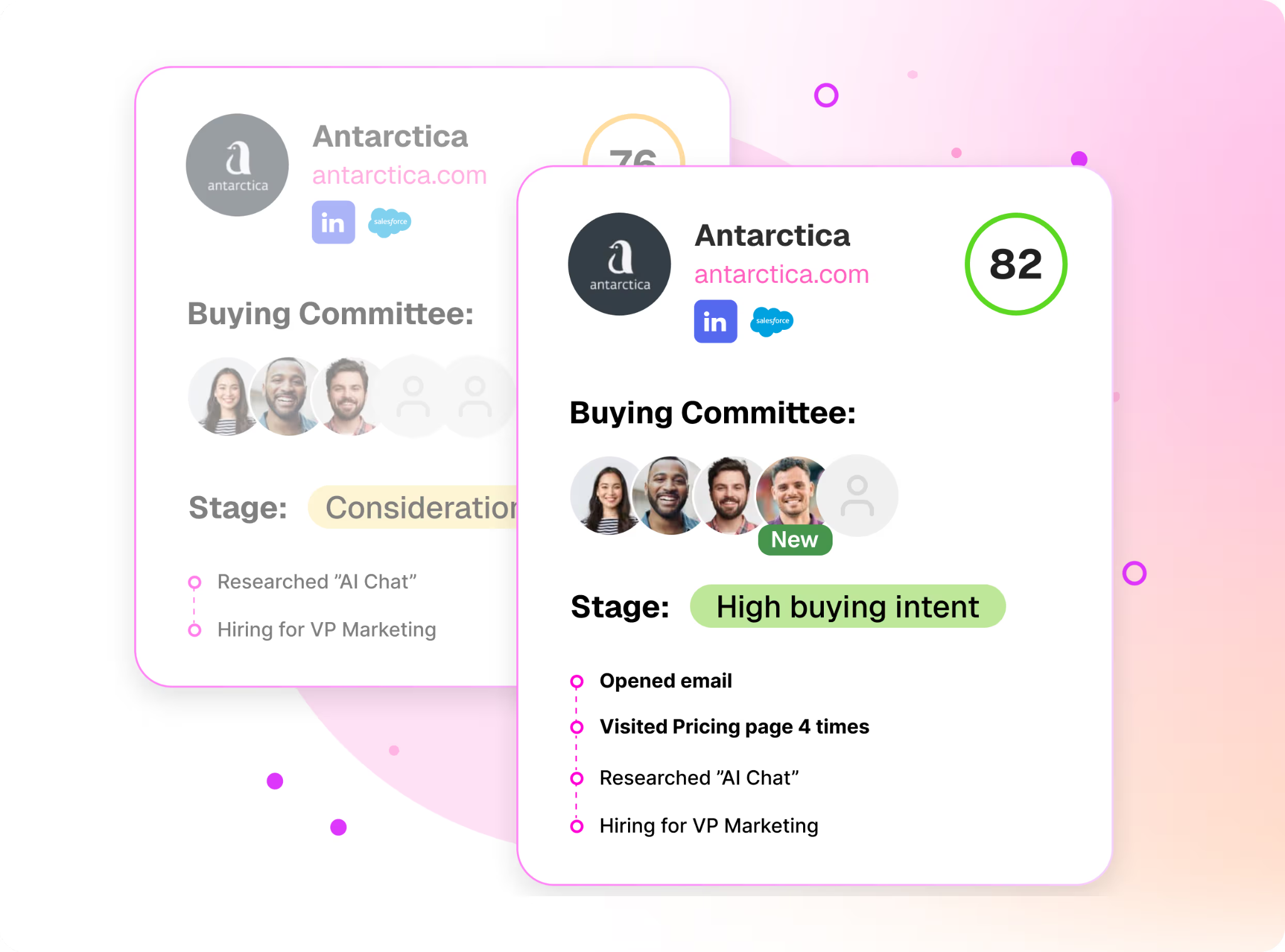
A TAM Agent is an AI system that builds your total addressable market from scratch, scores every account for intent and ICP fit, identifies the buying committee at each company, and activates those contacts across your outbound channels - HubSpot, LinkedIn Ads, and email sequences. Warmly's TAM Agent combines company data from 30M+ businesses, intent signals from 37K+ topics, and a contact database of 220M+ people to find the accounts that should know about you but don't yet. It's the upstream engine that feeds your inbound motion with the right accounts.
The Math: Your TAM Is Finite (and That's a Good Thing)
Here's an exercise we run with every new customer. Work backwards from your revenue goal.
Let's say you need $5M in new ARR this year.
If your average deal is $50K:
You need 100 new customers
At a 0.8% account-to-customer conversion rate (which is realistic for B2B SaaS), that's 12,500 accounts in your pipeline funnel
At a generous 2% of TAM entering your funnel annually, you need a TAM of about 625,000 - no, wait. Let's be real. You need to actively work about 12,500 accounts.
If your average deal is $20K:
You need 250 new customers
At the same 0.8% rate, that's 31,250 accounts to work
Here's the point: your TAM is finite. It's 10K to 30K companies. That's small enough to actually work. Small enough to know every account. Small enough to personalize outreach for. Small enough to own.
Most sales teams don't think this way. They're either:
Spraying cold emails at millions of contacts and hoping something sticks, or
Waiting for inbound and hoping enough people find their website
Both strategies leave money on the table. The right approach is to map your entire TAM, score every account for fit and intent, and then systematically move them through a journey:
Unaware → Aware → Engaged → Pipeline → Customer
The TAM Agent handles steps one through three. It finds the accounts that should know about you, makes them aware through LinkedIn Ads and outbound sequences, and engages them until they're ready for a conversation.
What the TAM Agent Does: 5 Steps
Here's a walkthrough of how the TAM Agent works, end to end. I recorded a full Loom walkthrough if you want to see it live.
The TAM Agent pulls accounts from multiple sources:
Your CRM - existing accounts from HubSpot or Salesforce that you want to re-score and enrich
Domain imports - paste a list of domains you're interested in (competitor customers, event attendee lists, target account lists)
Third-party signals - companies showing buying intent for topics relevant to your product
You can start with a hundred accounts or a hundred thousand. The agent doesn't care - it'll process and score all of them.
Step 2: Score Intent with ML
This is where most tools fall apart. They give you a black-box "intent score" and say "trust us." We think that's garbage.
Warmly's intent scoring is completely transparent. For every account, you can see exactly why it scored the way it did:
Session velocity - how many website sessions in the last 7/14/30 days, and is that accelerating?
Unique visitors - how many distinct people from that company visited?
Session quality - are they browsing the blog or spending 12 minutes on your pricing page?
Third-party intent - are they researching topics related to your product on other sites?
Engagement signals - have they opened emails, clicked ads, engaged on LinkedIn?
Each signal is visible. Each contributes a weighted score. You can see the math. No black boxes, no "proprietary algorithms" you can't inspect.
Why this matters for AI lead scoring: When your SDRs can see why an account is scored high, they trust the data and actually act on it. When it's a black box, they ignore it. We've seen this pattern with every customer who's migrated from 6sense or Demandbase - transparent scoring drives adoption.
Step 3: Qualify with AI Enrichment
Once accounts are scored, the TAM Agent enriches each one with AI-powered qualification:
Custom fields - define any field you need (e.g., "Does this company sell to enterprise?", "Do they have an outbound sales motion?") and the AI fills it in with reasoning
ICP Tier classification - our "easy button." The agent classifies every account as Tier 1, Tier 2, or Not ICP based on your ideal customer profile, and shows its reasoning for each classification
This isn't just a yes/no filter. The AI writes a sentence explaining why it made the classification. Something like: "Tier 1 - B2B SaaS, 230 employees, has SDR team of 8, active on G2 comparing sales engagement platforms, recently hired VP of Sales Development." Your reps can read the reasoning and decide whether to override.
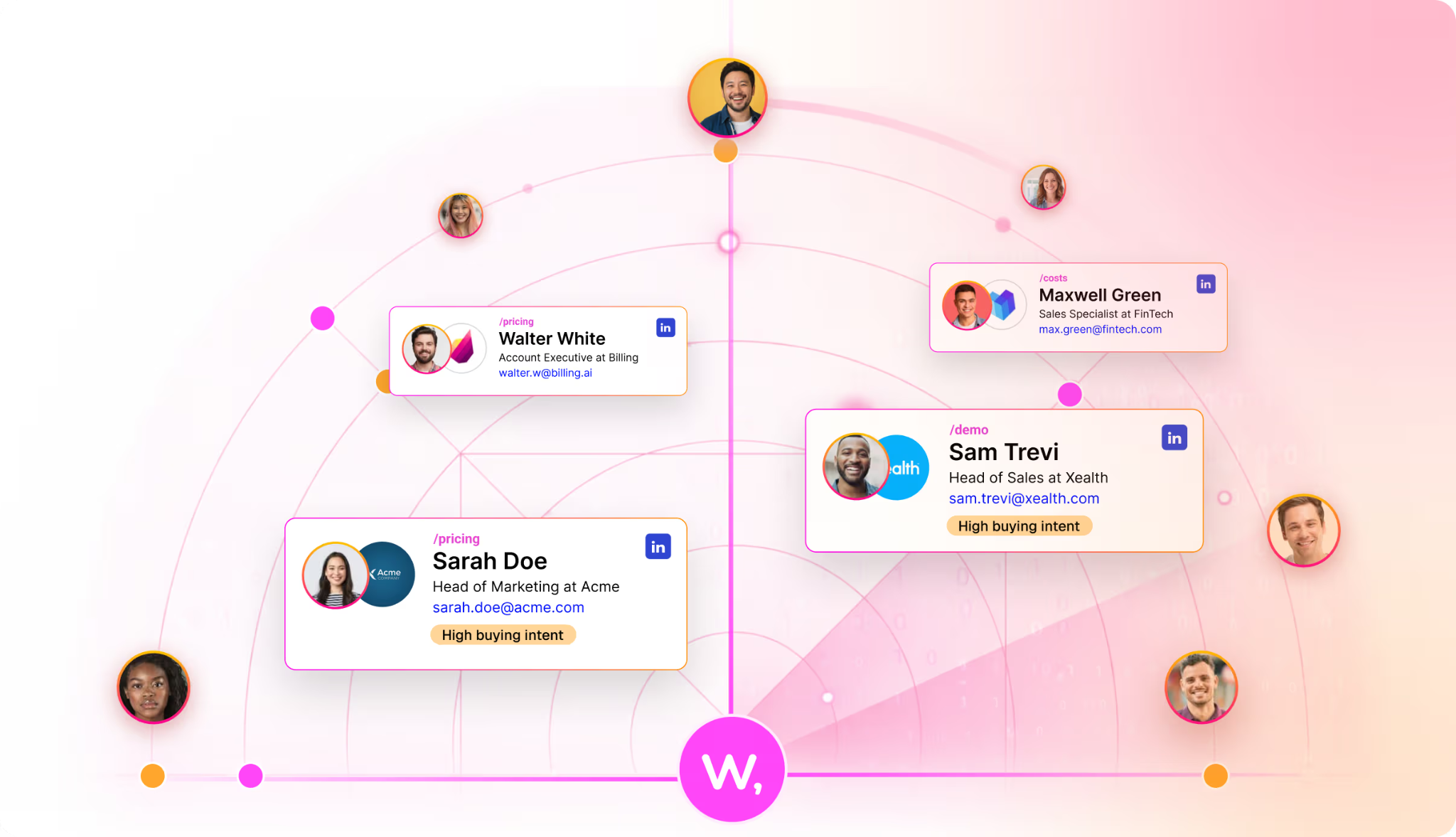
This is the step that changes the game. The TAM Agent doesn't just identify companies - it finds the specific people you need to talk to.
For each account, it:
Checks your CRM first - if you already have contacts at that company, it uses them
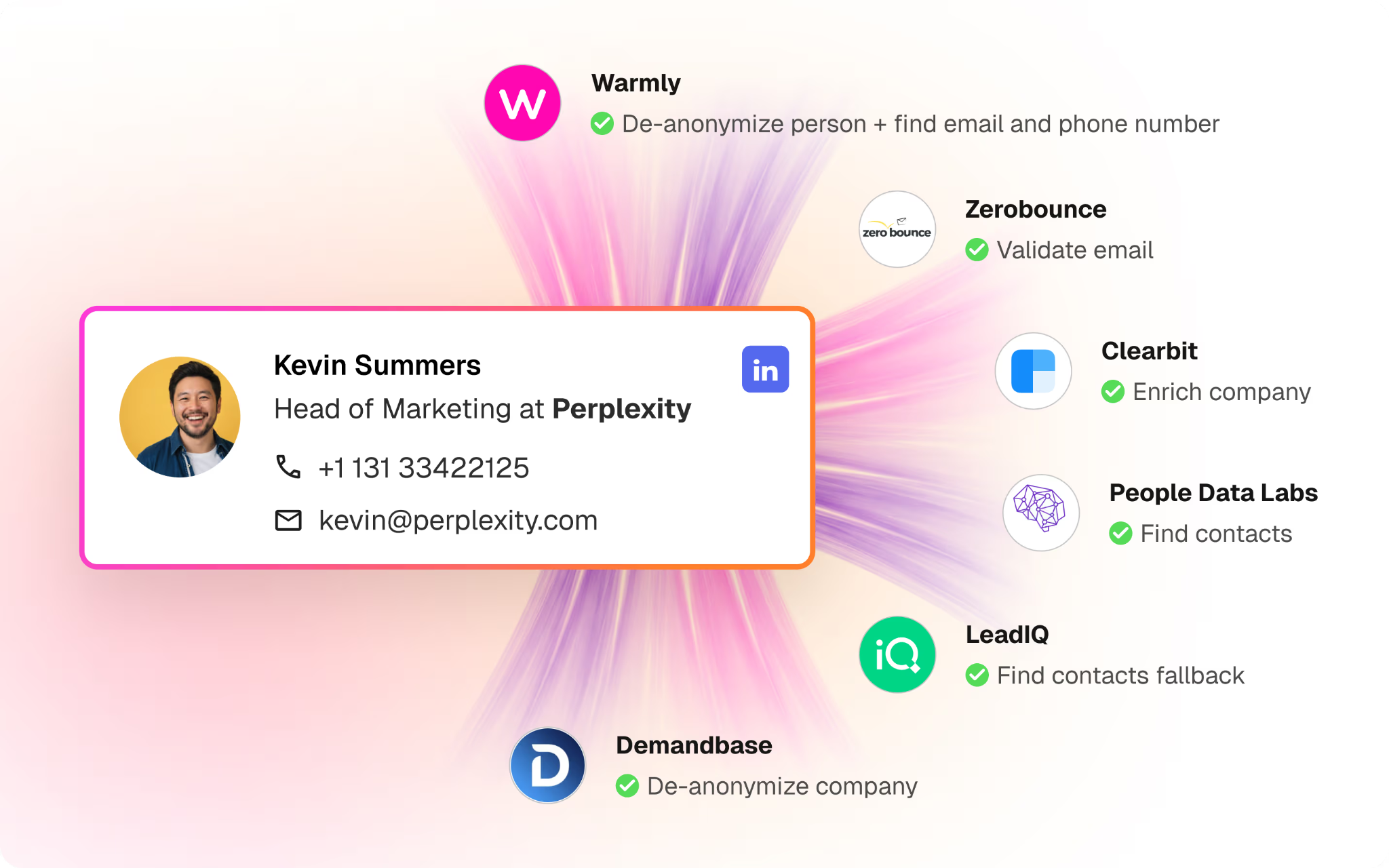
Searches 220M+ contacts - finds people matching your buying committee personas (Decision Maker, Champion, Influencer, Approver)
Assigns confidence scores - each contact gets a confidence score for how well they match the persona
Labels by persona - so your reps know exactly who to reach and what angle to use
The buying committee for a typical mid-market deal might look like:
Persona
Example Match
Confidence
Decision Maker
VP of Sales, Acme Corp
94%
Champion
Director of SDR, Acme Corp
91%
Influencer
Director of Marketing, Acme Corp
87%
Approver
CEO, Acme Corp
82%
You're not blasting a generic email to "info@acme.com." You're reaching the VP of Sales with a message about pipeline generation, the Director of SDR with a message about rep productivity, and the CMO with a message about account-based marketing. Each person gets a relevant angle.
This is buying committee identification software that actually scales. Most teams try to do this manually - a rep spends 15 minutes per account on LinkedIn finding the right people. The TAM Agent does it for thousands of accounts in minutes.
Step 5: Activate Everywhere
The last step is getting these contacts into your outbound channels:
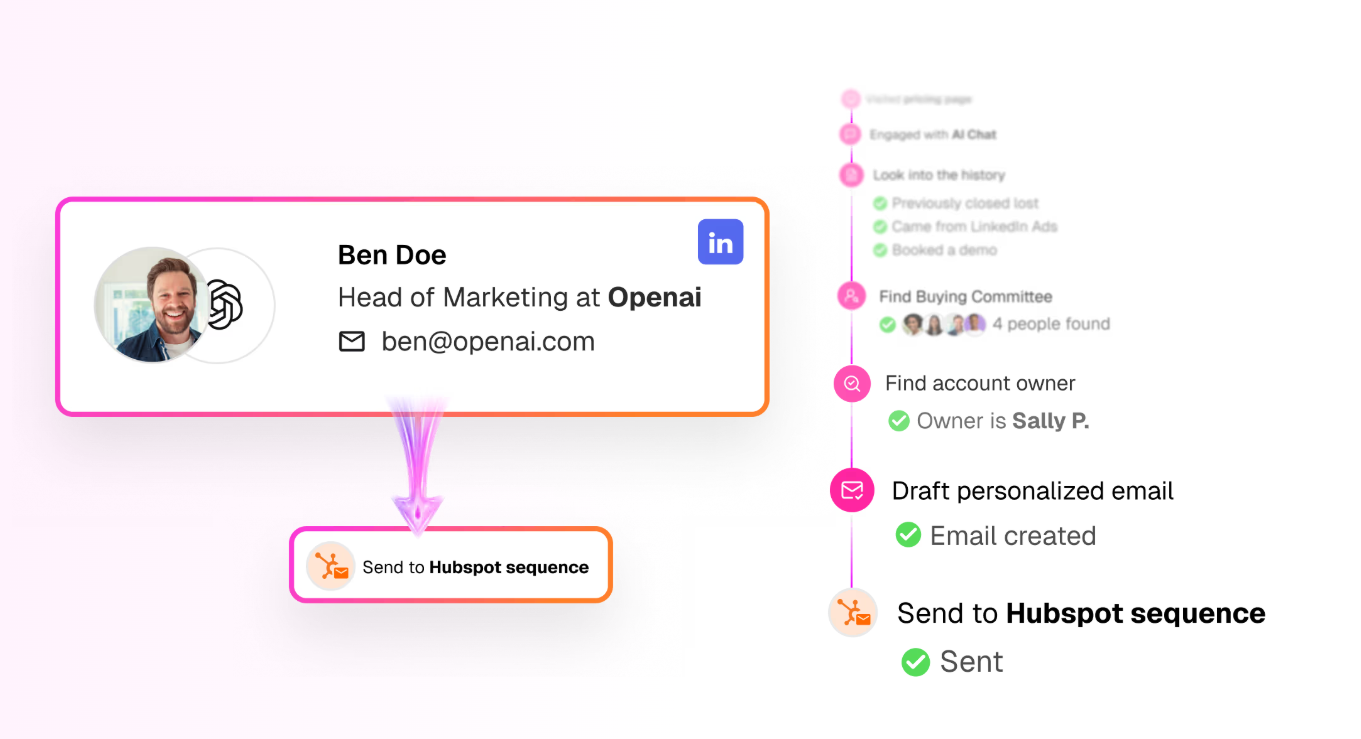
HubSpot sync - contacts are created or updated in HubSpot with persona labels, ICP tier, intent score, and all enrichment data. Your reps see everything in their CRM without switching tools.
CSV export for LinkedIn Ads - export a perfectly formatted CSV for LinkedIn Ads matched audiences. When every contact in your audience is a real buyer at an ICP account, your ad spend stops being wasted on random impressions.
Email sequences - push contacts into Outreach sequences or HubSpot sequences with persona-specific messaging
The TAM Agent doesn't just build a list. It builds the infrastructure for your entire outbound AI agent motion - the right accounts, the right people, the right context, pushed to the right channels.
The Signals That Power It
The TAM Agent doesn't rely on a single data source. It pulls from a wide range of company-level and contact-level signals to build the most complete picture possible.
Company-Level Signals
Signal Category
Source
Refresh Frequency
What It Tells You
Hiring trends
30M+ companies tracked
Weekly
Growing teams = growing budget. A company hiring 5 SDRs is about to invest in sales tools.
Intent topics
Bombora (37K+ topics)
Daily
What subjects they're researching across the B2B web
Company news
SEC filings, press releases
Daily
Fundraising, M&A, leadership changes
GitHub activity
Public repositories
Weekly
Tech stack signals, engineering investment
Social media
LinkedIn company pages
Weekly
Product launches, culture signals
Website intelligence
Warmly pixel
Real-time
Which pages they visit, how often, session quality
Product reviews
G2, TrustRadius, Capterra
Weekly
Comparing competitors in your category
SEO/traffic estimates
SimilarWeb data
Monthly
Website growth trends, marketing investment
Contact-Level Signals
Signal Category
Source
Refresh Frequency
What It Tells You
LinkedIn posts
Public activity
Bi-weekly
What topics they care about (great for personalization)
LinkedIn comments
Public activity
Bi-weekly
Who they engage with, what resonates
Job changes
LinkedIn profiles
Weekly
New role = new budget, new priorities
Podcast appearances
Public directories
Monthly
Thought leadership topics, speaking themes
Twitter/X activity
Public posts
Weekly
Real-time opinions and interests
YouTube
Public videos
Monthly
Conference talks, product demos
The key insight about intent data for outbound sales: No single signal is reliable on its own. Bombora intent alone has a high false positive rate. Hiring data alone doesn't tell you timing. Website visits alone might be a researcher, not a buyer. The TAM Agent combines all of these into a composite score that's far more predictive than any individual signal.
Real Results: The Drift Use Case
Here's a concrete example of what happens when you point the TAM Agent at a specific opportunity.
Imported 169 Drift customer domains into the TAM Agent
Let it score and classify - filtered down to ICP Tier 1 and Tier 2 accounts
Found the buying committee at each qualified account - Decision Makers, Champions, Influencers
Exported to LinkedIn Ads - created a matched audience of real buyers at companies actively looking for a Drift replacement
The result: 11% click-through rate on LinkedIn Ads.
For context, the average LinkedIn Ads CTR is 0.4-0.6%. We hit 11%. That's not a typo.
Why? Because every single impression in that audience was hitting a real buyer - someone with budget authority or influence - at a company that was actively looking for exactly what we sell. No waste. No impressions on random employees. No broad targeting and hoping for the best.
This is what happens when your audience is built from buying signal detection and buying committee mapping instead of loose firmographic targeting.
Full Funnel: TAM Agent + Inbound Agent
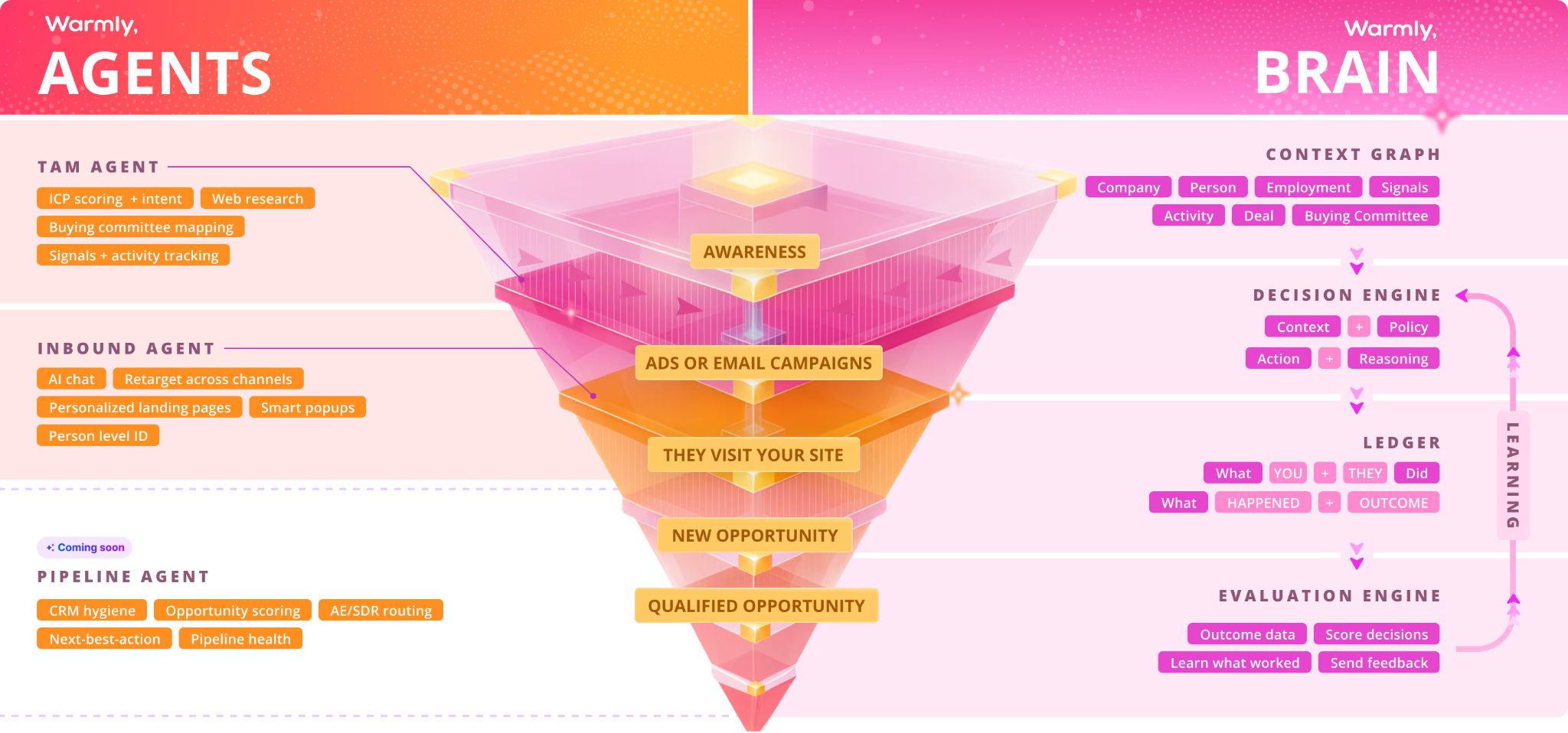
The TAM Agent doesn't replace our Inbound Agent. They're two halves of the same system.
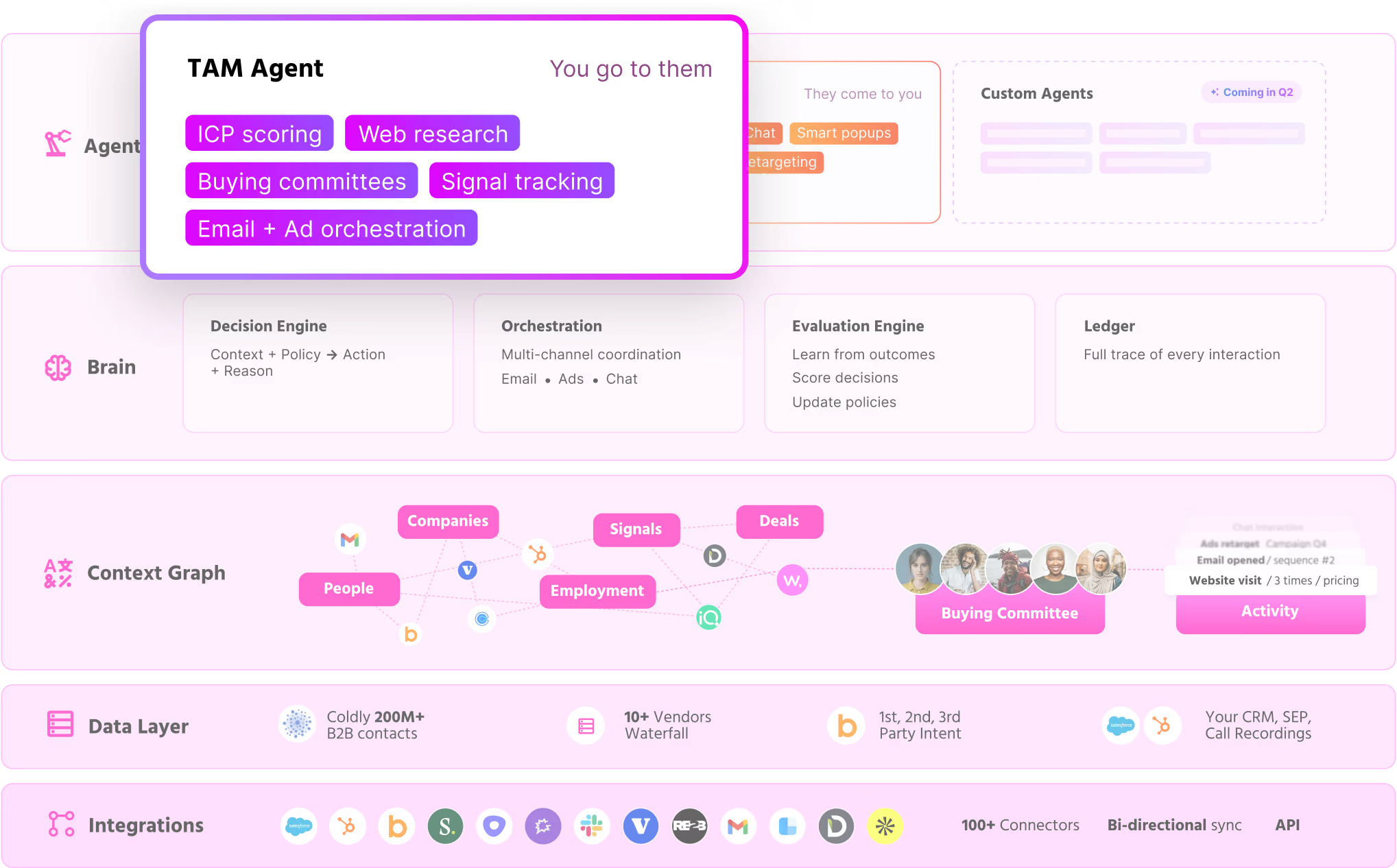
TAM Agent = everything pre-site. It handles the outbound AI agent motion - finding accounts, scoring intent, mapping buying committees, running LinkedIn Ads, and sending outbound sequences. Its job is to make the right people aware of you and drive them to your site.
Inbound Agent = on-site conversion. Once those people land on your site, the Inbound Agent takes over - AI chat, retargeting, email nurture, and real-time engagement. It already knows who they are (because the TAM Agent mapped them), so it can personalize instantly.
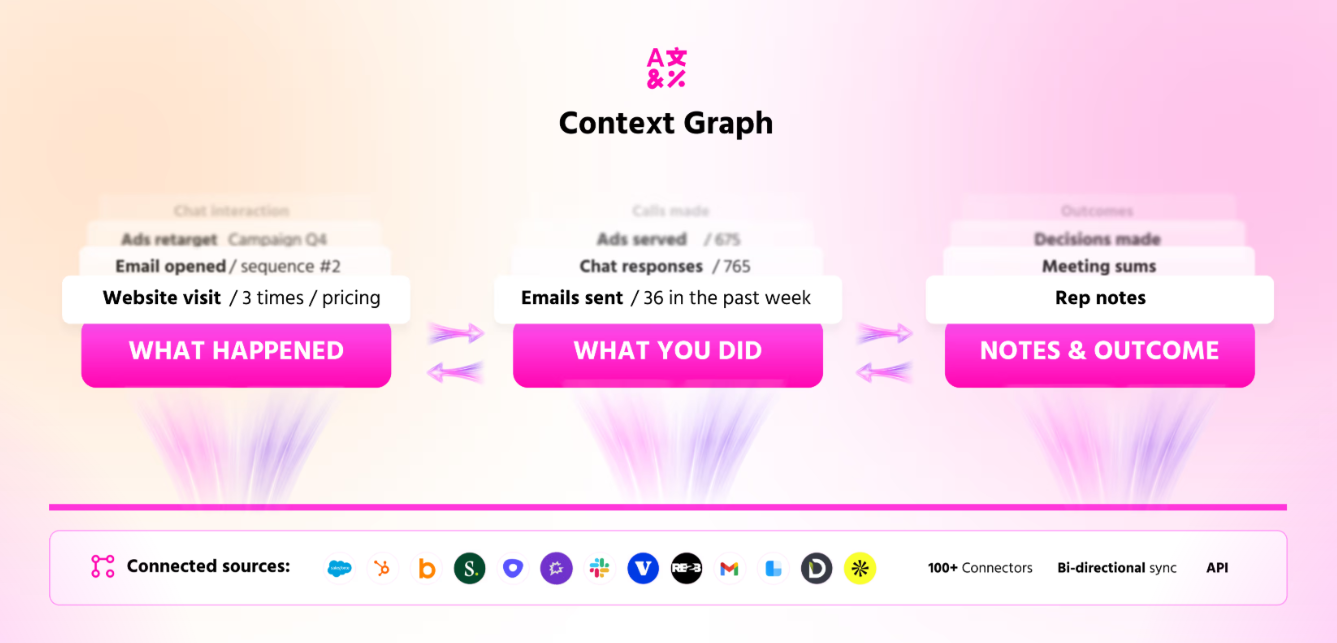
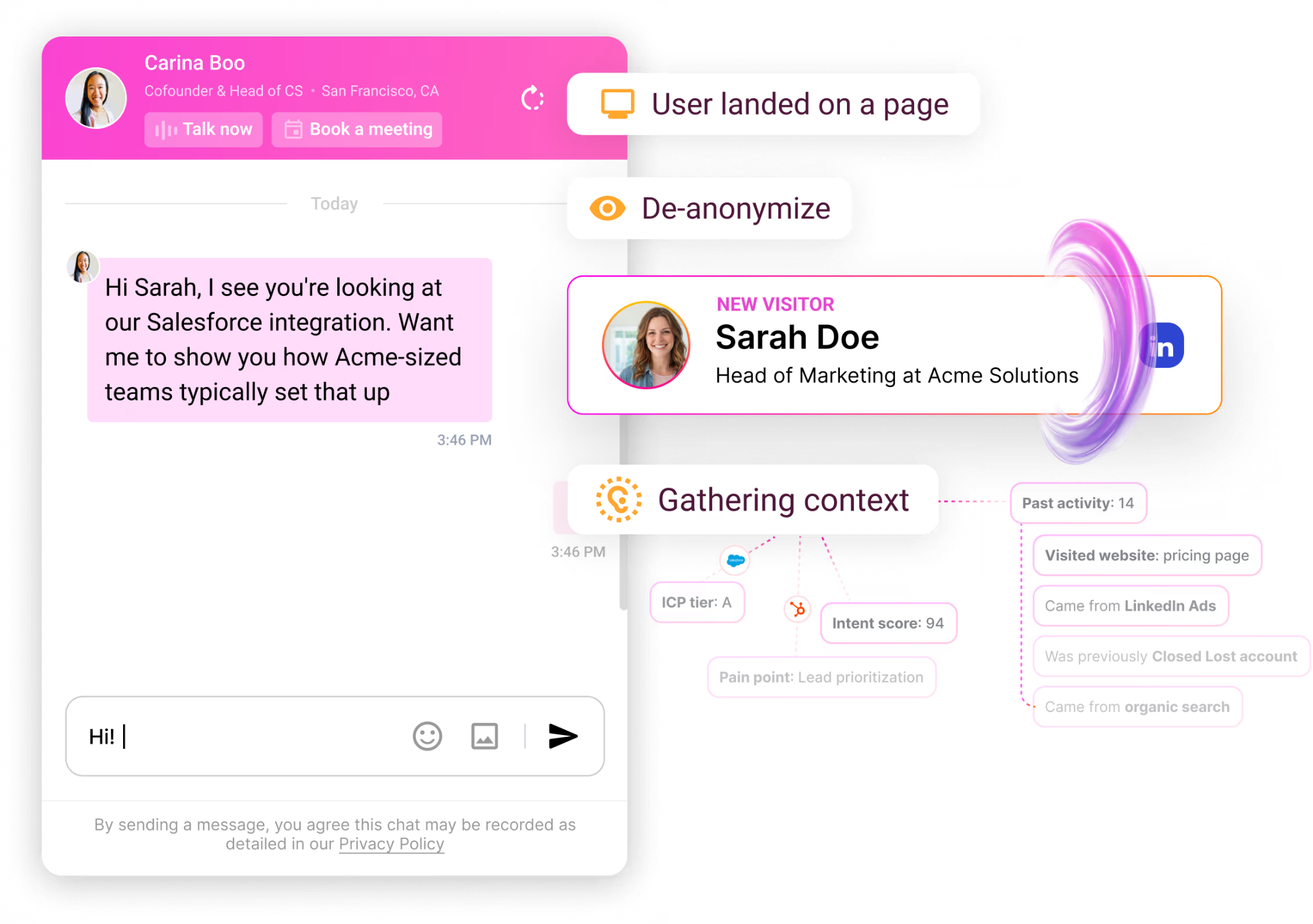
The Brain connects everything. It's the shared intelligence layer - a context graph that remembers every interaction, every signal, every touchpoint. When someone from a TAM Agent audience clicks a LinkedIn Ad and lands on your pricing page, the Brain knows their ICP tier, their buying committee role, their intent score, and their engagement history. The Inbound Agent uses all of that context to have a relevant conversation.
This is what full-funnel account-based marketing AI actually looks like. Not a small slice of the funnel with one tool for ads and another for email and another for chat. Full context, from first awareness to closed deal.
How Is This Different from ZoomInfo, 6sense, or Demandbase?
I'll be direct. Here are the real differences - not marketing speak.
vs. ZoomInfo: ZoomInfo is a contact database. A really good one. But it doesn't score intent transparently, doesn't classify ICP with AI reasoning, and doesn't build buying committees automatically. You get a list of people and you're on your own to figure out who matters and when to reach out. The TAM Agent does the thinking for you.
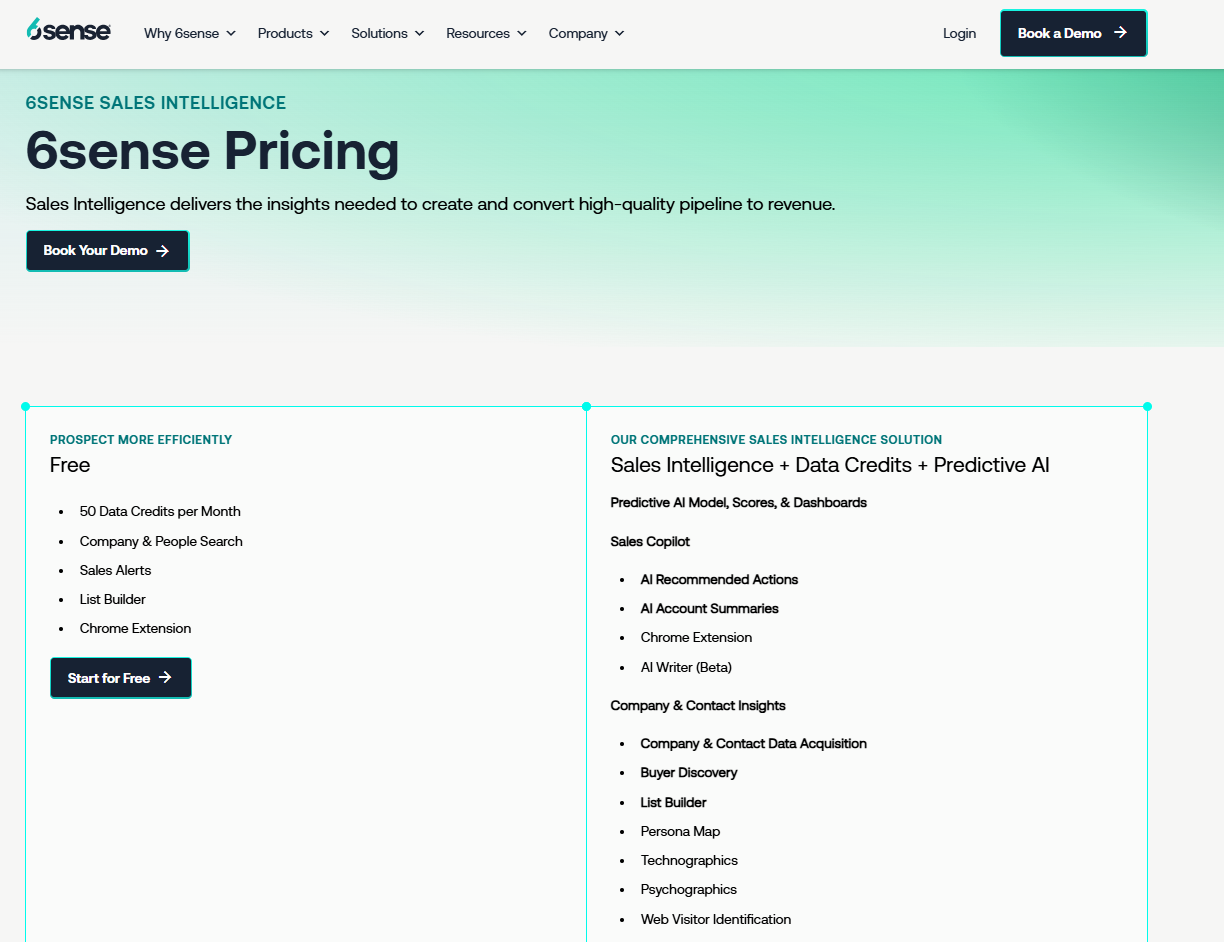
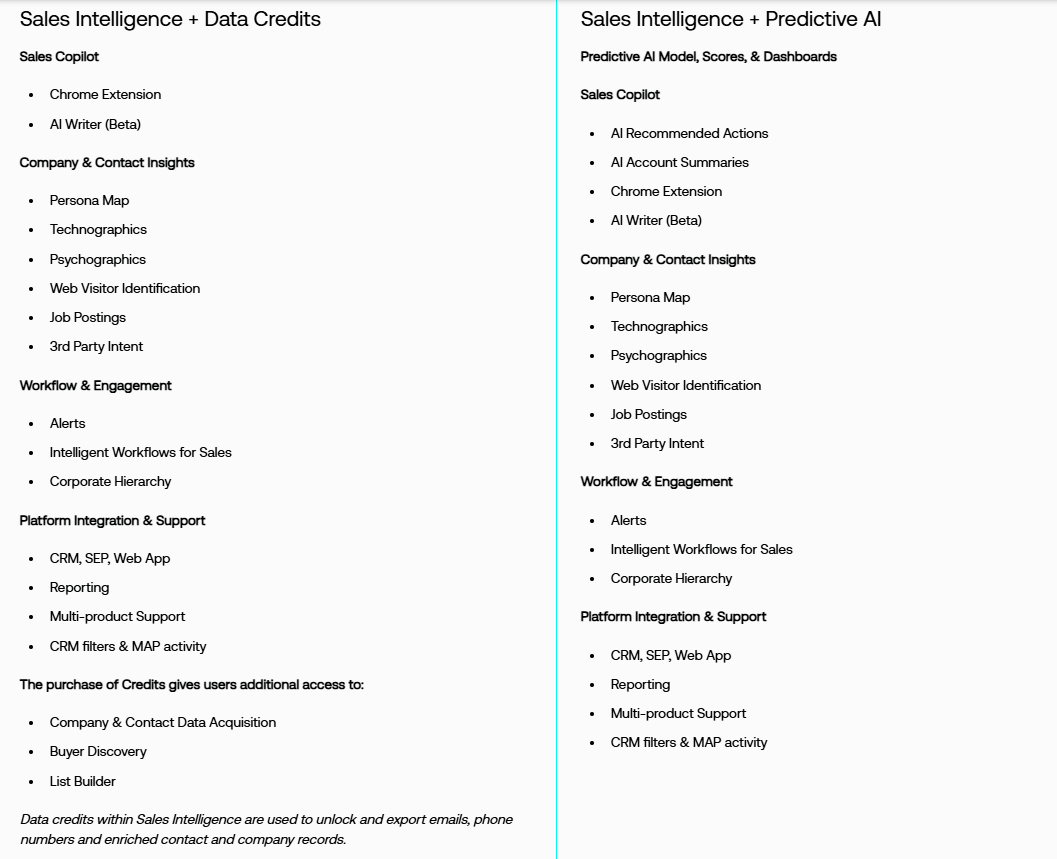
vs. 6sense: 6sense has strong intent data and predictive scoring, but it's a black box. You can't see why an account scored the way it did. Their buying committee features require manual setup. And their pricing starts at $55K+/year with complex implementation timelines. The TAM Agent is transparent, automated, and available at a fraction of the cost.
vs. Demandbase: Similar to 6sense - enterprise-focused ABM platform with strong ad targeting but opaque scoring, complex setup, and enterprise pricing. The TAM Agent gives you the same capability (intent scoring, buying committee, ad activation) without the 6-month implementation.
The real difference: These tools were built for a world where you have dedicated ops teams to configure, maintain, and interpret them. The TAM Agent was built for teams that want to press a button and get results. Import accounts, let the agent score, qualify, find people, and activate. That's it.
What's Coming Next
We're actively building:
Native LinkedIn Ads integration - one-click audience sync directly from the TAM Agent to LinkedIn Campaign Manager. No more CSV exports.
More third-party signal sources - we're adding new company and contact signal providers to make intent scoring even more accurate
Automated activation loops - the TAM Agent will automatically refresh audiences and sequences as intent scores change, keeping your outbound always current
Try It
The TAM Agent is available now for all Warmly customers.
Book a demo to see it in action on your actual TAM.
If you're already a Warmly customer, reach out to your account manager - they can get you set up in a single session.
Frequently Asked Questions
What is a TAM agent?
A TAM agent (Total Addressable Market agent) is an AI-powered system that builds, scores, and activates your total addressable market automatically. Instead of manually researching companies and contacts, a TAM agent identifies every company that fits your ideal customer profile, scores them for buying intent, finds the right people to contact, and pushes them into your outbound channels like HubSpot, LinkedIn Ads, and email sequences.
How does Warmly's intent scoring work?
Warmly uses a transparent, multi-signal intent scoring model that combines website session velocity, unique visitor counts, session quality metrics, third-party Bombora intent data, and engagement signals like email opens and ad clicks. Every signal is visible - you can see exactly which factors contributed to each account's score and how much weight each carries. This is fundamentally different from black-box scoring used by tools like 6sense and Demandbase, where you can't inspect the reasoning.
What is a buying committee and how does the TAM Agent find one?
A buying committee is the group of people at a company who influence or decide a purchase - typically a Decision Maker (VP/C-level with budget), a Champion (the person pushing for the tool internally), an Influencer (someone who shapes evaluation criteria), and an Approver (often CEO at smaller companies). The TAM Agent finds buying committees by first checking your CRM for existing contacts, then searching a database of 220M+ contacts to match people by title, seniority, and department to each persona, assigning confidence scores for each match.
How many contacts does Warmly have access to?
Warmly's contact database includes over 220 million professional contacts with verified email addresses, job titles, company affiliations, and LinkedIn profiles. The database is continuously refreshed with new contacts added weekly and existing records verified against multiple data providers using a consensus-based approach.
Can I connect the TAM Agent to HubSpot or Salesforce?
Yes. The TAM Agent integrates directly with HubSpot and Salesforce. Contacts are synced with full enrichment data including persona labels, ICP tier classification, intent scores, and AI-generated qualification notes. Your reps see everything directly in the CRM without switching between tools.
What signals does the TAM Agent use to score accounts?
The TAM Agent uses company-level signals (hiring trends across 30M+ companies, Bombora intent data for 37K+ topics, company news, SEC filings, GitHub activity, product reviews on G2/TrustRadius, SEO traffic trends, and website visitor behavior) plus contact-level signals (LinkedIn posts and comments, job changes, podcast appearances, and Twitter/X activity). These signals are combined into a composite intent score that's significantly more predictive than any single signal source.
How is the TAM Agent different from ZoomInfo or 6sense?
ZoomInfo is primarily a contact database - it gives you people to call but doesn't score intent transparently or build buying committees automatically. 6sense offers strong intent data but uses opaque, black-box scoring and starts at $55K+/year. The TAM Agent combines transparent intent scoring, automated ICP classification with AI reasoning, buying committee identification with confidence scores, and multi-channel activation — at a fraction of the cost and without the 6-month implementation timeline.
What does ICP tier classification mean?
ICP (Ideal Customer Profile) tier classification is the TAM Agent's AI-powered system for grading how well each account matches your ideal customer. Tier 1 accounts are a strong match across all criteria (industry, company size, sales team structure, tech stack). Tier 2 accounts match most criteria but may have one gap. Not ICP accounts don't fit your profile. The AI provides written reasoning for each classification so your team can verify and override if needed.
Can I use the TAM Agent for LinkedIn Ads?
Absolutely. The TAM Agent exports perfectly formatted CSV files for LinkedIn Ads matched audiences. Because the audience is built from buying committee contacts at ICP-qualified, intent-scored accounts, every impression hits a real buyer - which is why customers see dramatically higher CTRs (one campaign hit 11% CTR versus the 0.4-0.6% LinkedIn average).
What's the difference between the TAM Agent and the Inbound Agent?
The TAM Agent handles everything pre-site - building your target account list, scoring intent, finding buying committees, and running outbound across LinkedIn Ads and email sequences. The Inbound Agent handles on-site conversion - AI chat, retargeting, email nurture, and real-time engagement when visitors land on your website. Together, they cover the full funnel from first awareness to closed deal, connected by The Brain which maintains context across every interaction.
How do I import accounts into the TAM Agent?
You can import accounts four ways: (1) sync directly from your CRM (HubSpot or Salesforce), (2) upload a CSV of company domains, (3) pull from your Warmly website visitor data, or (4) import from third-party signal sources. Most customers start by importing their existing CRM accounts for re-scoring, then add target account lists and competitor customer domains.
How often is the data refreshed?
Signal refresh frequencies vary by type: website visitor data is real-time, Bombora intent data refreshes daily, hiring trends and job change data update weekly, LinkedIn activity scans bi-weekly, and broader market signals like SEO traffic and company news refresh weekly to monthly. Intent scores are recalculated as new signals arrive, so your account prioritization is always current.
Revenue AI in 2026: The Definitive Market Landscape (From Workflow Hell to Agent Intelligence)
Time to read
Alan Zhao
Revenue AI is the category of artificial intelligence tools that help B2B sales and marketing teams find, prioritize, and engage buyers. It includes everything from data enrichment and intent signals to AI SDRs, conversation intelligence, and autonomous orchestration platforms.
Here's the thing nobody in this space wants to admit: the $8.8 billion revenue AI market has a dirty secret. Most of these tools are just workflow automation with an AI label slapped on top. They connect Step A to Step B, maybe generate an email draft, and call it "intelligent." That's not intelligence. That's a fancy spreadsheet.
I've spent the last 18 months building autonomous GTM agents at Warmly. We run 9 AI agents in production every day. I've seen what actually works, what's marketing fluff, and where the real frontier is. This guide is the honest assessment I wish someone had written for me when we started.
This is part of a 4-post series on Autonomous GTM Infrastructure:
Best for enterprise ABM with complex sales orgs:6sense - predictive analytics leader, ~$55K-$200K/year, 5x consecutive Gartner Magic Quadrant Leader. You'll need a dedicated ops team and a 3-6 month implementation runway.
Best for autonomous full-funnel GTM:Warmly - person-level visitor identification, AI agents that act (not just inform), context graph with learning loops. Starts at $10K/year with a free tier. Operational in hours, not months.
Best for outbound-first sales teams on a budget:Apollo - 210M+ contacts, all-in-one sequencing and enrichment, free to $119/user/month. The best value if outbound is your primary motion.
Best for data enrichment power users:Clay --150+ data providers, waterfall enrichment, $134-$720/month. Incredibly powerful if you have a RevOps engineer to maintain the workflows.
Best for conversation intelligence and coaching:Gong - $1,360-$1,600/user/year + platform fee, 3.5B+ sales interactions analyzed. The gold standard for understanding what happens on calls.
Best for revenue forecasting + sales engagement:Clari + Salesloft - merged Dec 2025 into a $450M ARR entity, ~$140-$180/user/month. Building the first "Predictive Revenue System" spanning the full revenue cycle.
The Revenue AI Market Map (2026)
Let's talk numbers first.
The AI-in-sales market hit $8.8 billion in 2025 and is projected to reach $63.5 billion by 2032 at a 32.6% CAGR (PS Market Research). AI venture funding hit $211 billion in 2025, nearly doubling 2024's $114 billion (Crunchbase).
But here's the reality check. McKinsey reports that while 88% of organizations now use AI in at least one function, only 39% see any impact on EBIT. Most under 5% (McKinsey 2025 State of AI). BCG is even more blunt: only 5% of companies create substantial AI value at scale. 60% generate no material value at all (BCG 2025).
Translation: lots of money, lots of adoption, very little actual ROI for most teams.
The fragmentation problem makes this worse. The average B2B company uses 87 different software tools, but only 23% of them directly impact revenue (Netguru). Sales reps spend 65% of their time on non-selling activities. Employees waste 12 hours per week chasing data trapped in silos.
This is the landscape you're buying into. Hundreds of tools. Billions in funding. And most of it doesn't work.
Two structural shifts are happening right now that will reshape this landscape:
1. Gartner created a new category. In December 2025, Gartner published its first-ever Magic Quadrant for Revenue Action Orchestration, formally merging what used to be separate categories: sales engagement, conversation intelligence, and revenue intelligence (Gartner). The market is consolidating from 15+ point solutions to 5-7 integrated platforms.
2. The Clari + Salesloft merger happened. Two of the biggest names merged into a $450M ARR entity in December 2025 (Salesloft). Forrester called it "a bold, high-stakes bid for market dominance." This isn't the last mega-merger we'll see.
The winning stacks in 2026 are 5-7 integrated platforms, not 15-20 disconnected point solutions. Organizations with well-integrated tech stacks are 42% more likely to boost sales productivity (Highspot).
The Three Eras of Revenue AI
Understanding where the market came from explains where it's going. And honestly, most teams are still buying tools from an era that's already ending.
Era 1: Contact Databases (2015-2020)
The promise: More data = more pipeline.
ZoomInfo and Clearbit gave sales teams access to contact data at scale. Platforms competed on database size (ZoomInfo: 210M+ professionals) and accuracy rates (~95% email deliverability). The value proposition was simple: find decision-maker emails faster than manual research.
The limitation: Static data decays at 25-30% annually. Having a phone number doesn't tell you when to call. Sales teams drowned in data without context for prioritization.
Era 2: Intent and Workflow Orchestration (2020-2024)
The promise: Right accounts at the right time, connected through smart workflows.
6sense, Demandbase, and Bombora introduced intent signals and predictive analytics. The focus shifted from "who exists" to "who's buying." Meanwhile, Clay emerged as the "Zapier for data enrichment," and Outreach/Salesloft made multi-step sequences the default playbook.
The limitation: Company-level intent only. 6sense can tell you Acme Corp is researching your category, but not which of their 500 employees is doing the research. Clay requires 4-6 weeks to master and a RevOps engineer to maintain. And at $55K-$200K/year for 6sense, the technology stayed inaccessible to mid-market teams.
Era 3: Agent Intelligence (2024-Present)
The promise: AI that does the work, not just informs it.
This is where things get interesting. Foundation Capital's thesis captures it perfectly: enterprise value is migrating from "systems of record" (Salesforce, Workday) to "systems of agents." The new competitive advantage isn't the data itself. It's the context graph: a living record of decisions, relationships, and outcomes that agents can reason over.
What makes Era 3 different:
World models, not databases. Instead of static contact records, Era 3 platforms maintain a temporal representation of your market: companies, people, activities, and outcomes. The system knows what was true when past decisions were made.
Long-horizon agents. These aren't chatbots. They reason in loops: evaluate results, adjust strategies, continue working toward objectives without being prompted each step. They maintain persistent memory across weeks and months.
Decision traces, not logs. Every decision (reach out, hold off, escalate) gets captured with full context. This transforms exceptions into training data.
Work-based economics. Pricing shifts from seats to outcomes. As BCG notes, companies using seat-based pricing for AI products see 40% lower gross margins than those using outcome-based models.
The key insight: Most teams are still buying Era 2 tools for Era 3 problems. If you're evaluating revenue AI in 2026, ask yourself: "Does this platform have a world model that learns from outcomes, or just a database that tells me who to call?"
Why Workflow Tools Are Hitting a Ceiling
I'll be direct about our thesis. In a world of agent abundance, workflow tools will become obsolete. Not tomorrow. But the direction is clear.
Here's why.
The judgment problem. Clay, Zapier, and Make are brilliant at connecting A to B. If this trigger fires, run these steps. That's powerful for deterministic workflows. But GTM isn't deterministic. Should you email or LinkedIn message this VP? Both might be valid. The answer depends on her LinkedIn engagement score, your email bounce history with this domain, what similar personas responded to, the time of day, and whether your SDR already had a conversation with someone else at the company yesterday. That's judgment, not a workflow.
The coordination problem. Multi-channel GTM means email needs LinkedIn needs ads needs chat. One failure breaks the chain. When Agent A sends an email and Agent B sends a nearly identical LinkedIn message two hours later, that's not an edge case. That's the default outcome when tools don't share context. We've seen it happen in our own system. It's why we built the agent harness.
The memory problem. Clay doesn't know that John reports to Sarah. Zapier doesn't know the email it sent last week contributed to a closed deal this month. Make doesn't learn from outcomes. These tools are pipes, not brains. They have no persistent memory, no entity relationships, no learning flywheel.
The cost problem. Clay's hidden costs are real. Platform fees ($134-$720/month) plus credits plus the tools Clay connects to plus the RevOps engineer maintaining the workflows. We've seen total cost of ownership reach $40K-$80K/year for serious Clay deployments. At that point, you're paying workflow-tool prices for workflow-tool limitations.
This doesn't mean Clay is bad. It's genuinely powerful for what it does. But it's Era 2 technology. And if you believe GTM is heading toward agents that make judgment calls with full context, you need a different architecture.
What Replaces Them: The Agent Harness
Think about it this way. You wouldn't deploy a fleet of microservices without Kubernetes. You wouldn't run a data pipeline without Airflow. But somehow, we're deploying fleets of AI agents with nothing but prompts and prayers.
That's where the agent harness comes in.
An agent harness is the infrastructure layer between your AI agents and the real world. It does three things: gives agents shared context, ensures they don't collide through coordination, and enforces constraints that prevent them from going rogue.
This parallels what Anthropic built with Claude Code. Their design principles directly map to what we're building for GTM:
Progressive disclosure. Claude Code doesn't dump the entire codebase into context. It searches for what it needs. Our GTM agents do the same. They query the context graph for relevant information, not everything that exists. Raw data is pre-digested into computed columns that reduce token consumption by 10-100x while improving decision quality.
Trust earned, not configured. Claude Code starts with limited permissions and earns broader access. Our agents start at Level 1 (human approves every action). Over time, as they demonstrate good judgment, they progress to Level 2 (override window, acts if no human intervenes) and eventually Level 3 (fully autonomous). You don't set a "freedom dial" on day one. Trust builds through demonstrated results.
Capabilities-driven tool evolution. When a better model comes out, Claude Code gets smarter. Same principle. Swap in a newer LLM, and the emails get better, the research gets deeper, the decisions get more nuanced. The harness stays the same. The trust gates stay the same. Better model, same guardrails, better work.
How Warmly's Architecture Actually Works
Here's a concrete example. A VP of Sales visits your pricing page at 2pm on a Tuesday.
Without an agent harness: Your intent tool fires an alert. It goes into a Slack channel with 200 other alerts. An SDR sees it 4 hours later, spends 15 minutes researching the account, sends a generic email. Maybe.
With the agent harness: The context graph instantly resolves the visitor's identity. It knows she's Sarah Chen, VP of Sales at Acme Corp. The graph shows: ICP Tier 1, closed-lost deal from 6 months ago (reason: timing), her company just hired a new CRO (job change signal), and she has high LinkedIn engagement. The agent evaluates the full context and decides: LinkedIn message first, referencing the timing issue from the previous evaluation. It checks trust gates (within volume limits, quality threshold met, Level 2 override window active). The SDR gets a Slack alert with the full context and the drafted message. If no override in 30 minutes, it sends. Meanwhile, Sarah is added to a LinkedIn Ads audience for awareness reinforcement. Two months later, when this becomes a deal, every touch is attributed back to the decisions that drove it.
That's the difference between "AI that sends emails" and "AI that makes judgment calls with full context."
The Learning Flywheel
This is where the architecture compounds. Decisions lead to outcomes. Outcomes get graded. Grading improves the model. Better model, better decisions. Based on our production experience, approximately 100 graded decisions are needed to reach 90% agreement with human judgment. That means the system can cold-start in about 2-4 weeks.
Four feedback loops compound simultaneously:
Trust builds. Agents that prove themselves get more autonomy. Agents that make mistakes get pulled back.
Rules emerge. Human corrections become automatic policies. "Never contact healthcare on Fridays" started as a one-time fix. Now it's a rule.
Emails teach emails. Every AI-generated email is tracked against engagement. The system learns what resonates with YOUR buyers, not generic benchmarks.
Signals sharpen. The outcome loop measures which signals actually predict meetings. Intent scoring gets more accurate every month.
Every week you run the harness, it gets slightly smarter. That's infrastructure that appreciates rather than depreciates.
The 12 Platforms Defining Revenue AI in 2026
Let's get specific. Here's every major player, what they actually cost, what they're genuinely good at, and where they fall short.
Comparison Table
Platform
Category
Starting Price
Typical Cost
Person-Level ID?
Learning Loop?
Best For
6sense
ABM/Intent
Free (limited)
$55K-$200K/yr
No (company only)
No
Enterprise ABM
ZoomInfo
Data/Intelligence
$15K/yr
$30K-$100K+/yr
Limited (WebSight)
No
Data quality
Gong
Conversation Intel
~$25K/yr
$50K-$150K+/yr
N/A
No
Call coaching
Clari+Salesloft
Rev Forecast + Engagement
~$15K/yr
$50K-$200K+/yr
No
No
Rev forecasting
People.ai
Activity Capture
Custom
Custom
No
No
CRM hygiene
Apollo
All-in-One GTM
Free
$10K-$50K/yr
No
No
Outbound on budget
Clay
Data Orchestration
$134/mo
$8K-$22K+/yr
No
No
Enrichment workflows
Outreach
Sales Engagement
~$100/user/mo
$65K-$150K+/yr
No
No
Enterprise sequences
11x.ai
AI SDR
~$50K/yr
$50K-$60K/yr
No
Limited
AI outbound
Artisan
AI SDR
~$2.4K/mo
$29K-$86K/yr
No
Limited
Budget AI SDR
Demandbase
ABM/Marketing
Custom
$50K-$150K+/yr
No
No
Marketing-led ABM
Warmly
Autonomous Orchestration
Free
$10K-$22K/yr
Yes
Yes
Full-funnel GTM
Now let me break each one down honestly.
6sense: The Enterprise ABM Standard
6sense is genuinely excellent for what it does. Their predictive analytics estimate buying stage 3-6 months before traditional signals appear. They just launched RevvyAI, their most significant update ever, turning the platform into an "AI-powered GTM command center." Five consecutive Gartner Magic Quadrant wins is no joke.
Where it's limited: Company-level identification only. The median buyer pays ~$55K/year, but enterprise contracts run $100K-$200K+ (Vendr). Implementation takes 3-6 months. And the AI recommendations still function as a "black box." 40% of our customers previously used 6sense and switched because they needed person-level identification and couldn't justify the cost for what they were getting.
ZoomInfo maintains the largest B2B database: 210M+ contacts and 100M+ company profiles. Email accuracy (~95%) is the industry benchmark. They've rebranded hard, changing their ticker from ZI to GTM and launching Copilot Workspace with AI agents for account research and outreach.
Where it's limited: $15K-$45K/year starting, with typical enterprise deals at $30K-$100K+. 2024 revenue was $309M but declining (-2% YoY) before a slight recovery to $319M in 2025. Renewal price increases of 10-20% are commonly reported. One of our customers told us: "We had zero to one closed deals from ZoomInfo intent data over 3 years." Another saved $92K/year switching to Warmly ($44K vs. $136K for ZoomInfo).
Gong just launched Mission Andromeda, their most ambitious release, adding 18 AI agents, AI Call Reviewer, and an Account Console. They've analyzed 3.5B+ sales interactions. ARR passed $300M in early 2025, and they raised a $250M Series F at $7.25B valuation.
Where it's limited: Pricing is the #1 complaint. $1,360-$1,600/user/year plus a platform fee ($5K-$50K) plus implementation ($15K-$65K). For a 50-person sales team, you're looking at $80K-$130K in year one. Gong tells you what happened on calls. It doesn't proactively take the next action.
Clari + Salesloft: The Revenue AI Powerhouse
The December 2025 merger created the biggest private revenue AI company: $450M combined ARR, 5,000+ customers, and $10 trillion of revenue under management. Forrester called it "a bold, high-stakes bid for market dominance." They're building the "first Predictive Revenue System."
Where it's limited: Post-merger integration is still underway. Product roadmap clarity is limited. Pricing is enterprise-focused (~$140-$180/user/month for Salesloft, negotiated heavily at scale). If you want proactive autonomous agents, not just forecasting and sequencing, this isn't the right fit yet.
People.ai: The Activity Capture Specialist
People.ai auto-captures email, meetings, and contacts and writes them back to CRM. They just launched MCP integration, connecting AI agents directly to their data layer. $200M raised, $1.1B valuation.
Where it's limited: $63M ARR after 9 years with 100 employees raises questions about growth trajectory. Custom pricing only, no self-serve. Former employees note product struggles. It's an analytics layer, not an action layer.
Apollo: The Value King
Apollo is the fastest-growing sales platform through PLG: $150M ARR (up from $96M in 2023), 500K+ companies on the platform, $1.6B valuation. Free tier is genuinely useful. 210M+ contacts with international coverage that beats most US-focused tools.
Where it's limited: Real costs often reach 2-3x advertised prices ($150-$400/user/month with credit overages). Email accuracy (~85%) is lower than ZoomInfo. No real-time visitor identification. If inbound traffic is a lead source, you'll need to pair Apollo with something else.
Clay grew from $1M to $100M ARR in two years. That's insane. Their waterfall enrichment across 150+ data providers triples match rates (40% to 80%+). Claygent can browse websites and extract custom data points. $3.1B valuation. 10,000+ customers including OpenAI and Anthropic.
Where it's limited: Learning curve is steep (4-6 weeks to productivity). Credit burn is the #1 complaint on G2. No entity relationships, no decision traces, no outcome attribution, no trust gating. It's infrastructure for enrichment, not a system that learns. Every time a data provider changes their API, someone has to debug the workflow.
$301M revenue in 2024, 6,000 customers, the enterprise standard for multi-channel sequences. Kaia provides AI-powered conversation intelligence.
Where it's limited: No public pricing, but expect $100-$150/user/month. CEO transition in 2024. Buggy issues are a consistent G2 complaint. It's a sequence engine, not an intelligent agent. It does what you tell it, exactly how you tell it, without judgment.
Demandbase: The Marketing ABM Platform
Demandbase excels when marketing owns the ABM motion. Their ABX (Account-Based Experience) platform runs coordinated multi-channel campaigns: display ads, content personalization, and sales handoffs from one system. The "air cover" use case is strong. Running display ads to target accounts while sales pursues them creates familiarity that shortens sales cycles.
Where it's limited: Less sales-focused than 6sense. No free tier or mid-market option. Implementation is complex, similar to 6sense timelines. Pricing is enterprise-only ($50K-$150K+/year). If sales is driving your GTM motion and you need rep-level tools, 6sense or Warmly are better fits.
11x.ai: The VC Darling of AI SDRs
11x's "Alice" is the most well-funded AI SDR: $76M raised, a16z and Benchmark backing, $25M ARR (growing 150% quarterly). Claims Alice can replace 10 human SDRs. Enterprise customers include Siemens and ZoomInfo.
Where it's limited: $50K-$60K/year with rigid contracts. Difficulty canceling subscriptions is a common complaint. Narrow channel coverage (mostly email, some LinkedIn). About 30 days of contact history vs. 12-18 months in a context graph. No buying committee modeling. And the fundamental question: does replacing SDRs entirely actually work? The evidence is mixed.
Artisan: The Controversial Challenger
Artisan's "Stop Hiring Humans" campaign got attention (while hiring humans). $46M raised, 250 paying customers, $5M ARR. Ava handles lead sourcing from 300M+ contacts, personalized emails, and LinkedIn automation.
Where it's limited: The reviews are rough. Users report "AI slop" emails, 1,000-1,400+ emails with zero replies, and prospects that lack budget or authority even when meetings are booked. One user found only 3-7 C-level contacts matching their criteria from 3M+ records. Cancellation friction is a recurring complaint. At $2.4K-$7.2K/month, the ROI math gets hard when the output quality is inconsistent.
Warmly: The Context Graph Platform
This is us, so I'll be straightforward about what works and what doesn't.
What works: Person-level visitor identification (up to 40% match rate, vs. company-only for 6sense and ZoomInfo). Our context graph connects 400M+ person profiles across 50+ data sources. 9 AI agents run in production daily, coordinated through trust gates. Setup takes hours, not months. Pricing starts at $10K/year with a free tier.
What the data shows:
AI chat meetings booked growing 52% in 2 months (21 in November -> 32 in January)
AI Inbound Agent converting at 8-10%
Customer company identification rates hitting 91% (vs. 70% average)
AI-generated outreach achieving 45-57% open rates
40% of our customers are replacing 6sense or ZoomInfo
And our most interesting first-party data point: 40% of our inbound now comes through AI tools (ChatGPT, Claude, Perplexity). Buyers are finding us by asking AI, not by searching Google. One of our $32K deals came from someone who literally asked ChatGPT for a recommendation.
Where we're limited: Match rates are strongest in US/UK markets. You need website traffic for the identification to generate value. The learning flywheel takes 2-4 weeks to cold-start. We don't have a built-in dialer. And honestly, AI-generated outbound still converts at lower rates than we'd like. Open rates are great. Conversion? Still a frontier.
I could write a post that says "AI is transforming everything!" and call it a day. But that wouldn't be useful. Here's what's actually hard about revenue AI in 2026.
1. The Cold Start Problem
AI agents need data to learn, but you need agents to generate data. The first month won't be dramatically better than simpler tools. Our learning flywheel needs ~100 graded decisions to reach 90% agreement with human judgment. That's 2-4 weeks of active use. Most teams quit before the flywheel starts spinning.
2. AI Outbound Still Has a Conversion Problem
Here's something we don't love admitting: AI-generated emails get 45-57% open rates but conversion to meetings is still low. The emails are good enough to get opened. They're not yet consistently good enough to get replied to. This is the frontier for everyone in the space, not just us.
3. Attribution Remains Unsolved
We track 148 outcomes across our context graph. But attributing a closed deal back to the specific AI action that started it? That's still more art than science when the sales cycle is 60+ days.
4. The "Went Dark" Problem
42% of lost deals across our customer base come from prospects going dark after discovery calls. No amount of AI fixes a buyer who stops responding. The best we can do is detect the going-dark pattern earlier and try a different channel.
5. Model Costs Are Real
Running Claude Sonnet at production scale for thousands of personalized emails and research queries is not free. The cost per AI-generated email has come down dramatically, but for high-volume outbound, it adds up.
When Revenue AI Is NOT the Answer
Don't buy revenue AI if:
You're pre-product-market-fit. Fix your product first.
You have zero website traffic. Visitor identification needs visitors.
Your sales cycle is under 7 days and purely transactional. Simple automation works fine.
You don't have anyone who will review agent decisions in the first month. Unsupervised AI SDRs will send garbage.
Your team of 5 people doesn't need another $10K+ tool. Spreadsheets and LinkedIn InMail might be enough.
How to Choose: Decision Framework
By Company Stage
Seed / Pre-Revenue: Use Apollo's free tier + LinkedIn Sales Navigator. Don't spend money on tools until you have repeatable revenue.
Series A ($1M-$5M ARR):Warmly free tier or Startup plan for visitor identification + AI chat. Apollo for outbound. You don't need 6sense.
Series B ($5M-$20M ARR): This is where Warmly's full stack shines. Person-level identification, AI agents, context graph. You have enough traffic and enough deals to feed the learning flywheel. Add Gong if your deal sizes justify conversation intelligence.
Series C+ / Enterprise ($20M+ ARR): 6sense makes sense if you have the budget, the ops team, and long enterprise sales cycles. Clari+Salesloft for forecasting and engagement. Warmly for visitor identification and autonomous orchestration alongside your enterprise stack.
By GTM Motion
Pure outbound: Apollo + 11x or Artisan. But honestly, our data shows the hybrid approach (inbound signals triggering targeted outbound) outperforms cold outbound by 3x.
Inbound-first:Warmly is the strongest choice. Person-level visitor ID + AI chat + autonomous follow-up. No one else combines all three in real-time.
Account-based enterprise: 6sense for intent signals + Gong for conversation intelligence + Outreach for sequences. Or consolidate to Clari+Salesloft for the engagement+forecasting combo.
By Budget
Under $500/month: Apollo free tier + Warmly free tier + LinkedIn Sales Navigator.
$500-$2K/month:Warmly Startup ($700/mo) + Apollo Basic ($49/user/mo).
$2K-$5K/month:Warmly Business + dedicated enrichment (Clay or built-in).
$5K-$15K/month: Full Warmly agent stack + Gong or Clari+Salesloft.
$15K+/month: Enterprise stack. 6sense + Gong + Outreach + Warmly for visitor ID. Or consolidate.
What Happens Next (2026-2028)
Consolidation Accelerates
3-4 winners will emerge in each subcategory. The rest get acquired or die. Clari+Salesloft is the first mega-merger. Expect more. Salesforce has 25 PMs and 500 engineers building what sounds like a context graph inside Agentforce. When Salesforce enters a category, independent vendors either get acquired or get squeezed.
Execution Gets Commoditized. Judgment Becomes the Moat.
Sending an email is easy. Writing a decent subject line is easy. Even personalizing the first line based on LinkedIn data is easy. What's hard is deciding WHETHER to email this person, WHEN to do it, WHICH channel to use, and WHAT to say based on everything you know about the account, the buying committee, the competitive situation, and what worked for similar accounts.
That's judgment. And judgment requires context. And context requires a graph. This is why we're building the context graph. The companies that build the best brain win, even if the arms and legs (execution) become commoditized.
Learning Flywheels as Competitive Moats
Here's the thing about a learning flywheel: it compounds. A company that started building their context graph 6 months ago has 6 months of decision traces, outcome attributions, and policy improvements that a new entrant can't replicate. First-party data compounds. This isn't SaaS where you switch tools in a weekend. The longer you run the harness, the smarter it gets.
Multi-Modal Agents Go Live
Voice + email + LinkedIn + ads from a single decision. AI agents that call, email, and message through different channels based on a unified context. We're already building toward this. 2027 is when it goes mainstream.
AI-Driven Discovery Changes Everything
40% of our inbound now comes through AI tools. Buyers are asking ChatGPT and Claude "what's the best tool for X?" instead of searching Google. This means your SEO strategy needs to account for AEO (Answer Engine Optimization). If your brand doesn't show up when someone asks an AI, you're invisible to a growing share of buyers.
FAQs
What are the revenue AI and sales AI tools market trends for Warmly and 6sense in 2025-2026?
The revenue AI market grew to $8.8 billion in 2025, projected to reach $63.5 billion by 2032 at 32.6% CAGR. For 6sense specifically, they continue to dominate enterprise ABM with five consecutive Gartner Magic Quadrant wins and just launched RevvyAI. But they face pressure from platforms offering person-level identification at lower price points. Median 6sense contracts are ~$55K/year (Vendr).
Warmly is building Era 3 architecture: a context graph with autonomous GTM agents, person-level visitor identification (up to 40% match rate), and learning loops that improve from outcomes. Starting at $10K/year, it's capturing mid-market share from teams that can't justify or don't need 6sense's enterprise pricing. 40% of Warmly customers are replacing 6sense or ZoomInfo.
Market-wide: Gartner created the Revenue Action Orchestration category (Dec 2025). Clari and Salesloft merged ($450M ARR). AI VC funding hit $211B. But 40% of agentic AI projects will be canceled by 2027 according to Gartner. The gap between adoption and ROI is the defining tension of 2026.
What are the larger industry trends for revenue AI and sales AI tools?
Four structural shifts define the market:
From intent scores to context graphs. 6sense built its moat on predictive intent scoring. But the market is shifting toward context graphs that capture decision traces across time. Instead of a score, you get a temporal record of every interaction, decision, and outcome that agents can reason over.
From company-level to person-level. 6sense identifies companies. Warmly identifies individuals. Knowing "Acme Corp is researching your category" is less actionable than knowing "Sarah Chen, VP Sales at Acme, visited your pricing page 12 times this week." The industry is moving toward person-level as the standard.
From dashboards to autonomous agents. BCG predicts AI agents will fundamentally transform B2B sales by 2027. 54% of organizations are already deploying AI agents across the sales cycle (Futurum). The shift from "here's what to do" to "I did it" is the defining trend.
From seat-based to work-based pricing. Seat-based pricing dropped from 21% to 15% of companies in 12 months. The economics favor platforms that price on outcomes, not headcount.
How do I evaluate Warmly AI for identifying anonymous website visitors?
Evaluate across five dimensions:
1. Identification depth.Warmly identifies both companies AND individuals (up to 40% person-level match rate). 6sense, ZoomInfo WebSight, and most competitors only identify companies or have limited person-level coverage.
2. Match rate quality. Our customer Pipekit achieved 91% company identification (vs. 70% average) and 14.7% person-level contact identification. Request a proof-of-concept on your actual traffic to measure real rates. Results vary based on traffic quality and geography.
3. Signal context. Beyond identification, Warmly captures the full activity timeline: pages viewed, time spent, return visits, buying committee behavior. This context feeds the AI agents for autonomous outreach.
4. Action capability. Warmly's agents can automatically engage identified visitors via chat, email, or LinkedIn. Most visitor ID tools identify but require manual follow-up.
5. Speed to action. Accounts engaged within 5 minutes of high-intent page visits convert at significantly higher rates than those engaged after 24+ hours. Real-time matters.
What is the best revenue AI platform for mid-market companies?
For mid-market companies (50-500 employees), Warmly offers the strongest combination of Era 3 capabilities and accessible pricing. At ~$55K-$200K/year, 6sense consumes most of a mid-market sales tech budget. Implementation takes 3-6 months with dedicated resources most mid-market teams don't have.
Warmly starts at $10K/year with a free tier including 500 visitors/month. Person-level identification works out of the box (no implementation project). AI agents handle work that would otherwise require SDR headcount. The context graph and learning loop mean the system improves over time.
Apollo is a strong alternative for pure outbound at $49/user/month, but lacks visitor identification and learning loops. Clay is powerful for technical teams building custom enrichment, but the 4-6 week learning curve and ongoing maintenance costs are prohibitive for most mid-market teams.
Are AI agents for sales worth the investment in 2026?
Yes, with the right architecture. AI sales agents deliver measurable ROI when built on context graphs with learning loops. 83% of sales teams using AI report revenue growth vs. 66% without (SPOTIO). Early adopters of AI SDR workflows report up to 40% faster deal cycles and 50% higher lead-to-customer conversion.
But here's the honest answer: most AI agent implementations fail. RAND Corporation reports over 80% of AI projects fail overall. Gartner predicts 40%+ of agentic AI projects will be canceled by 2027. The difference between success and failure isn't the model. It's the infrastructure. Context graphs, trust gates, decision traces, and learning flywheels separate the 5% that work from the 95% that don't.
What's the difference between a context graph and a CRM?
A CRM (Salesforce, HubSpot) is a system of record. It stores current state: this contact works at this company with this deal stage. A context graph is a system of agents. It stores decision traces across time, entity relationships, and reasoning.
Example: Your CRM says "Sarah Chen is VP Sales at Acme Corp. Deal stage: Evaluation." Your context graph says "Sarah visited pricing 12x over 3 weeks. Her CFO visited the ROI page yesterday. Similar accounts at this stage closed at 3.2x rate. Our last outreach failed because we led with features, not outcomes. The AI SDR is holding off on email and will trigger LinkedIn when Sarah returns to site."
How do AI SDRs compare to human SDRs in 2026?
AI SDRs (11x at ~$50K/year, Artisan at $29K-$86K/year) are cheaper than human SDRs ($80K+ salary + benefits + tools + management). But the results are mixed.
What AI SDRs do well: High-volume prospecting, personalized first-touch at scale, 24/7 operation, consistent execution of proven playbooks.
What they struggle with: Genuine relationship building, handling complex objections, creative multi-threading across buying committees, and email quality that feels truly human. Artisan reviews specifically mention "AI slop" and zero-reply campaigns.
Our take: The best results come from AI augmenting humans, not replacing them. Use AI agents for the first touch, research, and qualification. Use humans for relationship building, complex negotiations, and enterprise deals where personal rapport matters.
What is long-horizon reasoning in AI agents?
Long-horizon reasoning means AI agents that pursue goals across extended timeframes, days, weeks, or months, rather than single-turn interactions. These agents maintain persistent memory, evaluate results, adjust strategies, and keep working toward objectives without being prompted each step.
In GTM context: a long-horizon agent can nurture an account from first website visit through closed deal, adapting its approach based on what works. It might start with a LinkedIn connection, move to email when the prospect engages, escalate to a sales rep when buying signals spike, and learn from the outcome to improve future sequences.
Most "AI" in sales tools today is short-horizon. Score this lead. Write this email. Long-horizon agents maintain the full context across the entire buyer journey. That requires a context graph, not just a database.
How much does revenue AI actually cost?
Real pricing across categories:
Category
Platform
Real Annual Cost
Enterprise ABM
6sense
$55K-$200K+
Data/Intelligence
ZoomInfo
$15K-$100K+
Conversation Intel
Gong
$25K-$150K+
Rev Forecast + Engagement
Clari+Salesloft
$15K-$200K+
All-in-One GTM
Apollo
Free-$50K
Data Orchestration
Clay
$1.6K-$22K+
Enterprise Engagement
Outreach
$65K-$150K+
AI SDR
11x
$50K-$60K
AI SDR
Artisan
$29K-$86K
Autonomous Orchestration
Warmly
Free-$22K+
Remember: published prices are usually the floor. Add credits, overages, implementation, and additional seats. Real total cost is often 2-3x the starting price.
What role does agentic AI play in improving sales efficiency?
Agentic AI in sales automates the full loop: identify prospects, research accounts, personalize outreach, send messages, follow up, qualify, and book meetings. Unlike rule-based automation (if X then Y), agentic systems make judgment calls: should I email or message on LinkedIn? Is this the right time? What should I say given what I know about this account?
The efficiency gains are real. Sales teams using AI report +30% productivity, and companies with autonomous AI workflows see up to 40% faster deal cycles (Markets and Markets). But the key is the infrastructure. Agents without a context graph optimize locally while destroying globally. Agents with trust gates and learning loops get better every week.
Which AI tools analyze buyer intent and behavior most accurately?
The most accurate buyer intent analysis layers multiple signal types. No single source gives you the full picture.
For real-time, first-party intent:Warmly offers the highest accuracy by combining website behavior (pages viewed, time spent, return visits), person-level identification, CRM context, and third-party signals from Bombora. The context graph architecture means intent is analyzed with full historical context, not just "this account is hot."
For predictive, third-party intent: 6sense excels at estimating buying stage 3-6 months before explicit signals appear. Best for enterprise accounts with long sales cycles. Limitation: company-level only.
For software purchase intent: G2 Intent shows when target accounts are researching your category or competitors on G2. Narrow but powerful for SaaS companies.
For best accuracy: Layer first-party signals (your website) with third-party signals (Bombora, G2) and person-level identification. Warmly does this by default; most other platforms require manual stitching across tools.
Which platforms will survive the next 3 years?
Prediction time. The platforms most likely to survive are those with:
Proprietary data moats (ZoomInfo's database, Gong's 3.5B interactions)
Network effects (Apollo's PLG flywheel with 500K+ companies)
Learning flywheels that compound over time (context graphs with decision traces)
Pricing models that scale with value, not headcount
The platforms most at risk are those competing purely on features without defensible data advantages. In 3 years, I expect: 6sense and Gong survive as enterprise standards. Apollo survives through PLG dominance. 1-2 of the AI SDR companies (11x, Artisan) get acquired or fail. Clari+Salesloft either becomes a category leader or gets acquired by Salesforce. And context graph platforms like Warmly either prove the thesis or pivot.
Want to see this in action?Book a demo to see Warmly's context graph, person-level identification, and AI agents working together. Or start free with 500 visitors/month and see the data for yourself.
In many expert domains (for example law or medicine), the core world model is relatively stable and deeply codified. If you can gather the right evidence, the “correct” decision framework changes slowly.
Go-to-market is different: - the market shifts constantly, - buyer behavior changes by segment and quarter, - channel economics move quickly, - and small context changes can flip what the best next action should be.
That means the challenge is not only “answer correctly once.” The challenge is to continuously maintain the organization-specific world model and make good decisions as conditions move.
This harness exists to do exactly that: 1. build and maintain a living world model for each organization, 2. enforce safe, auditable decision execution, 3. learn from outcomes and human corrections, 4. compound decision quality as models and data improve.
This is the strategic moat: not just automation, but a continuously improving, organization-specific GTM decision system.
0) Comprehensive overview (all pieces together)
This is the full runtime + memory + governance map.
Comprehensive System Overview
What this means in one sentence
Signals come in, the system decides whether to act, acts safely through guardrails, measures outcomes, and learns back into a shared GTM brain.
1) End-to-end operating loop
Signal to Trusted Action
Every signal follows the same loop:
Signal intake A trigger arrives: web behavior, chat, CRM update, intent surge, or scheduled run.
Action triage The first decision is: act now, later, or not at all.
Context retrieval If action is needed, the system pulls relevant context from shared memory.
Decision boundary The system chooses a candidate next action.
negative outcomes (bounce, no response at scale) reduce trust.
Pattern learning Repeated human corrections create policy patterns (for example, “skip this domain class” or “reconsider this persona class”).
End-to-end example: blocked outreach -> human approval -> policy update
Scenario: A target account visits pricing, chat reveals urgency, agent drafts a 3-step outreach sequence.
Agent proposes execution for outreach.
Trust gate evaluates and holds execution (score below threshold).
Batch enters human review queue with full rationale.
Human edits one message, approves two contacts, rejects one contact.
Approved actions execute; rejected path is canceled.
Decision Trace records:
original decision,
trust-gate reason,
human override,
final execution outcome.
Outcomes arrive (reply + one meeting booked).
Learning writeback updates:
trust score for similar action type,
reusable examples from approved/performing messages,
policy hints from rejection reasons.
Next similar account starts with improved defaults and less review friction.
4) Inbound + TAM as one coordinated system
Sales and Marketing Journey
Inbound and TAM are separate lanes, but they run on one shared memory substrate.
Why this matters for executives
Without a shared brain, teams optimize locally and conflict globally. With a shared brain, all lanes learn from the same outcomes.
Practical journey
Marketing captures high-intent activity.
Inbound agent qualifies and captures objections.
Shared account context updates instantly.
TAM chooses next best committee actions using updated context.
Safety-gated execution runs only eligible actions.
Outcomes write back to the same account memory.
Future inbound and TAM behavior both improve from that result.
5) Canary Model Rollout
Canary Model Upgrade Example
What it is
A canary model rollout is a controlled live test lane for model or policy upgrades before full rollout.
Why it exists
A model can look better in a demo but still hurt production quality. Canary rollout prevents that.
When it is used
Any time the decision engine changes in a meaningful way:
model version change,
prompt/policy logic update,
tool-routing behavior change,
risk-threshold adjustment.
How it works in plain terms
Create candidate New model/prompt configuration is prepared.
Golden dataset baseline check Candidate must pass offline checks against known-correct labeled examples.
Split live traffic Small live slice is split between current system (control) and new system (variant).
Compare both sides Evaluate quality, safety, and business metrics side-by-side.
Gate decision
If variant is better or safely equivalent -> promote.
If variant regresses safety or business outcomes -> hold/rollback.
Golden Dataset (What It Is, in Plain Language)
Golden dataset = a hand-validated set of examples where we know the correct answer with high confidence.
For GTM, this includes: - whether the company truly matches ICP criteria, - whether a title maps to the correct buying persona, - whether a detected behavior is a real intent signal (not noise), - whether the recommended action is policy-safe for that context.
It is the baseline contract the model must satisfy before touching live traffic.
Marketing example: web scrape -> labeling -> canary
Scenario: A prospect account is scraped from website + social + CRM context. The system must decide if this should enter a high-priority outbound motion.
Golden dataset labels (known-correct examples):
Company type label Example: “B2B SaaS, 200-1000 employees, North America” = ICP Tier 1.
Persona label Example: “Director of Revenue Operations” = Approver persona for this play.
Signal label Example: “Visited pricing + compared competitor page in same session” = high-intent signal.
Action label Example: “Generate personalized outreach + suppress paid retargeting for 48h” = correct first action.
How the rollout works:
New model is scored on this golden dataset first.
If it misses critical labels (ICP/persona/signal/action), it does not proceed.
If it passes, it enters canary on a small live slice.
Live metrics then validate real-world behavior (reply rate, trust blocks, duplicates, meeting quality, spend efficiency).
Only after both baseline correctness and live safety/KPI pass does full rollout happen.
End-to-end marketing example
You launch a new “pricing-page follow-up” messaging model.
10% of eligible traffic enters the upgrade test.
Half uses current messaging (control), half uses new messaging (canary variant).
Over a fixed window, compare:
reply quality,
meeting creation,
trust-block rates,
duplicate/cooldown incidents,
spend per useful outcome.
Result:
if variant increases meetings without safety regressions, promote to broader traffic.
if variant improves replies but causes higher trust blocks, keep it in test and revise.
This lets leadership move fast on model gains without risking production quality.
6) Learning system
Learning System
What it is
Learning is the mechanism that turns outcomes into better future decisions.
The three learning levels
Turn-level Was each individual message/action good and policy-safe?
Sequence-level Was the ordering/timing/channel mix good across multiple steps?
Business-level Did this path create meetings, pipeline, and revenue efficiently?
End-to-end marketing example
Scenario: a target account visited pricing, then engaged chat, then entered nurture + TAM outreach.
Turn level The first follow-up email gets a reply but low sentiment score. System marks that pattern as partially effective.
Sequence level Analysis shows better outcomes when chat follow-up happens before paid retargeting, not after. System updates sequencing preference.
Business level Two sequence variants are compared:
Variant A: lower reply rate but higher meeting-to-pipeline conversion.
Variant B: higher reply rate but weak downstream conversion. System prioritizes Variant A for similar accounts.
Policy/trust update High-performing patterns are promoted. Poor patterns are deprioritized or blocked for similar contexts.
Next cycle Future campaigns start with improved sequence defaults automatically.
Net effect: the system compounds commercial quality over time instead of repeating mediocre playbooks.
7) Budget and token optimization (operating model)
This harness is not only an accuracy system; it is also a cost-optimization system.
What is being optimized
token spend,
tool-call spend,
channel spend,
human review time,
cost per qualified outcome,
cost per meeting/pipeline dollar.
How optimization works
Progressive disclosure for context Start with fast/cheap memory, go deeper only when needed.
Action gating Don’t execute expensive actions when trust/safety is insufficient.
Canary economics checks Promotion requires not just quality safety, but healthy cost efficiency.
Outcome-weighted budget allocation Budget shifts toward sequences/channels with stronger downstream conversion, not vanity engagement.
Visibility loop in UI Operators can see spend, decisions, and outcomes in one place and adjust thresholds/policies.
Executive view
This turns GTM automation into a measurable optimization function: maximize qualified business outcomes under safety and budget constraints.
8) Visibility and control (not a black box)
UI Control Plane and Runtime
A core design principle: agent behavior must be inspectable and controllable.
Control Center UI gives
policy and trust controls,
autonomy/approval settings,
experiment + upgrade-test status,
safety + budget dashboards,
rollout controls.
Decision Trace UI gives
what action was selected,
why it was selected,
what evidence/context was used,
what policy state applied,
what happened after execution.
9) Extensibility layer: API + MCP tool surface
Extensible GTM Harness API + MCP Layer
The harness is designed to be an extensible GTM runtime, not a closed app.
Think of it as a GTM-specialized agent platform: - broad action capability like a general agent runtime, - constrained by GTM-specific trust, policy, and execution controls.
How external systems connect
External systems (internal copilots, workflow engines, CRM apps, and other agent systems) connect through:
REST API For operational workflows, dashboards, approvals, and reporting.
MCP tool API For agent-native tool calling from chat/assistant environments.
Both routes converge into the same harness core, so behavior stays consistent and auditable.
Explore spicy takes, bold predictions, and candid conversations featuring the best in sales and marketing. Tune in, level up, and stay ahead of what’s next.